
Every year, thousands of overseas-trained physiotherapists and other healthcare professionals relocate to Australia. Wonder why? It is, of course, due to better pay, work-life balance, and a quality lifestyle. Gone are the standard pathway days. Now it is time to embrace the new Australian Physiotherapy Entry Pathway (APEP). More streamlined, more seamless, because who doesn’t want to appear for a foreign licensure exam from the comfort of their home, right? Now, out of all the levels of this registration exam, the Australian Physiotherapy Council (APC) written assessment holds the most significance. In this blog, we will cover everything you need to know about the written exam, norms, nuances, and more.
What is the APEP Written Assessment?
The APEP written exam tests your clinical knowledge, reasoning skills, competency and readiness to work as a licensed physiotherapist in Australia. It takes place right after the eligibility assessment and cultural safety training.
The eligibility assessment and cultural safety training are a very simple process that you mandatorily need to clear before proceeding to the next steps. You receive an Interim certificate after passing the assessment. Please note, it is valid for 2 years from the date of issuance. You must pass the written assessment first to be eligible for the newly introduced capability assessment.
Note: The clinical assessment of the standard pathway is now replaced with the capability assessment. All these assessments can be completed from the comfort of your home. You need to book the exam dates prior. This new streamlined pathway has made it easier for many overseas physiotherapists to complete most of the licensure process earlier
What Does the APC Written Exam Assess?
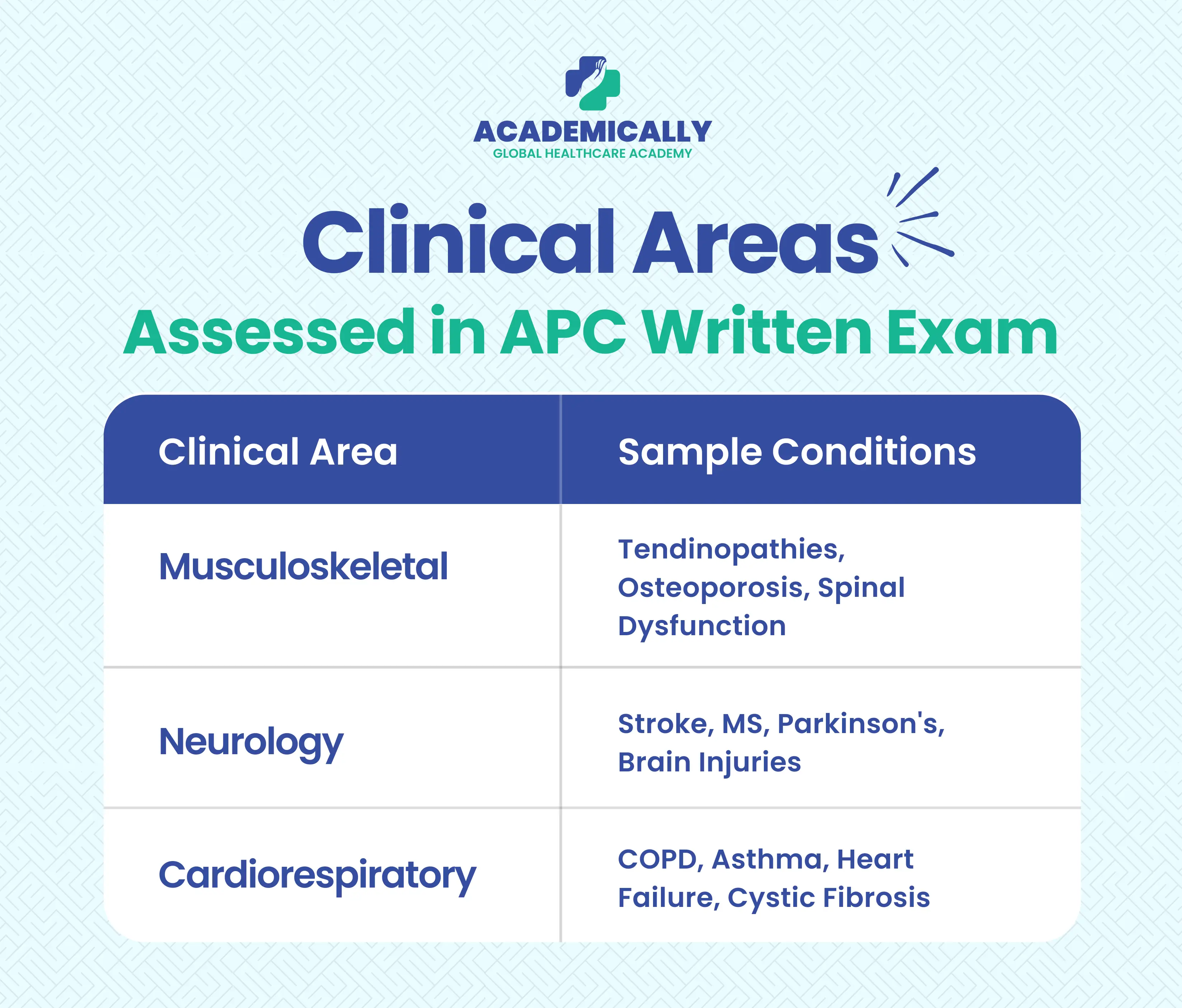
You’ll be evaluated across three core clinical areas:
- Musculoskeletal
- Cardiorespiratory
- Neurology
Each clinical area spans conditions across:
- Lifespan (Gerontology, Pediatric, Gender Health)
- Clinical Settings (acute/rehab, remote/ rural, private practice)
- Professional domains (ethics, Quality Assurance, risk management, evidence-based practice, health promotion)
Exam Format & Structure
The APC Written Assessment is a two-paper exam, held on the same day:
| Component | Duration | No. of Cases | No. of MCQs |
| Paper 1 (Morning) | 2 hours | 15 | 60 |
| Paper 2 (Afternoon) | 2 hours | 15 | 60 |
Each case reflects real-life Australian patient scenarios with 4 MCQs. You're expected to interpret, assess, and make clinical decisions like an entry-level Australian physio would.
How is the APEP Exam Scoring done?
Your result is NOT based on the percentage of correct answers but a scaled score using the Rasch measurement model. It is a very fair model of assessment, in which you are assessed based on your skills, meaning the difficulty of questions adjusts based on your responses.
- Pass Score: 500 (combined across all 3 clinical areas)
- Score Type: Scaled Score (fairly compares difficulty across versions)
- Result: PASS / FAIL – not graded on a curve
There is no negative marking, so you can attempt every question with peace of mind.
Mode of the APEP Written Examination
Did you know… You don’t have to travel across continents to appear for the APEP Written Examination? Yes, you heard it right. You can either appear in person or even sit in the comfort of your home. Here are the details:
Remote
- Take it from your home or an approved private location
- Requires webcam, primary device, secondary device & WebLock browser
- No external material allowed
- Strict live invigilation-web proctored.
In-Person
Venue: Melbourne & Sydney
Start time: 9 AM AEST/AEDT
- Carry a valid ID
- Invigilated by human proctors
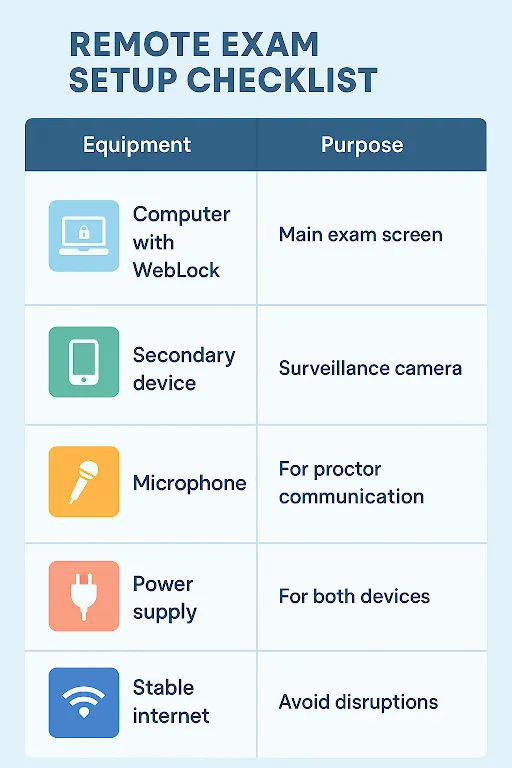
Tech Setup for Remote Exam
We all know how exciting (and a steal deal it is) to appear for a licensure exam from the comfort of your home. But here are some technical requirements you need to know:
- Primary computer with WebLock installed
- Secondary device with internet, camera, and mic
- Stable Wi-Fi and uninterrupted power
- A clean desk and quiet room
Compatibility Test:-
A compatibility test is arranged for you by the Australian Physiotherapy Council for an easy mock drill of the software.
Your secondary device must be placed 1 metre behind and 2 metres to the side, angled to view your screen. Here’s a checklist for you to bookmark to avoid any last-minute hassles.
APEP Written Exam Fees Structure for 2026
The APEP Written Exam fees structure differs from one pathway to another. Please refer to the table below to have a clear understanding of the updated entry pathway and its respective fee structure according to the updated norms.
| Stage | Fee (AUD) | Fee (INR approx.) |
| Eligibility Assessment | $1,170 | ₹64,350 |
| Cultural Safety Training | $235 | ₹12,925 |
| Written Assessment | $2,017 | ₹1,10,935 |
| Capability Assessment | $2,928 | ₹1,61,040 |
| Clinical Workshop | $1,464 | ₹80,520 |
| TOTAL (APEP 2026) | $7,814 | ₹4,29,770 |
If you’re applying near year-end, you can save money by submitting before the increases take effect.
Processing Times
- Eligibility Assessment: 3 weeks
- Written Exam Booking Confirmation: Sent post eligibility
- Assessment Outcome: Typically released within a few weeks post-exam
Study Tips & Resources to Clear the APEP Written Assessment Preparation
Here’s how to prepare smarter, not harder:
Enroll in Academically’s coaching classes
An exam of this gravity needs special coaching classes. In Academically, we have qualified mentors of physiotherapy who have appeared in the APEP exam and have gone down the same path as you will. You will get access to:
A. Live+recorded sessions with extended course access
B. AI-Based mock tests to simulate real case-based MCQs
C. Participate in community groups for peer support during preparation
D. Take advantage of 1-on-1 doubt-clearing sessions with experts and Alumni.
E. Get guidance from expert counsellors for settling in Australia as a full-time physiotherapist
Recommended Books:
- Brukner & Khan's Clinical Sports Medicine
- Shumway-Cook & Woollacott – Motor Control
- Main & Denehy – Cardiorespiratory Physiotherapy
- Carr, J & Shepherd, R 2010, Neurological Rehabilitation
- Hill, K, Denisenko, S, Miller, K, Clements, T & Batchelor, F 2010, Clinical Outcome Measurement in Adult Neurological Physiotherapy, 4th edn, Australian Physiotherapy Association, Melbourne.
- Lennon, S. and Stokes, M, (2018) Neurological Physiotherapy
- Lennon S et al (2018) Physical management
Important Exam Dates for 2026
Written Assessments are held four times a year. Below are the updated exam dates and their respective application schedule approved by the council:
| Exam dates | Applications open | Application deadline |
| 5 March 2026 | 22 Oct 2025 | 20 Jan 2026 |
| 11 June 2026 | 21 Jan 2026 | 28 Apr 2026 |
| 3 September 2026 | 29 Apr 2026 | 21 Jul 2026 |
| 3 December 2026 | 22 Jul 2026 | 20 Oct 2026 |
What Happens After You Pass the APC Written Assessment?
You're eligible for the final stage: Capability Assessment
The Capability Assessment is a remote clinical reasoning oral exam designed to test your ability to make decisions and communicate key clinical thinking in simulated patient contexts via video call.
If you fail? You may resit the Written Assessment by applying again and paying the respective fee.
APC Exam Success Story
Out of many successful students, our very own student Amritpal passed APC exam in the new APEP pathway with flying colours. Let’s take some inspiration about his journey and he has also shared some tips and tricks to make your written assess journey easier.
With the right mindset, resources, and strategy, you can crack the APC written examination in your first attempt itself.