Every year, thousands of interns appear for the intern pharmacy oral exams. Confident with their knowledge. However, they walk out failing the exam miserably. Believe or not, they know the guidelines. They know the drug doses. They know the therapeutic pathways.
Yet they do not meet the standards.
Are you preparing for the intern pharmacy oral exam this year? Then you must understand one important fact. The exam does not test how much you know. It tests whether examiners trust you to practise safely and independently.
In this blog, we will explain why smart interns fail and what you must do differently to pass.
Understanding the Intern Pharmacy Oral Exam in 2026
The pharmacy oral exam forms part of the registration process for intern pharmacists. It is conducted by the Pharmacy Board of Australia. The body that regulates this exam is the Australian Health Practitioner Regulation Agency (AHPRA).
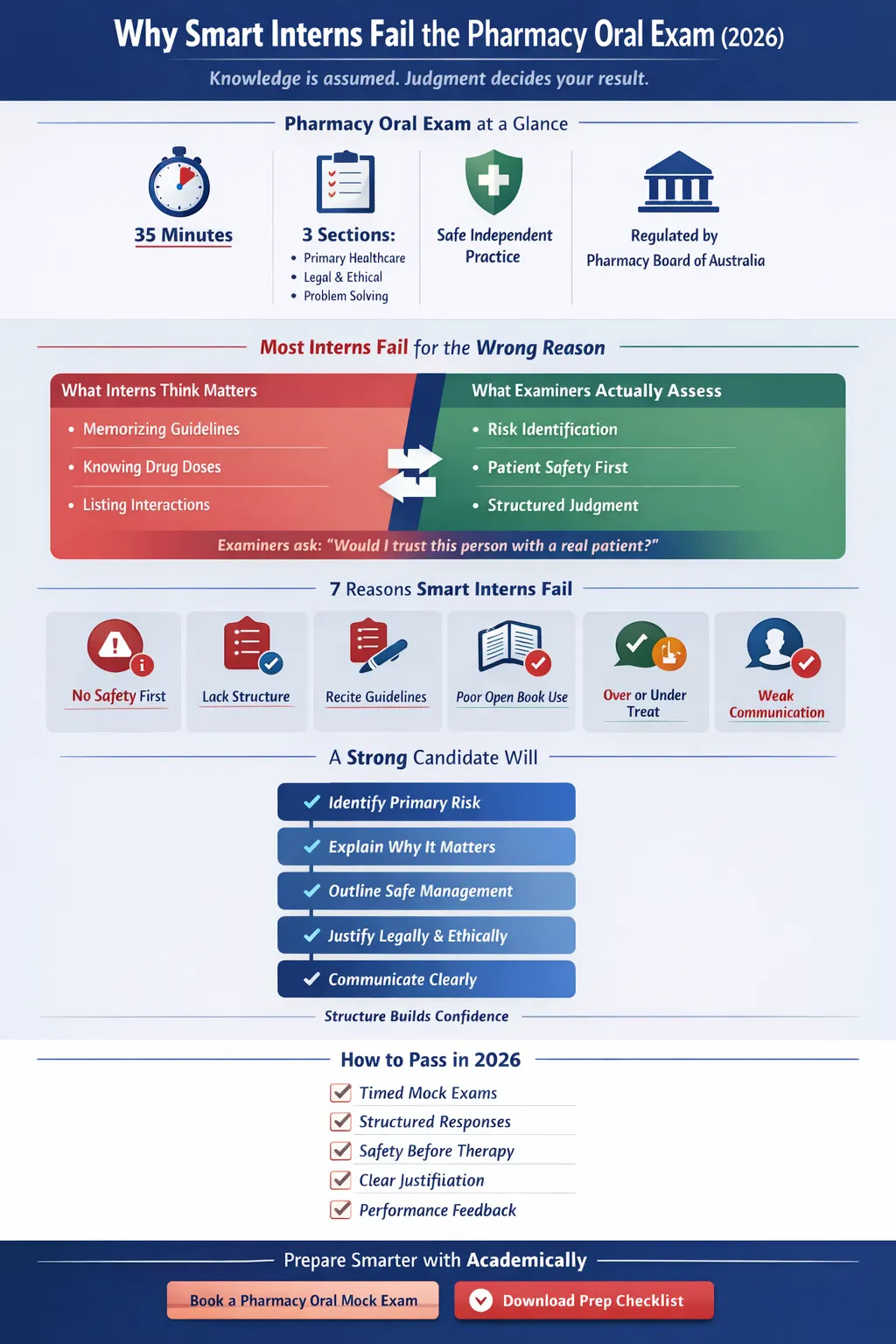
The exam runs for approximately 35 minutes and assesses three core domains:
- Primary healthcare
- Legal and ethical practice
- Problem-solving and communication
Examiners do not look for definitions. They look for a well-reasoned, structured clinical judgment. They ask themselves one question throughout the assessment:
“Would I trust this intern to manage a real patient safely?”
That mindset shapes every scoring decision.
Why Knowledge Alone Does Not Secure a Pass
Most candidates who fail do not fail because of knowledge gaps. They fail because they:
- Answer without structure
- Miss clinical priorities
- Communicate uncertainty poorly
- Focus on rules instead of patient safety
- Manage time poorly under pressure
In 2026, examiner expectations remain clear. They want to see safe practice patterns. They assess consistency. They evaluate how you think, not just what you say.
7 Reasons Smart Interns of Pharmacy Fail
1. They Do Not Prioritise Patient Safety
In primary healthcare scenarios, weaker candidates list differential diagnoses or treatment options without identifying red flags first.
For example, they discuss symptomatic relief before screening for urgent referral criteria. They recommend therapy before checking contraindications. They forget to clarify allergy status or pregnancy risk.
Examiners listen for one thing: risk recognition.
Strong candidates immediately:
- Identify the primary concern
- State why it matters
- Explain what action protects the patient
They structure their response around safety, not information.
2. They Treat the Scenario Like a Written Exam
The oral exam assesses reasoning in real time. It does not reward memorised monologues.
Some interns recite guidelines without applying them to the patient in front of them. Others quote professional documents without explaining why those standards guide their decision.
You must move beyond recall.
For ethical and legal questions, you should:
- Identify the issue
- Explain the legal or ethical principle involved
- Justify your decision using professional standards
- Connect your action to patient safety
Examiners expect alignment with documents such as the PSA Code of Ethics, but they award marks for application, not citation.
3. They Speak Without Structure
Structure builds examiner confidence.
When candidates jump between ideas, examiners struggle to follow the logic. That confusion creates doubt about clinical competence.
Strong candidates use a clear verbal framework:
- Identify the problem
- Assess risk
- Outline management steps
- Explain referral if required
- Confirm documentation and follow up
When you verbalise your reasoning in this order, you demonstrate control and clarity.
4. They Mismanage the Open Book Section
Part C allows access to references. Many interns assume this section will feel easier. It often becomes the most problematic part.
Common errors include:
- Searching references before identifying the main issue
- Checking multiple resources without a clear purpose
- Spending too long confirming minor details
- Failing to communicate clearly with the prescriber
Examiners do not reward resource usage. They reward decisive, risk-focused thinking.
Strong candidates:
- State the primary concern first
- Explain immediate steps
- Use references briefly to confirm specifics
- Communicate concisely and professionally
5. They Over-Treat or Under-Treat
In primary care cases, some interns recommend unnecessary medication. Others fail to escalate appropriately.
Examiners assess proportionality.
You must show that you:
- Recognise when self-care suffices
- Recognise when referral becomes mandatory
- Avoid unsafe reassurance
- Avoid defensive over-referral
Balanced judgment distinguishes a pass from a fail.
6. They Communicate Uncertainty Poorly
Clinical uncertainty exists in practice. Examiners accept that reality.
However, phrases such as:
- I am not sure
- I think maybe
- I guess
Reduce examiner confidence when you fail to anchor them with reasoning.
Instead, say:
- Based on the information provided, my primary concern is
- The safest next step would be
- I would confirm this by checking
You can acknowledge uncertainty while maintaining authority and structure.
7. They Prepare by Revising Content Only
Many interns spend months revising therapeutic guidelines and practising calculations. Few train performance skills.
The oral exam requires:
- Structured verbal reasoning
- Prioritisation under time pressure
- Safe professional communication
- Ethical justification
- Clear referral language
These skills improve through mock simulation, feedback, and repetition under exam conditions.
Reading alone will not develop them.
What Examiners Actually Look For, in Intern Pharmacists?
Examiners assess patterns of behaviour across the entire session. They do not rely on one isolated answer.
They look for:
- Consistent patient-centred thinking
- Clear identification of risk
- Logical answer structure
- Appropriate referral decisions
- Professional communication
- Alignment with regulatory standards
They do not calculate a numerical pass mark. They judge whether your overall performance meets the threshold for safe independent practice.
This is something you need to remember while applying for pharmacy jobs. Employers would look for a relevant skill set to include you in their system.
How to Prepare for the Intern Pharmacist Oral Exam Strategically in 2026
If you plan to pass on your first attempt, focus on performance training.
1. Practise Under Timed Conditions
Simulate 35-minute sessions. Train your brain to prioritise quickly.
2. Record and Review Your Responses
Listen for unclear structure, filler language, or missed red flags.
3. Focus on Verbal Frameworks
Develop a repeatable response structure for common scenarios.
4. Train Legal and Ethical Reasoning
Do not memorise clauses. Practise explaining why your decision protects the patient and complies with standards.
5. Use Realistic Mock Exams
Only structured feedback reveals performance blind spots.
At Academically, we specialise in healthcare licensing exam preparation with a strong focus on applied clinical judgment and oral performance training.
Our pharmacy oral exam preparation includes:
- Structured mock oral simulations
- Real-time feedback from experienced pharmacists
- Targeted correction of communication gaps
- Scenario-based legal and ethical reasoning practice
- Performance-focused preparation aligned with current examiner expectations
If you want to move from knowledge revision to exam readiness, structured training makes the difference.
To Conclude with…
Smart interns fail the pharmacy oral exam because they prepare like students instead of future practitioners.
The exam assumes knowledge. It evaluates judgment.
When you prioritise safety, structure your answers clearly, and communicate decisively, you give examiners what they truly assess: confidence in your readiness to practise independently.
If you train those skills deliberately, you dramatically improve your chance of passing the exam.