The Doctor of Pharmacy (PharmD) degree came to India with big promises. It’s meant to be globally competent, clinical and industry-ready pharmacy professionals. Yet, for thousands of graduates every year, reality looks very different. After six years of rigorous education, clinical postings, research work, and significant financial investment, many PharmD doctors still find themselves:
- stuck in low-paying hospital roles,
- uncertain about long-term career growth,
- unaware of high-value industry pathways,
- and questioning whether the degree truly delivered on its potential.
In this blog, we will discuss why the PharmD employment gap exists. We will also discuss what the pharmaceutical industry actually needs today. Get inspired by how one Indian PharmD graduate transformed his career trajectory within just 30 days.
The Hidden Crisis Facing PharmD Graduates in India
India produces thousands of PharmD graduates annually. At the same time, the pharmaceutical, biotechnology, and clinical research industries continue expanding rapidly. On paper, demand and supply should match. In reality, they do not.
The Demand–Supply Mismatch
The core issue is not the lack of skills. To be honest, PharmD graduates possess strong clinical understanding, pharmacology skills, and patient management exposure.
The problem lies elsewhere. Here are some observations:
- Limited awareness of non-clinical career roles
- Absence of structured industry transition pathways
- Lack of corporate positioning skills
- Minimal exposure to Medical Affairs and global pharma operations

Dr. Akram Ahmad (B.Pharm, Pharm.D, PhD from University of Sydney, Founder and CEO, Academically) often says:
“The gap is rarely talent. The gap is exposure. When graduates understand where the industry actually needs them, careers change very quickly. This mismatch leaves many highly trained professionals earning ₹10,000–₹20,000 monthly. This was the same when I was pursuing my career in pharmacy, and it is the same even now. The moment of surprise is that all of this is happening despite a thriving pharmaceutical industry.”
Inspiring Story of a PharmD Doctor Who Had a Rollercoaster Ride Career
Dr Salman’s journey mirrors the experience of countless PharmD doctors across India. After completing a six-year PharmD programme, he imbibed valuable clinical experience. But he remained trapped in unstable and underpaid roles. Professional satisfaction was missing. Career growth felt uncertain. Like many graduates, he had:
- strong academic knowledge,
- clinical exposure,
- dedication to healthcare
But what he didn’t have was a clear pathway into industry roles. Before seeking structured guidance, he had already tried another well-known academy. But alas! They promised placements that they failed to deliver tangible outcomes. Confidence had declined, and scepticism was high.
When he visited Academically’s Hyderabad experience centre, the hesitation was evident. Questions were careful, decisions were cautious. The team could feel his nerves; he was profusely sweating. What changed next was what we call a masterstroke strategy.
How can a PharmD Graduate Become Industry Ready?
Instead of focusing solely on theoretical learning, the approach shifted toward industry readiness. Dr. Salman enrolled in a structured Executive Programme in Medical Science Liaison (MSL), designed specifically to bridge the gap between healthcare education and pharmaceutical industry expectations. It isn’t just a certificate on paper. The current cohort calls it an “Onboarding training programme”. Within the first month, work began on the elements that most healthcare graduates are never formally trained in:
1. Professional Positioning
- Corporate CV restructuring
- LinkedIn and professional branding
- Scientific profile development
2. Industry Understanding
- Medical Affairs ecosystem
- Pharmaceutical company structures
- Drug lifecycle and evidence communication
3. Interview & Communication Mastery
- Scientific storytelling
- Stakeholder communication
- Mock industry interviews
- Role-based preparation
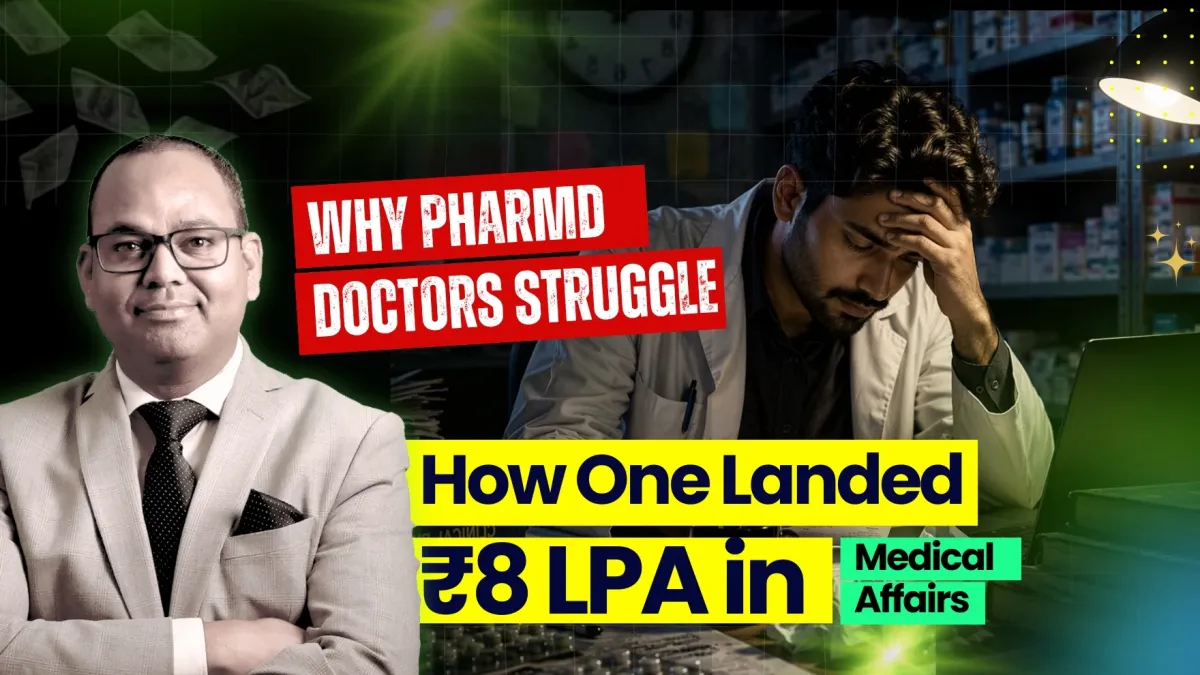
The objective was simple. Transform a qualified PharmD doctor into an employable industry professional. Within just one month, the results were measurable. Dr. Salman successfully cleared multiple interviews and received two industry offers:
- Olivia Medsafe: ₹7 LPA
- Syneos Health: ₹8 LPA
Can you imagine this is the same professional who previously struggled to secure stability was now choosing between competing opportunities. This transformation highlights:
- PharmD graduates are not unemployable.
- They are often under-positioned.
Why Medical Science Liaison (MSL) Is Emerging as a Top Career Choice
A Medical Science Liaison acts as the scientific bridge between pharmaceutical companies and the medical community. MSLs translate complex clinical data into meaningful insights for doctors, researchers, and healthcare stakeholders.
As per industry statistics, the MSL market is on the rise, and more and more biopharmaceutical organisations are hiring.
What MSL Professionals Actually Do (Job responsibilities)
- Engage with doctors, specialists, and researchers
- Explain clinical trial outcomes using scientific evidence
- Build relationships with Key Opinion Leaders (KOLs)
- Support medical strategy and advisory boards
- Participate in national and international conferences
- Provide scientific insights influencing drug development
Rather than routine clinical practice, the role focuses on scientific communication, strategy, and innovation.
Why Industry Roles Pay More Than Traditional Clinical Positions
Healthcare jobs are evolving globally. Pharmaceutical companies increasingly require professionals who can:
- interpret clinical evidence,
- communicate scientific value,
- support research commercialisation,
- and drive evidence-based decision-making.
PharmD graduates already possess foundational competencies aligned with these needs. However, without structured industry exposure, employers struggle to recognise that potential.
Dr. Akram Ahmad says:
“When clinical knowledge meets industry skills, PharmD graduates become some of the most valuable professionals in healthcare.”
Degrees Alone No Longer Guarantee Growth. This is the Harsh Reality
A major misconception persists among healthcare graduates. Qualification equals opportunity. Modern hiring trends suggest otherwise. Employers now prioritise:
- Applied skills,
- Professional communication,
- Industry familiarity,
- Real-world project experience.
Graduates who intentionally upskill often transition faster than those relying solely on academic credentials.
What sets Academically’s Onboarding Training Programme on Medical Science Liaison Apart?
For professionals seeking entry into Medical Affairs or MSL roles, structured training programmes are becoming increasingly relevant. Many organisations promise jobs but they don’t deliver just like Dr. Salma’s case. But we ensure our candidates are assisted in getting the right set of skills throughout the training programme so that they can get jobs.
Highlights of the course
Industry-Ready Curriculum
Designed with input from global MSL experts and pharmaceutical leaders.
Practical Learning
- Real-world case studies
- Scientific communication projects
- KOL engagement simulations
- Medical strategy exercises
Comprehensive Job Preparation
- CV and LinkedIn optimisation
- Mock interviews
- One-to-one feedback sessions
- Career pathway mentoring
Global Exposure
Programmes led by internationally experienced faculty with 20+ years of experience help align candidates with global pharma expectations. Under the leadership of Dr. Akram Ahmad, PhD, University of Sydney, such initiatives aim to prepare healthcare professionals for roles across India, Australia, the Middle East, and international markets.
Who Should Consider an MSL Career?
The pathway is particularly suitable for:
- PharmD graduates
- M.Pharm professionals
- MBBS doctors
- BDS/MDS graduates
- AYUSH graduates
- PhD or Life Sciences researchers
Anyone with strong scientific training and interest in industry careers can transition successfully with the right preparation.
Skills That Make Candidates Successful in Medical Affairs
Modern MSL professionals combine science with strategy.
Key competencies include:
- Scientific communication
- Clinical data interpretation
- Relationship management
- Presentation skills
- Evidence-based discussion
- Regulatory and clinical awareness
Training programmes increasingly incorporate capstone projects such as:
- Scientific manuscript development
- Medical strategy planning
- KOL engagement design
These experiences simulate real pharmaceutical job environments.
Industry Transition Beyond Pharmacy
Career transformation through structured upskilling is not limited to one individual. Healthcare professionals transitioning into industry roles frequently report outcomes similar to Dr Salman’s journey. He had confidence, a clearer career direction, and a high salary figure.
One participant described the experience as a turning point after gaining exposure to real medical affairs workflows, expert mentorship, and practical projects aligned with industry expectations. Read Dr. Saif’s success story and get inspired.
PharmD Graduates! Your Career Deserves a Major Upgrade
Dr Salman’s story represents a broader shift happening in healthcare careers. The opportunity exists. The industry demand exists. What many graduates lack is visibility into the pathway.
PharmD doctors today can build careers in:
- Medical Science Liaison (MSL)
- Medical Affairs
- Clinical Drug Development
- Pharmacovigilance
- Scientific Communication
- Global Healthcare Consulting
The transition begins not with abandoning clinical knowledge, but with expanding how that knowledge is applied.
To Conclude with…
Six years of education should not end in professional uncertainty. Healthcare careers are no longer linear. Doctors, pharmacists, and life-science professionals are increasingly moving into roles that influence research, innovation, and global patient outcomes.
Dr Salman’s journey demonstrates that career transformation does not always require years. Sometimes it requires direction, structured preparation, and decisive action. For many PharmD graduates asking “What next?”, the answer may not be another degree. It may simply be discovering where their existing expertise truly belongs.