“After working for 3 years in a clinical setup, I’ve realised it’s not for me. I don’t enjoy the responsibility of dealing with patients and their families, the working hours suck, and the mental pressure is just too much. I want to switch to something non-clinical but still related to medicine.”
If this sounds familiar, you’re not alone. Many MBBS graduates reach a point where they realise clinical practice isn’t the right fit for them. The good news is that your medical training opens up a wide range of non-clinical careers where you can still apply your knowledge, without the stress of bedside responsibility.
In this blog, we’ll explore who should consider non-clinical roles after MBBS, popular non-clinical career options and a self-assessment tool to help you decide.
Who Should Consider Non-Clinical Roles After MBBS?
Not every MBBS graduate is suited to lifelong clinical practice. Non-clinical paths can be the perfect fit if you relate to any of the following:
1. You don’t enjoy day-to-day clinical work
If OPDs, wards, or night duties exhaust you, or patient interactions feel overwhelming rather than meaningful, non-clinical careers may be a healthier option.
2. You love medicine, but not practicing it
Some doctors enjoy understanding diseases, analysing cases, and teaching others, but dislike procedures, emergencies, or long hours.
3. You value lifestyle, mental health, and predictable hours
Non-clinical roles often offer fixed schedules, lower stress, and better work-life balance without wasting your MBBS skills.
4. Your strengths lie outside the hospital
If you excel in writing, research, strategy, policy, or tech, non-clinical paths reward these skills in ways clinical medicine does not.
5. You want a broader impact
Some doctors are driven by system-level change, improving public health, hospital systems, or medical education, rather than individual patient care.
Non-Clinical Career Options After MBBS
Here’s a list of common non-clinical paths that leverage your medical knowledge:
- Medical Writing & Editing
- Clinical Research & Project Management
- Clinical Data Management
- Drug Safety & Pharmacovigilance / Medical Reviewer
- Medical Science Liaison (MSL)
- Health Economics & Outcomes Research (HEOR)
- Public Health & Policy
- Pharma Roles: Medical Affairs, Regulatory Affairs
- Healthcare Market Research, Competitive Intelligence & Data Analytics
- Health Tech & Startups
- Hospital Administration & Consulting
- Medical Education & EdTech
Academically offers certificate courses for these options and makes you job-ready in just 4 months!
Do Non-Clinical Roles Pay Well?
Many doctors worry about leaving clinical medicine because of money. Here’s a realistic overview of salaries for non-clinical roles in India:
| Non-Clinical Role | Entry Level (0–2 yrs) | Mid Level (3–6 yrs) | Senior Level (7+ yrs) |
| Medical Writer / Editor | ₹4–6 LPA | ₹8–15 LPA | ₹20+ LPA |
| Clinical Research (CRA, Project Mgmt) | ₹5–7 LPA | ₹10–18 LPA | ₹25+ LPA |
| Pharmacovigilance / Drug Safety | ₹4–6 LPA | ₹8–14 LPA | ₹18–25 LPA |
| Pharma Medical Affairs / MSL | ₹6–10 LPA | ₹15–25 LPA | ₹30+ LPA |
| Public Health (MPH roles) | ₹5–8 LPA | ₹10–20 LPA | ₹25+ LPA |
| Hospital Administration | ₹5–7 LPA | ₹12–20 LPA | ₹30+ LPA |
| Health Consulting | ₹8–12 LPA | ₹18–30 LPA | ₹40+ LPA |
| Health Tech / Startups | ₹6–12 LPA | ₹15–30 LPA | Highly variable |
| Medical Education / EdTech | ₹4–7 LPA | ₹10–18 LPA | ₹20+ LPA |
| Regulatory Affairs | ₹5–7 LPA | ₹10–18 LPA | ₹25+ LPA |
LPA = Lakhs per annum. Salaries vary by city, company, and skill set.
Clinical vs Non-Clinical Income: Understanding the Growth Curve
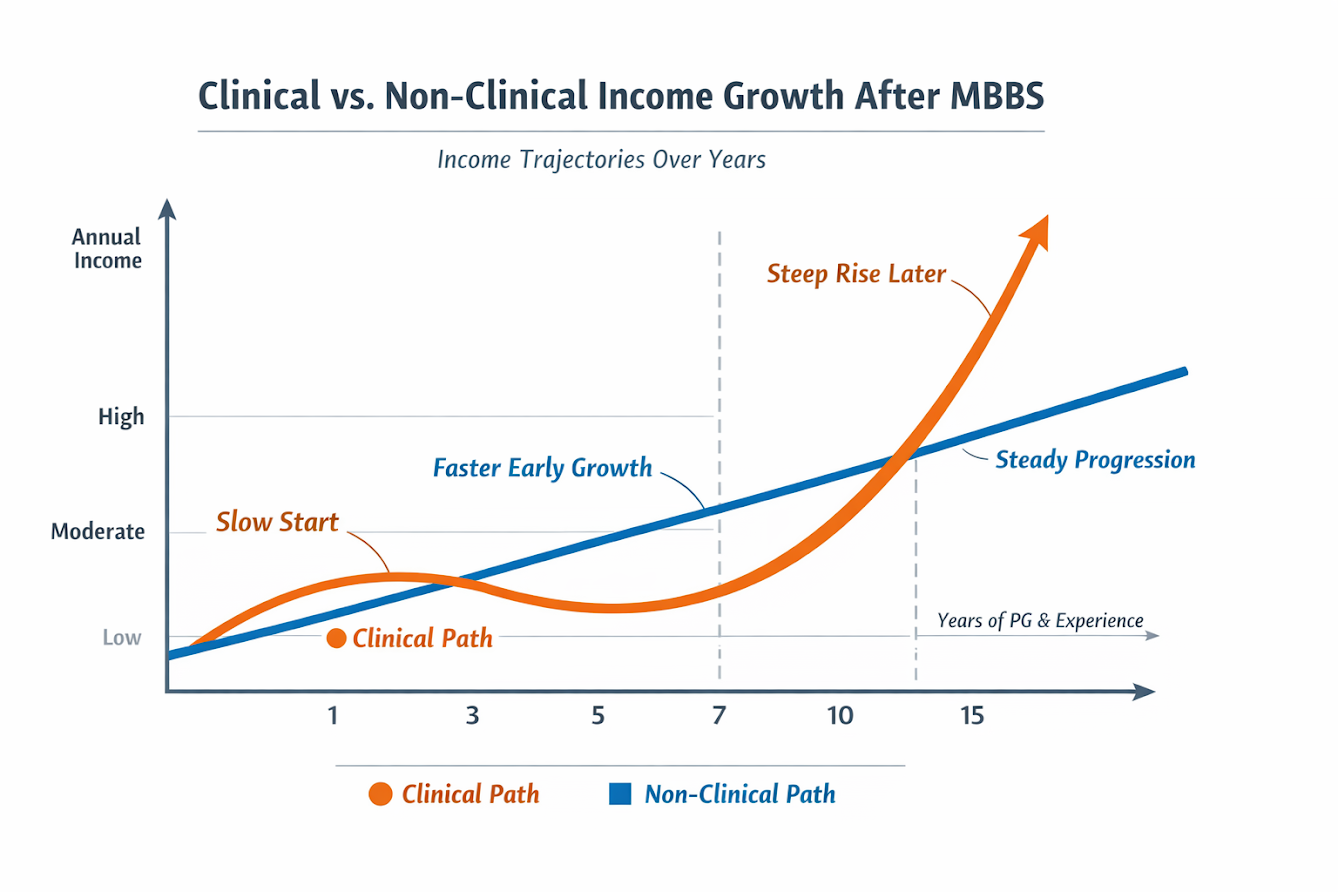
Interpretation:
- Early years (0–5) often favour non-clinical income and stability
- Clinical income is later, but requires higher responsibility and longer hours
Which Curve Suits You? (Self-Assessment)
Step 1: Read each statement and note what feels truer for you
Clinical Growth Curve
- I am comfortable with lower income early if it pays off later
- I don’t mind long hours and emergencies
- I enjoy hands-on patient care
- Social recognition and hierarchy matter
- I’m okay with delaying financial stability
Non-Clinical Growth Curve
- I prefer earlier financial stability
- Predictable hours and mental health are important
- I enjoy writing, research, teaching, or strategy
- I like solving system-level problems
- I’m open to learning new roles
- My identity is not tied solely to clinical practice
Step 2: Interpretation
- Mostly Clinical → Clinical curve may suit you
- Mostly Non-Clinical → Non-clinical curve may be a better fit
- Mixed → Consider hybrid roles (clinical + non-clinical)
Hybrid paths: Part-time clinical + research, teaching, or consulting roles.
Conclusion
Choosing a non-clinical role doesn’t mean leaving medicine behind. It’s about finding the path that aligns with your skills, lifestyle, and long-term goals. Your MBBS degree is still a powerful foundation; it just opens doors in different directions.
The best career curve is the one you can sustain…mentally, financially, and emotionally.
If you want more information or guidance on what to do next, reach out to our experts.