About the ADC Exam
The Australian Dental Council (ADC) Exam is a series of assessments designed to evaluate the knowledge, skills, and competence of overseas-trained dentists who wish to practice dentistry in Australia. It is a rigorous process that ensures all dentists practising in Australia meet the required standards of education, training, and professional competence.
The exam consists of two parts- Written Examination and Clinical Assessment. You can take this exam only after you undergo a preliminary assessment of your qualifications and credentials by the ADC. The exam is mandatory for foreign-registered dentists trying to set up practice in Australia.
Learn all you need to know about becoming a dentist in Australia in this video-
What's Next After ADC Written Exam ?
Congratulations on clearing the ADC Written Examination- you have successfully passed the first step to success. But what next? Here’s what you need to do to get registered and settled in Australia-
Step 1: The ADC Practical Examination
If you have just received your written exam results, your immediate next focus should be booking and preparing for the practical exam.
Passing the ADC Practical Exam allows candidates to register with the Dental Board of Australia, leading to dental practice rights within Australia. Until you clear the practical component, you cannot move forward with registration.
The exam is held only in Melbourne, across three periods in a year. It is a structured assessment that tests your competency through simulated clinical scenarios, not real patients. Once you clear it, you will receive your ADC Certificate via ADC Connect within approximately six weeks, and that certificate is what unlocks the next step: AHPRA registration.
Step 2: AHPRA Registration
This is the step most blogs gloss over, but it is arguably the most important. You cannot legally practise dentistry in Australia without AHPRA registration.
AHPRA, the Australian Health Practitioner Regulation Agency, manages registrations on behalf of the Dental Board of Australia. You cannot legally call yourself a registered dentist in Australia, and you cannot practise, until AHPRA grants you general registration.
Step 3: Understanding the Australian Dental Job Market
Here is the encouraging reality for internationally trained dentists entering Australia right now. The Australian dental industry, valued at $13 billion in 2025, faces a dental workforce that is strained by shortages and maldistribution, with general dentists in short supply nationwide.
The Australian dental sector faces a significant shortage of skilled professionals, with an estimated shortfall of 2,000 dentists in future. The Australian Dental Association reports that 70% of dental practices are struggling to fill vacancies.
Attracting and retaining clinicians and auxiliary staff is particularly difficult in regional areas, limiting many practices’ capacity to meet demand. Recruitment incentives and remuneration are rising, with nearly half of practices boosting pay rates or offering more flexible work arrangements to secure talent.
This shortage is your opportunity. For overseas-trained dentists willing to consider regional and rural placements, the combination of faster visa sponsorship, higher pay, and genuine demand makes these positions very attractive as a starting point.
Step 4: Finding a Job and a Sponsor
With registration secured, your next priority is finding employment. Most overseas-trained dentists entering Australia need employer sponsorship to obtain a work visa, so finding the right employer is both a career and immigration decision.
Here is where to look:
Online job portals: Seek, Indeed, LinkedIn, and Glassdoor all carry active dental job listings. Seek in particular has a strong volume of dental roles, including regional positions with sponsorship stated upfront.
Dental recruitment agencies: Firms that specialise in healthcare recruitment can connect you directly with practices looking to sponsor overseas candidates.
Regional and rural areas: These placements are often easier to secure, come with better financial incentives, and tend to have a smoother visa sponsorship pathway due to the consistent demand.
Networking: Attending dental conferences and professional events, or joining Australian dental forums and Facebook groups, can surface opportunities that are not publicly advertised.
Step 5: Apply For Visa
Once you have your AHPRA registration and a job offer in hand, the next step is securing the right visa. Australia offers several pathways for overseas dentists, depending on whether you have employer sponsorship, are applying independently, or are open to regional placements.
| Visa Subclass | Type | Best For |
| Subclass 482 | Temporary Skill Shortage (TSS) | Employer-sponsored; work up to 4 years |
| Subclass 494 | Skilled Employer Sponsored Regional (Provisional) | Regional placements; pathway to PR after 3 years |
| Subclass 491 | Skilled Work Regional (Provisional) | Points-based; state/territory or family nominated |
| Subclass 190 | Skilled Nominated (Permanent) | Points-based permanent residency; state nominated |
| Subclass 186 | Employer Nomination Scheme (Permanent) | Direct PR through employer sponsorship |
Most overseas dentists enter through the Subclass 482 as their first visa, particularly those working in metro areas. Those open to regional placements often find the Subclass 494 easier to secure and a faster route to permanent residency. If you are building your points score independently, the Subclass 491 and Subclass 190 are worth exploring with a registered migration agent.
How Much Can You Earn as a Dentist in Australia?
The average salary for a dentist in Australia is AUD 130,827 per year, with the typical pay range between AUD 100,000 at the 25th percentile and AUD 175,000 at the 75th percentile. Top earners report making up to AUD 200,000 annually. Here is how earnings break down by experience and location:
By Experience
| Experience Level | Annual Salary (AUD) | Annual Salary (INR) |
| Fresh Graduate (0–2 years) | 70,000 – 90,000 | ₹38,50,000 – ₹49,50,000 |
| Mid-Level Dentist (3–7 years) | 100,000 – 150,000 | ₹55,00,000 – ₹82,50,000 |
| Experienced Dentist (8+ years) | 160,000 – 200,000+ | ₹88,00,000 – ₹1,10,00,000+ |
By Location
| City / Region | Annual Salary (AUD) | Annual Salary (INR) |
| Sydney | 205,000 – 225,000 | ₹1,12,75,000 – ₹1,23,75,000 |
| Perth | 210,000 – 230,000 | ₹1,15,50,000 – ₹1,26,50,000 |
| Rural / Regional Areas | 90,000 – 250,000+ | ₹49,50,000 – ₹1,37,50,000+ |
| National Average | 100,000 – 175,000 | ₹55,00,000 – ₹96,25,000 |
Rural and regional placements often come with relocation bonuses, housing support, and higher base salaries on top of these figures. Specialists in orthodontics, oral surgery, or paediatric dentistry command salaries well above the general dentist averages listed here.
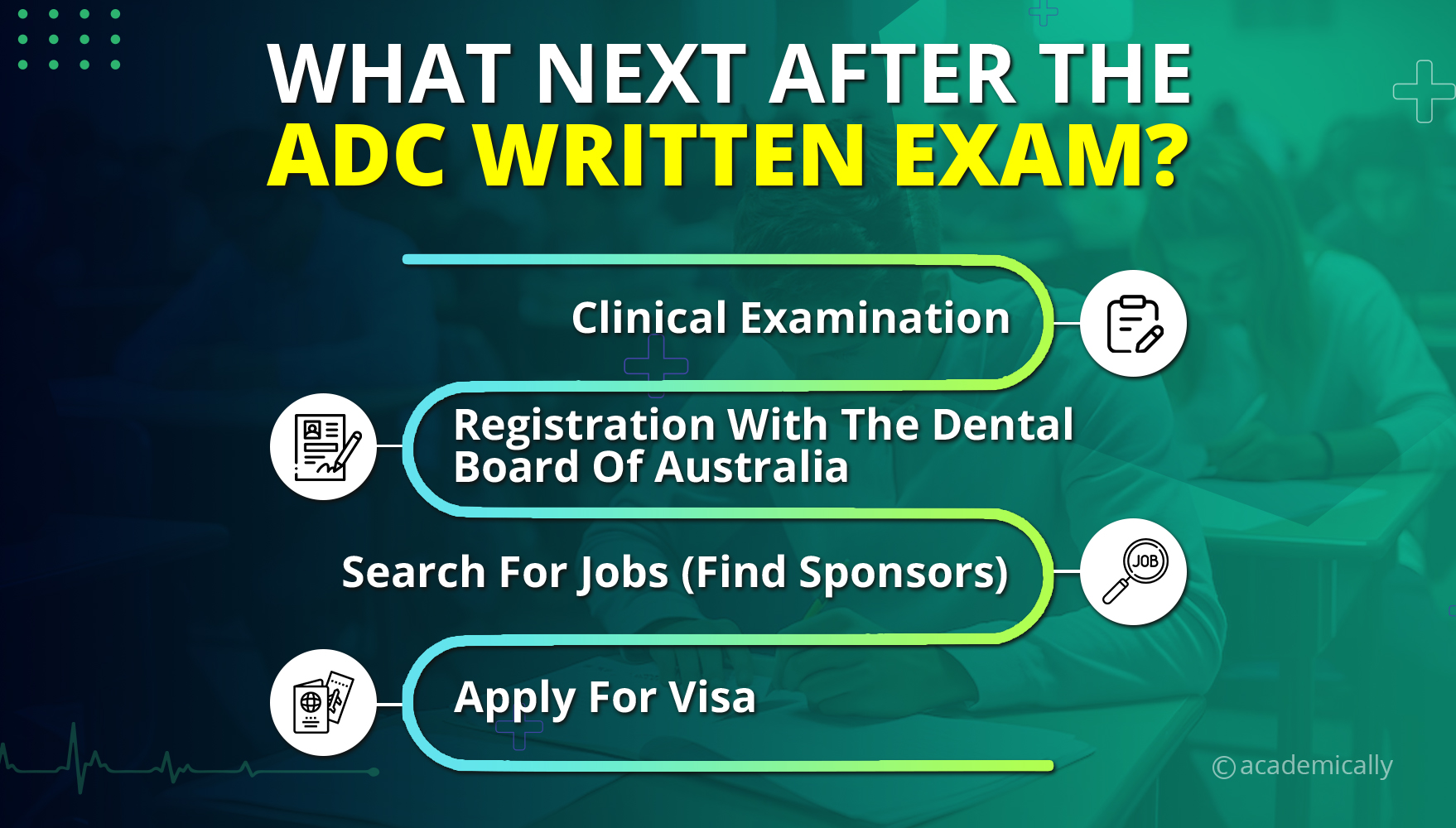
Clinical Examination
Following the theoretical component of the ADC exam, candidates must undergo a clinical examination. This practical assessment evaluates their clinical skills and ability to perform dental procedures competently. The clinical examination typically consists of simulated patient scenarios or real patient cases under the supervision of examiners. Success in this phase is vital for demonstrating proficiency in dental practice and ensuring readiness for registration.
Registration with the Dental Board of Australia
Search for jobs (Find Sponsors)
With registration secured, the next step involves seeking employment opportunities in the Australian dental industry. Many overseas-trained dentists opt to work in regional or rural areas, where there may be a higher demand for dental professionals. Finding a job often entails networking with dental practices, attending job fairs, or utilising online job platforms such as Indeed, Seek, LinkedIn, etc. Moreover, securing a job offer from an employer willing to sponsor your visa application is essential for obtaining a work visa and beginning your practice in Australia.
Apply for Visa
Once a job offer with sponsorship is secured, dentists can proceed with applying for the appropriate visa to work and reside in Australia. Depending on individual circumstances and the specific visa pathway chosen, this may involve applying for a skilled work visa, such as the Subclass 482 Temporary Skill Shortage visa, or a regional visa, such as the Subclass 494 Skilled Employer-Sponsored Regional (Provisional) visa. Navigating the visa application process requires careful attention to documentation, meeting health and character requirements, and complying with visa conditions.
Parting Words
In conclusion, pursuing a career as a dentist in Australia after passing the ADC exam requires determination, perseverance, and a strategic approach. By leveraging your skills, networking with industry professionals, staying updated on advancements in dental practice, and embracing opportunities for further education and specialisation, you can carve out a fulfilling and rewarding career in the Australian dental sector.
Remember, the journey may have its challenges, but with dedication and a clear vision, you can make significant contributions to oral healthcare while thriving personally and professionally Down Under. So, take the leap, chart your path, and embark on an exciting adventure as a dentist in Australia. Your future in dentistry awaits!
In case you are searching for holistic guidance regarding ADC preparation and the complete dental registration process, Academically is the one-stop-solution for all your needs. Contact our experts today to kickstart your journey on the path to dental registration in Australia.
Book a FREE one-on-one counselling session with our experts today!