Three countries, three completely different exams, three completely different immigration realities - pick wrong and you lose a year.
If you are an international physiotherapist planning to move abroad in 2027, choosing the right country is the biggest career decision you will make. The United States, Canada, and Australia remain the top three destinations for global healthcare professionals. However, their licensing exams, qualification costs, and visa rules are worlds apart. A pathway that works perfectly for your friend might leave you stuck in visa processing for years.
To help you make a clear, confident choice, let us break down the 2026–2027 licensing exams, exact costs , realistic visa timelines, and real-world candidate profiles.
Licensing Exam Comparison: APEP vs CPTE vs NPTE
Before you can treat patients abroad, you must prove your clinical competency to the country's regulatory body. In 2026, the global testing landscape shifted significantly most notably in Canada, which retired its old two-step exam and launched the single Canadian Physiotherapy Examination (CPTE).
| Feature | Australia (APEP) | Canada (CPTE) | USA (NPTE) |
| Exam Authority | Australian Physiotherapy Council (APC) | Canadian Alliance of Physiotherapy Regulators (CAPR) | Federation of State Boards of Physical Therapy (FSBPT) |
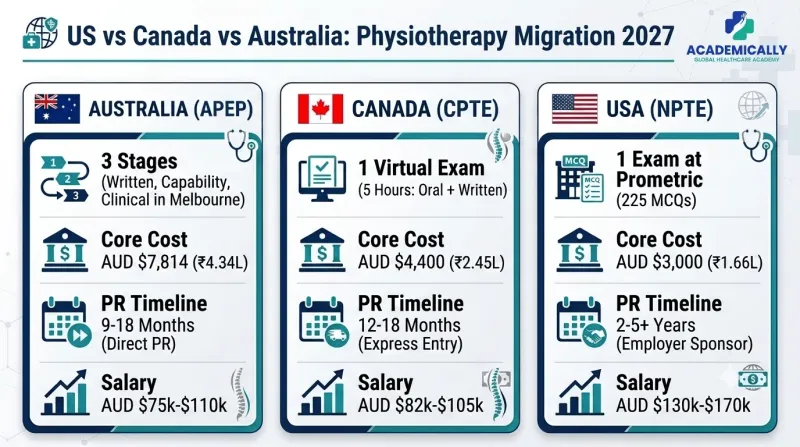
| Exam Structure | 3 Stages: 1. Written Assessment 2. Capability Assessment (Oral) 3. Clinical Workshop | Single Combined Exam: A 5-hour exam divided into a 2.5-hour Oral section and a 2.5-hour Written section | Single Exam: 5-hour computer-based test with 225 MCQs (180 scored, 45 unscored pretest questions) |
| Exam Location | Written and Capability stages are remote. Clinical Workshop is in-person in Melbourne, Australia. | Fully virtual and remotely proctored from your home country. | In-person at Prometric testing centers (available globally, including India). |
| Clinical Focus & Difficulty | Very High. Focuses heavily on practical clinical reasoning, communication, and Australian patient safety standards. | High. Tests hands-on clinical decision-making, ethics, and Canadian healthcare standards in a virtual format. | High. Extremely theoretical, academic, and textbook-focused; requires deep mastery of differential diagnosis. |
Cost to Qualify: Full Breakdown by Country
Your budget will heavily influence which pathway you choose. Below is the updated 2026 regulatory, credentialing, and travel cost breakdown converted into Australian Dollars (AUD) and Indian Rupees (INR).
Australia (APEP Pathway)
Australia requires the highest upfront financial commitment, especially with travel for the final APEP stage, but it rewards you with a fast and reliable permanent residency pathway. (Note: The APC fee schedule increases slightly from AUD $7,814 to AUD $8,321 on October 21, 2026).
- Eligibility Assessment & Cultural Safety Training: AUD $1,405 (approx. ₹78,000 INR)
- Written Assessment:AUD $2,017 (approx. ₹1,12,000 INR)
- Capability Assessment:AUD $2,928 (approx. ₹1,63,000 INR)
- Clinical Workshop (Melbourne):AUD $1,464 (approx. ₹81,000 INR)
- Core Regulatory Cost:AUD $7,814 – $8,321 (approx. ₹4,34,000 – ₹4,65,000 INR)
- Estimated Travel & Stay (Melbourne Workshop): ~ AUD $2,000 – $2,500 (approx. ₹1,10,000 – ₹1,40,000 INR)
Join the Academically APEP Preparation Course to get 1-on-1 mentorship from licensed experts, comprehensive study materials, mock Written and Capability exams, and step-by-step guidance to clear every stage on your very first attempt!
Canada (CPTE Pathway)
Canada sits comfortably in the middle. Because the new 2026 CPTE is conducted entirely online, you save thousands of dollars on international flights and hotel stays during the testing phase.
- Credentialing Assessment (CAPR): ~ AUD $1,350 / CAD $1,230 (approx. ₹75,000 INR)
- CPTE Exam Fee:~ AUD $2,750 / CAD $2,500 (approx. ₹1,53,000 INR)
- Travel Costs for Exam:$0 (100% Remote)
- Core Regulatory Cost:~ AUD $4,100 – $4,400 (approx. ₹2,28,000 – ₹2,45,000 INR)(Excludes provincial registration fees).
United States (NPTE Pathway)
The US offers the lowest initial exam fees, making it very attractive to recent graduates. However, candidates must account for educational credit deficits (often requiring extra online coursework to match US DPT standards) and long immigration waits.
- Credential Evaluation (FCCPT Type I): ~ AUD $1,900 / USD $1,240 (approx. ₹1,05,000 INR)
- NPTE Exam, Prometric & State Licensing Fees: ~ AUD $1,100 / USD $700+ (approx. ₹61,000 INR)
- Travel Costs for Exam: Minimal (can be taken at regional Prometric centers in India and worldwide).
- Core Regulatory Cost:~ AUD $3,000 (approx. ₹1,66,000 INR)
Visa & PR Timeline Compared
Passing your licensing exam is only half the journey. Your immigration timeline dictates how soon you can actually relocate, work, and settle with your family.
- Australia (9 to 18 Months): Highly favorable. Physiotherapists sit firmly on Australia's priority skilled occupation lists. Once you receive your APC Final Certificate and clear your English test, you can apply directly for independent Permanent Residency (Subclass 189), state-nominated PR (Subclass 190), or regional visas (Subclass 491) without needing an employer sponsor. Recent 2026–27 Australia visa changes for healthcare professionals have further streamlined permanent residency pathways for physiotherapists.
- Canada (12 to 18 Months): Very straightforward. Canada’s Express Entry system regularly conducts category-based selection draws specifically for healthcare occupations. This lowers the required Comprehensive Ranking System (CRS) cut-off score, giving qualified physiotherapists a direct, predictable path to Canadian PR.
- United States (2 to 5+ Years): The most challenging immigration reality. Passing the NPTE does not grant you the right to move to the US. You must find an American employer or staffing agency willing to sponsor an H-1B work visa (which is subject to an annual lottery) or an EB-2/EB-3 employment-based green card. For candidates born in high-demand countries like India, green card backlogs can stretch for several years.
Salary & Cost of Living
All three countries reward physiotherapists with high living standards, though tax structures and healthcare expenses differ greatly.
- Australia: Annual salaries range for physiotherapists from AUD $75,000 to $110,000 (approx. ₹41.5 Lakhs to ₹61 Lakhs INR). While housing costs in major cities like Sydney and Melbourne are high, Australia offers universal public healthcare (Medicare), mandatory employer pension contributions (12% Superannuation), and an unmatched 38-hour workweek.
- United States: The highest raw earning potential for physiotherapist. Annual salaries in US equal AUD $130,000 to $170,000+ (USD $85,000 to $110,000+ / approx. ₹72 Lakhs to ₹94 Lakhs INR). However, private health insurance premiums, out-of-pocket medical expenses, and high performance targets in private clinics are standard.
- Canada: Annual salaries range from AUD $82,000 to $105,000 (CAD $75,000 to $95,000 / approx. ₹45.5 Lakhs to ₹58 Lakhs INR). Taxes and winter living costs are relatively high, but residents enjoy free universal healthcare and strong social security benefits.
Recommendation Based on Candidate Profile
Every physiotherapist’s clinical background, financial savings, and family goals are different. To help you see where you fit in 2027, examine these three realistic candidate profiles:
Profile 1: Priya Sharma — The Fast-Track Specialist
Age: 29
Background: Bachelor of Physiotherapy (BPT) + Master of Physiotherapy (MPT) in Neurology with 5 years of clinical hospital experience.
Financial Position: Has personal savings and family backing (~₹6–8 Lakhs in liquid funds).
Primary Goal: Direct permanent residency, clinical respect, and starting a family abroad without visa anxiety.
Best Fit:Australia (APEP Pathway)
Why Australia Suits Priya:
Priya has the budget to cover Australia's higher upfront assessment fees (~AUD $7,814 / ₹4.34 Lakhs) plus travel to Melbourne for the final Clinical Workshop. Her Master’s degree and 5 years of clinical experience give her high points on the Australian immigration grid.Under the new Australia skilled worker visa rules for healthcare professionals, priority processing makes it easier for her to secure Permanent Residency (Subclass 189 or 190) independently without hunting for an employer sponsor first. Once licensed, she steps into a healthcare system that deeply values neurological rehabilitation and guarantees a balanced 38-hour workweek
Profile 2: Rahul Verma — The High-Yield Long-Term Planner
Age: 25
Background: BPT graduate with 2 years of outpatient orthopedic and sports clinic experience.
Financial Position: Moderate budget; wants minimal upfront exam fees (~₹2–3 Lakhs).
Primary Goal: Maximizing lifetime earnings, aggressive savings, and working in specialized sports clinics.
Best Fit:United States (NPTE Pathway)
Why the US Suits Rahul:
Rahul is young, single, and not in an immediate rush for permanent settlement. The US offers the lowest initial licensing cost (~AUD $3,000 / ₹1.66 Lakhs) and lets him sit for the 225-question MCQ exam at a local Prometric center without flying abroad. While he may need to complete a few online bridging credits to meet US educational equivalency and wait a couple of years for an H-1B or EB-3 visa, starting salaries in US outpatient and travel therapy roles (AUD $130,000–$170,000) will allow him to build massive wealth in his twenties.
Profile 3: Ananya Sen — The Balanced & Budget-Conscious Mover
Age: 32
Background: BPT with 8 years of combined clinical and community health experience; relocating with her spouse.
Financial Position: Mid-range budget; cannot risk expensive travel for exams or multi-year visa lotteries.
Primary Goal: Predictable immigration, dual-income opportunities, and remote exam convenience.
Best Fit:Canada (CPTE Pathway)
Why Canada Suits Ananya:
Canada’s new 2026 CPTE exam is 100% virtual, meaning Ananya does not need to spend extra money flying overseas for a practical assessment. The total licensing cost sits neatly in the middle (~AUD $4,400 / ₹2.45 Lakhs). With Canada’s healthcare-targeted Express Entry draws, Ananya’s 8 years of experience make her profile highly competitive for direct PR. Plus, moving via Express Entry allows her spouse to work immediately, giving the couple two stable incomes from day one.
The 2027 Physiotherapy Job Market: What Roles Await You?
Passing your licensing exam gets your foot in the door, but understanding where the actual job vacancies are in 2027 will help you land the highest-paying and most rewarding offers. Across all three countries, aging populations and rising chronic health needs have created a massive shortage of registered physiotherapists—each with unique hiring trends:
- Australia: The job market is booming across NDIS (National Disability Insurance Scheme) community roles, aged care facilities, private musculoskeletal practices, and public regional hospitals. Regional employers frequently offer relocation allowances and visa sponsorship to attract international talent.
- Canada: High demand is concentrated in provincial public hospital networks, long-term care homes, and multidisciplinary private rehabilitation clinics. Provinces like British Columbia, Ontario, and Alberta are actively offering signing bonuses and rural recruitment incentives for licensed physiotherapists.
- United States: The largest hiring volume is found in outpatient orthopedic clinics, Skilled Nursing Facilities (SNFs), home health agencies, and high-paying "Travel PT" (short-term contract) positions. International candidates often find the fastest visa sponsorship through large national rehabilitation networks and specialized healthcare staffing agencies.
No matter which country you choose, you do not have to navigate international job boards or cold-email clinics on your own. Build your free professional profile on Jobslly today to get matched directly with verified hospitals, private clinics, and global healthcare recruiters in Australia, Canada, the US, and beyond!