Must Read Articles

Written by
Aritro ChattopadhyayCo-Author
Dr. Akram AhmadUpdated

Summary:
Australia has announced a new set of migration reforms in September 2026 that tighten several temporary visa pathways while giving higher processing priority to skilled sectors such as healthcare. From 19 September 2026, new skilled visa processing directions place healthcare alongside construction, teaching, agriculture, aquaculture, fishing and resources in the highest processing priority group for certain temporary, provisional and permanent skilled visas. At the same time, Australia is restricting family members on most new student and graduate visas, introducing a No Further Stay condition on visitor visas, and using ballot systems for second and third Working Holiday Maker visas. For overseas doctors, pharmacists and dentists, the key message is that licensing and skills assessment remain central to the migration pathway, but passing an exam does not automatically grant PR.
Australia has made another major change to its migration system, and healthcare professionals need to understand what it actually means. The reforms announced by Home Affairs Minister Tony Burke on 17 September 2026 are aimed at controlling temporary migration, reducing visa hopping and directing skilled migration towards areas of workforce demand. Some measures are already taking effect, while others will be progressively rolled out over the next 12 months.
For doctors, pharmacists, dentists and other healthcare professionals, there is an important distinction. Australia has not removed healthcare from its skilled migration pathways. In fact, healthcare is explicitly included in the highest processing priority group for several skilled visa categories. However, that does not mean every healthcare professional automatically qualifies for permanent residency.
Your professional registration, skills assessment, occupation, visa subclass, sponsorship or nomination requirements and other eligibility criteria still matter.
Here is what the new Australia visa changes 2026 mean in simple words.
The September reforms cover several parts of Australia's migration system.
| Visa or migration area | New Updates | What healthcare professionals should know |
| Skilled visas | Healthcare placed in the highest processing priority group for certain skilled visas | Relevant skilled healthcare applicants may receive priority processing, subject to all eligibility requirements |
| Student visas | Family members restricted on all new student visas (except PhD candidates) | Important for healthcare professionals coming to Australia to study |
| Graduate visas | Family restrictions also introduced | Affects people planning to use study as part of a longer migration plan |
| Visitor visas | No Further Stay condition to be attached to visitor visas | Visitor visas are being closed off as a route to changing to another visa in Australia |
| Working Holiday Maker | Ballot for years two and three | Less relevant to most healthcare migration pathways, but important for eligible young professionals |
| Skilled migration priorities | Healthcare joined by construction, teaching, agriculture, aquaculture, fishing and resources | Priority is based on government processing directions, not an automatic PR grant |
Note: The new migration measures are designed to deliver net overseas migration forecasts of 245,000 for 2026-27 and 225,000 for 2027-28.
This is one of the biggest changes for international healthcare students.
The government announced that international students and graduate visa holders will generally no longer be able to attach family members to their visas, although exceptions will apply.
The government specifically says special visa conditions will continue for people from Pacific and ASEAN countries, as well as certain courses such as PhD programmes. Existing families already in Australia will not be separated by this reform.
So the earlier idea that every healthcare student could simply come to Australia for a bachelor's or master's degree and bring a spouse and children needs to be reconsidered.
For someone planning an MPH, MBA, master's degree, pharmacy degree or another healthcare-related course, family arrangements now need to be checked before choosing the study route.
There is another important change. Australia is also tightening rules around visa hopping. Moving up the qualification level, such as progressing from a bachelor's degree to a master's, can still fit the new approach. But repeatedly moving between courses simply to extend a stay is being targeted.
The government says these measures will be progressively implemented over the next 12 months.
Australia is introducing a No Further Stay condition on visitor visas so that visitor visas cannot be routinely used as a stepping stone to extending a person's stay through another visa.
The new policy is aimed at stopping visitors from using onshore visa changes as an alternative migration pathway. This matters for healthcare professionals and their families too. For example, using a visitor visa as part of a plan to arrive in Australia first and then change to another substantive visa is becoming much less flexible.
The government has also clarified that the change relates to future visa grants and does not alter the position of people who are already in Australia under existing arrangements. Home Affairs continues to state that a No Further Stay condition can, in limited circumstances, be waived, but applicants should not plan their migration strategy around obtaining such a waiver.
This change is less important for established doctors, pharmacists and dentists, but younger healthcare professionals may still come across it. Under the new system, second and third Working Holiday Maker visas will use a ballot.
For a second-year visa, applicants still need to complete 88 days of eligible regional work, but the ballot will be limited to 45,000 places. For the third year, applicants need to complete six months of the required regional work, with the ballot limited to 5,000 places.
The government said 57,000 people qualified for the second-year group and 31,000 for the third-year group in the previous year, highlighting the scale of the reduction. For most international healthcare professionals seeking long-term practice in Australia, this is not the main pathway to focus on.
The new rules do not mean that existing healthcare workers must suddenly leave Australia. The reforms are focused on future applications, processing priorities and tighter controls around several temporary visa pathways. The government has also stated that existing families already attached to visas will not be broken up by the new student-family restrictions.
This is probably the most important point for overseas healthcare professionals. From 19 September 2026, Australia's new Ministerial Directions 121 and 122 place applications connected to healthcare, construction, teaching, agriculture, aquaculture, fishing and resources in the first processing priority group for certain skilled visas. For temporary skilled migration, this includes the Skills in Demand visa, subclass 482. For provisional and permanent skilled migration, the directions cover visas including:
The erstwhile onshore vs offshore distinction has been removed from the priority order for these applications.
So, if you're an IMG planning your medical career in Australia, this is an update you should know about.
Priority processing does NOT mean automatic visa approval, you still need to meet all visa and registration requirements.
Australia continues to face workforce shortages across healthcare, making qualified international professionals important to its skilled migration strategy. Jobs and Skills Australia reported that around 30% of Australian occupations remained in shortage, with healthcare continuing to be a key area of workforce demand.
The September 2026 migration reforms reinforce this demand by placing healthcare in the highest skilled-visa processing priority group.
For doctors, pharmacists, dentists and physiotherapists, this creates an opportunity to enter a market actively seeking skilled professionals. However, registration, skills assessment and visa eligibility remain essential steps.
As you can see from the Occupation Shortage List, there is a huge shortage of general practitioners, surgeon, paediatricians, kidney specialists, cardiologists/heart surgeons in both urban and regional areas.
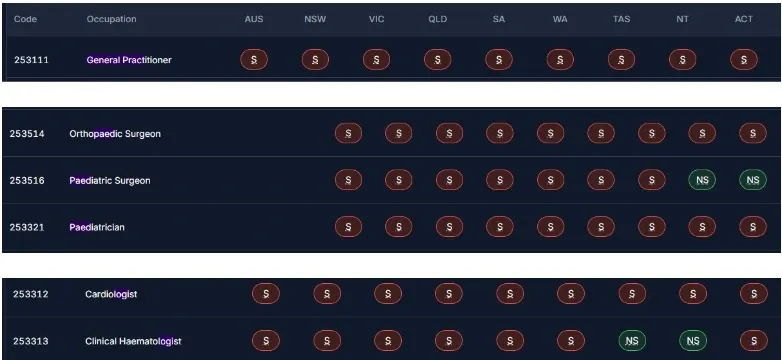
For doctors using the Standard pathway, the Medical Board of Australia states that international medical graduates generally complete the AMC assessment process, including the required AMC CAT MCQ Part I Written Exam and AMC Clinical Exam Part II, before progressing towards AHPRA registration.
Doctors who qualify through the Competent Authority pathway do not need to sit the AMC exams. They still need to meet the pathway requirements, obtain provisional registration and complete the required supervised practice before moving towards general registration.
AMC → visa
Think in terms of:
Medical qualification → verification → appropriate registration pathway → registration requirements → employment/visa pathway
That is a more accurate way to plan an Australian medical career.
As you can see from the Occupation Shortage List, there is a huge shortage of hospital pharmacists and retail pharmacists in urban and regional areas.
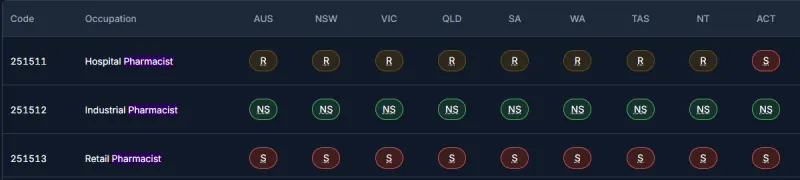
For internationally qualified pharmacists, the Australian Pharmacy Council's Overseas Pharmacist Readiness Assessment, is part of the knowledge-based pathway for pharmacists whose qualifications were completed outside Australia, Canada, Ireland, New Zealand, the UK and the USA.
The APC states that the Skills Assessment Outcome is used to support a visa application with the Department of Home Affairs.
The licensure exam is a computer-delivered multiple-choice assessment with 120 questions over 2.5 hours. This makes early exam planning particularly relevant to pharmacists who are considering Australia as both a professional and migration destination.
But again, just qualifying the licensure exam does not equal a visa grant. The assessment supports your professional and migration process. You will need to complete your internship, registration and get a full time pharmacist job to get a lifetime PR and settle with your family without any restrictions.
As you can see from the Occupation Shortage List, there is a huge shortage of dentists, dental therapists, dental technician, dental prosthetics, etc. dental professionals in urban and regional areas.
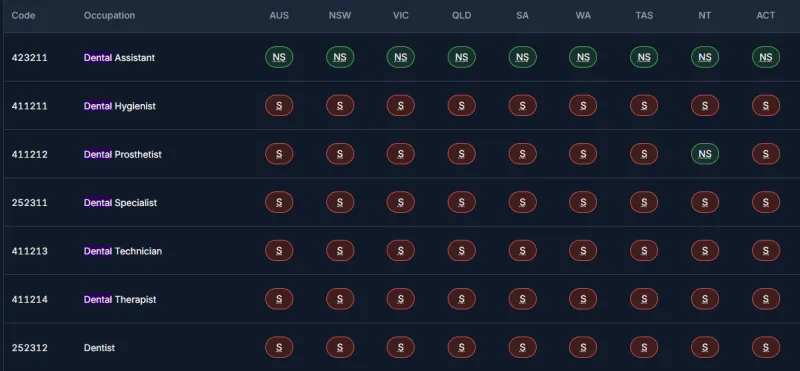
For overseas-qualified dentists whose qualifications do not meet Australia's direct registration requirements, the Australian Dental Council assessment process remains central.
The ADC describes a three-stage dentist assessment process:
Initial assessment → ADC Part I Written examination → ADC Part II Practical examination
The initial assessment determines whether a candidate can progress to the written examination. Successful candidates then move through the remaining assessment stages before becoming eligible to apply for registration with the Dental Board of Australia.
The ADC also distinguishes between its registration process and skills assessments used for migration purposes. Overseas-qualified dentists seeking a visa to live and work in Australia may need a skills assessment as part of their migration application.
So for dentists, the new visa environment makes one point particularly relevant. Do not separate your ADC preparation from your longer-term migration planning.
Physiotherapists are also part of Australia's healthcare workforce, which remains in the highest processing priority group under the new skilled visa directions introduced on 19 September 2026. Healthcare-related applications for certain temporary, provisional and permanent skilled visas are given priority under the new directions.

For overseas-qualified physiotherapists, however, getting a priority position in the visa system does not remove the professional registration requirements.
The Australian Physiotherapy Council (APC) assesses overseas-qualified physiotherapists who want to practise in Australia. Depending on your qualification and country of training, you may be eligible for the Australian Physiotherapy Entry Pathway (APEP), FLYR, or Express FLYR pathways. The APC also provides a separate assessment pathway for skilled migration purposes.
For physiotherapists planning to migrate to Australia, the process should be viewed as two connected but separate tracks:
Physiotherapy assessment and registration
↓
Migration skills assessment and visa eligibility
↓
Skilled visa application
↓
Priority processing may apply because healthcare is a priority sector
The important point is that healthcare priority does not mean automatic PR. You still need to meet the requirements of your chosen visa, registration pathway and, where required, skills assessment.
Physiotherapists should also factor in Australia's English-language registration requirements. AHPRA's common English Language Skills standard applies to physiotherapy and other registered health professions, with updated minimum English test scores applying from 23 April 2026.
For someone planning to work and settle in Australia, starting the physiotherapy assessment process early can help avoid leaving registration and migration planning until the end of a study or temporary visa period.
Overseas Healthcare Professional
↓
Check Australian registration pathway
↓
Choose the relevant assessment/exam
↓
Doctor: AMC / Competent Authority pathway
Pharmacist: APC skills assessment + Overseas Pharmacist Readiness Assessment + Registration
Dentist: ADC assessment pathway
↓
Meet registration / skills assessment requirements
↓
Check suitable skilled visa
↓
Meet occupation + nomination/sponsorship + visa criteria
↓
Lodge complete application
↓
Healthcare priority processing may apply
↓
Visa outcome
↓
Work and progress towards longer-term residence
Important: Priority processing does not remove the normal visa eligibility requirements.
The September 2026 reforms make Australia's migration system more selective. For healthcare professionals, the picture is different from the general temporary migration environment. Healthcare remains a priority sector for processing under the new skilled visa directions. At the same time, Australia is making it harder to rely on temporary study, visitor visas or repeated visa changes as an extended route into the country.
That makes early preparation more important. For an overseas doctor, pharmacist or dentist, the sensible planning sequence is now much clearer:
Understand your registration pathway → complete the required assessment → identify the right skilled visa pathway → meet all eligibility requirements → lodge a complete application.
A licensing exam alone does not guarantee permanent residency. But delaying professional assessment can make an already complex migration plan harder to manage.
The Australian government's new rules are still being rolled out, so applicants should check the latest Department of Home Affairs and regulator requirements immediately before lodging an application.
Yes. From 19 September 2026, healthcare is in the highest processing-priority group for several temporary, provisional and permanent skilled visas. This includes visas such as subclass 482, 186, 189, 190, 191, 491 and 494, subject to meeting the applicable visa requirements.
Healthcare remains a priority sector, but priority processing does not guarantee permanent residency. Doctors, pharmacists and dentists must meet their professional registration, skills assessment, occupation, nomination or sponsorship and visa requirements. Their specific pathway depends on their qualifications, experience, occupation and chosen Australian visa.
Yes. Jobs and Skills Australia continues to identify healthcare shortages across Australian occupations. Its 2025 shortage analysis specifically identifies pharmacists, dental practitioners, physiotherapists, specialist physicians and other medical practitioners among occupations affected by long training gaps.
Physiotherapy has strong projected employment growth. Jobs and Skills Australia projects physiotherapist employment to increase by 33.6% between May 2025 and May 2035, the strongest projected growth among the highlighted health-therapy occupations. Physiotherapists are also identified under the 2025 shortage-driver analysis.
Australia is restricting secondary applicants on most new student visas as part of its migration reforms. However, exceptions apply, including specific arrangements for certain students such as PhD candidates and people from designated Pacific and ASEAN countries. Applicants should check the rules applying to their exact visa and course.
Australia is introducing a No Further Stay condition on visitor visas to prevent them being used as a pathway to extend a stay. The government says the measure is intended to ensure visitor visas are used by genuine visitors rather than as a migration pathway.
It depends on the registration pathway. International medical graduates may use different pathways depending on their circumstances. Doctors on the Standard pathway generally need to meet AMC assessment requirements, while eligible applicants may qualify through other pathways. Visa eligibility and medical registration are separate processes.
Many internationally qualified pharmacists from specified countries use the Australian Pharmacy Council's knowledge pathway, which includes the Overseas Pharmacist Readiness Assessment. However, eligibility depends on the pharmacist's qualification and circumstances. Passing an assessment does not by itself guarantee registration or a visa.
The ADC pathway remains an important route for eligible internationally qualified dentists. The assessment process includes initial assessment followed by written and practical examinations. Dentists also need to satisfy the Dental Board of Australia's registration requirements and any applicable migration skills-assessment requirements.
Start with your professional registration pathway, not the visa application. Doctors should identify their medical registration route, pharmacists should check APC requirements, dentists should review the ADC pathway, and physiotherapists should assess their Australian pathway. Then match your registration and skills profile with an appropriate skilled visa.

Content Lead (Academically), MSc (HNB Central Uni.), Cert. in TESOL (Uni. of Glasgow), Cert. in English Mentorship (Uni. of Southampton). Aritro Chattopadhyay is a seasoned content strategist, SEO copywriter, English teacher, and an eminent food and lifestyle blogger based in Dehradun. Currently heading the content team at Academically Global, he formulates web-based content on international medical licensure pathways, and search-driven digital storytelling for global healthcare professionals. With over 10 years of experience in content marketing, blogging, English language training, and brand communication, Aritro has collaborated with 270+ national and international brands spanning across food, healthcare, edtech, fashion, travel, lifestyle, e-commerce domains. Aritro's work and journey have been featured in prominent media houses like Amar Ujala, Vistara in-flight magazine, and The Dehradun Street. Aritro actively mentors students globally for foundational communication skills and English proficiency exams like IELTS, TOEFL, PTE, CPE, CELPIP.

Our experts will contact you soon

Enter your details below to access the guide instantly.
Your download is starting. Redirecting you now…