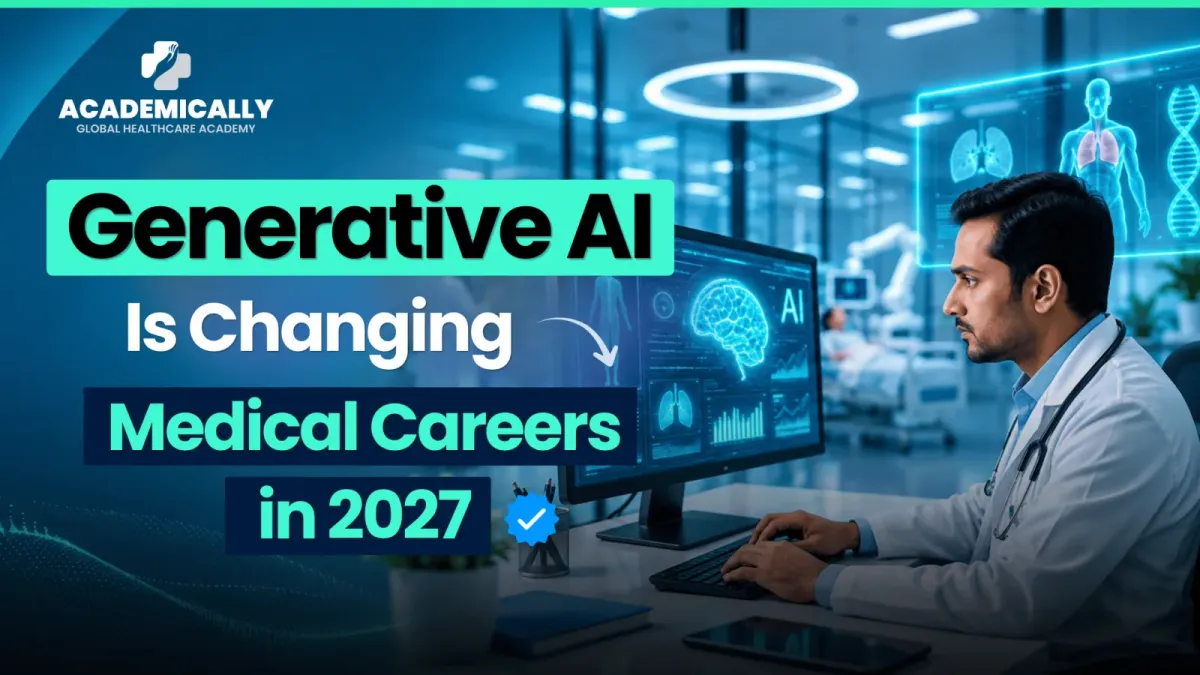
Picture a doctor who types fewer notes after clinic, a medical writer who lets a tool organise a messy literature review, or a clinical research associate who uses one to flag missing paperwork. None of this is science fiction any more. It's already happening, and 2027 will probably push it further.
The numbers back that up. The American Medical Association's 2026 physician survey found that 81% of US physicians use AI in practice, up from 38% in 2023. In India, more than 42,000 doctors had registered for the National Board of Examinations in Medical Sciences' (NBEMS)AI training programme by January 2026. Interest in generative AI medical careers is clearly not a niche concern.
There's a catch, though. Knowing how to chat with a bot isn't the same as using AI safely around patients, trial data or safety reports. That gap is where careers will be won or lost.
What Does Generative AI Mean in Medicine?
Generative AI creates content, such as text, images and summaries, from instructions or material you supply. In a hospital it might draft a discharge summary, simplify a patient leaflet or pull scientific papers together. Predictive AI is different. It estimates risk or spots patterns. Many products blend the two, which is why the line gets blurry.
The World Health Organization (WHO) sees uses across healthcare, research, public health and drug development, but warns that outputs may be inaccurate, incomplete or biased. Human review isn't optional, and that one point shapes every one of the generative AI medical careers covered below.
What is Likely to Change Most in 2027?
Probably the way work gets divided inside existing jobs. Repetitive drafting and information sorting can shift to software, leaving professionals to verify accuracy, apply evidence and explain what it means for a real patient or study.
That doesn't mean every hospital will cut staff. Adoption depends on clinical risk, regulation, budgets, digital infrastructure and training. Some employers will move quickly, others won't. Treat 2027 as a likely acceleration of current trends, not a promise that every workplace will look the same.
Generative AI Medical Careers, Role By Role
1. Doctors and Clinical Specialists: Less Typing, More Reviewing
AI scribes can turn a consultation into a draft note, summarise records and prepare patient-friendly explanations. For generative AI medical careers in clinical practice, the shift is from writing to reviewing. Imagine a physician reading a drafted note after a busy clinic and noticing that it says "no known allergies" when the patient had mentioned one. Catching that is now part of the job.
Examination, clinical reasoning, consent and accountability remain with the clinician. In 2027, the valuable skill is knowing when to trust AI output, when to check it and when to reject it.
2. Radiology, Pathology and Diagnostics
AI-enabled devices already support image analysis and clinical decisions. By September 2026, the FDA had authorised more than 1,600 AI-enabled medical devices for marketing. That list isn't limited to generative tools, so read it as a sign of the wider AI trend.
Generative tools may help draft reports or gather information in one place. Radiologists and pathologists still interpret findings in each patient's context, recognise uncertainty and decide what needs investigating. Their judgement, not the software, determines the next step.
3. Clinical Research: Faster Evidence Work, Tighter Oversight
Research teams juggle protocols, eligibility criteria, site documents, safety reports and study data. Generative AI can draft or summarise documents and pull out details for review, which touches coordinators, clinical operations staff, medical monitors, biostatisticians and data managers. Research is one of the generative AI medical careers where verification matters most.
Every output must be checked against source records and approved study documents. One invented citation or a wrong eligibility summary can affect participant safety. Regulators are watching: the FDA recognises AI use across nonclinical, clinical, post-marketing and manufacturing stages, and in January 2026 the FDA and European Medicines Agency published good-practice principles built on human-centric design, risk-based assessment and multidisciplinary expertise.
4. Medical Affairs and MSL Roles: Evidence Gets Easier to Reach
Medical affairs professionals explain clinical data, answer medical information requests, support scientific exchange and gather field insights. AI can help search internal knowledge, group insights and draft first answers. What it can't do is sit across from a clinician, work out what they're really asking, stay within approved boundaries and escalate when something feels off. That's the core of an MSL's role.
Anyone weighing a move here, say a pharmacist or physician leaving the ward, usually benefits from structured grounding in how the function works. The Medical Affairs Certification Course from Academically is built around that.
5. Clinical Drug Development and Pharma
AI is influencing target identification, molecule design, nonclinical research, trial planning, data review and post-marketing surveillance. Generative systems support document preparation, while other AI methods analyse datasets and predict outcomes. Pharma is where generative AI medical careers meet the heaviest regulation.
Clinical development associates, project managers, drug safety professionals and regulatory specialists all feel this. They need to ask whether a dataset is suitable, what a model is predicting and whether anyone has validated it. The FDA's 2026 principles stress context of use, data governance, performance assessment and lifecycle management.
6. Medical Writing and Communications
Generative AI can outline, summarise research and suggest plain-language wording, so early drafting gets faster. But say a writer asks a tool to summarise a trial. The paragraph comes back polished, yet it reports the headline benefit and skips the fact that it applied only to a subgroup. Medical writers must verify claims and references, understand study design, report results accurately and follow publication or regulatory rules. Evidence appraisal and editorial judgement stay at the core of generative AI medical careers in communications.
7. Pharmacovigilance and drug safety
Drug safety teams assess adverse event reports, review literature, write case narratives and monitor signals. AI may sort information, spot duplicates or draft summaries. Trained professionals still handle case review, causality assessment and required reporting. In pharmacovigilance, traceability matters more than speed.
8. Clinical AI Implementation And Governance
Hospitals and companies also need people who connect clinical workflows with technical teams: clinical AI implementation, AI quality and safety, health informatics, data governance, model evaluation and digital health product support. Doctors, pharmacists, nurses and allied health staff can contribute by testing tools, checking performance across patient groups, documenting limits, training colleagues and reporting problems. Job titles are still settling, but the need for clinical oversight is obvious, and it's a growing corner of generative AI medical careers.
What AI is Unlikely To Replace
AI carries no professional responsibility. It can't build trust in a sensitive consultation, weigh a patient's preferences or make an accountable decision. WHO warns about false or biased outputs and about automation bias, where people trust a system and overlook its errors. The UK's 2026 National Commission on AI in Healthcare similarly says AI should augment professionals and that clinicians need training to understand the tools they use. Empathy, ethics, communication and accountability will keep anchoring generative AI medical careers.
Skills Healthcare Professionals Should Build For 2027
Most healthcare professionals won't need to code, but they do need practical AI literacy:
- AI literacy: tell generative, predictive and decision-support systems apart.
- Evidence appraisal: check original studies, guidelines, dates, populations and limitations.
- Domain depth: build real knowledge in medicine, pharmacy, research or drug development.
- Privacy: keep identifiable patient and confidential company data out of unapproved tools.
- Validation: look for missing context, fabricated references, bias and unsupported claims.
- Communication: explain AI-supported findings and know when to escalate.
India's direction makes this local, too. In February 2026 the Government of India launched the Strategy for Artificial Intelligence in Healthcare for India (SAHI) and the BODH benchmarking platform to encourage safe, transparent and evidence-based use. In plain terms, evaluation and governance will matter as much as adoption, so professionals should learn to judge whether a tool works reliably for its intended users and setting.
How to Prepare for an AI-influenced Medical Career
Preparing for generative AI medical careers starts with the role you want, not a list of trendy tools. A doctor might need documentation skills. A pharmacist heading into industry may need medical affairs, pharmacovigilance or clinical development knowledge. A medical writer should sharpen evidence appraisal first.
Then practise on public, non-confidential material. Ask an AI tool to summarise a published trial, compare it with the paper, check the population, primary endpoint, adverse events and limitations, and note every error. That teaches validation, not just prompting. Turn a few of those exercises into a small portfolio, such as a verified evidence summary or a mock medical information response.
A simple checklist works:
- Open the original source,
- Confirm the date and population,
- Compare every number,
- Look for invented citations and
- Note what the source doesn't prove.
- Save the verified version, never the raw AI draft.
For anyone moving from clinical practice into industry, it usually happens in stages. Identify the role family that fits your experience. Learn its workflow and compliance expectations. Practise with public material. Then compare your skills with live vacancies. Where drug development is the target, the Executive Programme in Clinical Drug Development walks through how medicines progress from discovery to evaluation, and that foundation lasts longer than familiarity with any single AI platform.
Hiring managers feel the same way. They rarely want someone who claims AI expertise after a few prompts. They want a candidate who understands the risks in their own discipline.
Are there Medical Careers for People Who Don't want Direct Patient Care?
Yes. Medical affairs, clinical drug development, pharmacovigilance, regulatory affairs, medical writing, clinical research and health informatics all remain relevant. AI changes the tools, not the need for scientific interpretation and communication. The right path depends on your qualifications, experience and interests, and no course can guarantee a job. Real vacancies are the best reality check, so it helps to browse current openings on Jobslly and see what each specialisation actually asks for before you commit.
Inspiring Career Move: From clinical practice to Healthcare AI
Dr. Charan is a doctor who wanted out of the clinic and had no one to ask. As he puts it, he didn't know any doctors who had made the non clinical switch. After speaking to a counsellor and then an alumnus of Academically, he enrolled, partly because the programme was upfront about what it offered: a curriculum and faculty, not a promise of a job.
His first role came within days, as a drug safety physician. It was a solid job, but he wanted medical affairs, and he found the repetition wasn't for him. Eleven days in, he left for an offer from a startup building a health AI assistant, which is where he has spent the last two months.
He doesn't see it as a detour. His plan is to carry that medical AI experience back into medical affairs, including roles in the medical device space. That's the pattern this article describes: domain knowledge first, AI fluency on top.
To hear him explain the decision in his own words, watch the full conversation below interviewed by Dr. Ateeb A. Parray (Programme Manager- Non Clinical/Upskilling Courses, BDS, MSS, MPH)
Become Better at Work, Not Just Faster
Generative AI medical careers will keep evolving through 2027, and the change reaches how healthcare professionals document, research, communicate and develop medicines. The opportunity isn't just learning a new tool. It's combining healthcare expertise with the willingness to question AI output, protect patients and make sound decisions. That combination will matter in clinical and non clinical roles alike.