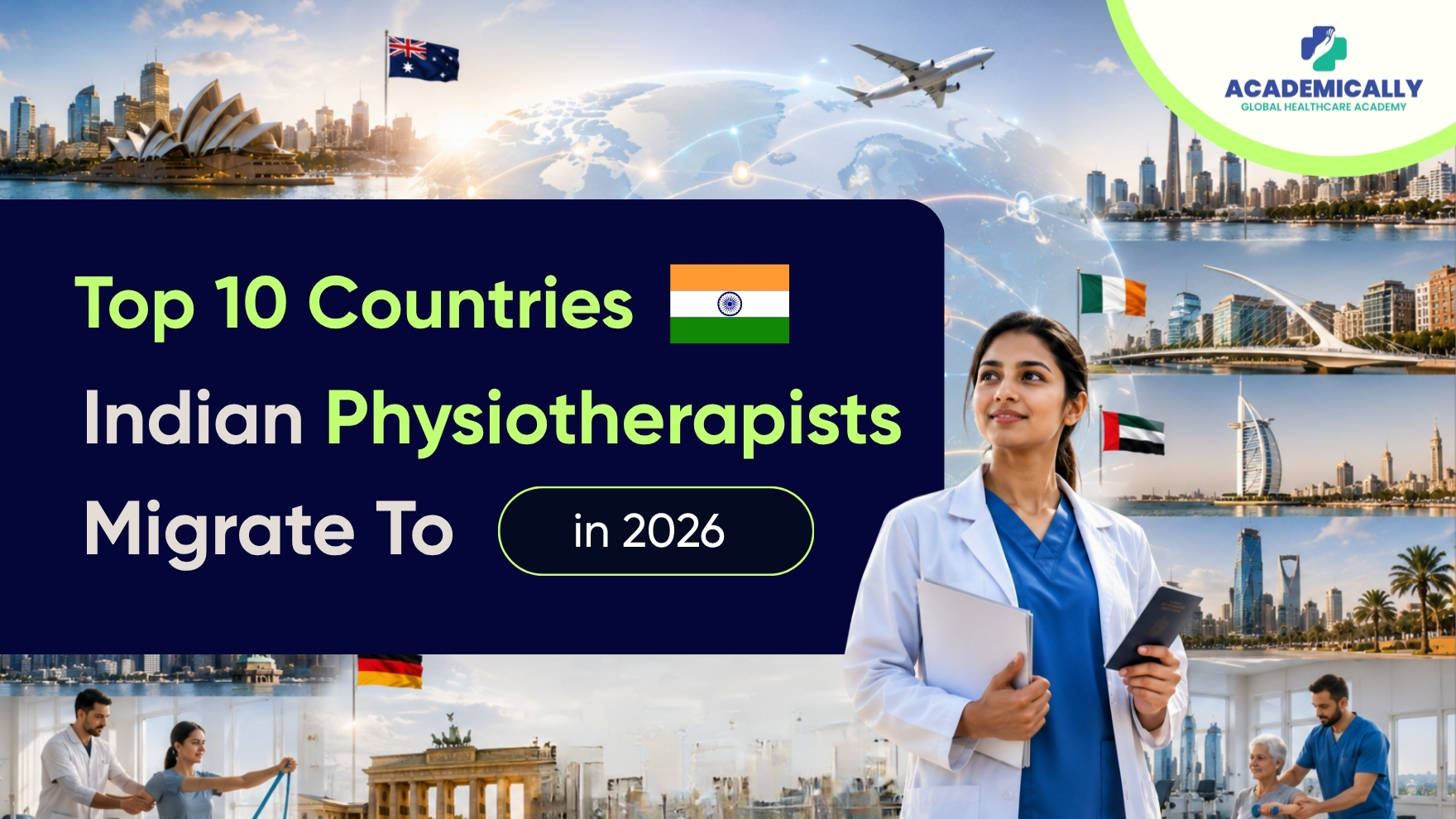
You spent four or five years earning your BPT. Maybe you added an MPT on top. You’ve treated patients, logged the hours, and you’re good at what you do. But the math stopped adding up somewhere. The salary, the career ceiling, the grind of private practice for returns that just don’t match the effort.
So you started looking outward.
At some point, every physio types the same question into Google: which is the best country for physio from India? The honest answer is, it depends. On whether you want the highest paycheck, the fastest PR, the simplest registration, or just a better life.
This blog covers all 10 countries where Indian physios migrate in real numbers.
Before the Rankings: What Actually Matters
Every physio has different priorities. Some want PR within three years. Some want tax-free income fast. Some have families and want stability over salary spikes. The 10 countries below are ranked by overall attractiveness, factoring in demand, pathway accessibility, salary, and long-term settlement potential. Not just salary alone.
Rank 1: Australia
Registration body: Australian Physiotherapy Council (APC) / Australian Health Practitioner Regulation Agency (AHPRA) | Exam: APEP
Australia is the gold standard for most Indian physios. Strong demand, a clear pathway, solid salaries, and a genuine PR route.
Employment in physiotherapy is projected to grow 33.6% between 2025 and 2035, making it one of the fastest-growing occupations nationally. There are currently over 45,900 practising physiotherapists, with roughly 2,100 new vacancies opening every year.
The APEP pathway (Australian Physiotherapy Entry Pathway) replaced the old Standard Assessment Pathway from 1 October 2025. It has five stages:
Eligibility Assessment
Cultural Safety Training (online)
Written Assessment (online)
Capability Assessment (video call), and
One-day Clinical Workshop in Melbourne (only stage requiring you to travel. Everything else can be completed from India)
Salary: AUD 65,000 entry-level, AUD 95,000 average, AUD 120,000+ for experienced clinicians. In rupees, that’s roughly ₹44–82 lakhs per year before tax.
Cost: APEP fees, English test, visa application, and Melbourne travel typically total ₹5–7 lakhs.
Time to registration: 12–18 months.
PR: Strong. Physiotherapy is on the skilled occupation list. Subclass 189 and 190 visas are accessible, especially for regional postings in Queensland, South Australia, and Western Australia.
Honest note: Sydney and Melbourne are competitive and expensive. Your first 2–3 years in regional Australia can get you to PR faster and often offer comparable pay with lower living costs.
Rank 2: New Zealand
Registration body: Physiotherapy Board of NZ
New Zealand’s biggest draw is its direct Work to Residence pathway. Physiotherapy is on the NZ Green List Tier 2, meaning that with a job offer from an accredited employer, you can apply for a visa that leads directly to residence.
Pathway reality for Indian physios: Your Indian BPT will likely go through competency assessment. The Board frequently flags Indian qualifications for additional scrutiny. This doesn’t mean rejection. It means extra time. Budget 3–5 months for assessment alone.
Salary: NZD 59,000–100,000 per year in public health. Senior physios earn NZD 85,000–100,000. In INR, that’s roughly ₹33–57 lakhs annually.
Registration fee: NZD 1,735 for overseas graduates (2025–26 schedule).
Time to registration: 6–12 months after documents are submitted.
PR: Yes. Green List Tier 2 with an accredited employer job offer provides a residency pathway within 2 years.
Honest note: New Zealand is genuinely beautiful and the lifestyle is excellent. But it’s a smaller job market than Australia, and after taxes and cost of living, the financial headroom is tighter than it looks on paper.
Rank 3: Canada
Registration body: Canadian Alliance of Physiotherapy Regulators (CAPR)
Canada made a significant change at the start of 2026. The old two-part PCE exam was retired and replaced with the Canadian Physiotherapy Examination (CPTE), a single virtual assessment covering both oral and written components in one day. This is genuinely better for Indian physios. Fewer bottlenecks, more exam dates per year, and one sitting instead of two.
Before you sit the CPTE, you need CAPR credentialing, a process that evaluates your degree, clinical hours (minimum 1,025 supervised hours required), language proficiency, and familiarity with Canadian practice standards. Standard processing takes around 26 weeks. Credentialing fee: CAD 1,486. CPTE fee: CAD 2,500.
Salary: CAD 65,000–90,000 per year for most roles. Alberta and British Columbia pay above the national median. At current rates (CAD 1 = ₹62), that’s roughly ₹40–56 lakhs annually.
Time to registration: 12–18 months, including credentialing and exam.
PR: One of the strongest in this list. Express Entry healthcare-specific draws are running every 4–8 weeks, with CRS cutoffs stabilising around 462–475. Physiotherapists have a realistic shot at PR without needing a perfect score.
Honest note: The new single-day CPTE is a genuine improvement. Canada remains one of the best long-term bets for Indian physios who want PR without the massive upfront investment that the USA requires.
Rank 4: United Kingdom
Registration body: Health and Care Professions Council (HCPC)
The UK is the only country in this list where you don’t sit any exam. HCPC registration is document-based. Submit your degree, transcripts, good standing certificate, and work experience proof. If your qualifications meet their standards, you’re registered. Another major advantage is if you get registered in the UK, you can work in New Zealand or Australia. You don’t have to take any exams!!
Both BPT and MPT holders with 1–2 years of post-internship experience are eligible to apply directly from India.
Scrutiny fee: £678 (approximately Rs 75,000), non-refundable and paid at application. Registration fee: £232 (approximately Rs 26,000), paid once approved and renewed every two years.
Total upfront cost is approximately £910.
Salary: NHS Band 5 starts at £30,000–£32,000, rising to £40,000+ at Band 6 and 7. In rupees, that’s roughly ₹33–44 lakhs. NHS pay is structured, predictable, and comes with pension and annual leave entitlements.
Time to registration: 2–6 months, the fastest in this list for a Western country.
PR: Indefinite Leave to Remain after 5 years on a Skilled Worker visa.
Honest note: London looks attractive on a gross salary, but the rent will eat it. Northern NHS Trusts such as Sunderland, Leeds, and Sheffield offer comparable Band 5 and 6 pay with dramatically lower living costs. Run the numbers by location, not by country average.
Rank 5: Ireland
Registration body: CORU (Physiotherapists Registration Board)
Ireland is quietly becoming one of the more sensible destinations for Indian physios, and it doesn’t get nearly enough attention. Physiotherapy is on Ireland’s Critical Skills Occupations List, which means a faster employment permit and a PR pathway within 2 years via Stamp 4.
Pathway: CORU assesses your Indian qualification against Irish standards. If gaps are found, you may need an aptitude test or a supervised adaptation period before full registration. It’s case-by-case, so timelines vary.
Salary: HSE (public health) roles start around €38,000, with mid-level roles reaching €50,000–65,000. In rupees, that’s roughly ₹34–56 lakhs.
Time to registration: 6–12 months typically.
PR: Critical Skills Employment Permit leads to Stamp 4 after 2 years, making it one of the cleaner PR routes in Europe.
Honest note: Dublin is expensive. Cork, Galway, and Limerick are considerably more liveable on the same salary. Ireland is English-speaking, EU-located, and has a growing healthcare sector. It deserves more consideration than it gets from Indian physios.
Rank 6: UAE / Dubai
Registration bodies: DHA (Dubai), DOH/HAAD (Abu Dhabi), MOHAP (other emirates)
The Gulf’s value proposition is simple: tax-free income. No income tax means what you earn, you keep.
Starting salaries for overseas physiotherapists are AED 12,000/month (approximately ₹2.85 lakhs/month), rising to AED 16,000–20,000 with experience. That’s roughly ₹34–48 lakhs per year, tax-free.
Each emirate has its own licensing authority: DHA for Dubai, DOH for Abu Dhabi, MOHAP for Sharjah and northern emirates. Most applicants sit a Prometric exam. The process involves DataFlow document verification, exam, eligibility letter, then job offer and visa.
Cost: DataFlow and exam fees typically total ₹30,000–60,000, far lower than any Western pathway.
Time to registration: 3–6 months.
PR: Not available in the traditional sense.
Honest note: UAE is the fastest route to a significant income jump from India. Many Indian physios use it as a 2–3 year savings phase before funding their APEP or CPTE preparation. That is a legitimate strategy. Just go in knowing it’s not a permanent home.
Rank 7: Saudi Arabia
Registration body: SCFHS (Saudi Commission for Health Specialties)
Exam: SPLE (Saudi Prometric Licensing Exam)
Saudi Arabia’s healthcare sector is expanding aggressively under Vision 2030 and physiotherapy demand is real. The SPLE is mandatory for all physiotherapists, Indian or otherwise. You need a BPT or MPT, a valid home-country license, and minimum one year of post-internship experience to be eligible.
Salary: SAR 7,000–9,000/month at entry level (approximately ₹1.55–2 lakhs/month). Senior roles in Riyadh private hospitals reach SAR 18,000–22,000. All tax-free. Roughly ₹18–60 lakhs per year depending on experience.
Time to registration: 3–5 months.
PR: No.
Honest note: Saudi Arabia has modernised significantly in recent years. It is not Dubai in terms of lifestyle, but the savings potential is comparable. A solid option if UAE roles are not available.
Rank 8: Qatar
Registration body: QCHP (Qatar Council for Healthcare Practitioners)
Qatar is the smallest Gulf destination in this list but offers the highest Gulf salaries. Physiotherapists earn approximately QAR 318,800 per year, around ₹72–73 lakhs annually. Senior professionals including overtime and bonuses can cross QAR 500,000, approximately ₹1.13 crore.
Registration process mirrors UAE and Saudi: DataFlow PSV, QCHP Prometric exam, employer sponsorship. Timeline is 3–6 months.
PR: No.
Honest note: Qatar is a strong option for physios who want Gulf income with good clinical exposure. The country is small, which limits long-term career variety, but for savings-focused 3–5 year stints, it is hard to beat on salary.
Rank 9: USA
Registration body: Federation of State Boards of Physical Therapy (FSBPT)
Exam: National Physical Therapy Examination (NPTE)
The USA has the highest salary ceiling in this entire list. The national average salary for physical therapists is around USD 107,905, approximately ₹1 crore annually. But it also has the most complicated and expensive pathway for Indian physios.
Your Indian BPT is not considered equivalent to the US Doctor of Physical Therapy (DPT). You will need FCCPT credential evaluation first, which almost always requires completing a Bridge Program or Transitional DPT (tDPT) before you can sit the NPTE. That programme costs USD 20,000–60,000 (₹18–55 lakhs) and takes 1–2 years in the US on an F-1 student visa.
Time to registration: 2–4 years from India.
PR: Yes, but the H-1B visa lottery makes it less predictable than Canada or Australia.
Honest note: The US is a 5–10 year game. The financial returns are exceptional if you commit, but it requires the largest upfront investment of any country here. If you want results in 2–3 years, start somewhere else.
Rank 10: Germany, Sweden, Norway
The common thread: all three require a language you do not currently speak.
Germany: Salary €2,500–3,500/month gross (approximately ₹2.1–3 lakhs/month). Registration through state health authorities. German B2 is essentially mandatory for clinical practice.
Sweden: Salary SEK 35,000–50,000/month (approximately ₹2.8–4 lakhs/month). Registration through Socialstyrelsen. Swedish B1–B2 required.
Norway: The highest-paying European destination. NOK 660,000–720,000 annually (approximately ₹55–60 lakhs). Private practice owners can cross NOK 900,000–1,000,000. Norwegian B2+ required. Registration through HELFO.
All three offer genuine permanent residency pathways within 5–8 years and exceptional work-life balance once you are settled.
Time to registration: 2–4 years when language preparation is included.
Honest note: The real barrier in Scandinavia and Germany is not clinical knowledge, it is the language. Most Indian physios who do not make it in these countries underestimated how long B2 takes. If you are in your late 20s, child-free, and willing to invest 2+ years in language learning, Norway in particular offers something Australia and the Gulf simply do not: a genuinely exceptional quality of life with one of the best work-life balances in the world.
Comparison Table
Country | Annual Salary (approx ₹) | Registration Body | Difficulty | Cost (₹) | Timeline | PR? |
Australia | ₹44–82L | APC/AHPRA (APEP) | Moderate | ₹5–7L | 12–18 months | Yes, strong |
New Zealand | ₹30–51L | Physio Board NZ | Moderate–High | ₹2–4L | 6–12 months | Yes, Green List |
Canada | ₹40–56L | CAPR (CPTE) | Moderate | ₹3–5L | 12–18 months | Yes, very strong |
UK | ₹33–44L | HCPC | Low | ₹1–2L | 2–6 months | Yes (5 yrs) |
Ireland | ₹34–56L | CORU | Moderate | ₹1–3L | 6–12 months | Yes (2 yrs) |
UAE | ₹34–48L (tax-free) | DHA/DOH/MOHAP | Low | ₹30K–60K | 3–6 months | No |
Saudi Arabia | ₹18–60L (tax-free) | SCFHS (SPLE) | Low | ₹25K–50K | 3–5 months | No |
Qatar | ₹72L+ (tax-free) | QCHP | Low | ₹40K–70K | 3–6 months | No |
USA | ₹95L–1Cr+ | FSBPT (NPTE) | Very high | ₹18–55L+ | 2–4 years | Yes (complex) |
Germany/Sweden/Norway | ₹25–60L | State/National bodies | High | ₹2–5L + language | 2–4 years | Yes |
The Honest Verdict
Easiest pathway: UK, no exam, just documents, fastest registration.
Fastest income jump: UAE or Qatar, tax-free, low registration cost, 3–6 months to start working.
Best PR pathway: Canada, healthcare Express Entry draws, CRS cutoffs around 462–475, and the new single-day CPTE is genuinely manageable.
Best overall package: Australia, strong demand, clear APEP pathway, solid PR route, and an established Indian physio community.
Highest salary ceiling: USA, but the investment is enormous. It is a long game.
Best for family settlement: Australia or Canada, diaspora support, quality schools, clear citizenship timelines.
Best quality of life long-term: Norway or Sweden, once you are through the language barrier, there is genuinely nothing quite like it.
Best stepping stone: UAE or Saudi Arabia, earn tax-free for 2–3 years, save for your APEP or CPTE prep, then move. Several Indian physios currently in Australia followed exactly this route.
Ii you have any questions about a specific country or pathway, you can reach out to the experts at Academically.
Book A Free Counselling Session