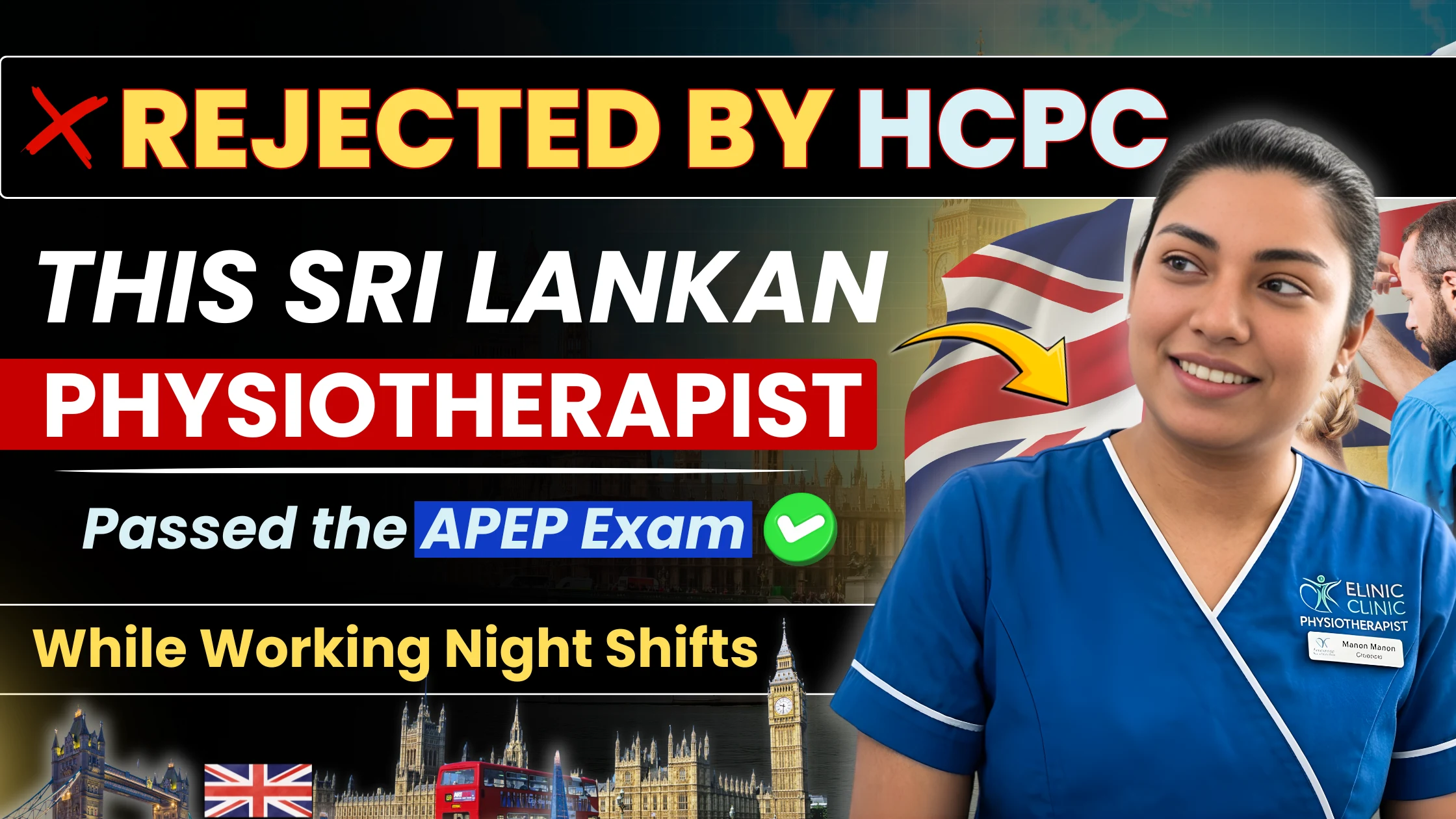
After a career gap, a license rejection, and a life reduced to care-assistant shifts, a Sri Lankan physiotherapist found the immense courage to reclaim her profession. Let’s get inspired.
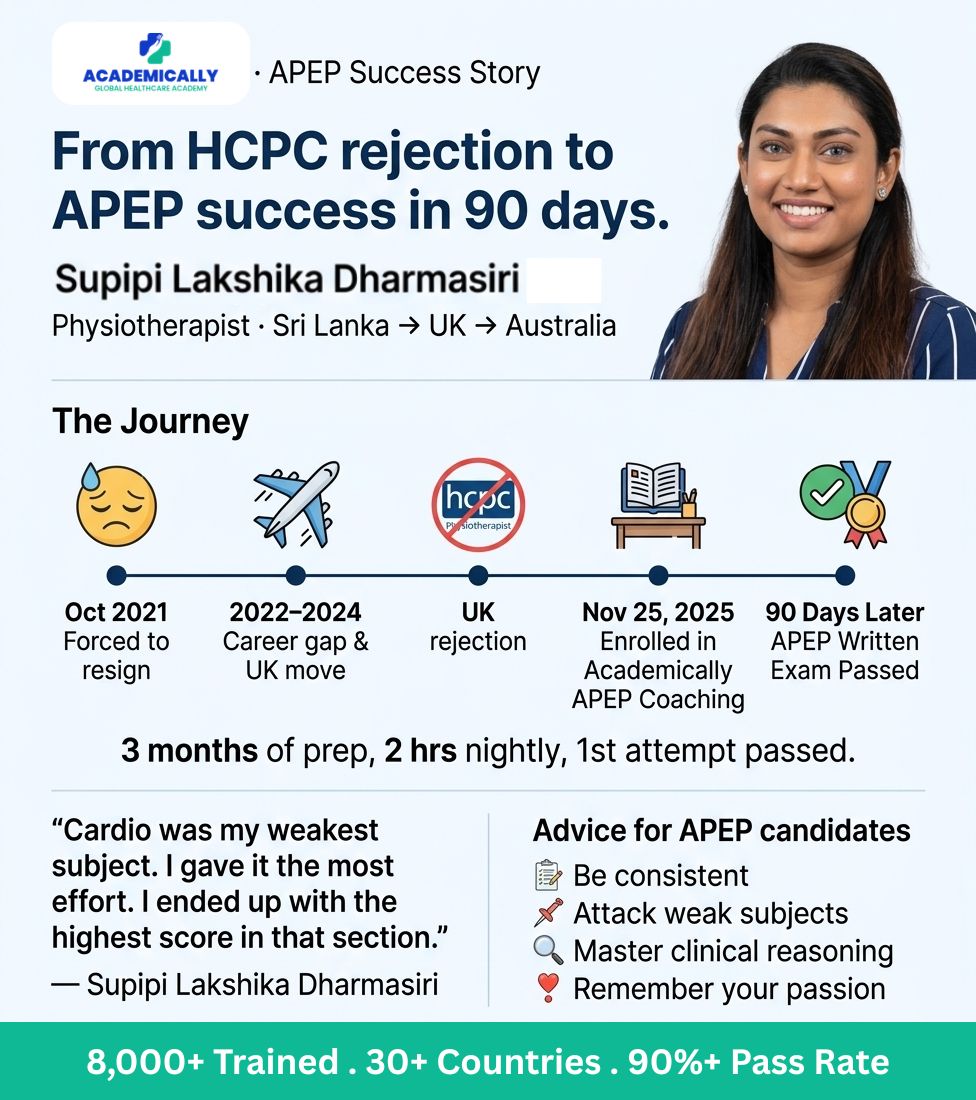
There is a particular kind of professional grief that sets in when a career you have trained for years. The one that defines who you are. Everything suddenly becomes blurred. Supipi Lakshika Dharmasiri, a physiotherapist from Anuradhapura, Sri Lanka, was quite literally grieving her life. She was subjected to a forceful resignation in October 2021 amid the pandemic. Then a year-long career gap happened. She then decided to move to the UK to pursue a master’s degree and cherish new beginnings. But alas, her HCPC registration was cancelled due to the career gap.
How did she succumb to the pressure?
In a tete-a-tete with Tahreem Mirza (BPT, Registered Physiotherapist and Program Manager of Physiotherapy at Academically), our APEP-qualified candidate, Lakshika, poured her heart out. Let’s get reading.
The Pivot from Failure to Success with Structured Guidance
Before Lakshika’s story became one of triumph, it passed through years of detour. After resigning in 2021, she secured a 1-year contract as a demonstrator and assistant lecturer at a Sri Lankan university, keeping her close to medicine, but not to clinical practice.
She then moved to the UK for her graduate programme, hoping it would strengthen her registration case with the HCPC all by herself. It did not. The gap in her physiotherapy career was the deciding factor. What happened after is a rejection letter after a long wait.
What could have been the end of the story was, instead, a pivot point. Her husband introduced her to Academically, a global healthcare ed-tech platform founded by Dr. Akram Ahmad (PhD, University of Sydney) specifically to bridge the gap between qualified international healthcare professionals and the licensing systems of their destination countries.
The premise was simple and, for Lakshika, a revelation.
After browsing through the website and social channels of Academically and a thorough consultation, she enrolled for the Australian Physiotherapy Entry Pathway (APEP) written exam coaching on 25 November 2025. Why so?
Because you don’t have to budget and visit all the way to Australia for an exam. You can stay in the comfort of your home and complete almost the entire registration pathway here itself. When you qualify all the important steps, you just have to attend a small clinical workshop in Australia and voila! You are a licensed physiotherapist in Australia.
How did she prepare for the physiotherapy exam in just 3 months?
Study Routine for the Australian Physiotherapy Entry Pathway (APEP) Exam While Working Full Time
Lakshika’s day job as a care assistant ran from 8:00 AM to 8:00 PM. She would arrive home around 10 PM, sit down, and open one set of Academically’s lecture notes. From 10:00 PM to midnight, she would read, summarise, and internalise.
At 6:00 AM, she was back up for another shift. On her days off, she extended her sessions to two or three consecutive hours. Sometimes she would add an evening block on top.
Lakshika could not attend Academically’s live sessions due to her shifts. She relied entirely on recorded video lectures and the accompanying notes. She studied asynchronously, but no less rigorously.
In her words, “The recording videos of Academically are really well done,” she said. “I summarised the lecture notes, and from those summaries I could recall information whenever I had free time.”
APEP COMPLETE PREPARATION TOOLKIT
No external materials, no textbooks, no additional resources. |
3 Months of preparation | 2 hrs/night post 12-hr shift | 1st Attempt passed |
Cracking the MCQs based on the Australian Physiotherapy Council’s Norms
The Australian Physiotherapy Council’s written exam is known within the profession for a specific kind of question pattern. Multiple-choice questions where two of the four options are plausible. The ability to quickly eliminate the two obviously incorrect answers is rather easy. But your real skill lies in distinguishing between the remaining two through deep clinical reasoning.
This is precisely what Academically’s faculty trains candidates to do. Rather than teaching students to memorise answers, the programme focuses on the underlying clinical logic. Why one answer is correct, and why the close-but-wrong option is not. And why not! Our faculty members are trained physiotherapists who are well-settled, AHPRA-registered and working in Australia.
.jpg)
Lakshika describes applying this method under exam pressure: “I went to the strong reason, ticked it, and moved on. Even when I doubted about two answers, I trusted the reasoning.”
The MCQ mock tests were particularly important here. Regular exposure to timed practice in a format mirroring the actual exam built not just knowledge, but confidence, a quality that is easy to underestimate when, as Lakshika put it, “50 cameras are watching you.”
Tried and Tested APC Exam Preparation Strategy for APEP
When asked what she would tell candidates currently preparing for the APC written exam, Lakshika’s answer had the directness of someone who has earned every word of it:
- Put in the effort your goal deserves. There is no shortcut. Lakshika studied two hours every night after a twelve-hour shift. The result was proportional to the input.
- Consistency is the actual strategy. Cramming is not an option for a high-stakes clinical reasoning exam. Daily, sustained contact with the material is what builds the recall you need under pressure.
- Do not avoid your weak subjects. Lakshika’s instinct was to pour extra time into cardiorespiratory physiotherapy. Her initial weakness is the opposite of what most candidates do. It is also why she topped that section. In her own words,
“Cardio was my weakest subject. So I gave it the most effort. I ended up with the highest score in cardio out of all three sections.”
- Remember why you chose this. “We are learning what we like,” she said. When the 10:00 PM fatigue sets in and the notes blur, that sense of vocation is what keeps the page open.
Passed the APC Written Exam? Does Academically Guide for APEP Capability Assessment also?
Passing the APC written exam is a significant milestone, but it is one last step in a journey towards full physiotherapy registration in Australia. Lakshika’s next phase is the capability assessment preparation of APEP. She will be navigating with continued guidance from Academically.
In her words,
“The results directly reflect the effort you invested.”
That statement cuts both ways. It is an affirmation of Lakshika’s work. But it is also a promise to every physiotherapist sitting in a similar position right now stuck in a country that does not yet recognise them, doubting whether the career they trained for is still available to them. It is.
To Conclude with…
Lakshika’s story is not exceptional because it is rare. It is exceptional because it is possible and repeatable. A career gap, a visa setback, a 12-hour shift: none of these is the end of the story for a qualified physiotherapist who refuses to stop. The new APEP pathway is a much more streamlined route to practising physiotherapy in Australia. With the right preparation that’s structured, consistent, and clinically grounded. Passing on the first attempt is well within reach. Academically exists precisely for this to make sure that the only thing standing between a qualified healthcare professional and their career is the effort they choose to put in.