
Pharmacotherapeutics-III is one of the most demanding subjects in the Pharm.D curriculum. It shapes how your skills that define your entire clinical career.
This blog will guide you on how to prepare for Pharmacotherapeutics-III effectively without feeling overwhelmed. It gives you a step-by-step blueprint. From scheduling your study hours to writing clinically meaningful notes, you will find it all.
Master the subject with a foolproof preparation plan.
Ready? Let’s start.
What Pharmacotherapeutics-III Tests
You must know what the subject expects from you, before creating a study plan.
- Understand disease pathophysiology
- Know conventional and alternative treatments
- Integrate diagnostic parameters
- Make therapeutic decisions
- Monitor outcomes and adverse effects
- Apply guidelines in real-world scenarios
Pharmacotherapeutics-III is application-focused.
Topic Coverage and Estimated Weightage
Below is the approximate weightage chart.
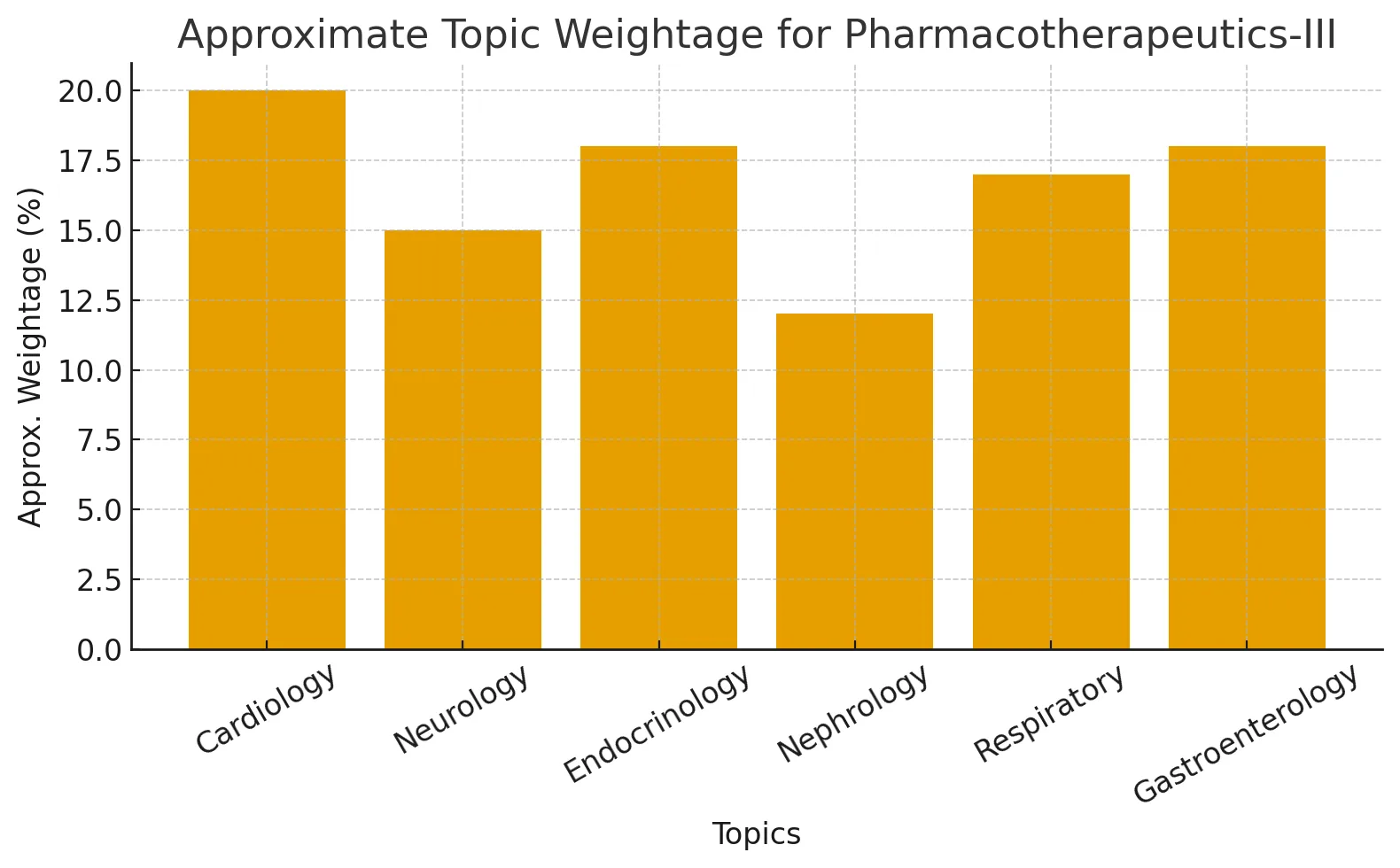
Topic-wise Snapshot
| System / Module | What to Focus On | Why It Matters |
| Cardiology | HF ACS HTN Afib | High patient load frequent case discussions |
| Neurology | Epilepsy Stroke Parkinsonism | Requires guideline-based decision-making |
| Endocrinology | Diabetes Thyroid Disorders | High-yield Core clinical domain |
| Nephrology | CKD AKI RRT drug dosing | Critical for dose adjustments |
| Respiratory | Asthma COPD Pneumonia | Most OPD and hospital cases fall here |
| Gastroenterology | PUD GERD Liver disorders | Important for ADR and drug-interaction topics |
Prepare for Pharmacotherapeutics-III - Step-by-Step Strategy
This is the core part of your preparation. Follow this structured plan to avoid confusion and burnout.
Step 1: Build a Weekly Study Framework
Instead of studying everything randomly, create a rotation-based schedule.
Example Weekly Plan
| Day | Topic Focus | Tasks |
| Monday | Cardiology | Read HF Watch explanation videos |
| Tuesday | Cardiology | Solve 2–3 case scenarios |
| Wednesday | Neurology | Read epilepsy Write notes |
| Thursday | Endocrine | Diabetes therapy revision |
| Friday | Respiratory | Solve COPD and asthma cases |
| Saturday | Mixed revision | 50 MCQs Previous cases |
| Sunday | Light review | Flowcharts Tables Summaries |
This format prevents overload and helps build conceptual memory.
Step 2: Use the 3-Layer Study Approach
To truly master the subject, use a layered method:
Layer 1: Basic Reading
Sources you can rely on:
- Koda-Kimble
- Pharmacotherapy by Dipiro
- Standard clinical guidelines
Focus on:
- Disease overview
- Pathophysiology
- Core drug classes
- Monitoring parameters
Layer 2: Focused Notes
Make short, high-yield notes with:
- Flowcharts
- First-line vs Second-line tables
- Contraindications
- Dose adjustments (renal/hepatic)
- Red-flag symptoms
Your goal should be that you’re able to revise a topic in 20 minutes.
Layer 3: Case-Based Mastery
Pharmacotherapeutics-III is case-driven.
Practice:
- SOAP notes
- Drug therapy problems (DTPs)
- Prescription evaluation
- Clinical decision trees
The more cases you solve, the more confident you become.
Step 3: Master Guidelines, Don’t Memorize Them
Guidelines evolve often. Instead of memorizing:
Do This Instead:
- Understand why a drug is first-line
- Learn target goals like:
- BP
- Glucose level
- INR
- LDL
- Know when to step up or step down therapy
- Memorize
- Critical values
- Risk factors
- Diagnostic cut-offs
Small Example
For hypertension:
- First-line → ACEi/ARB, CCB, Thiazides
- Compelling indications → HF → ACEi + beta-blocker
- Monitoring → BP, K⁺, renal function
This type of understanding helps you answer both cases and MCQs.
Step 4: Write Notes the Right Way
Your notes must be:
- Short
- Structured
- Exam-friendly
- Case-friendly
- Guideline-linked
What to include in every set of notes:
- Pathophysiology in 4 to 5 bullet points
- Goals of therapy
- First-line drug
- Alternative options
- Dose and adjustment
- Monitoring
- Patient counseling
- Drug interactions
- Contraindications
Quick Example (Asthma)
- Goals: Reduce symptoms and prevent exacerbations
- First-line: ICS
- Step-up: ICS + LABA
- Monitoring: PEF, symptom diary
- Counseling: Inhaler technique and trigger avoidance
Step 5: Active Recall and Spaced Repetition
These two techniques will take your score to another level.
Active Recall Methods
- Close the book and summarize
- Try to explain a disease to a friend
- Test yourself with flashcards
Spaced Repetition
Revisit key topics:
- After 24 hours
- After 3 days
- After 7 days
- After 21 days
This method drastically improves long-term retention for huge topics like cardiology and endocrinology.
Step 6: Solve Real Case Scenarios
This is where most students struggle.
Case-based questions appear in:
- Internals
- Finals
- Viva
- Clinical evaluations
How to practice cases:
- Read the patient history
- Identify the problem
- Choose the right drug:
- What?
- Why?
- How much?
- Until when?
- Monitor meaningful parameters
- Write a short justification
Mini Example
Case:
A 62-year-old diabetic patient presents with worsening shortness of breath. EF = 35%.
Your thought process:
- Diagnosis → HF (reduced EF)
- First-line → ACEi/ARB + Beta-blocker + SGLT2 inhibitor
- Monitoring → ECG, BP, renal function
- Counseling → Daily weight, salt restriction
This is exactly the kind of reasoning examiners expect.
Step 7: Use Mnemonics, Flowcharts & Tables
These tools speed up revision.
Common Mnemonics Example
- Asthma Severity: IIMMS
- Intermittent, Mild, Moderate, Severe
- Heart Failure Drugs: ABCDS
- ACEi, Beta-blocker, CCB (rare), Diuretics, SGLT2 inhibitors
Flowcharts help you recall protocol-based steps quickly in the exam.
Step 8: Practice MCQs and Previous Question Papers
Solve:
- 50 MCQs per week
- At least 1 full mock every two weeks
This boosts clinical reasoning and exam confidence.
Step 9: Build Application Through Clinical Exposure
During hospital rotations, apply what you study:
- Review prescriptions
- Identify drug therapy problems
- Ask doctors about therapy choice
- Check lab profiles
- Observe transitions of care
Linking real-world cases with your notes improves retention 5X.
Step 10: Final 30-Day Revision Strategy
What to do in the last month:
- Revise all flowcharts & tables
- Re-read high-yield topics
- Practice 3 to 4 cases per day
- Do rapid-fire revision of ADRs and interactions
- Revise doses and adjustments
Consistency is the key, not perfection.
Conclusion
To master Pharmacotherapeutics-III is to learn to think like a clinician. When you understand the “why” behind every therapeutic decision, the subject becomes far more logical and easier to navigate. Make you learning easier with
- Structured notes
- Case-based practice
- Spaced revision
- Exposure to clinical scenarios
This method will help you not only score well in exams but also build the confidence you need for real-world patient care.
Stay consistent and keep your concepts clear. Every hour you invest in learning brings you one step closer to becoming a skilled and competent healthcare professional.
Most importantly, it gives you the skills you can use in your future career. Did you know that the OPRA exam, the one you need to pass before you can practice in Australia, has 45% quotations from this topic? Now that is another reason why you should master the subject.
If OPRA is on your mind, why not take a look at our OPRA preparation course? With an astounding success rate, this course has everything you can think of. Mentor guidance? Check. Mock exams? Check. Recorded sessions to go back to? Check.
Now is the time to start thinking of your future. With your Pharm.D degree in hand, a world of opportunities open up for you. It is now up to you what you do with them.
Ready to take on the world?