Becoming a Medical Science Liaison is one of the most coveted roles in medical affairs. India is famously known as the “World of Pharmacy” with its cutting-edge pharmaceutical and biotech landscape. MSLs serve as the scientific bridge between healthcare professionals and pharmaceutical companies. They support evidence-based arguments, clinical insights, and strategic adoption of therapies.
Getting a job in an MSL role isn’t a cakewalk. Hiring managers assess not just scientific acumen, but communication skills, presentation ability, and strategic thinking. In this blog, we will take you through the most common Medical Science Liaison interview questions, along with well-structured expert answers, preparation tips, and actionable insights that help you secure a job.
What Is a Medical Science Liaison?
A Medical Science Liaison (MSL) is a field-based scientific expert who:
- Engages with key opinion leaders (KOLs) and healthcare professionals
- Provides unbiased scientific and clinical information
- Gathers field insights to inform medical affairs strategy
- Supports clinical trial execution and scientific communication
This role acts as a bridge between scientific expertise and strong interpersonal and communication skills.
Why MSL Interviews in India Are Different?
In India, MSL roles are growing as multinational and domestic companies expand their medical affairs functions. Interview panels typically include hiring managers, medical directors, and cross-functional partners. Expect questions that evaluate:
- Scientific knowledge and clinical judgment
- Strategic engagement and relationship management
- Communication and presentation skills
- Industry understanding (including regulatory and ethical norms)
What Questions Will You Face in the Interview: Prediction 101
1. Tell us about yourself.
Expert Answer: I hold a postgraduate qualification in life sciences and have worked across medical affairs. I’m aligned with functions such as pharmacovigilance, clinical research coordination, and scientific content development.
Through consistent interaction with clinicians from tertiary care hospitals and academic institutions in India, I discovered that my strength lies in translating complex scientific evidence into meaningful clinical discussions. The Medical Science Liaison role allows me to apply this skill in a structured, ethical, and impactful manner.
2. Why do you want to become a Medical Science Liaison?
Expert Answer: The MSL role aligns closely with my interest in science-driven, non-promotional engagement. In the Indian healthcare ecosystem, clinicians increasingly expect credible scientific conversations rather than product-focused discussions.
As an MSL, I can support evidence-based clinical decisions, gather meaningful insights from the field, and contribute to long-term improvements in patient care.
3. What do you understand about the role of an MSL in India?
Expert Answer: In India, an MSL functions as the scientific representative of the organization, particularly in metro and tier-1 cities where clinicians are academically driven and data-focused.
The role involves structured KOL engagement, medical education, insight generation, and internal collaboration, while navigating diverse practice settings ranging from government hospitals to corporate healthcare institutions.
4. How is an MSL different from a sales representative in the Indian context?
Expert Answer: An MSL operates independently of commercial targets and does not engage in product promotion or pricing discussions.
In India, this distinction is essential because senior consultants and academic clinicians expect unbiased scientific dialogue. The MSL’s responsibility is to discuss clinical evidence, treatment guidelines, and unmet needs while strictly adhering to compliance standards.
5. Which therapeutic areas have you worked in?
Expert Answer: I have worked in (choose or enter your field: oncology/diabetes/cardiology/immunology), therapeutic areas that are highly relevant in India due to increasing disease burden and evolving treatment paradigms.
My experience includes understanding disease pathophysiology, reviewing key clinical trials, and interpreting how global guidelines are applied in Indian clinical practice.
6. How do you stay updated with scientific developments relevant to India?
Expert Answer: I regularly review international and Indian peer-reviewed journals, follow updates from PubMed, and attend medical conferences such as API, ISMICON, ESMO Asia, and specialty-specific CMEs.
I also monitor CDSCO updates and clinical practice trends emerging from leading Indian institutions like AIIMS and Tata Memorial.
7. How would you explain a complex global clinical trial to an Indian physician?
Expert Answer: I focus on translating global data into local clinical relevance by discussing patient demographics, disease severity, safety outcomes, and practical considerations such as affordability and access.
This approach helps Indian physicians evaluate how trial outcomes may apply to their patient population.
8. Who are considered KOLs in the Indian healthcare system?
Expert Answer: In India, KOLs include senior consultants in high-volume centers, department heads in teaching hospitals, guideline contributors, and principal investigators involved in clinical research.
Institutions such as AIIMS, PGI Chandigarh, CMC Vellore, and large corporate hospital networks play a significant role in shaping clinical opinion.
9. How would you identify and prioritise KOLs in India?
Expert Answer: I would evaluate factors such as publication history, conference faculty roles, involvement in clinical trials, patient load, and regional influence.
Given India’s geographical diversity, I believe in region-wise KOL mapping aligned with medical strategy and therapeutic priorities.
10. How do you build long-term trust with Indian KOLs?
Expert Answer: Trust is built through scientific preparedness, consistency, and respect for the clinician’s time.
Indian KOLs value credible discussions, honest acknowledgment of data limitations, and timely follow-ups. Long-term engagement rather than transactional interactions strengthens these relationships.
11. How do you handle senior clinicians who strongly challenge your data?
Expert Answer: I approach such discussions with respect and openness, acknowledging the clinician’s experience while supporting my responses with evidence.
When needed, I align trial data with real-world practice patterns, ensuring the conversation remains collaborative and focused on patient benefit.
12. What is your understanding of compliance in Indian medical affairs?
Expert Answer: Compliance involves adherence to CDSCO regulations, UCPMP guidelines, company SOPs, and global ethical standards. As an MSL, maintaining compliance ensures that all scientific interactions are ethical, transparent, and focused on patient safety.
13. How do you manage off-label questions from Indian doctors?
Expert Answer: I follow established medical information processes and provide balanced, factual responses supported by published literature. I ensure that the discussion remains scientific and non-promotional, in line with regulatory expectations.
14. How do you handle requests for sponsorships or favours?
Expert Answer: I clearly explain regulatory and company policy limitations while maintaining a professional tone. Where possible, I suggest compliant alternatives such as scientific resources, medical education programs, or formal medical information channels.
15. What metrics define success for an MSL in India?
Expert Answer: Success is measured by the quality of scientific interactions, depth of KOL engagement, relevance of insights generated, and contribution to medical strategy. Prescription or sales numbers are not appropriate indicators of MSL performance.
16. How do you capture and report insights from the field?
Expert Answer: I document insights related to treatment challenges, guideline gaps, patient affordability, and regional practice variations. These insights are structured and communicated to internal stakeholders to inform medical and strategic planning.
17. Describe a challenging scientific discussion you had with an Indian physician.
Expert Answer: During a discussion on biologic therapies, a clinician expressed concerns about cost and long-term safety.
I acknowledged these concerns and discussed patient selection criteria, available safety data, and real-world evidence relevant to Indian patients, which helped create a balanced discussion.
18. How do you prepare for scientific presentations in India?
Expert Answer: I focus on clarity and clinical relevance, using simplified visuals and avoiding excessive statistics. I also prepare for questions related to safety, affordability, and practical use, which are commonly raised by Indian clinicians.
19. What would you do if you do not know the answer to a question?
Expert Answer: I believe in transparency. I would acknowledge the gap and commit to providing a validated response through appropriate medical information channels rather than offering speculative answers.
20. How do you collaborate with sales teams in India?
Expert Answer: I support sales teams by providing scientific training and therapy education while maintaining clear non-promotional boundaries. This ensures compliance and preserves the scientific credibility of the MSL role.
21. What do you know about our company’s presence in India?
Expert Answer: I am aware of your company’s therapeutic focus, key brands, manufacturing or research footprint in India, and recent launches or pipeline developments. Understanding the Indian portfolio helps align scientific discussions with strategic priorities.
22. How do you approach new product launches in India?
Expert Answer: I focus on deep scientific training, early KOL education, and alignment with Indian regulatory approvals. Pre-launch engagement helps ensure scientific readiness across internal and external stakeholders.
23. How do you handle physicians with limited time?
Expert Answer: I prioritise concise, high-value discussions tailored to the clinician’s interest. Being well-prepared allows me to deliver meaningful scientific insights within a short interaction window.
24. What role does real-world evidence play in India?
Expert Answer: Real-world evidence is particularly important in India due to diverse patient populations and healthcare settings. It helps bridge the gap between controlled clinical trials and everyday clinical practice.
25. How do you ensure scientific objectivity in a competitive Indian market?
Expert Answer: I present balanced data, acknowledge study limitations, and avoid comparative or promotional language. Objectivity strengthens trust and scientific credibility.
26. Describe your experience with clinical trials in India.
Expert Answer: I have been involved in supporting Indian trial sites through investigator coordination, data review, or protocol discussions, and I understand the role of ethics committees and regulatory oversight in India.
27. How do you handle ethical dilemmas in the field?
Expert Answer: I rely on company SOPs, regulatory guidelines, and internal escalation pathways to address ethical concerns while prioritising patient safety and scientific integrity.
28. What motivates you to work in medical affairs in India?
Expert Answer: I am motivated by the opportunity to elevate scientific standards, support evidence-based practice, and contribute to improved patient outcomes in a rapidly evolving healthcare landscape.
29. How do you plan your territory in India?
Expert Answer: I segment territories based on city classification, institutional importance, and KOL influence, ensuring engagement aligns with medical priorities and resource availability.
30. How do you handle extensive travel across Indian regions?
Expert Answer: I plan schedules efficiently, cluster engagements geographically, and maintain professional discipline to ensure productivity while managing travel demands.
31. How do you contribute to internal medical strategy?
Expert Answer: By sharing field insights related to guideline adoption, treatment gaps, and clinician expectations, I support evidence-based decision-making within the organization.
32. What soft skills are critical for an Indian MSL?
Expert Answer: Effective communication, cultural sensitivity, adaptability, and active listening are essential for engaging clinicians across diverse regions and practice settings.
33. How do you tailor communication for different Indian specialties?
Expert Answer: I adjust the depth and focus of discussions based on specialty-specific challenges, patient profiles, and clinical priorities.
34. How do you handle differing opinions among Indian KOLs?
Expert Answer: I respect diverse viewpoints and facilitate balanced scientific discussions, ensuring all perspectives are acknowledged without taking sides.
35. What are the biggest challenges for MSLs in India?
Expert Answer: Key challenges include limited physician time, regional diversity in practice patterns, and aligning global data with local clinical realities.
36. How do you support investigator-initiated studies in India?
Expert Answer: I help identify research gaps, support compliant study discussions, and coordinate internally to facilitate ethical evidence generation.
37. What role does medical education play in India?
Expert Answer: Medical education supports responsible knowledge dissemination and helps improve overall standards of patient care.
38. How do you handle feedback from Indian physicians?
Expert Answer: I actively listen, document feedback, and share relevant insights internally to improve medical strategy and support.
39. Describe a successful KOL engagement in India.
Expert Answer: A successful engagement involves sustained interaction, meaningful scientific exchange, and insights that contribute to both clinical practice and internal strategy.
40. How do you manage documentation and reporting?
Expert Answer: I ensure timely and accurate documentation aligned with compliance and internal reporting systems.
41. What is your understanding of publication ethics in India?
Expert Answer: Publication ethics involve transparency, appropriate authorship, conflict disclosure, and adherence to ethical research standards.
42. How do you measure engagement quality?
Expert Answer: Engagement quality is measured by the depth of scientific discussion, follow-up interactions, and relevance of insights generated.
43. How do you handle conflicting internal priorities?
Expert Answer: I prioritise based on medical strategy, communicate proactively, and align expectations with stakeholders.
44. How do you support evidence generation in India?
Expert Answer: I identify unmet clinical needs and support real-world and observational studies in a compliant manner.
45. How do you handle objections related to affordability?
Expert Answer: I acknowledge affordability concerns and discuss patient selection, value-based outcomes, and available data without engaging in promotional claims.
46. What is your long-term goal in medical affairs?
Expert Answer: My goal is to progress into a senior medical affairs or medical strategy role, contributing at a broader organisational level.
47. How do you maintain credibility as an MSL?
Expert Answer: By being scientifically prepared, consistent in communication, and ethically grounded in all interactions.
48. What would your first 90 days in this role look like?
Expert Answer: I would focus on learning the portfolio, understanding internal processes, mapping key stakeholders, and initiating high-quality scientific engagements.
49. Why should we hire you for this MSL role?
Expert Answer: I bring strong scientific understanding, ethical judgment, and a realistic appreciation of the Indian healthcare landscape, enabling effective and credible scientific engagement.
Behavioural Questions You Must Prepare For
In most Indian MSL interviews, you’ll face behavioral questions such as:
- Describe a time when you led a project under pressure
- How do you handle team conflicts?
- Give an example of a scientific insight you gathered that influenced a strategy
Use the STAR method to structure responses with concrete examples.
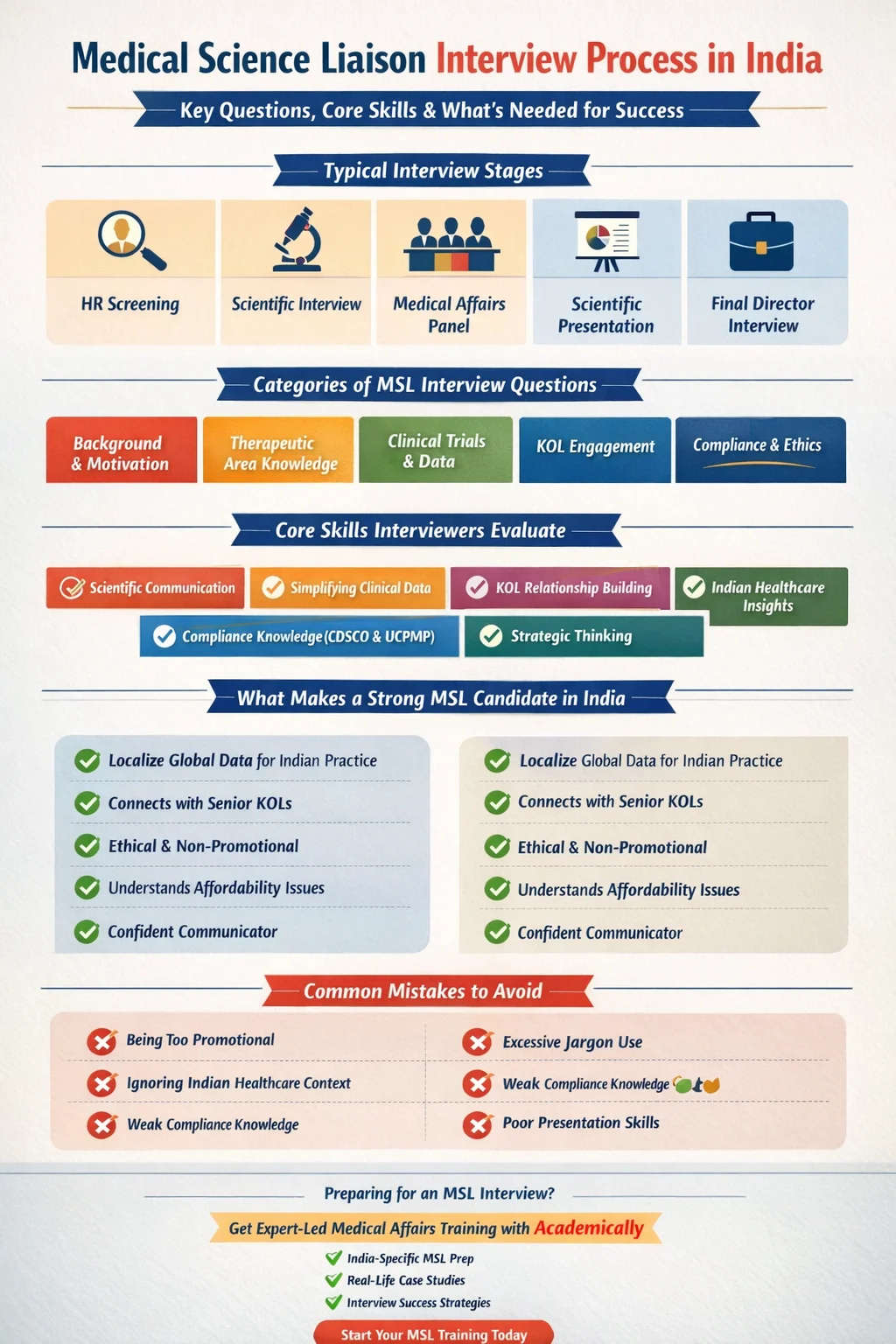
Presentation Component: What to Expect
Many MSL interviews include a scientific presentation. You’ll be asked to present complex data and handle questions from senior leaders. Prepare:
- Clear slides with key clinical insights
- Simplified scientific explanations
- Strategic implications for practice and patients
Practice with peers or mentors to refine delivery and anticipate follow-ups.
Questions You Should Ask the Interviewer
Asking questions shows strategic thinking. Good examples include:
- How do you measure success in the first 6–12 months?
- What are the top priorities for the MSL team?
- What training and support are provided for continuous learning?
These display interest in role impact and long-term fit.
How to Prepare for Your MSL Interview (Step-by-Step)
Step 1: Know the Role in Depth
Study job descriptions and industry expectations for MSLs.
Step 2: Learn the Therapeutic Area
Understand disease states, treatment guidelines, and current research.
Step 3: Practice Behavioural Stories
Use STAR methodology for real-world examples.
Step 4: Master Scientific Communication
Create and rehearse a polished scientific presentation.
Step 5: Customise Answers
Align responses with the company’s portfolio and culture.
To Conclude with…
An MSL role opens pathways to senior medical affairs leadership, clinical strategy roles, and cross-functional positions in evidence generation and health outcomes research. Ready to make a career in MSL?