"The secret of getting ahead is getting started. The secret of getting started is breaking your complex, overwhelming tasks into small, manageable tasks, and then starting on the first one."
- Mark Twain
There is a particular kind of ambition that does not arrive in a jiffy. It lives behind a pharmacy counter, inside a double shift at a family business, between school runs and mortgage repayments, waiting for a window that may never quite open wide enough, but is seized anyway.
That is the ambition that brought two women, Bushra from New Zealand and Athira from Melbourne, Australia, to the same milestone. They passed the Overseas Pharmacist Readiness Assessment (OPRA) exam in the March-April session 2026. We are so proud that they took this decisive step toward becoming registered pharmacists in Australia and New Zealand.
In a tete-a-tete with Sr. Akram Ahmad (B.Pharm, PharmD, PhD, University of Sydney, Founder & CEO, Academically Global), Bushra and Athira narrate about their experience with the OPRA exam, the demands it places on candidates, and the preparation strategies that actually work. They speak with a force that awakens the voice of overseas pharmacists. Come, let’s get informed.
Bushra's Winding Road to Clearing OPRA Exam March 2026
Bushra's journey with pharmacy registration stretches back over a decade. After completing her Bachelor's and Master's of Pharmacy in India, the latter through GPAT, she arrived in New Zealand with a clear long-term goal but a more immediate pull toward business and marketing. She pursued a Master of International Business, then added a pharmacy technician qualification to secure a viable working pathway.
The pharmacy technician route served its purpose. It gave her a foothold in the New Zealand healthcare system, a working knowledge of local pharmacy culture, and a visa pathway. But it also added years of delay to the registration she had always intended to achieve.
“We are busy with the kids, with the house, with a business running seven days a week, seven to seven. I was not getting enough time. But somehow I managed.”
- Bushra, New Zealand
Running a seven-day business while raising children, while studying for a high-stakes professional licensure exam, is not a scenario that invites complacency. Bushra enrolled in structured preparation in March the previous year, attended live classes, and worked through the syllabus when her schedule allowed. But the final push! What she calls the real preparation happened in the month before the exam window opened.
She took annual leave. She studied eight to nine hours a day. She repeated her mock tests, some of them up to ten times, until the patterns were second nature.
…and voila! She passed the exam.
Athira’s Ambition of Becoming a Pharmacist Took Her from Kerala to Melbourne
Athira's trajectory is equally layered. A pharmacist from Kerala, she arrived in Australia in 2022 on a student visa and completed a Master of Health Economics at Deakin University. It is a qualification with strong potential in outcomes research, health technology assessment, and clinical trials coordination. She is currently working as a support coordinator while exploring those research pathways.
So why sit the OPRA exam at all?
The answer is strategic. Athira observed early in her Australian career that pharmacist registration opens doors in research and academia that qualifications alone do not. Whether she eventually pursues clinical trial coordination, health economics consultancy, or a return to direct patient care, a registered pharmacist's licence significantly strengthens every one of those applications.
"When there is a will, there is a way. I came here, I got my TR, I have time. I will get my internship. It might take time but I'm happy for the process."
- Athira, Melbourne
Her first attempt at the OPRA was disrupted by family circumstances and work pressures. Rather than abandoning the goal, she reassessed her preparation strategy, re-enrolled in structured coaching, and came back with a cleaner, more focused approach: detailed personal notes, thorough review of handout materials, and consistent mock test practice.
She attempted the exam again. This time, she passed with flying colours.
What the OPRA Exam 2026 Actually Tests
Both Bushra and Athira make a point that anyone considering the OPRA exam needs to hear clearly. This is not a test of pharmacology textbooks alone. The Overseas Pharmacist Readiness Assessment, conducted by the Australian Pharmacy Council (APC), has evolved significantly with the replacement of the KAPS exam.
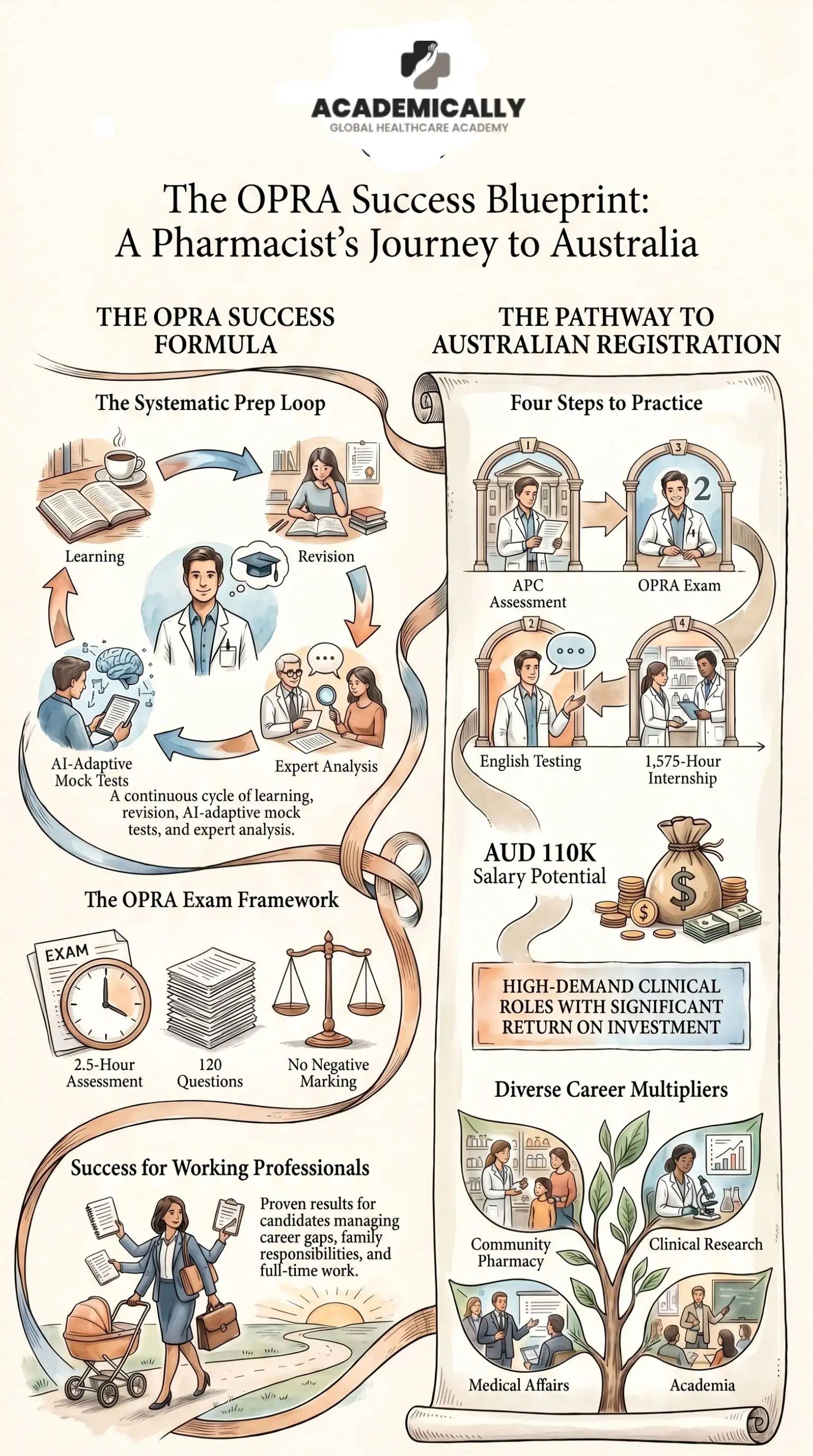
It's 120 questions, delivered in 2.5 hours via computer-based testing, now places heavy weight on clinical reasoning, case-based scenarios, and real-world patient care decision-making.
Exam Format: Computer-Based MCQ
Total Questions: 120 Questions
Duration: 2.5 Hours
Frequency: 3×/year (Mar, Jul, Nov)
Negative Marking: None
Conducting Body: Australian Pharmacy Council
Bushra found that the most demanding section of her preparation was clinical pharmacology and pharmacotherapy, precisely the areas where many internationally trained pharmacists, educated in more theory-heavy systems, feel least confident. The shift from memorising drug mechanisms to applying clinical reasoning in patient scenarios requires a different mode of thinking and a different kind of teaching.
Both candidates highlighted the value of having a medically qualified pharmacology expert, an MBBS doctor with postgraduate pharmacology training, as part of their teaching faculty. The clinical lens that such a teacher brings, they said, is genuinely irreplaceable for OPRA preparation.
AUD 110K
Maximum Annual Salary for Registered Pharmacists in Australia
3,000+
Current Openings for Registered Pharmacist Roles Nationally
120
MCQ Questions in a Single OPRA Exam Paper
1,575
Internship Hours Required After Clearing OPRA for Provisional Registration
OPRA Exam 2026 Preparation Strategies: Tried & Tested
Between their two experiences, Bushra and Athira offer a composite picture of OPRA preparation that is worth paying close attention to. These are not theoretical recommendations. They are the specific methods that two working professionals with severe time constraints used to pass one of the more demanding pharmacy registration exams in the world.
OPRA Exam 2026 Expert-Suggested Study Plan
- Attend live classes for concept building, then consolidate through recordings. Athira relied heavily on notes taken during live sessions, then revised those notes repeatedly rather than re-attending the same material from scratch.
- Repeat mock tests multiple times, not once. Bushra completed her mock tests and grand tests up to ten times. The goal is pattern recognition and speed under pressure, not novelty of content.
- Prioritise clinical pharmacology and pharmacotherapy over rote pharmacology. OPRA questions are scenario-based. Understanding drug application in patient contexts matters more than drug classification lists.
- Use concise, targeted calculation notes. Both candidates cited focused calculation revision as a high-yield, time-efficient component of final preparation.
- Increase daily study hours significantly in the final month. Bushra dedicated 8–9 hours per day in her final month, having taken annual leave from her business specifically for exam preparation.
- Seek mentorship from clinically experienced faculty. Both candidates attributed significant value to guidance from a pharmacology expert with an MBBS background particularly for clinical reasoning and motivation during difficult stretches of preparation.
Athira's approach to her second attempt was deliberately more structured than her first. Rather than trying to cover every resource available, she narrowed her focus with a thorough revision of her own notes, systematic work through handout materials, and methodical mock test practice. Less breadth, more depth.
The lesson that emerges from both stories is not merely about study hours. It is about how you use the hours you have and the willingness to take the preparation seriously enough to rearrange your life around it, even temporarily.
Start Your Journey
Browse the OPRA Preparation Course
120+ hours of live and recorded tutorials, AI-driven mock tests, one-on-one mentorship, and full faculty access, built for working professionals.
The OPRA Pathway to Registration: Step-by-Step Process
For pharmacists who are earlier in their journey, it helps to understand where the OPRA exam sits within the full registration process in Australia and what comes before and after it.
Step 1: Initial Skills Assessment: Australian Pharmacy Council (APC)
Submit academic credentials, transcripts, and home-country registration documents to the APC for eligibility determination. Accuracy and completeness here prevent delays.
Step 2: Pass the OPRA Exam
120 MCQs, 2.5 hours, computer-based. Conducted in March, July, and November. No negative marking. Available at test centres across India, Australia, New Zealand, UAE, UK, and 30+ other countries.
Step 3: English Language Proficiency
IELTS Academic (7/7/7/6.5), OET (B/B/B/C+), or PTE Academic (66/66/66/56). Results must be valid at the time of registration application.
Step 4: Provisional Registration + Paid Internship
Apply for provisional registration and complete 1,575 hours of supervised internship in Australia, approximately one year. Many internship positions include visa sponsorship.
Step 5: Intern Written and Oral Examinations
Sit after completing at least 75% of the internship. Assesses clinical decision-making, communication, and real-world pharmacy competence.
Step 6: General (or full) Registration
Apply to the Pharmacy Board of Australia for full registration. You can now practice independently across the country.
Athira is currently at step four, actively pursuing a pharmacy internship in Australia, with the advantage of a Temporary Residency visa that gives her several years of working rights. Bushra, having passed the OPRA equivalent for New Zealand's registration pathway, is on her own version of this journey toward full registration in New Zealand.
Is Registration Important for an Overseas Pharmacist?
For many internationally trained pharmacists, the case for OPRA preparation is assumed to be simple. Pass the exam, get registered, and work as a pharmacist. That pathway is entirely valid.
But Athira's experience makes clear that pharmacist registration opens opportunities well beyond community pharmacy. For candidates with additional qualifications in health economics, public health, clinical research, or pharmaceutical sciences, the registered pharmacist licence dramatically expands what is possible.
In research roles, particularly in clinical trials and health technology assessment, licensure signals clinical credibility and often meets formal requirements for research positions. For academic roles, it strengthens standing within pharmacy and health sciences faculties. For clinical research coordinator (CRC) positions, a well-trodden entry point into the research industry, it is frequently advantageous and sometimes mandatory.
The license, in other words, is not just a professional credential. It is a multiplier on every other qualification you hold.
Live Practice
Participate in India’s first AI Mock Test to Assess Your Knowledge
Experience the OPRA exam format with our AI-driven adaptive mock test that mimics the original Rasch methodology to get you acquainted with a real-time exam.
Are you a Pharmacist looking to Work in Australia?
Athira was asked directly, “What would she say to the pharmacists back in Kerala and across India, who want to build a career abroad but are holding back? Her answer was immediate. “Just come. Step out of your comfort zone. Stay focused. The blessings are with you.”
It is a deceptively simple statement from someone who knows exactly how hard it is to follow. She had family pressures. She had a first attempt that did not go as planned. She was navigating a new country, a new qualification, new visa rules, and a part-time job simultaneously. She still passed.
Bushra's message is equally unsparing. Her decade-long journey from a B.Pharm in India as a pharmacy technician in New Zealand to OPRA pass was not linear. It involved detours through business studies, delays caused by children and commercial responsibilities, and a preparation period that had to be carved out from a life with virtually no slack in it. She still passed.
What both of them demonstrate is something that transcends exam preparation advice: the willingness to stay committed to a professional identity across years of disruption. The degree does not expire. The knowledge does not disappear. The goal remains valid for as long as you choose to pursue it.
India produces over 70,000 pharmacy graduates annually. A fraction of them will ever attempt international registration. A smaller fraction will complete it. The difference between those who do and those who do not is rarely intelligence or preparation capacity. It is usually the decision, the actual, committed decision, to begin.
"When there is a will, there is a way. Don't get scared. Step out of your comfort zone. Stay focused."
-Athira, Melbourne
Role of Faculty Support in OPRA Exam Preparation
Both candidates were candid about the difference that having the right teaching support made to their preparation. Beyond the subject matter expertise, which is table stakes for any serious OPRA preparation resource, what they valued was something harder to replicate. Motivation, accountability, and clinical insight delivered by expert mentors who understand the exam from the inside.
Bushra spoke specifically about the value of pharmacology instruction delivered by a medically trained physician named Dr. Nishtha Khatri, who has an MD in pharmacology. The clinical perspective of how drugs behave in actual patients, across comorbidities and polypharmacy scenarios, is precisely what the OPRA now tests most heavily.
Academic pharmacists and clinically experienced physicians bring fundamentally different things to that teaching, and having both perspectives available matters.
Athira highlighted the importance of faculty who had already walked the OPRA or KAPS pathway themselves. AHPRA-registered pharmacists like Caitlyn, Teena and Femi could speak to the Australian pharmacy system from direct professional experience, not just from a curriculum document.
The practical takeaway for OPRA candidates is simple: the quality of your teaching support is not a secondary consideration. It is arguably the most important variable in your preparation.
Batch Starting Soon
Reserve Your Seat in the Next OPRA Batch
Four months. 120+ hours of live instruction. AI mock tests. One-on-one faculty access. A structured programme built for candidates managing demanding professional lives.
To Conclude with…
Bushra and Athira passed the OPRA exam under conditions that most people would consider reasonable grounds for postponement indefinitely. Family businesses, young children, cross-border migration, new qualifications, career pivots, visa complexity, their lives, at the time they were preparing, were not quiet.
The exam did not wait for quiet. They did not wait either.
For internationally trained pharmacists reading this from India, New Zealand, Australia, the UAE, or anywhere else, the OPRA exam is challenging, yes. It demands genuine clinical reasoning, not surface-level pharmacology recall. It requires a preparation strategy that is honest about what the exam actually tests. And it requires consistency over a period of months, particularly for candidates who cannot study full-time.
The question is not whether you are ready. The question is whether you are willing to start.