Why do some doctors land ₹2 crore roles or international contracts through LinkedIn while others struggle to get even one recruiter message? The gap is not experience. It is visibility. Most doctors treat LinkedIn as a digital CV. Recruiters do not. They use it as a search engine to find high-value candidates for leadership, specialist, and non-clinical roles.
If your profile does not match how recruiters search, you do not exist in their results. LinkedIn reports that recruiters fill a large share of roles through active sourcing, not applications. That means they search for candidates before jobs even reach job boards.
In this blog, we will discuss how to turn your LinkedIn profile into a high-conversion asset. You will learn how to rank in recruiter searches, signal business and clinical impact, and convert profile views into interviews for premium, high-paying roles.
Why LinkedIn Matters for High-Paying Medical Careers
Most doctors depend on referrals, internal networks, or job portals to find opportunities. That approach works for standard roles, but it rarely unlocks high-paying positions. Premium roles in healthcare, especially leadership, international placements, and non-clinical transitions, often never reach job boards. Executive recruiters fill them through targeted searches long before they become public.
This is where LinkedIn changes the equation.
Recruiters actively use LinkedIn to identify candidates who meet specific criteria, such as specialty, leadership experience, certifications, and measurable impact. They do not read profiles line by line. They scan for keywords, outcomes, and signals of authority within seconds.
If your profile does not align with this search behaviour, you get filtered out, regardless of your clinical experience.
A well-optimised LinkedIn profile does three critical things:
- It makes you discoverable in recruiter searches for high-value job roles
- It positions you as a specialist or leader, not just a job seeker
- It builds credibility through visible proof such as achievements, publications, and insights
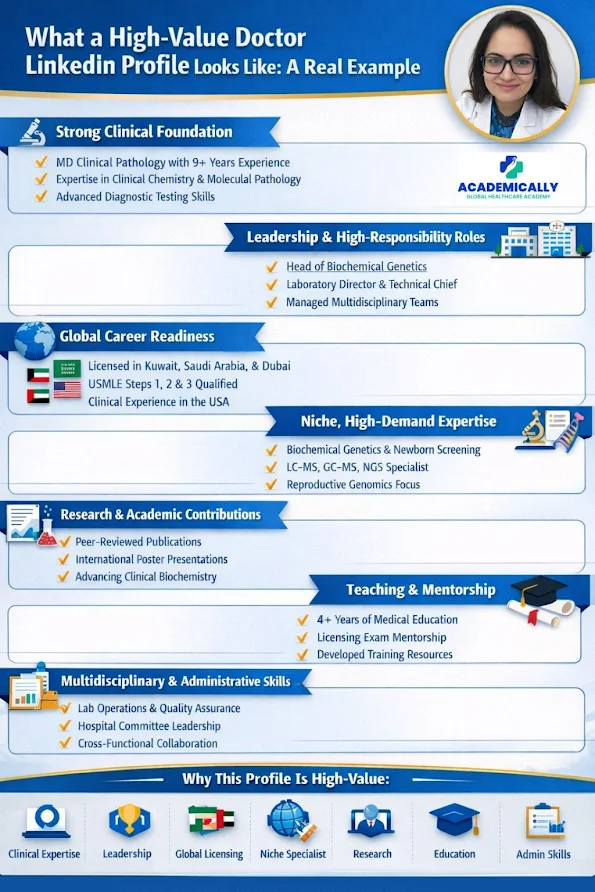
Your profile also works as your first impression. Before any conversation, recruiters evaluate your headline, summary, and recent activity to assess whether you fit senior or high-impact roles. At this level, your digital presence directly influences how they perceive your value.
Content plays an equally important role. When you share insights on clinical outcomes, healthcare systems, or emerging trends, you signal that you think beyond routine practice. This is exactly what recruiters look for in candidates suited for leadership, consulting, or global opportunities.
LinkedIn reports that fully completed profiles receive up to 21 times more views and 40 times more opportunities. This is not just about visibility. It directly impacts how often you appear in recruiter searches and how many inbound opportunities you attract.
Build a Recruiter-Optimised Foundation
1. Use a Professional Photo That Signals Authority
- Wear formal clinical or business attire
- Maintain eye contact and a neutral background
- Avoid casual or group photos
Profiles with professional photos get significantly higher engagement.
2. Write a Keyword-Rich Headline That Targets High-Pay Roles
Do not write:
“Consultant Cardiologist at XYZ Hospital”
Write:
“Interventional Cardiologist | Structural Heart Specialist | $2M+ Procedure Volume | Medical Director Aspirant”
Why this works:
- Includes specialty keywords recruiters search
- Signals revenue impact and leadership ambition
Example:
A senior cardiologist with 12+ years of experience updated his headline from
“Consultant Cardiologist at ABC Hospital”
to
“Interventional Cardiologist | 5,000+ Angioplasties | Led Cardiac Unit Expansion Increasing Revenue by 40% | Interested in Medical Director Roles”
Within a few weeks, his profile might start appearing in recruiter searches for leadership positions. He received inbound messages from a hospital group and a healthcare consulting firm, both hiring for high-paying strategic roles.
3. Craft a Summary That Sells Outcomes, Not Duties
Your first 2 lines decide whether a recruiter reads further.
Structure:
- Line 1: Specialisation + value
- Line 2: Measurable achievement
- Body: Experience, leadership, business impact, career direction
Example:
- Performed 3,000+ interventional procedures with a 98% success rate
- Led a team that improved patient throughput by 35%
- Interested in leadership roles in cardiac programmes or private healthcare systems
End with a clear CTA:
Open to leadership, consulting, and international opportunities
Turn Experience Into Revenue Language
Most doctors list responsibilities. High-paying roles reward measurable impact.
Recruiters hiring for senior, international, or non-clinical roles do not evaluate you based on tasks. They assess how your work translates into outcomes, efficiency, and business value. A generic description signals average performance. A quantified statement signals authority and scale.
Replace This:
- Managed ICU patients
- Conducted surgeries
These statements tell the recruiter what your job was. They do not answer the most important question: “How well did you perform and what value did you create?”
With This:
- Managed a 20-bed ICU with a 92% patient recovery rate and improved patient turnaround time by 15%
- Performed 1,200+ surgeries annually, maintaining a 97% success rate and contributing ₹18 crore in procedural revenue
Why This Shift Works
When you add numbers and outcomes, your profile immediately communicates:
- The scale at which you operate
- The consistency and quality of your outcomes
- Your contribution to hospital performance and revenue
- Your readiness for leadership or high-responsibility roles
What Recruiters Actually Look For
When a recruiter scans your experience, they look for four clear signals:
- Scale:
Volume of patients, procedures, or departments handled
Example: 100+ patients per day, 1,000+ surgeries per year - Efficiency:
Improvements you created in systems or outcomes
Example: Reduced ICU stay duration, improved recovery rates - Financial Contribution:
Direct or indirect revenue impact
Example: High-value procedures, department growth, cost optimisation - Leadership: Teams managed, initiatives led, or systems improved
Example: Led a team of residents, set up a new unit, and trained junior doctors
Simple Upgrade Formula
Use this structure to rewrite every bullet point: Action + Volume + Outcome + Impact
Example:
- Led a team of 8 doctors in a high-volume emergency unit, handling 200+ cases weekly and reducing patient wait time by 30%
Where to Find These Numbers
You do not need perfect data. Start with realistic estimates:
- Daily or monthly patient load
- Annual procedures performed
- Success or complication rates
- Department size or bed capacity
- Any measurable improvement you contributed to
Even approximate metrics make your profile significantly stronger than generic descriptions.
Use Keywords That Recruiters Actually Search
Recruiters do not search casually. They use precise combinations.
High-Intent Keyword Examples
Clinical + Leadership
- “Board-certified anesthesiologist leadership”
- “Consultant surgeon hospital director”
Non-Clinical High Pay
- “Medical affairs physician pharma”
- “Healthcare consultant MBBS MBA”
International Roles
- “GP Australia AMC cleared”
- “Specialist doctor, Gulf DHA HAAD”
Free Tools to Find Keywords
- LinkedIn search suggestions
- Job descriptions of high-paying roles
- Google keyword planner
Optimise Skills, Certifications, and Featured Section
Skills
- Add 20 to 30 relevant skills
- Include clinical + leadership + business skills
Examples:
- Clinical governance
- Healthcare operations
- Medical research
- Revenue optimisation
Certifications
Highlight:
Featured Section (Critical for Premium Roles)
Upload:
- Research papers
- Conference presentations
- Case studies
- Media mentions
This builds instant credibility.
Activate “Open to Work” the Smart Way
Avoid public desperation signals.
Best Practice:
- Enable “Open to Work” for recruiters only
- Target roles like:
- Medical Director
- Consultant Physician
- Pharma Medical Advisor
Use Advanced Job Filters
Search for:
- Salary range
- Location
- Experience level
Save searches for:
- “Medical Director Healthcare”
- “Consultant Physician International”
Proactive Outreach That Gets Responses
Do not wait for recruiters.
InMail Template
Subject: Open to Leadership Opportunities
Message:
- Brief intro
- Highlight one strong achievement
- State your interest
- Ask for a short discussion
Keep it under 100 words.
Example (High-Converting Message)
Subject: Actively Looking for Medical Director Roles
Message:
Hello Dr. Sharma,
I am an interventional cardiologist with 10+ years of experience, currently leading a high-volume cardiac unit performing 2,500+ procedures annually. I recently led an initiative that improved patient throughput by 30%.
I am actively looking for leadership opportunities in cardiac programs and would value your perspective on relevant roles in your network.
Would you be open to a brief 10-minute conversation?
Thank you for your time.
Why This Works
- It gets to the point quickly and respects the recruiter’s time
- It highlights a specific, credible achievement
- It clearly states the career direction
- It ends with a low-commitment ask, increasing response rates
Pro Tips for Better Response Rates
- Personalise the first line based on the recruiter’s role or organisation
- Keep the message under 80 to 100 words
- Avoid attaching your CV in the first message
- Follow up once after 5 to 7 days if there is no response
A well-crafted outreach message can open doors that applications alone rarely do. The goal is not to ask for a job, but to start a relevant, value-driven conversation.
Build Thought Leadership for High-Value Visibility
High-paying roles go to visible experts.
Content Strategy
Post 2 to 3 times per week:
- Clinical insights
- Healthcare trends
- Case learnings
- Policy opinions
High-Impact Topics
- AI in healthcare
- Hospital revenue optimisation
- Patient safety systems
- Healthcare leadership
Target High-Paying Career Paths
Your profile should align with one or more of these:
Clinical High-Income Roles
- Private practice partnerships
- High-volume surgical specialties
- International contracts
Non-Clinical High-Paying Roles
- Pharma medical affairs
- Healthcare consulting
- Hospital administration
- Health tech leadership
Executive Roles
- Medical Director
- Chief Medical Officer
- Clinical Program Head
Use LinkedIn Premium Strategically
Premium offers:
- InMail access
- Advanced filters
- Profile insights
Use it to:
- Identify decision-makers
- Track profile views
- Contact recruiters directly
Avoid Common Mistakes That Kill Opportunities
- Writing like a research paper
- Ignoring business impact
- Leaving profile incomplete
- Using unprofessional banners
- Sharing patient information
- Not engaging with content
Track Your Profile Performance
Measure progress weekly:
- Profile views
- Search appearances
- Connection growth
- Recruiter messages
15-Minute Daily Routine for Results
- 5 min: Accept and send connections
- 5 min: Engage with posts
- 5 min: Post or comment insightfully
Consistency drives visibility.
Bonus: High-Converting Headline Templates
For Specialists
“[Specialty] | [Subspecialty] | [Key Achievement] | Open to Leadership Roles”
For Non-Clinical Roles
“Physician | Healthcare Consultant | Driving Clinical Strategy & Revenue Growth”
For International Aspirants
“MBBS | AMC/PLAB/USMLE Qualified| Open to Global Opportunities in [Country]”
4-Week Action Plan to Start Getting Recruiter Attention
Optimising your LinkedIn profile is not a one-time task. It works best when you take structured, consistent action. This 4-week plan helps you move from zero visibility to active recruiter engagement.
Week 1: Build a Strong First Impression
Focus on the elements recruiters see first and decide within seconds.
- Rewrite your headline using specialty, achievements, and career direction
- Craft a summary that highlights your clinical impact, leadership, and goals
- Upload a professional photo and create a clean, credible banner
- Add 20 to 30 relevant skills aligned with your target roles
Outcome: Your profile becomes searchable and starts appearing in relevant recruiter queries.
Week 2: Turn Your Experience Into a High-Impact Story
This is where most doctors lose opportunities. Fix that.
- Rewrite all experience points using metrics, outcomes, and scale
- Add numbers such as patient load, procedures, success rates, or revenue contribution
- Highlight leadership roles, team management, or system improvements
- Upload supporting proof in the featured section, such as publications or presentations
Outcome: Your profile shifts from a job description to a value-driven portfolio that signals seniority.
Week 3: Build Visibility Through Content and Engagement
An optimised profile without activity stays invisible.
- Post 2 to 3 times per week on clinical insights, healthcare trends, or learnings
- Engage with posts from doctors, recruiters, and healthcare leaders
- Send 5 to 10 personalised connection requests daily to relevant professionals
- Join and participate in healthcare and medical groups
Outcome: Your profile activity increases visibility, improves search ranking, and builds credibility.
Week 4: Convert Visibility Into Opportunities
Now that your profile attracts attention, take control of the outcome.
- Enable “Open to Work” for recruiters with targeted roles
- Apply selectively to high-value roles using tailored applications
- Send personalised messages to recruiters and hiring managers
- Follow up strategically and track responses
Outcome: You start receiving recruiter replies, interview calls, and inbound opportunities.
What You Can Expect After 30 Days
If executed consistently:
- Higher profile views and search appearances
- Increased connection requests from relevant professionals
- Initial recruiter outreach or responses to your messages
- Better alignment with high-paying and leadership roles
Most doctors update their LinkedIn profile once and expect results. High-value outcomes come from optimisation plus consistent visibility and outreach.
If you follow this plan with intent, your profile will not just exist on LinkedIn. It will actively work to bring the right opportunities to you.
To Conclude with…
Your LinkedIn profile is not a static CV. It is a dynamic asset that can either limit your visibility or unlock access to high-paying opportunities.
Most doctors remain stuck in average roles not because of a lack of skill, but because they fail to position that skill in a way the market understands. Recruiters do not evaluate effort. They evaluate visibility, relevance, and impact.
When you optimise your profile with the right keywords, measurable achievements, and clear career direction, things start to change. You appear in searches for premium roles instead of competing on job portals. Recruiters begin to approach you instead of the other way around. Your perceived value increases, which directly influences the quality of offers you receive. This is how doctors move from routine clinical roles to leadership positions, international placements, and high-paying non-clinical careers.
The shift is not complex, but it requires intent and consistency. A few strategic changes in how you present your experience can completely change how the market responds to you.
If you treat LinkedIn as an active career tool rather than a passive profile, it becomes one of the most powerful platforms to accelerate your growth and income.
The opportunity already exists. The difference lies in whether your profile is built to capture it.