What if your MBBS degree could earn you the prestige of an Indian Armed Forces officer? Imagine that offer letter that emblems a senior entry rank equivalent to Squadron Leader or Major. A career at the cutting edge of aviation, human physiology, and space science is beyond rewarding. In a country where thousands of doctors compete for conventional postgraduate branches every year, only a few candidates get the opportunity to enter the highly exclusive world of Aerospace Medicine. The competition is real. This rare MD specialisation features medicine, defence, research, and advanced aerospace science. It offers not just a respected uniformed career, but the chance to contribute directly to national defence, pilot safety, and the future of human flight. Here’s everything MBBS graduates need to know about becoming an Aerospace and Aeronautic Doctor in India.
What is Aerospace Medicine?
Aerospace Medicine is a specialised branch of medicine that studies and manages the physiological and psychological challenges that arise from flight and space environments. It sits at the intersection of clinical medicine, applied physiology, atmospheric physics, and engineering science, making it one of the most technically demanding postgraduate specialities available to MBBS doctors in India.
Practitioners in this field assess how altitude, pressure, acceleration, hypoxia, spatial disorientation, and other aeronautical factors affect the human body, with a particular focus on the health and performance of aircrews, ground personnel, and, increasingly, astronauts and space travellers.
Did you know... Aerospace Medicine is an extended branch of both Occupational Medicine and Applied Physiology. Doctors in this field are less focused on tertiary clinical care and more oriented toward research, preventive health, and physiological assessment in aviation and defence environments.
The MD Aerospace Medicine Programme in India
In India, the only institution offering the MD Aerospace Medicine degree is the Institute of Aerospace Medicine (IAM), Indian Air Force, based in Bengaluru. The programme is fully recognised by the Medical Council of India (MCI) and state government regulatory bodies.
| Programme Detail | Information |
| Duration | 3 years (full-time) |
| Recognition | National Medical Commission (NMC) and State Government |
| Offering Institution | Institute of Aerospace Medicine, Indian Air Force, Bengaluru |
| Total Seats | 10 (7 reserved for Armed Forces; 3 for civilian candidates) |
| Eligibility | MBBS degree + qualifying NEET-PG rank |
| Entry Rank (IAF) | Squadron Leader (Air Force) / Major (Army) |
| Service Bond | 3 years compulsory service post-qualification |
| Transfer Cycle | Every 3 years per defence service norms |
Eligibility and Admission Process
The admission criteria for MD Aerospace Medicine mirror those of other postgraduate medical courses in India. Candidates must:
MBBS Degree
From a recognised medical college in India or abroad, as accepted by National Medical Commission (NMC).
NEET-PG Rank
A competitive qualifying rank in the National Eligibility cum Entrance Test Postgraduate (NEET-PG)
Defence Commission
Upon selection, civilian candidates are commissioned as officers in the Indian Air Force.
Service Bond
A mandatory 3-year compulsory service commitment with a financial penalty for breach.
With only 3 civilian seats available nationally, competition is intense. Strong NEET-PG performance and a clear orientation toward research and analytical work are essential.
Confused about eligibility, NEET-PG strategy, or whether Aerospace Medicine is the right fit after MBBS? Get personalised guidance on postgraduate pathways, competitive exam preparation, and career planning for defence and non-clinical medical specialisations.
Programme Structure: What You Will Study
The three-year MD programme is divided into a foundational classroom phase followed by practical departmental rotations.
Classroom and Theoretical Foundation
The first year is dedicated entirely to classroom teaching. Students study atmospheric physics, environmental science, basic engineering principles relevant to aerospace systems, and the physiological bases of flight medicine. This year is unlike any other postgraduate medical curriculum in India.
Clinical Rotations Begin
In the second year, students are attached to departments on a rotation basis, applying their foundational knowledge in practical settings alongside active duty military medical units.
Advanced Rotations and Research
The final year deepens departmental exposure and research work. Students continue serving as commissioned officers throughout, with their clinical postings integrated into the broader defence medical system.
Career Path and Salary
Upon completing the MD programme, graduates are commissioned into the Indian Armed Forces at a senior officer rank. The entry rank is equivalent to Squadron Leader in the Indian Air Force or Major in the Indian Army, both corresponding to substantial salary packages under current defence pay scales.
An important benefit is ante-grade seniority. Graduates enter the service at a higher grade than peers who joined without a postgraduate specialisation, giving them a head start in rank progression and career advancement.
Did you know... During the programme itself, students receive a stipend aligned with state government norms. Full defence salary begins upon programme completion and commissioning.
Looking for alternative medical careers beyond traditional hospital practice? Explore high-growth opportunities in aviation medicine, research, healthcare administration, medical education, and global healthcare careers for doctors.
Skills and Attributes for Success
Aerospace Medicine is not a conventional clinical specialty. According to experts in the field, the doctors who thrive here tend to have a distinct professional profile:
Analytical Mindset
Less bedside medicine, more data analysis, physiological modelling, and evidence synthesis
Technology Openness
Comfort working with advanced engineering systems and a willingness to adopt new scientific tools.
Research Orientation
Strong interest in occupational medicine and applied physiology as research domains.
Adaptability
Readiness for transfers every three years to postings across India.
Life in the Armed Forces as an Aerospace Doctor
Selected candidates become defence officers from the moment they join the programme. This means they are subject to all applicable defence service rules. It includes the transfer policy that moves officers to a new posting approximately every three years.
Military stations are typically self-contained communities with populations exceeding 2,000 personnel, offering modern amenities, residential facilities, clubs, and a strong social infrastructure. The lifestyle is comfortable but mobile, and prospective candidates should be genuinely prepared for regular relocation.
Outpatient clinical duties at Air Force units form part of the role, though these are typically at the primary care level. The work is referral-based rather than tertiary super-speciality.
Can Overseas Doctors Join the MD Programme?
Foreign Air Force candidates have previously participated in the programme, but admission is governed by a complex multi-ministry approval process. Clearances from the Ministry of Foreign Affairs, Ministry of Defence, and the Ministry of Education are required. Eligible foreign candidates receive an Advanced Course Certificate rather than the MD degree awarded to domestic participants.
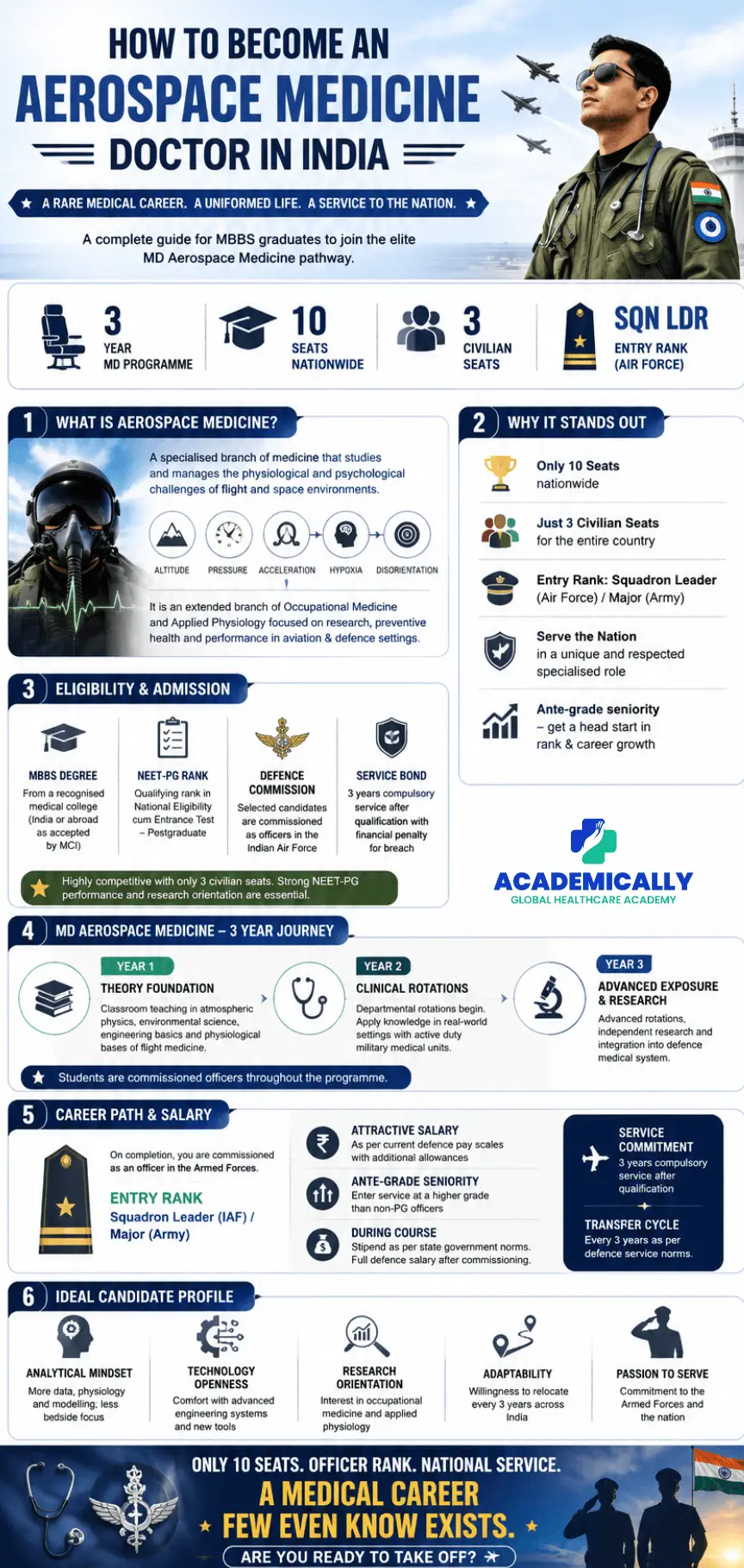
Here’s the complete Aerospace Medicine career pathway in one glance.
To Conclude with...
Aerospace Medicine is not just another postgraduate option for MBBS graduates. It is a rare and respected pathway that combines medicine, defence service, research, and national contribution. With limited seats, a specialised curriculum, and the opportunity to serve as a commissioned officer, it offers a career that is both intellectually demanding and professionally rewarding.
Doctors who are curious about aviation, physiology, and life beyond conventional clinical practice, this branch opens a truly unique horizon. If the idea of serving the nation while working at the frontier of human flight appeals to you, Aerospace Medicine may be the right destination.