The US path has three separate gatekeepers before you can even apply for a visa , here's how they fit together.
For an internationally educated physiotherapist, the United States offers tremendous career growth, clinical autonomy, and some of the highest compensation packages in the global healthcare market. However, the biggest hurdle isn't clinical skill, it's navigating the fragmented American regulatory system. Many international applicants lose months (and thousands of dollars) because they confuse academic credentialing with immigration screening, or assume passing the national board exam automatically grants them the right to work anywhere in the country.
When pursuing a physical therapist license USA international candidates must treat the process like a sequential blueprint. Here is the exact breakdown of how credential evaluation, board exams, state licensing, and visa screening connect.
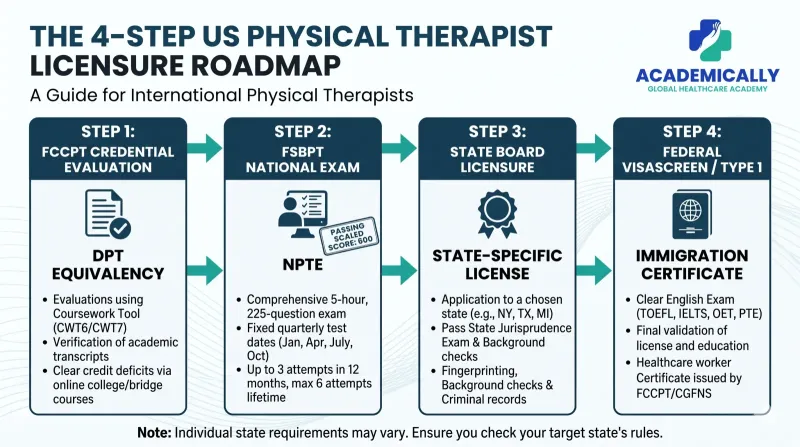
Step 1: FCCPT Credential Evaluation
Before you are allowed to sit for the US board exam, you must prove that your foreign physiotherapy education is "substantially equivalent" to a first professional degree in physical therapy in the United States which is the Doctor of Physical Therapy (DPT).
For the vast majority of US states, the primary gatekeeper for this step is the Foreign Credentialing Commission on Physical Therapy (FCCPT) (though select states also accept evaluations from CGFNS or IERF for licensing purposes).
What the FCCPT Checks
When you submit an application for an FCCPT credential evaluation (specifically the Educational Credentials Review, or ECR), evaluators do not just look at your diploma. Once your primary-source documents arrive from your university, it takes 5 to 7 business days to authenticate them into your portal, followed by an average processing queue of 23 to 25 weeks.
Evaluators audit your official university syllabi and transcripts line-by-line using the FSBPT Coursework Tool (CWT). Throughout 2026, evaluations use CWT 6 (with CWT 7 scheduled to take effect on January 1, 2027).
To be deemed substantially equivalent, your education must meet strict minimums across three buckets:
- Minimum Total Academic Credits: Usually a minimum of 150 semester credits (the benchmark for a post-baccalaureate/entry-level doctoral degree).
- General Education Credits: Courses in humanities, physical sciences, biological sciences, social sciences, and mathematics. (Note: Because many international 4-year BPT programs dive straight into clinical sciences, international grads frequently face deficits in US general education credits like English composition, history, or sociology).
- Professional Education & Clinical Internships: Specific didactic coursework in patient evaluation, differential diagnosis, pharmacology, cardiovascular/pulmonary systems, musculoskeletal management, and supervised clinical practice hours.
Why It's Required (and How to Handle Deficits Safely)
US state boards rely on the FCCPT to protect public safety by ensuring every practitioner regardless of where they trained holds the same baseline diagnostic and clinical competencies.
If the FCCPT finds deficits in your transcript, don't panic and don't guess which courses to take. You can clear General Education deficits through accredited online US college courses or CLEP (College-Level Examination Program) exams, and clear Professional Education deficits by taking post-professional university bridge courses. To avoid wasting tuition on courses that might be rejected during re-evaluation, international grads can use FCCPT's PLAN (Professional Learning Needs) service, which provides an advisor who pre-approves your exact deficiency coursework and includes one re-evaluation (which typically takes ~14 weeks).
Step 2: The National Physical Therapy Examination (NPTE)
Once your state board approves your credential evaluation and grants an Authorization to Test (ATT), you move to the second gatekeeper: the NPTE exam.
Administering Body
The NPTE is developed and administered by the Federation of State Boards of Physical Therapy (FSBPT) and delivered at Prometric testing centers. The exam is offered four times a year on fixed quarterly dates (January, April, July, and October).
Format of the Exam
The NPTE is a comprehensive, computer-based examination designed to test entry-level clinical competence and patient safety.
- Duration: 5 hours (divided into 5 sections, with an optional scheduled break after Section 2).
- Structure: 225 multiple-choice questions in total (180 scored items and 45 unscored pre-test items used by FSBPT for future exam development).
- Question Types: Standard standalone multiple-choice questions, scenario-based patient case sets (3–5 questions tied to a single clinical vignette), and short video-based clinical items.
- Core Content Areas: The exam heavily weights the Musculoskeletal, Neuromuscular/Nervous, and Cardiovascular/Pulmonary systems, alongside Other Systems (Integumentary, Metabolic/Endocrine, GI/GU), Equipment/Devices, Therapeutic Modalities, Safety/Protection, and Research/Evidence-Based Practice.
Scoring Explained
The NPTE uses a criterion-referenced scaled score ranging from 200 to 800.
- Passing Score:600 (this minimum passing threshold is uniform across every single US state and territory).
- Because the exam is scaled to account for slight variations in difficulty across different test forms, there is no fixed percentage of raw questions you need to get right, though passing typically requires answering roughly 65% to 75% of the 180 scored questions correctly.
- Retake Limits: The FSBPT enforces strict lifetime limits—candidates are permitted a maximum of 3 attempts in a 12-month period and a lifetime limit of 6 attempts. Thorough preparation before your first sitting is non-negotiable.
Step 3: State-by-State Licensure
One of the biggest misconceptions among international physical therapists is that passing the NPTE makes you a "US-licensed Physical Therapist." There is no single national physical therapy license in the United States.
Under the US Constitution, healthcare regulation is reserved for individual states. Every state (plus Washington, D.C., and US territories) has its own State Physical Therapy Board and its own Practice Act.
How State Licensure Works
To obtain your initial physical therapist license USA international applicants must apply for Licensure by Examination in a specific state. You will select a target state before you even take the NPTE, because that state board is the entity that reviews your FCCPT report and authorizes you to sit for the exam.
Beyond your FCCPT equivalency and passing NPTE score, individual states require a mix of the following:
- State Jurisprudence Exam: Most states (like California, Texas, Florida, and New York) require you to pass a separate exam testing your knowledge of that specific state's laws, ethics, and scope-of-practice rules.
- Criminal Background Checks & Fingerprinting: Usually completed via FBI fingerprint cards or LiveScan.
- Social Security Number (SSN) Rules: Most states require a US Social Security Number before issuing a permanent license. Because you cannot get an SSN until you arrive in the US on a work visa, international candidates strategically apply first to "SSN-waiver" or "SSN-affidavit" states.
Top 3 Initial States for International PTs Compared
| State | Credentialing Agency Accepted | SSN Required to Issue License? | Why International PTs Choose It |
| New York | NYSED (Direct) or FCCPT / CGFNS | No (SSN Waiver Form available) | Most flexible credit evaluation; lowest barrier to getting an ATT and full license from abroad. |
| Michigan | FCCPT or CGFNS | No (Affidavit accepted) | Streamlined online application; strong Midwest hospital networks for H-1B sponsors. |
| Texas | FCCPT or CGFNS | Yes (for final license, but issues ATT without SSN) | Massive PT job market; member of the PT Compact, making future multi-state practice easy. |
Once you are licensed in one state and working in the US, transferring your license to another state is done via Licensure by Endorsement meaning you transfer your passing NPTE score without ever retaking the national board exam. Additionally, over 35 states participate in the PT Compact, allowing eligible licensed PTs in a compact home state to purchase instant multi-state practice privileges.
Visa Screening (CGFNS) & English Requirements
Most licensure guides stop at state board approval, skipping the federal immigration hurdle that delays thousands of international physical therapists.
Under Section 343 of the US Illegal Immigration Reform and Immigrant Responsibility Act (IIRIRA), any foreign healthcare worker seeking an occupational visa (such as an H-1B or an EB-2/EB-3 Green Card) must obtain a federal Healthcare Worker Certificate—commonly called a VisaScreen (via CGFNS International) or a Type 1 Certificate (via FCCPT).
Licensure Evaluation vs. Visa Screening
- State Credential Evaluation (ECR): Only checks whether your university coursework meets a specific US state's requirements to sit for the NPTE.
- FCCPT Type 1 / CGFNS VisaScreen Certificate: A federal immigration requirement that verifies your education meets full entry-level US DPT standards, validates that all of your past domestic and foreign licenses are unencumbered, and confirms your English language proficiency.
English Proficiency Requirements
Unless you graduated from an entry-level physical therapy program in an exempt country (United States, United Kingdom, Australia, Canada [except Quebec], New Zealand, or Ireland), you must pass a federally approved English proficiency exam.
Following recent federal updates, both FCCPT and CGFNS accept multiple English exams for Type 1 / VisaScreen immigration certification, with the following FCCPT minimum passing standards:
- TOEFL iBT (Updated 2026 Scale): For exams taken on or after January 21, 2026, under ETS's 1–6 scale: Overall 4.5 (Reading: 3.5, Listening: 3.5, Writing: 3.5, Speaking: 4.5). For valid scores taken prior to Jan 21, 2026: Total 89 (Reading: 22, Listening: 21, Writing: 22, Speaking: 24). FCCPT also accepts the TOEFL Home Edition and MyBest Scores for Type 1 reviews.
- IELTS Academic:Overall 6.5 (with a minimum Speaking score of 7.0).
- OET (Occupational English Test):Reading: 340, Listening: 320, Writing: 350, Speaking: 360.
- PTE Academic (Pearson):Overall 55 (Reading: 62, Listening: 62, Writing: 62, Speaking: 76).
- Michigan English Test (MET) & Cambridge Assessment English (B2 First, C1 Advanced, or C2 Proficiency): Also accepted at designated federal thresholds.
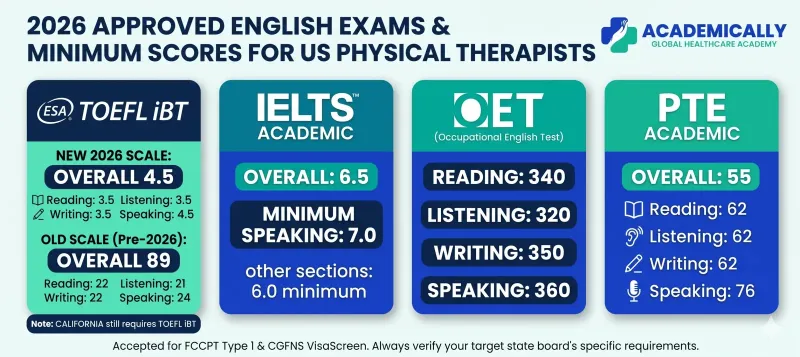
Crucial Caveat on TOEFL iBT: While you have flexible exam choices for your federal immigration certificate, certain individual state licensing boards (such as California) still strictly require the TOEFL iBT achieved in a single test sitting for state licensure. Always cross-check your target state board's rules before choosing which English test to take!
Don't let English test retakes delay your FCCPT Type 1 Certificate or state licensure. Join Academically’s expert-led English Preparation Program for targeted strategies, mock tests, and module-by-module coaching tailored for international physical therapists.
Realistic Timeline From Degree to First US Job
Many recruiting agencies promise a 6-month fast track to the USA. In reality, university paperwork bottlenecks, FCCPT queue times, quarterly board exam windows, and US visa processing mean you should plan for an honest 18- to 30-month timeline from start to finish:
| Phase | Milestone | Estimated Time | What Happens During This Window |
| Phase 1 | Document Collection & FCCPT Review | 6 to 8 Months | Requesting sealed university syllabi/transcripts, 5–7 business days for portal authentication, and waiting in the FCCPT evaluation queue (~23–25 weeks once all docs arrive). |
| Phase 2 | Clearing Credit Deficiencies | 3 to 9 Months | Skip if you hold a US-equivalent DPT. Using FCCPT's PLAN service and enrolling in online college courses, CLEP exams, or bridge modules to clear missing credits, followed by a ~14-week re-evaluation. |
| Phase 3 | State Application, ATT & NPTE Prep | 3 to 6 Months | Submitting evaluation to your target State Board, receiving your Authorization to Test (ATT), studying for and sitting in a quarterly NPTE window, plus taking the State Jurisprudence Exam. |
| Phase 4 | English Exam & Type 1 / VisaScreen | 2 to 4 Months | (Can be done concurrently with Phases 2–3). Achieving required English test scores (TOEFL/IELTS/OET/PTE) and receiving your final FCCPT Type 1 or CGFNS VisaScreen Certificate. |
| Phase 5 | Job Offer, Visa Sponsorship & Relocation | 4 to 12+ Months | Interviewing with US employers, filing for an H-1B visa (fast-tracked if hired by a cap-exempt hospital/university; lottery-dependent for private clinics) or EB-2/EB-3 Green Card sponsorship, embassy stamping, and relocation. |
To Conclude
Earning your physical therapist license in the USA as an international graduate requires patience, strategic planning, and a clear understanding of how the gatekeepers fit together. By approaching the FCCPT credential evaluation, the NPTE exam, state board requirements, and federal VisaScreen certification as an interconnected checklist rather than isolated hurdles, you can avoid costly delays and credit missteps.
Start gathering your university transcripts early, pick an international-friendly initial licensing state, and take each milestone one step at a time, your rewarding new clinical career in the United States is well worth the journey.
Getting your FCCPT evaluation, passing the NPTE, and securing your state license takes serious dedication ,finding the right US healthcare employer to sponsor your visa shouldn't be another headache.
At Jobslly, we connect internationally trained physical therapists directly with verified US hospitals, outpatient clinics, and rehabilitation networks that actively offerH-1B and Schedule A Green Card sponsorship.
Whether you are just starting your credential evaluation or already hold your NPTE pass and Type 1 Certificate, our platform matches your clinical profile with high-paying roles tailored to your licensing state.