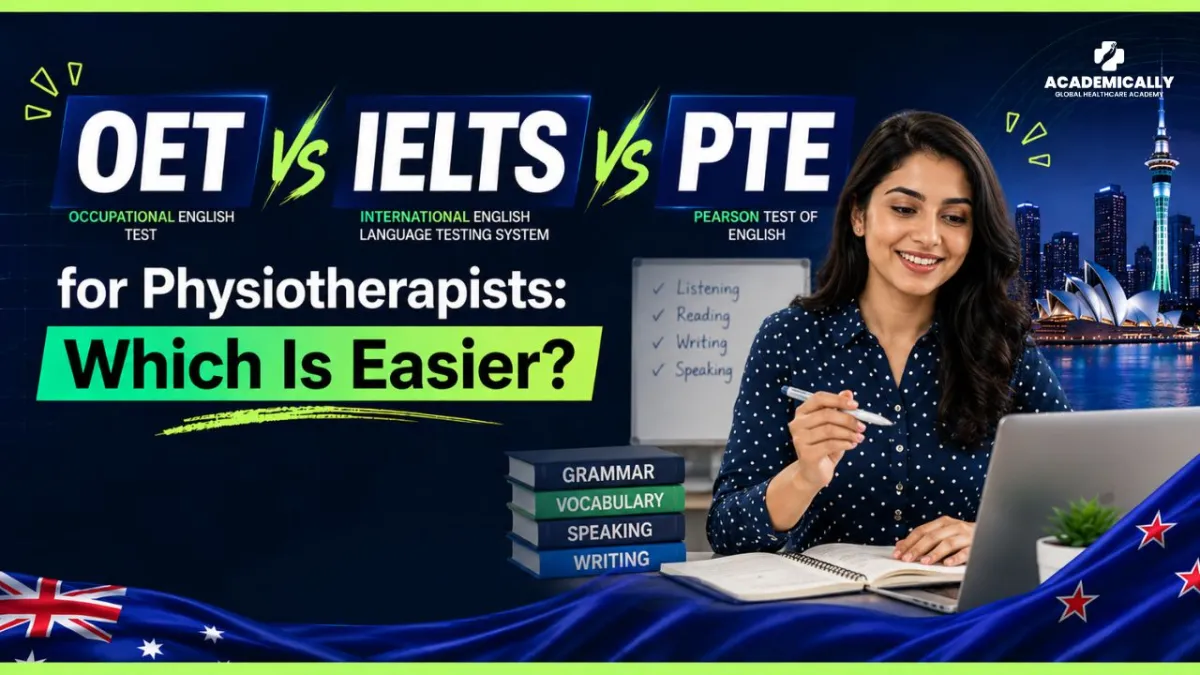
Did you know... more than 1 in 3 internationally qualified health practitioners fail AHPRA's English proficiency requirements? Yes, you heard it right. They do so not because their clinical English is weak. But because they chose the wrong test for their skill set. According to AHPRA's own registration data, physiotherapy is consistently among the top 5 professions where English re-assessment is required, with a significant share of applicants sitting the wrong exam the first time.
Are you an internationally qualified physiotherapist preparing to register with AHPRA? Are you counting Australian Permanent Residency (PR) points? Then, the English proficiency test you choose matters enormously.
OET, IELTS, and PTE Academic all meet the bar. But they are very different exams designed for very different types of test-takers. In this blog, you will get a very detailed idea about OET vs IELTS or any other exam to choose to appear into. Always remember, the exam you choose must match how you already think, communicate, and practise physiotherapy.
AHPRA English Score Cut-Offs for Physiotherapists
AHPRA requires physiotherapy applicants to meet all sub-test minimums in a single sitting. A strong reading score cannot compensate for a borderline speaking result.
Scores are valid for three years from the date of the test. You must achieve all required scores in a single sitting. Mixed results from different attempts are not accepted.
OET vs IELTS vs PTE: Full Comparison
| Factor | OET | IELTS Academic | PTE Academic |
| Test Format | 4 sub-tests; health-specific content throughout | 4 sub-tests; general/academic English content | Computer-based; AI-scored; 3 sections |
| Total Duration | ~3 hours | ~2 hrs 45 min (computer) / ~2 hrs 55 min (paper) | ~2 hrs (+ optional 10-min break) |
| Approx. Cost (AUD) | ~AUD 590–640 | ~AUD 385–430 | ~AUD 390–430 |
| Test Frequency | Monthly in major cities; 14 dates/yr approx. | Weekly (computer); ~48 dates/yr | On demand; almost daily in major centres |
| Results Turnaround | 16 business days | 3–5 days (computer-delivered) | 24–48 hours (Fastest) |
| Score Validity | 3 years | 3 years | 3 years |
| Writing Task (Physio) | Referral / discharge letter (clinical scenario) | Graph/chart description + argumentative essay | Integrated tasks; summarise written text + essay |
| Speaking Task | Role-play with trained interlocutor (patient scenario) | 3-part interview with examiner | Read aloud, describe image, retell lecture (computer mic) |
| AHPRA Accepted? | Yes | Yes | Yes |
Why OET is Easier for Working Physiotherapists
The Occupational English Test was designed for healthcare professionals, specifically. If you see closely, IELTS asks you to describe a bar chart or argue a point about urban planning. On the other hand, OET places you inside a musculoskeletal outpatient clinic, a post-surgical ward, or a community rehabilitation setting. As simple as that.
This is exactly why OET is easier for working physiotherapists.
The Writing sub-test asks you to write a referral or discharge letter using case notes provided in the question. You may have to write patient letters as part of your daily practice, referring to orthopaedics, updating a GP on a patient's progress, or discharging a patient to community care. With OET and relevant skills and practice, you already have the genre knowledge that most IELTS candidates spend weeks acquiring from scratch.
The Listening sub-test plays audio from healthcare consultations. Ward handovers, patient histories, team briefings. The vocabulary is exactly what you hear on shift. The Speaking sub-test is a structured role-play where you counsel a patient on a physiotherapy-relevant scenario. You explain a home exercise programme, a diagnosis, or patient's expectations post-surgery.
IELTS, in contrast, expects you to produce a coherent 250-word academic essay, a genre that most clinicians have not written since university. OET removes that cognitive load and lets your existing clinical knowledge work for you, not against you.
Why PTE is Seamless for Physiotherapists
Is your AHPRA application windows tight? Is your Visa contingent on a registration outcome within weeks? PTE Academic has a structural advantage that OET and IELTS simply cannot match. You can actually get results within 24 to 48 hours.
OET results take 16 business days (roughly three weeks). Even IELTS computer-delivered results, which arrive in 3-5 days, are slower than PTE's near-instant turnaround. PTE is also the most flexible in scheduling. Test slots are available almost daily at major Pearson centres across Australia and India.
PTE is entirely computer-scored and AI-evaluated. There is no examiner interaction, no role-play and no human listener for your speaking responses. For physiotherapists who are confident in their general English but less comfortable with clinical writing conventions, PTE's standardised, machine-graded format can actually reduce variability. You score on what you say, not how a human examiner interprets your accent.
PTE also tends to reward test-takers who prepare systematically for its specific question types, which are highly repeatable. Two to three weeks of targeted PTE preparation, focusing on its unique integrated tasks can yield strong results for candidates with a perfect foundation.
Which English Proficiency Test Gives the Best Australia PR Points?
Under Australia's General Skilled Migration points test, English proficiency can contribute up to 20 points to your Expression of Interest score. The points are awarded by proficiency level, not by test choice. It means OET, IELTS, and PTE are all pathways to the same points ceiling.
| Proficiency Level | OET | IELTS | PTE | PR Points |
| Competent | B in each | 6.0 in each | 50 in each | 0 |
| Proficient | B in each | 7.0 in each | 66 in each | 10 |
| Superior | A in each (OET 2.0+) or A in all | 8.0 in each | 79 in each | 20 |
Notice that simply meeting AHPRA's minimum (OET B/IELTS 7.0 /PTE 66) already earns you 10 PR points. Scoring at the Superior level earns 20 points which is a significant boost in a competitive skilled migration pool.
If your primary goal is more PR points, the question should not be, which test to take. But how achievable the Superior threshold is for you in each test.
For most physiotherapists who are strong clinical communicators, pushing from OET B to OET A is often more intuitive than pushing from IELTS Band 7.0 to IELTS Band 8.0 across academic writing tasks.
However, this depends heavily on individual strengths. A structured mock test in all three formats is the most reliable way to assess your baseline before committing.
According to the Department of Home Affairs points calculator, English proficiency points are among the most reliably achievable in the skilled migration system. This makes the test choice a genuine strategic decision, not an afterthought.
English Proficiency Test Preparation Timeline: 2 Weeks to 3 Months
How long you need to prepare depends almost entirely on your current English proficiency and how familiar you are with the test's format, not on which test you choose. Here is a guide for physiotherapists at different starting points:
Fast Track : 2 Week Strategy: Strong English base, formal preparation needed for format only
You write clinical letters confidently. You can also speak in English at work daily. You are aware of significant grammar gaps. You need to learn the test structure, practise OET letter conventions or PTE question types. Do 3–4 timed full practice tests. PTE is fastest to learn at this stage. OET requires you to master the letter-writing rubric but the content is intuitive. Best suited to: physios already working in English-medium environments.
Standard Track: 4–6 Weeks: Fluent Clinical English, gaps in writing or speaking
Most internationally qualified physios fall here. You understand clinical English receptively but your writing is informal. Your speaking lacks the structured AHPRA-level energy. Six focused weeks covers vocabulary, task-specific strategies. 5 full mock tests with feedback is sufficient to reach the required band.
3 Months: Significant English gaps or first attempt not successful
If you have grammar inconsistencies, a limited clinical vocabulary in English, or if a previous attempt ended just below the cut-off, a structured 10–12 week programme gives you time to address root causes rather than practise around weaknesses. A diagnostic mock test at week one and regular tracked mock tests throughout are essential to measure genuine progress, not just familiarity with sample questions.
Not Sure Which Test Suits You?
Academically's OET, IELTS, and PTE preparation courses are built specifically for internationally qualified health professionals. It is not for English students from school. It is professionally curated by experts who have gone down the same pathway. Structured study plans, clinical writing feedback, and full mock tests included. Expert mentors with 10+ years of experience and community support on Discord!
Common Physio-Specific Writing Prompts
If you are preparing for OET, the writing sub-test is where physiotherapists consistently gain or lose the most marks. Understanding the prompt types that appear most frequently for physiotherapy candidates gives you a meaningful head start. Here are real-world scenarios that frequently form the basis of OET Writing tasks:
Referral to Orthopaedic Surgeon:
Using case notes provided, write a referral letter on behalf of a GP to an orthopaedic surgeon for a patient presenting with chronic knee pain, reduced range of motion, and failure to respond to conservative physiotherapy management over 8 weeks.
Discharge to Community Care:
A 68-year-old patient recovering from a total hip replacement is ready for discharge. Write a discharge letter to their community physiotherapist summarising the inpatient rehabilitation programme, current functional status, home exercise plan, and follow-up requirements.
GP Update Letter:
Using provided case notes, write a letter to a patient's GP updating them on progress following a six-week physiotherapy intervention for low back pain, noting ongoing limitations and recommending further investigation.
Allied Health Referral:
Following assessment of a patient with chronic shoulder impingement, write a referral to an occupational therapist for a workplace assessment and ergonomic review, based on the clinical findings in the case notes.
For OET preparation, practise writing these letters within 45 minutes, following AHPRA-accepted clinical letter conventions. Appropriate salutation, clear purpose statement, relevant clinical summary, recommendations, and professional close. Avoid reproducing case notes verbatim, OET Writing assesses how effectively you select, synthesise, and present clinical information for a specific reader and purpose.
Free Practice Questions for English Proficiency Test
Many sample papers on the internet reflect outdated structures. We'll give you an idea about the kind of questions and their responses apt for you. Have a look here:
IELTS Academic (2026): 3 Sample Questions with Answers
The IELTS Academic format in 2026 continues to include Listening, Reading, Writing, and Speaking sections with computer-based and paper-based options still available in many regions.
1. IELTS Writing Task 2 Sample
Question
Some people believe that online learning is more effective than classroom learning, while others disagree. Discuss both views and give your opinion.
Sample Answer
Online learning has become increasingly popular over the last decade, especially after institutions began integrating digital education platforms into mainstream learning. While some people believe virtual education is more effective than traditional classrooms, others argue that face-to-face learning remains superior.
On the one hand, online learning offers flexibility and accessibility. Students can attend classes from any location, save commuting time, and learn at their own pace. Recorded lectures and digital resources also allow learners to revise concepts repeatedly, which can improve understanding. For working professionals and international students, online education has created opportunities that were previously difficult to access.
On the other hand, classroom learning encourages better interaction and discipline. Physical classrooms allow direct communication with teachers and peers, creating a more engaging learning environment. Students can ask questions immediately, participate in group discussions, and develop practical interpersonal skills that are often harder to build online.
In my opinion, both systems have advantages, but a blended approach is the most effective. Combining digital flexibility with classroom interaction can provide students with a more balanced and efficient learning experience.
2. IELTS Speaking Part 2 Sample
Cue Card
Describe a skill you would like to learn in the future.
You should say:
what the skill is
why you want to learn it
how you plan to learn it
and explain how it may help you in the future
Sample Answer
One skill I would really like to learn in the future is public speaking. Although I am comfortable communicating with people individually, I often become nervous while speaking in front of large audiences.
I want to learn this skill because effective communication is extremely important in both academic and professional environments. Public speaking can help improve confidence, leadership ability, and career growth opportunities.
I plan to improve this skill gradually by joining speaking clubs, practicing presentations regularly, and watching experienced speakers online. I also think recording myself while speaking could help me identify areas where I need improvement.
Learning public speaking would benefit me greatly in the future because it would help me during interviews, presentations, and professional meetings. It would also make me more confident in social situations.
3. IELTS Reading Sample
Passage Excerpt
“Many universities now provide hybrid learning models that combine online lectures with traditional classroom teaching.”
Question
According to the passage, what is one benefit of hybrid learning?
Sample Answer
One benefit of hybrid learning is that it combines the flexibility of online education with the interaction of classroom teaching.
PTE Academic (2026): 3 Sample Questions with Answers
PTE Academic format includes integrated speaking, writing, reading, and listening tasks. Newer task types introduced after August 2025 include “Summarise Group Discussion” and “Respond to a Situation.”
1. PTE Read Aloud Sample
Question
Read the following text aloud:
“Technology has transformed modern healthcare by improving communication, diagnosis, and patient monitoring systems.”
Sample Response
Technology has transformed modern healthcare by improving communication, diagnosis, and patient monitoring systems.
2. PTE Summarise Written Text Sample
Question
Read the passage below and summarise it in one sentence.
“Climate change has increased global temperatures over the past century, leading to rising sea levels, extreme weather events, and environmental instability across multiple regions.”
Sample Answer
Climate change has contributed to rising temperatures and environmental instability worldwide through sea-level rise and extreme weather conditions.
3. PTE Respond to a Situation Sample (2026 Format)
Question
You are unable to attend an important meeting due to illness. Explain the situation and suggest an alternative arrangement.
Sample Answer
Hello, I’m sorry that I won’t be able to attend today’s meeting because I am feeling unwell and have been advised to rest. However, I would still like to contribute to the discussion, so I would appreciate it if we could either reschedule the meeting or allow me to join virtually once I feel better. Thank you for understanding.
OET for Physiotherapists (2026 Format): 3 Sample Questions with Answers
The OET continues in 2026 as a profession-specific English test for healthcare professionals, including physiotherapists. Writing and Speaking tasks remain profession-focused.
1. OET Writing Sample (Physiotherapy Referral Letter)
Question
Write a referral letter to an orthopedic consultant regarding a patient with chronic lower back pain requiring further evaluation.
Sample Answer
Dear Dr. Sharma,
I am writing to refer Mr. Rajiv Mehta, a 48-year-old patient experiencing persistent lower back pain for the past six months.
Despite regular physiotherapy sessions involving posture correction exercises, mobility training, and pain management techniques, the patient continues to report discomfort during prolonged standing and walking. Clinical assessment indicates reduced lumbar flexibility and intermittent radiating pain to the left leg.
Given the limited improvement and ongoing symptoms, I would appreciate your orthopedic evaluation to determine whether further imaging or specialist intervention is required.
Please feel free to contact me if further information is needed.
Yours sincerely,
Aarav Singh
Physiotherapist
2. OET Speaking Sample (Physiotherapy Roleplay)
Scenario
A patient recovering from knee surgery is worried about returning to normal walking.
Sample Answer
I understand your concern, and it is completely normal to feel anxious during recovery after knee surgery. The good news is that your progress so far has been encouraging. With regular physiotherapy exercises, gradual strengthening, and consistent movement practice, your walking ability should continue improving over the coming weeks. It is important not to rush the recovery process and to follow the rehabilitation plan carefully.
3. OET Reading Sample
Passage Excerpt
“Early physiotherapy intervention after surgery can significantly improve mobility outcomes and reduce recovery time.”
Question
What is one advantage of early physiotherapy intervention?
Sample Answer
One advantage is improved mobility and faster recovery after surgery.
What if my English Communication Skills is not that Strong to Pursue OET vs IELTS vs PTE?
If you are weak in English, join our Foundational English course where you'll get basic knowledge of English communication. Led by expert mentors who are not just MA/PhD but licensed to teach English in India and abroad.