
“Goals are met through hard work, not just by manifesting. Just as animals do not enter the mouth of a sleeping lion on their own.”
There is a story that plays in the lives of thousands of physiotherapists across India every single day. Long hours, low pay, high efforts and shrinking hope. Shravani had lived that story, and then she rewrote her destiny completely.
A physiotherapist holding both a Bachelor of Physiotherapy (BPT) from Karnataka State Open University and a Master of Physiotherapy (MPT) from the prestigious Father Muller's College, Shravani had every qualification on paper. She had the knowledge, the dedication, and the clinical acumen. What she did not have, at least not in India, was the recognition and compensation her expertise deserved.
Today, Shravani has cleared the Australian Physiotherapy Entry Pathway (APEP) exam and is on her way to registering as a physiotherapist in Australia. Dr. Akram Ahmad (International Healthcare Career Coach, PhD in Medicine, University of Sydney, Founder and CEO, Academically) had a tete-a-tete with Shravani, where she tells her story that every internationally qualified physiotherapist needs to read.
The Reality of Physiotherapy Career in India: High Efforts, Low Rewards
When Dr. Akram spoke to Shravani, one of the first things she addressed was something many Indian physiotherapists are afraid to say out loud.
"The effort that physiotherapists put in is enormous," she told me, "but what we were being paid, that was just not worth it for the sort of work we used to do."
The numbers tell the full story. After completing her master's and working for two years at Aster Hospital, one of India's most respected hospital chains, Shravani was earning somewhere between ₹15,000 and ₹20,000 a month.
Working roughly 10-hour days, 6 days a week, in many hospitals. Doing the kind of skilled, high-touch clinical work that, in Australia, commands an annual salary of over $95,000 AUD.
This is the structural problem in Indian healthcare. It is not due to lack of talent or hard work. It is due to a profound mismatch between clinical excellence and financial recognition. It is a push factor that is driving some of India's most capable physiotherapists to look outward, towards countries where their skills are valued appropriately.
Shravani was one of them. Australia was her dream, and she was determined to get there.
How the Maldives Became an Indian Physiotherapist’s Stepping Stone to Australia
Here is where Shravani's story gets genuinely strategic and instructive.
She did not have the financial resources to immediately invest 5 to 7 lakh rupees in Australian registration processes, exam fees, and migration costs. Many physiotherapists find themselves in exactly this position.
So Shravani made the most practical decision. She applied everywhere she could.
"I was applying everywhere, Malaysia, Singapore, Saudi Arabia, here and there," she told me. "Wherever I found a job on Google, I applied."
That persistence paid off. She landed a position at a hospital in the Maldives, a move that, on the surface, might seem like a detour, but was in fact the most strategic career decision she could have made.
Working in the Maldives gave Shravani three things that India could not provide at that stage of her career:
- A significantly better salary, allowing her to save money purposefully
- International clinical exposure, strengthening her professional profile
- The financial foundation to now invest seriously in the APEP pathway and her Australian registration
"With the job I had in India, I was definitely not going to make it to Australia. It was going to take me a very long time," she said. "I needed an option where I could get through this process and somehow land in Australia one day."
What Is the APEP, and Why Does It Matter?
By now, you all know that the former Standard Assessment Pathway has been replaced by the brand-new Australian Physiotherapy Entry Pathway (APEP). It has been deemed a more flexible and internationally accessible route to registration due to its feasibility in completing almost the entire registration process from the comfort of your home.
Here is what makes the APEP genuinely exciting for overseas-trained physiotherapists:
- Most of the assessment can be completed from your home country. You do not need to fly to Australia just to take the exam.
- The pathway is structured in clear stages: skill assessment, cultural safety training, written assessment, remote capability assessment, and a one-day clinical workshop in Melbourne.
- The written assessment consists of two papers on the same day, each containing 15 clinical case scenarios and 60 multiple-choice questions, covering musculoskeletal, cardiorespiratory, neurological, and professional practice domains.
- The remote capability assessment is an open-book, online oral exam lasting approximately 1.5 hours, conducted by a single experienced Australian physiotherapist assessor.
It is more flexible than what came before. But make no mistake, it is rigorous. Passing on your first attempt requires structured, expert-guided preparation. That is exactly what Shravani invested in when she came to Academically.
How Academically Helped Shravani Pass the APEP on Her First Attempt
When Shravani enrolled in our APEP Preparation Course, she was already a competent, experienced physiotherapist. What she needed was not a crash course in physiotherapy; she had that. What she needed was a structured, exam-specific roadmap that understood the APEP's unique format, question style, and competency framework.
Here is what our course gave her:
- 14 weeks of intensive live sessions led by highly trained physiotherapy faculty, covering the full APEP exam syllabus
- 100+ hours of structured learning across all APEP domains: musculoskeletal, cardiorespiratory, neurology, pharmacology, lifespan, settings, and professional practice
- 4,000+ practice questions designed specifically for the APEP Written Assessment
- AI-based mock tests and full-length grand tests to simulate real exam conditions and strengthen her exam readiness
- Live 1:1 Q&A and doubt-clearing sessions, ensuring no concept was left unclear
- End-to-end APEP guidance, from registration and documentation to exam strategy and final submission
The outcome? Shravani cleared the APEP in her first attempt.
But beyond the result, what inspires all of us about her journey is the wisdom of her approach. She did not just prepare for an exam. She built a career strategy; one that moved her from ₹18,000 a month in India, to international experience in the Maldives, to a registered physiotherapy practice in Australia.
Expert Advice to Physiotherapists Wanting to Make it Big in Australia
When Dr. Akram asked Shravani what she would say to Indian physiotherapists who were where she was two years ago, her answer was clear:
Keep applying. Do not limit yourself. "Search on Google, apply wherever you find something, Malaysia, Singapore, Saudi Arabia, anywhere. You will find a break somewhere."
Use middle-income countries as a bridge. If you cannot immediately afford to pursue direct migration to Australia, the UK, Canada, or the US, move to a higher-paying country first: the Maldives, UAE, Qatar, Bahrain, or Saudi Arabia. Earn more, save deliberately, and use that financial base to fund your registration journey.
Invest in proper preparation. The APEP is a professional licensing exam. It rewards structured preparation, not last-minute cramming. Enrol in a course designed specifically for the APEP. Use AI-based mock tests. Practice case-based questions. Do not leave your first attempt to chance.
Australia is within reach. The APEP's remote assessment model means you can prepare and sit the exam from wherever you are in the world. The pathway is more accessible than ever before, but it still demands seriousness and strategy.
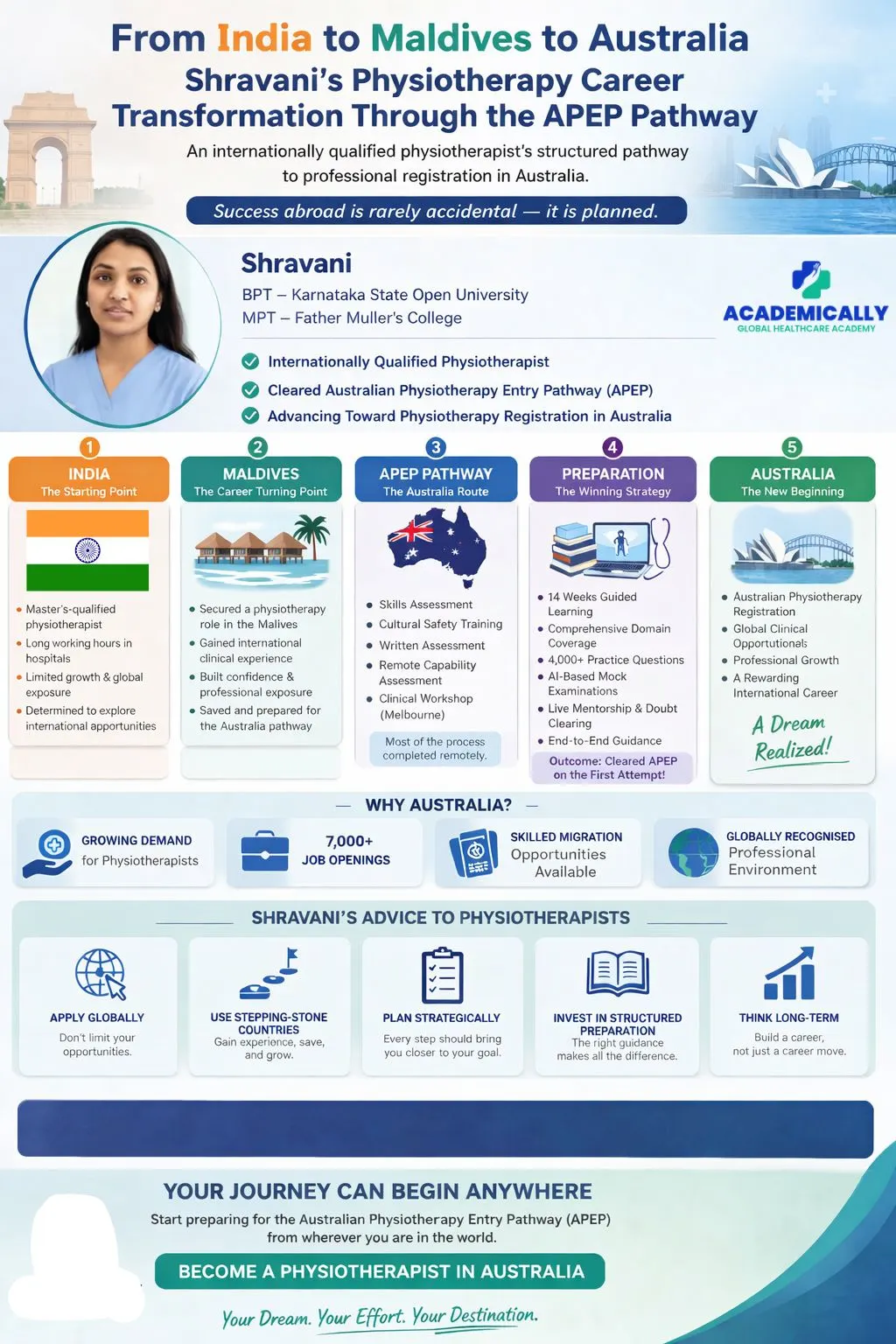
Why Australia?
For physiotherapists who are on the fence, here is the reality of the Australian physiotherapy market right now:
Metrics | Figure |
| Average annual salary for registered physiotherapists in Australia | $95,000 AUD |
| Current job openings for registered physiotherapists | 7,000+ |
| Visas available for skilled healthcare workers in Australia | 185,000+ |
These are not statistics only. They are current market realities. Australia is actively seeking internationally qualified physiotherapists, and the APEP is the structured gateway that allows you to meet their standards and enter the profession with full registration.
Is the APEP Right for You?
The APEP pathway is designed for:
- Internationally qualified physiotherapists who want to work, migrate, and settle in Australia
- Overseas physiotherapy graduates preparing for the APEP for the first time, or reattempting with proper guidance
- Physiotherapists seeking AHPRA registration support, step-by-step help with documentation, exam preparation, and the full registration process
- Professionals working full-time who need a self-paced, structured preparation option they can pursue alongside their current job
If that describes you, the pathway is open. What you need now is the right preparation.
To Conclude with…
Shravani's story is not exceptional because of where she started. It is exceptional because of the decisions she made along the way, the persistence, the strategy, and the willingness to take incremental steps rather than waiting for a perfect leap.
You can do the same.
The APEP preparation course by Academically is open for enrolment. Whether you are in India, the Maldives, the Gulf, or anywhere else in the world, you can begin your structured preparation for Australian physiotherapy registration today, from the comfort of wherever you are.