Every international healthcare career begins with a decision, the decision to start again.
Practising in Australia for internationally trained optometrists is a professional reinvention. New clinical expectations, a different healthcare culture, and one defining gateway career move. It is the Optometry Council of Australia and New Zealand (OCANZ) Competency in Optometry Examination (COE).
Ravneet Sandhu's journey began in busy clinics in Mohali, expanded through clinical practice in Canada, and eventually converged on a single goal. She wanted to become a registered optometrist in Australia. With nearly a decade of hands-on clinical experience, she understood patient care deeply. What she did not have was the time to prepare.
Just two months later, she cleared the OCANZ Written Examination, a milestone that brings internationally trained optometrists one decisive step closer to Australian registration.
In a tete-a-tete with Dr. Akram Ahmad (International Healthcare Career Coach, Founder & CEO of Academically), Ravneet Sandhu (OCANZ COE-Qualified) shares the strategy, mindset shifts, and mentorship that helped her clear an international licensing exam of optometry in just 2 months. Let’s get inspired.
"Whatever they taught in the classes, I just tried to go a bit more into detail. I tried to understand the logic behind it, not just memorise it."
- Ravneet Sandhu, Optometrist | OCANZ COE Written Exam Qualified Candidate
Does Work Experience Matter for Optometrists to Clear the OCANZ COE?
Ravneet completed her optometry degree from Punjabi University, Chandigarh. She spent approximately seven years practising in Mohali, primarily under a retina specialist. She later migrated to Canada as a permanent resident, where she worked under a glaucoma specialist. With clinical depth across two of the most demanding subspecialties in eye care, she was no newcomer to the field.
Yet when she decided to move to Australia due to family ties, the lifestyle, and a warmer climate, she found that she must pass the OCANZ Competency in Optometry Examination (COE).
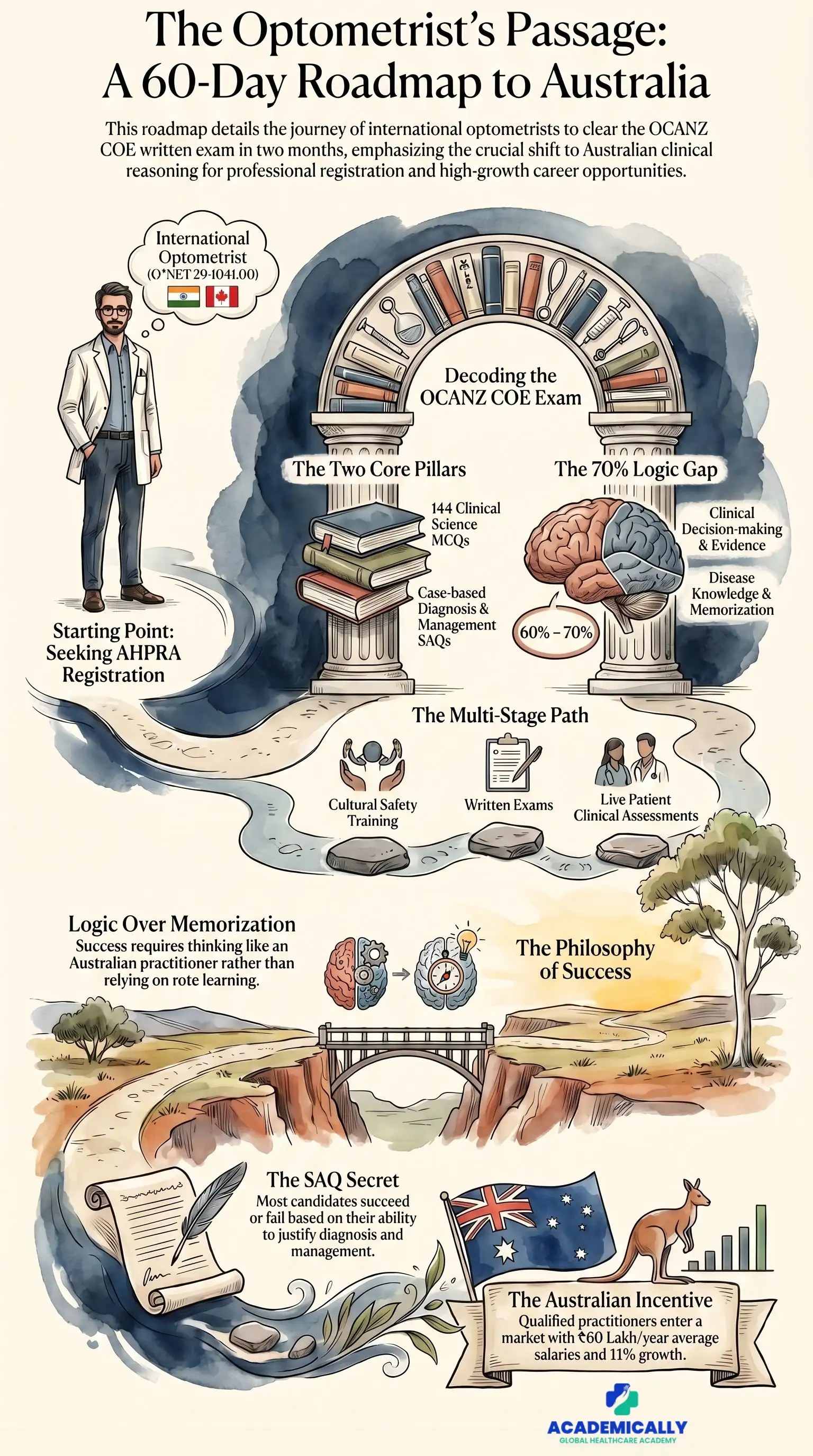
Australia's optometry registration pathway mandates that all foreign-trained optometrists sit and clear the COE before they can apply for AHPRA registration. The exam, conducted under the Optometry Council of Australia and New Zealand (OCANZ), has a rigorous structure, and it is not something candidates can wing with general clinical knowledge alone.
₹60L
Avg. Annual Salary Registered Optometrist, Australia
≈11%
Projected Job Growth in the Next 5 Years
185,000+
Skilled Worker Visas Available Annually
Understanding the OCANZ COE Exam: In a Nutshell
Before diving into Ravneet's preparation story, let’s understand exactly what the COE entails, because this exam is structured very differently from the licensing examinations most Indian healthcare professionals are used to.
OCANZ COE Exam Structure at a Glance
1. Written Examination: Paper 1: Clinical Science (MCQ)
3-hour paper, 144 multiple-choice questions (120 scored). Tests background knowledge in biomedical, optical, vision and clinical science, with emphasis on clinical application.
2. Written Examination: Paper 2: Diagnosis & Management (SAQ)
3-hour paper, 18 short-answer questions. Case-based and photograph-based. Requires candidates to diagnose, manage, refer and explain clinical findings in written form.
3. Cultural Safety Training (Online, Self-Paced)
6 tutorials covering culturally safe care for Aboriginal, Torres Strait Islander and Māori peoples. Must score 80%+ on all assessments before proceeding. Approximately 5 hours total.
4. Clinical Examination: Skills Station
Conducted at the Australian College of Optometry (ACO), Melbourne. Candidates must pass all 12 optometric skills across 6 stations.
5. Clinical Examination: Patient Examination
Full patient consultations with live assessment. Must pass 3 of 4 patient exams. Evaluated on communication, diagnosis, management, and accurate documentation.
Ravneet sat the Written Examination, and passing it marked a major milestone. The written exam is administered as a remote online proctored examination, meaning candidates can complete it from their home country. Both papers are held on consecutive days. Candidates must pass both before proceeding to the clinical stage.
Why Indian Optometrists Find the OCANZ COE MCQ Paper Different from Other Exams
One of the most striking things Ravneet shared was how different the COE's MCQ paper is from the kinds of examinations most Indian healthcare graduates have faced. "It was something completely unexpected," she said. "Only 30–40% of the questions were disease-based, the kind we'd studied in college."
The rest? Research methodology. Clinical decision-making frameworks. How you'd approach a new job. How would you evaluate evidence? “Australia is more research-oriented," Ravneet observed, and the exam reflects that deeply. This isn't trivia about pathologies. It's a test of whether you can think and practise like an Australian optometrist.
This also explains why candidates with strong clinical experience sometimes struggle in the MCQ, while candidates who understand the Australian healthcare system's emphasis on evidence-based practice, patient communication, and research literacy tend to perform better.
Mastering the OCANZ COE SAQ Paper: Why Structured Coaching Makes the Difference
The Diagnosis and Management paper is where structured coaching makes the most measurable difference. Ravneet was emphatic: “The short answer questions, everything came from what our teachers had taught us. They told us which topics were important, that they'd come in the SAQ section, and they actually came.”
This isn't a coincidence. The SAQ paper demands that candidates write detailed, structured answers to case-based questions, such as describing clinical findings, proposing diagnoses, outlining management plans, identifying referral needs, and discussing prognosis. It requires not just knowledge, but the ability to apply and communicate that knowledge in a structured format under timed conditions.
Faculty who have attempted the COE themselves, who teach specifically to its curriculum, and who understand its question patterns are simply better positioned to help candidates prepare for this section. "The faculty would know what's going to be in the exam," Ravneet said. Dr. Akram Ahmad acknowledged the same and implied, "and not just that, they have faculty from various backgrounds like ophthalmologists and those who have themselves cleared OCANZ COE so they are well-acquainted with the career journey."
"In optometry, there is so much to cover. You have to go much further than what the course teaches. But in ophthalmology, I completely followed the faculty, and whatever he said was important; it came."
- Ravneet Sandhu, Optometrist | OCANZ COE Written Exam Qualified Candidate
Expert-Recommended OCANZ COE Preparation Strategies
Ravneet's preparation was unconventional by most standards. She completed the entire course in two months, studying exclusively through recorded lectures, without attending a single live session. She did not complete the practice MCQs, and yet, she cleared the exam.
Her secret, as she explains it, was not speed or volume; it was depth. “If the faculty mentioned retinal detachment, I didn't just note it down and move on. I went a bit more into the details. I tried to understand the logic behind what he was saying. That extra month of just understanding completely; that's where most of my time went.”
She is also the first to admit that her approach was high-risk. Towards the end of the MCQ paper, she had 45 questions left and 30 minutes on the clock. "I don't know how I did those questions," she laughed. Her advice to future candidates is clear: don't follow her timeline. "No one should take this risk. Attend all the lectures, do all the practice MCQs, do the mock tests, then give the exam."
Study Plan for the OCANZ Exam
- Complete all lecture materials, live and recorded, before attempting any practice questions
- Work through all practice MCQs methodically to build exam-pacing skills and identify weak areas
- Attend the live mock test (grand test) to simulate exam-day conditions
- For optometry topics, the COE tests applied knowledge across a wide spectrum of optometric science
- For ophthalmology topics, trust the structured curriculum, which is closely aligned with what the SAQ paper tests
- Understand, don't memorise, the MCQ paper rewards clinical reasoning, not rote recall
Ravneet credits two sources of support for getting her through, beyond the study material itself. First, her family. "I wasn't confident at all about giving this exam. But my parents said: Just give it a try. You can give it four, five, as many times as you want. No one is going to stop you." That framing, removing the fear of failure, reframing each attempt as a step forward, gave her the psychological space to actually try.
Second, the mentorship she received from the Academically’s course programme. "They told me I should go for it because I had solid clinical experience." That targeted encouragement from someone who understood both the exam and her background gave her the confidence to act. "Without that push, I might have kept waiting."
How Academically's OCANZ COE Exam Preparation Course Supports This Journey
Academically's OCANZ COE Exam Preparation Course is purpose-built for foreign-trained optometrists who want to practise in Australia or New Zealand. It is one of the most comprehensive structured programmes available to Indian and international optometrists preparing for the COE.
The course is designed around the full OCANZ exam curriculum, covering both the Clinical Science (MCQ) and Diagnosis and Management (SAQ) papers and is delivered by a faculty team that includes AHPRA-registered optometrists, OCANZ COE-qualified specialists, and experienced ophthalmologists.
- 120 hours of live online training
- One-on-one feedback sessions with the trainer
- Study handouts, mock tests & COE grand test
- Exclusive tips on approaching the COE exam
- Extended access to all course materials
- Live + recorded sessions, never miss a class
- Community of alumni, mentors & registered practitioners
- Free AI mock test access + scholarship available
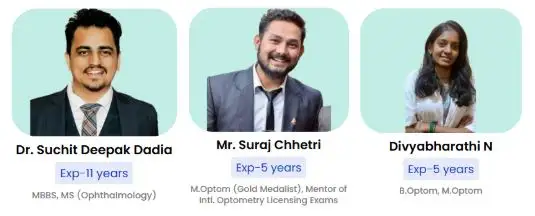
Faculty highlights include Dr. Suchit Deepak Dadia (MBBS, MS Ophthalmology), Divyabharathi N (B.Optom, M.Optom), Mr. Suraj Chhetri (M.Optom (Gold Medalist), Mentor of Intl. Optometry Licensing Exams).
The course runs for four months and gives candidates extended access to materials, meaning those who need multiple attempts can revise thoroughly without repurchasing.
To Conclude with…
Ravneet Sandhu’s journey reminds us that international healthcare careers are not built overnight. They are built through clarity, courage, and consistent preparation. The OCANZ COE is more than an examination. It is a transition into a new clinical mindset and global professional identity. Her success in just two months highlights an important truth: experience matters, but strategy matters more.
With the right mentorship, structured preparation, and belief in one’s abilities, internationally trained optometrists can successfully navigate Australia’s registration pathway. For those considering the same dream, the first step is simple. Start preparing, start learning, and start moving forward today.