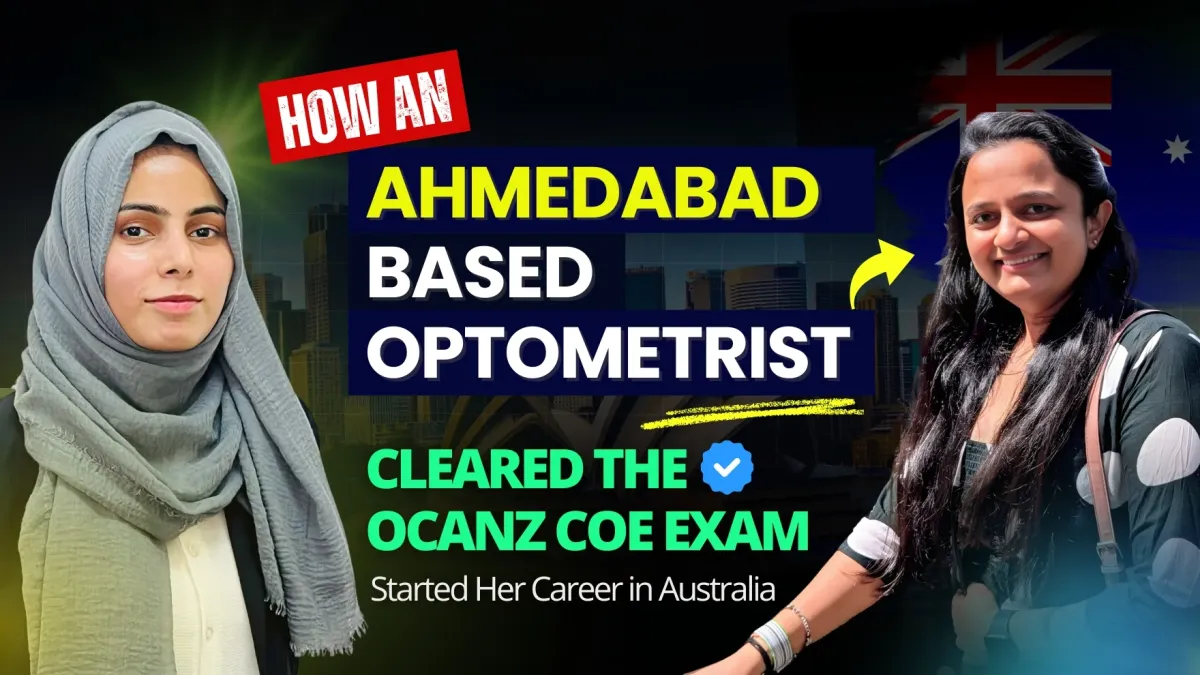
Australia is facing a growing demand for optometrists. With projected job growth of nearly 11% over the next five years and average annual salaries reaching AUD 110,000–130,000 (₹60 lakh+). This is a golden opportunity for internationally trained optometrists. It does not just represent migration, but a rewarding career upgrade. The gateway to that opportunity, however, is the OCANZ COE. It is an exam that determines who successfully makes the transition.
Jinal Desai had built her entire academic life in Ahmedabad, a Bachelor's and a Master's in Optometry, years of rigorous clinical learning, before love and life brought her to Australia. When she arrived, she carried both the ambition to practise again and the anxiety of an unfamiliar licensing system. A few months later, she was on a video call, beaming at the camera, freshly out of stress after learning she had cleared the OCANZ COE Written Exam.
This is her story, and there's a lot in it for every Indian-trained optometrist standing at the same crossroads. Let’s read and get inspired.
Understanding the OCANZ COE: Where Most Indian Optometrists Begin
Jinal is honest about where she began. "I didn't have any idea about the OCANZ, how they conduct it, how they perform the questions, how they ask, how we can write down the answers," she admits. That candour matters because it's the same place most Indian optometrists start when considering migrating to Australia.
The Competency in Optometry Examination (COE), conducted by the Optometry Council of Australia and New Zealand (OCANZ), is the mandatory gateway for all foreign-trained optometrists who wish to register and practise in Australia or New Zealand. The OCANZ COE Written Exam has two distinct parts: a Multiple-Choice Question (MCQ) paper and a Short Answer Question (SAQ) paper. Both must be qualified.
The SAQ component is what makes this exam genuinely distinctive. While the MCQ paper is challenging in its own right, with deliberately tricky question framing, it is the short-answer paper that tests a different cognitive muscle entirely: the ability to interpret clinical scenarios, justify diagnostic reasoning, and communicate answers in a structured written form.
"The MCQ was a bit tricky, and the SAQ was a bit simpler, but if you clearly read the questions and understand what they are actually asking, you already know the answer you need to write down."
- Jinal Desai, COE Written Exam Qualified
Choosing Structured OCANZ COE Preparation Instead of Self-Study
Jinal had friends who had attempted the exam. She had heard how it worked. But the gap between knowing the exam exists and knowing how to prepare for it in the right way remained wide. Some of her peers had attempted it twice without clearing.
That's when she found Academically.
Academically's OCANZ COE Exam Preparation Course is built specifically for Indian and other internationally trained optometrists aiming to register in Australia. With 120 hours of live online training, subject-specific handouts, MCQ and SAQ practice sets, mock tests, and a final grand test, the course covers the full OCANZ exam curriculum structured not just for knowledge, but for exam strategy.
Jinal joined the programme in September of the previous year. At the time, she was also working full-time in Australia. It is a real constraint that many aspiring candidates share.
OCANZ COE Preparation Strategy: Balancing Full-Time Work and Exam Study
September – January
Joined Academically's COE course. Studied 3–4 hours daily while working full-time. Never missed a live lecture, even during the heavier weeks.
Early February
Booked the exam for March. Made the commitment concrete by locking in a date.
February (entire month)
Full-time study mode: 10–12 hours daily. Took leave from work. Studied from early morning to late night, covering all lectures, practice questions, and mock tests.
March
Appeared for and cleared the OCANZ COE Written Exam.
What's notable about Jinal's journey is not the final sprint; it's the foundation. The steady three-to-four hours of study every day from September to January kept the material from going stale. By the time February arrived, she wasn't learning from scratch. She was consolidating.
Four Proven Strategies That Helped Clear the OCANZ COE Written Exam
Never Missed a Live Lecture
Jinal attended every live session, not just the new content lectures, but revision classes and discussion sessions too. When she needed to revisit something, she went back to the recordings. Consistency over intensity.
Followed Faculty Guidance on Priority Topics
When faculty marked something as important, she treated it as guaranteed exam material, because, as she discovered in the exam hall, those topics did appear. Trust in expert guidance paid off directly.
Grand Mock Test as a Confidence Builder
Academically's full-length grand test, structured to replicate actual exam conditions, was, in Jinal's words, "really helpful." Passing the grand test gave her the confidence to walk into the real exam, believing she would clear it.
Time Management in the SAQ Section
Each SAQ question was long, requiring at least two minutes just to read. Jinal learned to resist the urge to rush, to read carefully, and to take the extra time needed to
understand what the question was truly asking before writing a word.
OCANZ COE Exam Syllabus Explained: Why Strong Fundamentals Matter
One of the most practical insights Jinal offers is about how the OCANZ COE actually tests knowledge. It does not ask straightforward factual questions. There is no "what is the glass prescription for this case" or "name the layers of the retina." That is not the level at which this exam operates.
"They ask tricky, deep questions. They don't ask the basics, but you have to be sure your basics are completely clear. Because if your basics aren't clear, you cannot attempt the deep questions."
- Jinal Desai, COE Written Exam Qualified
The good news, she confirms, is that there is no fundamental difference between the optometry syllabus taught in India and the content assessed in the OCANZ COE. What changes is the level of application. The exam is primarily focused on interpretation and diagnosis, which means clinical judgement over rote recall. For those who studied thoroughly during their bachelor's or master's programmes, the foundation is already there. It simply needs to be sharpened.

How Structured Coaching Supports Success in the OCANZ COE Written Exam
What Jinal described from her experience maps closely onto what Academically's COE programme is built to deliver. The course doesn't just cover content. It trains candidates for the specific demands of the OCANZ examination format.
What sets us apart?
- 120 hours of live online training across both COE papers
- Live + recorded sessions never fall behind due to work or time zone
- One-on-one feedback sessions with mentor
- Subject handouts, MCQ sets, and SAQ practice papers
- Grand mock test replicating actual OCANZ exam conditions
- Exclusive exam approach tips from faculty who have guided 1,000+ students
- Extended access to all materials for revision across multiple attempts
- Community access to alumni, mentors, and registered practitioners
Jinal specifically acknowledged the faculty for flagging high-priority topics that appeared in the actual exam, a testament to the teaching team's depth of understanding of the OCANZ examination pattern.

Why Optometrists Choose Australia: Demand, Salaries, and Career Growth
The OCANZ COE is demanding for a reason. Registered optometrists in Australia are among the most valued healthcare professionals in the country. The numbers speak to what's on the other side of this exam:
- Average annual salary of a registered optometrist in Australia: ₹60 lakh
- Projected job growth in optometry over the next 5 years: approximately 11%
- Australia issues 185,000+ skilled worker visas annually, with optometry among the in-demand professions
The COE exam is not a barrier for Indian optometrists with a solid academic foundation. It is one of the most rewarding pathways for optometrists to enjoy a highly rewarding career.
Exam Tips and Advice for International Optometrists
When asked what she would tell optometrists currently preparing for the OCANZ COE, Jinal's answer was simple and direct:
"Do hard work. If you do hard work, you will definitely get the result. Read the questions clearly, understand what they are asking and give yourself the time to do that in the SAQ section. Don't rush."
- Jinal Desai, COE Written Exam Qualified
She adds a specific note about live attendance: "I didn't miss any lecture, not even the revision lectures." For students tempted to rely solely on recordings, this is a meaningful reminder. The live format, the ability to ask questions, stay focused, and hear which topics the faculty emphasise, is a different quality of engagement.
To Conclude with…
Jinal Desai’s journey reminds us that international registration is rarely about starting over. It is about translating existing skills into a new healthcare system. The OCANZ COE is designed to ensure clinical readiness, not to create barriers. Her experience shows that success comes from structured preparation, consistent effort, and clarity of strategy.
The pathway to Australia may initially feel unfamiliar for many Indian-trained optometrists. But the fundamentals learned during years of education already form a strong foundation. With the right guidance, disciplined study habits, and focused practice, the transition becomes achievable and predictable rather than overwhelming.
Australia continues to offer strong professional demand, competitive salaries, and long-term career stability. Jinal’s story is therefore more than a personal milestone. It is proof that with the right approach, global opportunities in optometry are within reach for those ready to take the first step.