Clinical research is the backbone of medical innovation, but it’s often slowed down by the same problems like slow recruitment, high costs, manual data processes and safety monitoring challenges.
These issues don’t just delay trials; they delay treatments that patients desperately need.
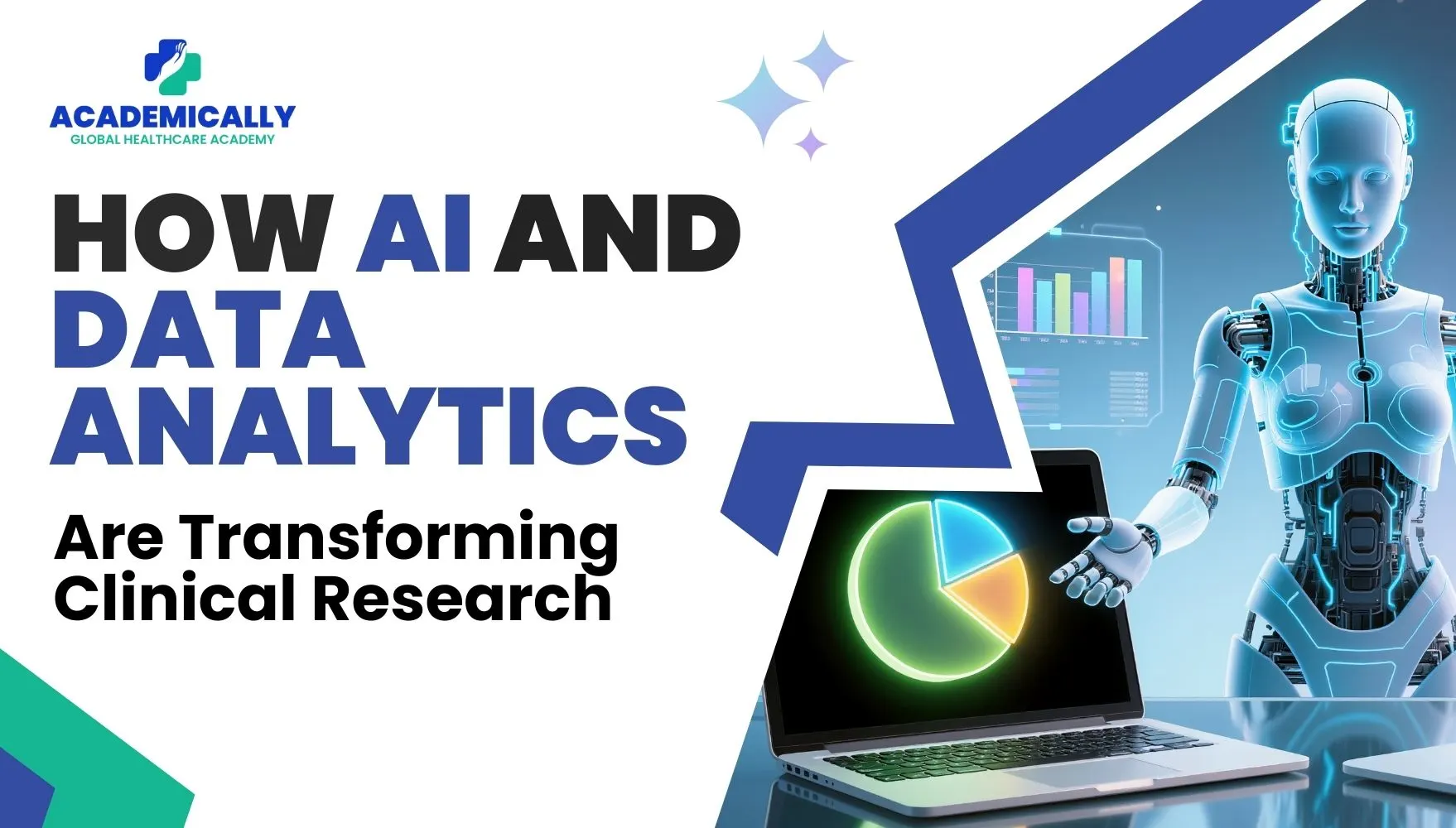
But AI and data analytics are fixing that. With powerful algorithms, real-time insights, and predictive modeling, researchers are finally able to work faster, reduce risks, and create more reliable trials. What once took months can now be done in minutes.
Clinical research is evolving and AI is leading the charge. Read the blog till the end to find out.
What Is Clinical Research?
Clinical research helps us understand whether a new drug, device, or treatment is safe, effective, and useful for patients. It’s the core of medical innovation.
Why Clinical Research Matters
- Ensures medical treatments are safe
- Confirms how well new therapies work
- Helps discover side effects early
- Improves patient care and global health standards
Phases of Clinical Research
| Phase | Goal | What Happens |
| Phase 1 | Safety | Tests a drug on a small group; finds safe dose |
| Phase 2 | Effectiveness | Checks how well the drug works |
| Phase 3 | Large-scale testing | Compares new treatment to standard care |
| Phase 4 | Long-term monitoring | Tracks safety after approval |
How the Clinical Research Process Works
- Discovery & early research
- Preclinical testing on cells/animals
- Trial design + regulatory approvals
- Human clinical trials (Phases 1–4)
- FDA/EMA approval
- Post-approval real-world monitoring
Are you thinking of getting into Clinical Research and making a difference? Then, do a Post Graduate Certificate in Clinical Research course from Academically. This way, you can complete the course and be job-ready in just 4 months.
Common Challenges in Clinical Research (Before AI)
| Challenge | Why It’s a Problem | Impact |
| Slow recruitment | Strict criteria, finding eligible patients | Trial delays |
| High costs | Staff, equipment, site management | Expensive development |
| Manual data entry | Time-consuming + risky | Errors, delays |
| Complex protocols | Hard to manage across locations | Low efficiency |
| Safety tracking | Requires real-time monitoring | Possible missed signals |
How AI Is Transforming Clinical Trials
AI enhances nearly every phase of clinical research. Let’s break down the major areas.
1. AI for Patient Recruitment and Retention
Recruiting the right participants is one of the biggest bottlenecks in research.
How AI Helps
- Scans EHRs to quickly find eligible patients
- Matches patients to trials based on health history
- Predicts dropout risk
- Improves diversity by reaching underrepresented groups
| AI Capability | Benefit |
| Eligibility screening | Faster recruitment |
| Predictive retention | Fewer dropouts |
| EHR data scanning | Reduces manual screening time |
| Automated outreach | Higher enrollment |
2. AI in Drug Discovery and Development
Traditional drug discovery can take 10–15 years. AI speeds this up dramatically.
AI’s Role
- Predicts molecular behavior
- Identifies effective compounds early
- Simulates drug interactions
- Cuts down trial-and-error guesswork
| Process Step | How AI Helps | Outcome |
| Molecule screening | Finds promising candidates rapidly | Saves years |
| Mechanism prediction | Analyzes biological reactions | Better accuracy |
| Toxicity prediction | Highlights safety concerns early | Fewer failures |
3. Predictive Analytics for Clinical Outcomes
Predictive models analyze past + real-time data to forecast:
- Treatment success
- Side effects
- Patient risk levels
- Disease progression
This leads to smarter trial designs and fewer safety issues.
How Data Analytics Improves Clinical Research
Data analytics converts raw medical data into actionable insights.
1. Improving Trial Efficiency
Analytics tools can:
- Automate data entry
- Generate reports instantly
- Reduce site workload
- Improve protocol adherence
| Task | Before Analytics | After Analytics |
| Data cleaning | Manual, slow | Automated |
| Reporting | Time-consuming | Real-time |
| Communication | Email-heavy | Centralized dashboards |
| Monitoring | On-site only | Remote + continuous |
2. Enhancing Data Quality and Integrity
Bad data = bad results.
Analytics tools improve accuracy with:
- Anomaly detection
- Data validation
- Duplicate checks
- Error alerts
This makes trials more reliable, especially in multicenter studies.
AI + Wearables + IoT: The Power Trio
Wearables and smart devices continuously track patient vitals. AI analyzes that data instantly.
What These Devices Collect
- Heart rate
- Sleep patterns
- Activity levels
- Blood pressure
- Oxygen saturation
Benefits
| Feature | Benefit for Trials |
| Continuous monitoring | Early detection of issues |
| Remote data collection | Fewer hospital visits |
| Real-world data | More accurate results |
| Digital biomarkers | Better predictions |
This shift supports decentralized clinical trials, which are more patient-friendly.
Ethical Considerations and Data Privacy
AI must be handled responsibly.
Key Concerns
- HIPAA compliance
- Transparent algorithms
- Secure patient data storage
- Fairness and bias prevention
Ethics ensures AI supports all populations fairly.
Real Examples of AI in Clinical Research
| Organization | How They Use AI | Result |
| Pfizer | AI for inflammatory disease drug analysis | Faster discovery |
| Novartis | Predictive recruitment analytics | Improved enrollment |
| IBM Watson Health | Trial matching algorithms | Better accuracy |
Future Trends in AI-Driven Clinical Research
Here’s what’s coming next:
- Personalized medicine based on genetic profiles
- Decentralized trials powered by digital devices
- AI-driven protocol optimization
- Smart trial forecasting before the trial even starts
- Greater use of real-world evidence (RWE)
The future is faster, smarter, and more patient-centric.
Challenges in Adopting AI and Analytics
| Challenge | Why It Matters |
| Tech infrastructure | AI needs reliable systems |
| Regulatory ambiguity | Guidelines still evolving |
| Staff training | Teams need AI skills |
| Data integration | Hospitals use disconnected systems |
Final Thoughts
AI and data analytics are reshaping clinical research from top to bottom. They make trials quicker, safer, more accurate, and far more efficient. From patient recruitment to predictive modeling and decentralized monitoring, AI is helping researchers bring life-changing treatments to patients faster than ever before.
As technology evolves, the future of clinical research will continue shifting toward smarter, data-driven, and patient-centered solutions.
If you have any questions or doubts, feel free to contact the experts at Academically. They will be happy to help you with anything you need.