Every healthcare professional carries two passports. One that is issued by their country, and another earned through courage. The second is stamped not at airports, but at moments when comfort is left behind, and reinvention begins.
The Australian Dental Council (ADC) Exam is that very passport for internationally trained dentists. It does not merely test knowledge. It tests persistence, adaptation, and the willingness to begin again in a system that demands excellence on its own terms.
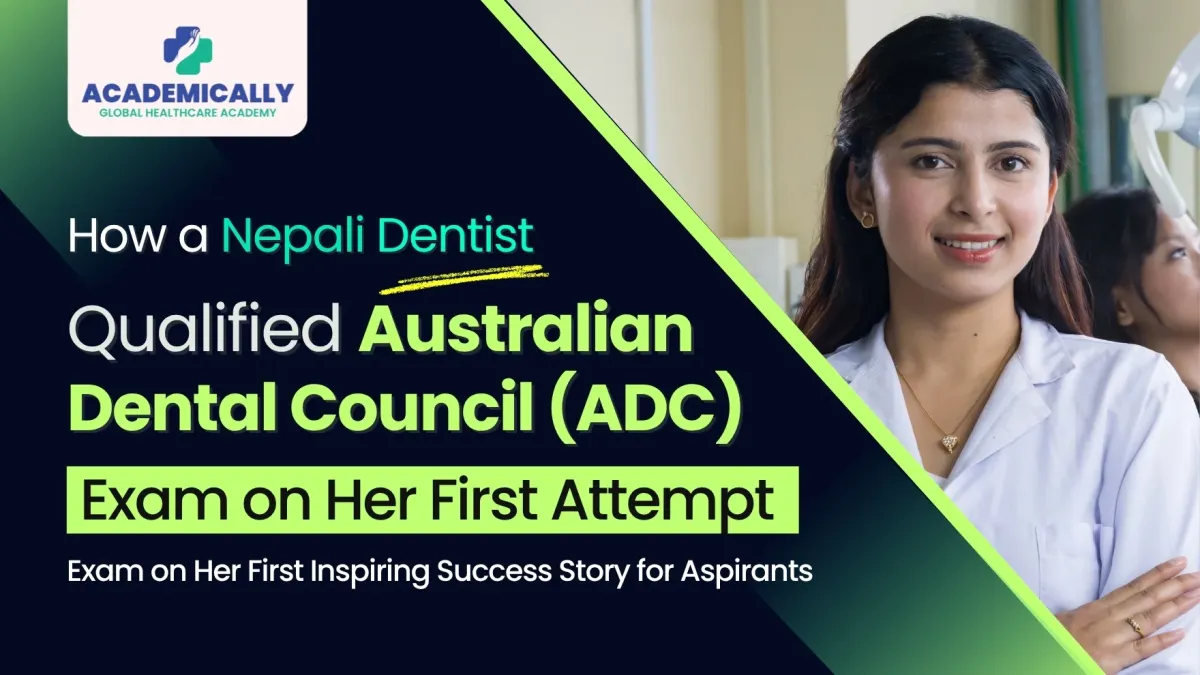
Dr. Sonu, a Nepali dentist who completed her Bachelor of Dental Surgery (BDS) from the University of Milagosa in San Carlos, Philippines, it was the bridge between where she was and where she wanted to be.
In a tete-a-tete with Dr. Sonal (Programme Manager, Dentistry), Dr. Sonu (BDS, ADC-Qualified Candidate) speaks about the journey, what emerged was less a celebration and more a masterclass, quiet, methodical, and deeply instructive for every internationally trained dentist eyeing Australia. Let’s get inspired.
Why Australia? Understanding the ADC Pathway for International Dentists
Dr. Sonu wants to pursue an MDS in Endodontics, and she wants to do it in Australia. Having already studied outside her home country for her undergraduate degree, the idea of continuing her education abroad felt natural, even necessary.
But there's a procedural reality she understood clearly. In Australia, overseas dental qualifications are not automatically recognised. The ADC written exam is the first step after the skill assessment that you need to pass mandatorily.
Then attempt the ADC practical exam in Melbourne. Finally, you register with AHPRA (the Australian Health Practitioner Regulation Agency), and only then can you practice legally. In Dr. Sonu's case, pursue specialist registration for an MDS pathway.
62
Dentists per 100,000 people in Australia, one of the lowest ratios in the developed world
3,000+
Current job openings for registered dentists across Australia
$150K+
Average annual salary of a registered dentist in Australia
The shortage is real, and the opportunity for internationally trained dentists is significant. However, this is only for those who navigate the ADC process correctly. Dr. Sonu did. Here's how.
Dr. Sonu’s ADC Written Exam Preparation Strategy: Study Plan & Resources
When asked how she approached her preparation, Dr. Sonu didn't give a complicated answer. Her strategy, in essence, was built on one principle. Repetition over diversity.
She didn't try to cover everything once and move on. She covered the same material multiple times until it was absorbed, not just recognised. Through Academically's Learning Management System (LMS), she had access to recorded lectures, PowerPoint presentations, structured study handouts, and a suite of topic-wise tests and grand tests. Her approach was sequential but iterative.
- Start with the PPTs and lectures. She began with the structured content on the LMS, working through each module's presentations before layering in the lecture recordings. The recorded format gave her the flexibility to revisit complex sections on her own schedule.
2. Do every test, then do it again. She attempted most of the mock tests at least three times. Some, where she struggled with the subject matter, she repeated five to seven times. "The repetitions," she said, "are what I relied on." This helped her gain confidence during the actual exam because our mock tests simulate real time based exam scenario. So the aspirants are already acquainted with what they can expect on the exam day.
3. Master the TG and ICG, obsessively. The Therapeutic Guidelines (TG) and Infection Control Guidelines (ICG) were singled out by her faculty as critical, and Dr. Sonu followed that guidance faithfully. She went through the TG approximately five times. The ICG, similarly, repeated until the content felt rather different.
4. Work through the Odell cases at least twice. The case-based content in the curriculum received dedicated revision passes, reinforcing clinical reasoning in the format that the ADC actually tests it.
5. Use live mock tests for time practice, not just content. One of the most overlooked aspects of ADC preparation is exam timing. The written exam is a two-day, 280-question computer-based test, four papers of 70 questions each, two hours per paper. Dr. Sonu credited Academically's live mock tests with giving her a genuine simulation of that time pressure. "Because of the practice, the time was just enough," she noted.
Whatever they said, I followed that. Because of their support, their help, their advice, it was possible.
- Dr. Sonu (ADC Exam Qualified)
Inside the ADC Written Exam: Syllabus, Question Pattern & Competency Focus
There's a persistent misconception among candidates that the ADC Written Exam leans heavily on a single domain, such as infection control or ethics. Dr. Sonu's experience flatly contradicts that. Her assessment: it's comprehensive, and there are no reliable shortcuts based on topic weighting.
The exam tests across all dental clusters, clinical and theoretical both. Treatment planning, pharmacology, periodontics, endodontics, oral surgery, infection control, paediatric dentistry, radiography, everything in the Academically curriculum has a reason to be there. The exam format includes both straightforward knowledge questions and more complex scenario-based cases that demand clinical judgement, not just recall.
Her approach to difficult questions during the exam itself was telling: read the question at least twice, identify what's actually being asked, then evaluate the options against that core question rather than guessing based on familiarity. It's an approach born from extensive practice, not from reading about it once.
Mentorship & Guidance: The Faculty Support That Accelerated Success
Dr. Sonu was specifically vocal about the mentorship she received from her Academically faculty. When preparation becomes overwhelming, and for a comprehensive exam like the ADC, it does, guidance from someone who has navigated the same process is invaluable. She pointed to the focused advice on high-yield areas and the encouragement to prioritise depth over breadth as the inflexion point in her preparation.

Top 3 Lessons Every ADC Written Exam Aspirant Must Learn
Dr. Sonu's interview surfaces three ideas that are worth internalising before you begin your own preparation, regardless of your background, country of training, or how many times you may have already attempted the ADC.
Repetition is a strategy, not a fallback. It can feel intellectually unsatisfying to do the same test five times. But the ADC tests clinical pattern recognition under time pressure, and pattern recognition is built through repetition, not variety. Dr. Sonu didn't try to find new questions. She deepened her relationship with existing ones.
The TG is not supplementary material. The Therapeutic Guidelines are the reference framework Australian clinicians actually use. The ADC tests your ability to reason within that framework. Treating TG revision as an optional extra is a mistake candidates make more than once. Dr. Sonu treated it as the exam.
Simulated conditions beat theoretical preparation. Knowing the answers is not the same as knowing the answers under exam conditions. Dr. Sonu's use of live mock tests, in which she had to complete papers within fixed time limits, made the real exam feel calibrated rather than alien. The practice built confidence where it matters most: in the room.

After Clearing ADC Written: Dr. Sonu’s Next Step Toward Practising in Australia
With the ADC Written Exam behind her, Dr. Sonu now prepares for the ADC Practical Exam, a two-day assessment conducted in Melbourne, evaluating both technical and clinical competencies. Completing it allows her to register with AHPRA as a general dentist. From there, the path toward specialist registration for an MDS in Endodontics opens up.
She joins Academically's alumni community, a network of practitioners who have cleared the ADC and are actively working in, or migrating to, Australia. For candidates still in the preparation phase, that kind of peer network is one of the less-discussed but genuinely valuable dimensions of structured coaching.
Planning Your ADC Journey? Here’s How You Can Start
Academically's ADC Written Exam Preparation Course is built for internationally trained dentists who want to pass, not just attempt. The same programme that guided Dr. Sonu.
- 14 weeks of intensive sessions covering the full ADC exam syllabus
- 100 hours of live online training with recorded session access
- AI-powered mock tests, grand tests, and one-on-one feedback
- Extended LMS access for multiple revision cycles, over 12 months
- An alumni community with cleared ADC practitioners and AHPRA-registered dentists
- Support for AHPRA registration, migration, and first job in Australia
To Conclude with…
Dr. Sonu’s journey reminds us that international success in dentistry is rarely about brilliance alone. It is about clarity, consistency, and the courage to commit to a structured path. The ADC Written Exam is not an obstacle designed to stop overseas dentists.
It is a standard designed to prepare them for practising safely and confidently within the Australian healthcare system. What separates those who eventually qualify from those who remain stuck is not background, nationality, or even prior academic performance, but disciplined preparation guided by the right strategy and mentorship.
Her story demonstrates that when preparation becomes deliberate and repetitive, uncertainty gradually turns into confidence. For every internationally trained dentist considering Australia, the message is simple: the pathway is demanding, but it is achievable.
With the right guidance, focused revision, and sustained effort, the distance between aspiration and registration becomes shorter than it first appears. Your ADC journey can begin exactly where you are today.