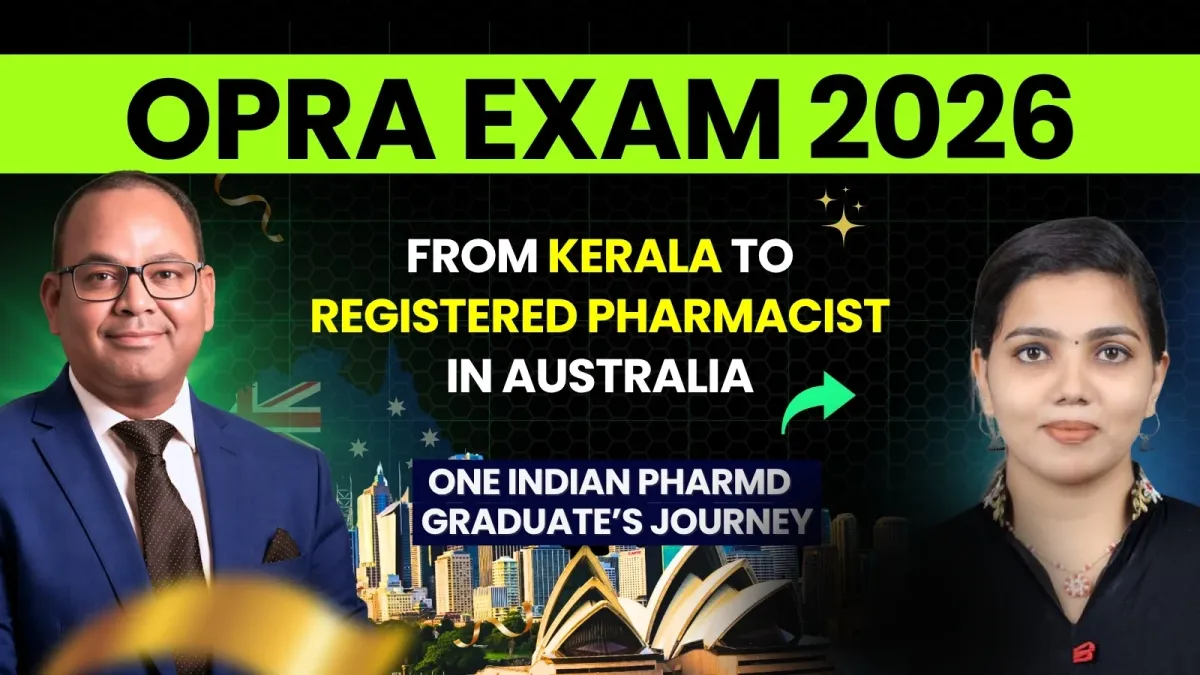
PharmD Graduate’s Success in OPRA Exam Results 2026: From Kerala to Australia

Written by

Dr. Indu K

Reviewed by

Dr. Akram Ahmad
From Kerala to Registered Pharmacist in Australia
Created On : Apr 21, 2026 Updated On : Apr 21, 2026 4 min read

Key Takeaways

  • How one Indian PharmD graduate went from 4 hours a week to full registration
  • The smartest first move most internationally qualified pharmacists skip
  • The one mindset shift that stops internationally qualified pharmacists from drifting away from their profession in Australia​​​​​​​​​​​​​​​​

Breaking into the Australian pharmacy system is no small feat. Especially when you’re starting from scratch in a new country, juggling a master’s degree, and working part-time just to keep the lights on. But that’s exactly what Megha, a PharmD graduate from Kerala, did and her story is worth every pharmacist reading this paying close attention.

The Beginning: A Bold Decision to Start Over

Megha completed her Doctor of Pharmacy from Mangalore and worked as a clinical pharmacist in India for about nine months. Anyone who has worked in that space knows the reality like long hours, demanding responsibilities, and a salary that rarely crosses ₹18,000 a month. It’s not sustainable, and it’s not what years of pharmacy education deserves.

So she made the move to Australia, enrolling in a Master of Health Management in Tasmania. That decision alone took courage. But what she did next made all the difference.

The Smart Move Most Pharmacists Skip

While studying for her master’s, Megha actively sought work as a pharmacy assistant. That first role? Just four hours a week. Most people would have walked away from that. She didn’t.

She showed up, proved herself, and gradually those four hours turned into 24 hours a week, all in the same pharmacy. This hands-on experience became the foundation that made her internship smoother than most.

“I started in a pharmacy where they offered me only 4 hours in a week. And gradually when I proved them that I was a true candidate, they gave me more number of hours.”

Here’s why working as a pharmacy assistant matters so much for internationally qualified pharmacists:

What You Learn as a Pharmacy AssistantWhy It Matters for Registration
Dispensing prescriptions under supervisionBuilds real workflow familiarity
Webster pack preparationDirectly tested competency      
Stock and inventory management  Operational pharmacy understanding
Patient counselling support Communication skills in Australian context

The Australian pharmacy system is genuinely different from India’s. Megha put it plainly:

“Every pharmacist in India when they come here, they need to at least work as an assistant and have hands-on experience with the pharmacist.”

Even the most clinically sharp PharmD graduate needs time to understand how the workflow actually runs on the ground. Working as an assistant bridges that gap faster than any textbook can.

Cracking the OPRA Exam: What Actually Worked for Megha

The Overseas Pharmacist Readiness Assessment (OPRA) is the gateway exam every internationally qualified pharmacist must clear to practise in Australia. Megha started preparing just three months before the exam, which sounds risky, but her approach was focused. No scattered resources, no information overload. She committed to Academically’s OPRA Preparation course, attended recorded sessions when she couldn’t make live classes, and worked through revision PDFs and mock exams consistently.

Her honest take on daily study time?

“If you listen to the class, 2 hours a day, if you spend at least 2 hours a day, that’s actually quite enough for anyone to crack the OPRA exam.”

A few things Megha flagged about the actual paper:

  • Microbiology and pharmacokinetics featured more heavily than she expected
  • Pharmacotherapeutics questions were present but not dominant
  • Calculations were fewer than anticipated, around six or seven
  • Most questions were application-based, not rote recall

This is a useful reality check for anyone preparing. Don’t over-index on pharmacology alone. Microbiology and pharmacokinetics deserve serious attention. As Megha noted:

“It’s not very hard like we all think it is. It’s actually if you can learn, it’s manageable.”

The Bigger Message for Indian Pharmacists Abroad

There’s a pattern that plays out too often. An internationally qualified pharmacist arrives in Australia, struggles to find pharmacy work immediately, takes up something unrelated to pay bills, and slowly drifts away from the profession entirely. Years pass. The registration dream gets quieter.

Megha’s journey pushes back against that pattern directly. As she put it:

Being able to work in your own profession is very important. Students find it hard to find a job in pharmacy and then they get deviated but staying in your field makes all the difference.”

Stay in your field, even if the entry point is a four-hour-a-week assistant role. The experience compounds. The familiarity compounds. And when you sit that exam, you’re not just prepared on paper, you’ve already been living the role.

For women especially, who often face additional pressure around timelines and expectations, Megha’s story is a straightforward reminder: the path doesn’t have to look perfect to work.

Final Thought

Megha’s story isn’t extraordinary because she had special advantages. It’s extraordinary because she made ordinary decisions consistently.

If you are an internationally qualified pharmacist reading this and wondering whether the investment of time, money, and energy is worth it, Megha’s answer is clear. The Australian pharmacy system rewards those who commit to it. The OPRA pathway is structured, it is transparent, and it is absolutely passable. What it requires from you is consistency, the right preparation, and the willingness to start even when the starting point feels small.

Your four hours a week could be the beginning of everything. If you are thinking about doing it, start today with us!


About Us

Academically is a global Ed-Tech healthcare platform, led by Dr. Akram Ahmad (PhD in Medicine, University of Sydney, Global Healthcare Career Coach) and his expert team, that helps pharmacists, doctors, dentists, physiotherapists, and other allied healthcare professionals to achieve their career goals in India and abroad. We provide complete career guidance, like skill assessment, Visa, PR and coaching for International licensure exams such as AMC, OPRA, APEP, ADC, DHA, SPLE, OCANZ COE and more for countries like Australia, New Zealand, Gulf countries, the US, the UK, and Canada. We have trained more than 8,000 students across 30+ countries, with a 90%+ success rate on international healthcare licensure exams. We are India’s first healthcare Ed-Tech platform to introduce AI-based mock tests, to help students study smarter and track progress effectively. Beyond exam preparation, we also offer job assistance programmes, such as Upskill by Academically, covering clinical drug development and MSL (Medical Science Liaison). To help you land your dream job, we have recently launched our job platform Jobslly by Academically, only for healthcare professionals for both India and abroad.

FAQs

1. What is the OPRA exam?

The Overseas Pharmacist Readiness Assessment (OPRA) is an examination for internationally trained pharmacists seeking registration in Australia. It is regulated by the Australian Pharmacy Council (APC) and assesses whether candidates have the necessary knowledge and understanding required for Australian pharmacy practice.

2. Has OPRA replaced the KAPS exam?

Yes. From March 2025, the Australian Pharmacy Council officially replaced the KAPS exam with OPRA. If you are preparing for pharmacist registration in 2026, you will no longer sit the KAPS exam.

3. Who needs to take the OPRA exam?

The OPRA exam is compulsory for international pharmacists outside accredited countries. Exemptions generally apply only to pharmacists who qualified in the UK, Ireland, Canada, or the USA, as these countries have more direct registration pathways.

4. What is the format of the OPRA exam?

The examination includes 120 multiple-choice questions to be completed in 2.5 hours. It covers Biomedical Sciences (20%), Medicinal Chemistry and Biopharmaceutics (10%), Pharmacokinetics and Pharmacodynamics (10%), Pharmacology and Toxicology (15%), and Therapeutics and Patient Care (45%).

5. How many times a year is the OPRA exam conducted?

The APC holds the OPRA exam three times per year -  in March, July, and November.

6. Can the OPRA exam be taken outside Australia?

Yes. The OPRA is a computer-based exam administered at various Pearson VUE test centres globally. Most applicants can schedule and take the exam in their home country or a nearby major city.

7. Is the OPRA exam available in India?

Yes. The OPRA exam is available at multiple test centres across India, including Delhi, Mumbai, Bangalore, Chennai, Hyderabad, Pune, and more.

8. What is the fee for the OPRA exam?

The updated OPRA exam fee for 2026 is AUD $2,245 per attempt, which works out to approximately ₹1.35 lakh INR.

9. How is the OPRA exam scored?

The APC uses the Rasch methodology for OPRA examination scoring, which does not determine a fixed pass percentage.

10. Is prior work experience required to apply for OPRA?

No prior work experience is required to apply or sit for the OPRA exam. Fresh graduates are eligible to apply.

11. What happens after passing the OPRA exam?

After passing OPRA, you apply for provisional registration with the Pharmacy Board of Australia, complete a supervised internship in an approved pharmacy, pass the intern written and oral exams, and then apply for general registration to practise independently.

12. What is the eligibility check and how long does it take?

You apply through the APC Candidate Portal and pay the eligibility fee of about AUD $810. Processing usually takes 4–6 weeks. Once approved, you receive a Skills Assessment Eligibility Letter, which allows you to book the OPRA exam.

13. Can I retake the OPRA exam if I don’t pass?

Yes. If you don’t pass, you can reattempt the exam in the next sitting. There is no need to panic, the next available window is always a few months away.

14. Which subject carries the most weight in OPRA?

Therapeutics and patient care carry the highest weightage at 45%, making clinical understanding the most important focus area for OPRA preparation.

15. Is coaching necessary to pass the OPRA exam?

Coaching is not mandatory, but it is highly recommended to improve clinical reasoning and exam readiness.  Structured preparation including mock exams, revision notes, and recorded sessions, can make a significant difference, as Megha’s own experience demonstrates.

Dr. Indu K
Dr. Indu K
about the author

Dr. Indu K is a dentist with one year of clinical experience. She seamlessly transitioned into content writing three years ago. Her passion lies in making complex medical information accessible to everyone. She uses her unique blend of medical knowledge and exceptional writing skills to bridge the gap between healthcare and the general audience.

Build a Successful Global Healthcare Career
Academically

Get Complete Details & Expert Guidance

Our experts will contact you soon

Free guidance • No spam • No obligation

Students
Trusted by 50,000+ healthcare aspirants