Are you an international medical graduate planning to migrate to Australia but failed the AMC Clinical exam? Don’t quit yet. There’s still a golden chance.
You've spent months, sometimes over a year, preparing for the Australian Medical Council (AMC) Clinical exam. Role plays, coaching sessions, late nights revising differentials. But then the result comes, and it isn't what you hoped.
What happens next is something most resources don't talk about. It is the silence, the confusion, and the most dreaded question: “What now?”
In this blog, we will go through the PESCI (Pre-Employment Structured Clinical Interview) pathway as a legal and structured route forward for IMGs. Let’s figure out your career together.
What is PESCI, and is it Right for you?
PESCI stands for Pre-Employment Structured Clinical Interview. It's a clinical assessment tied directly to a specific job offer, most commonly for General Practice (GP) roles. This is an important distinction from the AMC clinical exam:
| AMC Clinical Exam | PESCI | |
| Primary pathway | Hospital-based roles | General Practice (GP) roles |
| Triggered by | Candidate initiative | Securing a job offer |
| Validity | General (not role-specific) | Tied to a specific position |
| Exam focus | History, physical exam, diagnosis, differentials | All of the above + management plan |
| Pass rate | Notoriously low | Relatively more achievable |
| Providers | AMC (single body) | IME, RACGP, ACRRM |
Because PESCI is job-specific, you typically cannot use a PESCI passed for one role to apply for a different position or in a different state. This means full commitment to the role you're applying for is essential before you sit the exam.
The Three PESCI Providers: Which One Applies to You?
Not all PESCIs are the same. The provider is determined by the organisation overseeing the GP training programme associated with your job offer.
IME (Institute of Medical Education)
Currently considered slightly more accessible than the other two providers. IME's PESCI structure closely mirrors the AMC clinical exam format. It means candidates who have prepared for the AMC clinical will find the transition less jarring. If you're considering sitting both exams, aligning with IME PESCI first is a strategic choice.

RACGP (Royal Australian College of General Practitioners)
The RACGP PESCI tends to be more rigorous and is aligned with the Fellowship training pathway. It requires more targeted preparation.

ACRRM (Australian College of Rural and Remote Medicine)
ACRRM's PESCI is for those pursuing rural and remote GP training. If you're open to working in regional or remote Australia, this pathway can offer faster access to positions.
Choose the provider based on the job offer you receive. You won't always have a choice, but understanding the differences helps you tailor your preparation.

How PESCI Preparation Differs from AMC Clinical
If you've prepared for the AMC clinical exam, you're not starting from zero. The core skills are history taking, physical examination, communication, and clinical reasoning that carry across. But there's one significant addition:
Management Plans
AMC clinical focuses heavily on reaching a diagnosis. PESCI goes further. Once you've assessed the patient, you're expected to articulate a clear, structured management plan. This includes immediate management, investigations, referrals, follow-up, and patient education. Practically, this means your preparation should include:
- Role plays with specific management scenarios: practise articulating management out loud, not just arriving at a diagnosis
- Telegram study groups: these communities have proven particularly useful for IMGs, providing structured discussion, peer role plays, and shared case material
- Tailoring to your specific provider: review past candidates' experiences with your PESCI provider, as formats and emphasis can vary
The good news: if you've genuinely studied for AMC Clinical, adding the management layer is a targeted upgrade rather than a complete restart.
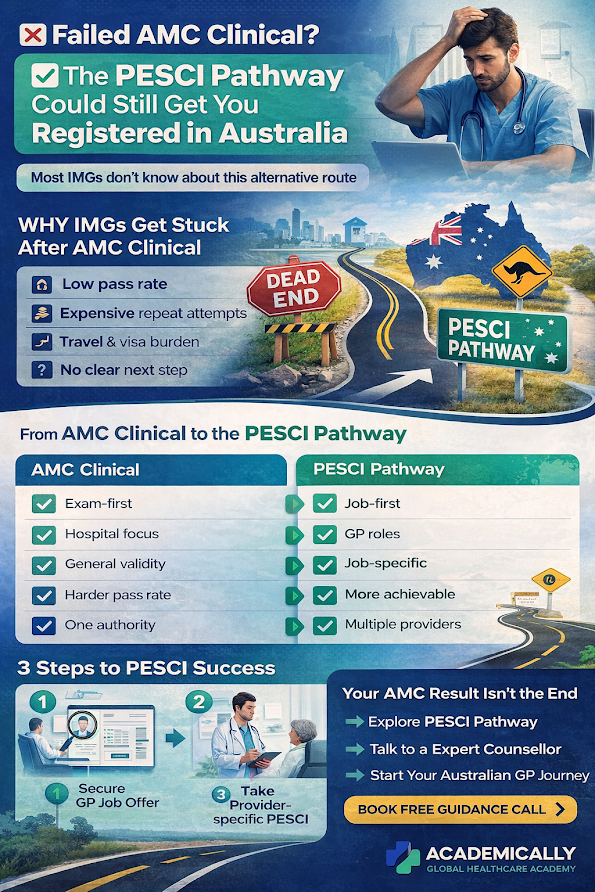
Why the AMC Clinical Exam is Difficult for IMGs?
Many IMGs feel stuck during clinical assessment because:
- It requires physical presence in Australia. This means arranging a valid tourist visa and managing finances. You need months of planning before you head towards a new continent.
- It's expensive. Between exam fees, travel, accommodation, and coaching costs, the financial investment is substantial, and there's no refund if you don't pass.
- The pass rate is notoriously low. However in Academically there’s a 90%+ success rate. How’s that possible? We’ve onboarded only AMC, USMLE, and PLAB (UKMLA) qualified faculty. They’ll guide you based on Australian guidelines, so you have an extra edge over others.
These challenges don't mean you should avoid AMC clinical, but they do mean it shouldn't be your option on the table.
Your Next Steps After AMC Clinical Exam
Many candidates fall into the same trap. They treat exam preparation and job searching as sequential activities. First, pass the exam, then look for jobs.
The reality of the IMG job market in Australia doesn't allow for that luxury anymore. The market is increasingly competitive, and securing a position, especially in general practice, takes time, persistence, and often several rounds of applications.
The smarter approach is to run both tracks simultaneously.
While studying, actively apply to positions on healthcare-specific job portals like Jobslly. Don't filter by role type. GP positions, RMO roles, intern positions. Apply widely. The key is volume and consistency, and always send follow-up emails to recruiters. Most candidates don't, which means those who do stand out.
When a job offer comes, confirm the PESCI provider, then begin targeted preparation immediately.
Preparing for the PESCI Pathway? Here’s What You Need to Know
Preparation quality makes a measurable difference in outcomes for both AMC Clinical and PESCI. If you haven't yet sat AMC Clinical, building a strong clinical foundation from the beginning with structured guidance, mock tests, and feedback significantly improves your chances and reduces the need to repeat the cycle.
Academically's AMC Exam Preparation Course is designed specifically for IMGs working towards registration in Australia. It includes 100+ hours of live and recorded sessions, AI-driven adaptive mock tests, one-on-one feedback, and practical strategies for the MCQ and Clinical components. If you're mapping your path to practice in Australia, it's worth exploring whether structured preparation is the right investment at this stage.
To Conclude with…
IMGs whose skills and interests align with general practice, PESCI is often the more direct route to meaningful, sustainable work in Australian medicine.
The job market is competitive, the licensing system is complex, and the timeline rarely goes exactly to plan. But none of that is disqualifying. IMGs are actively working in hospitals and GP clinics across Australia. People who faced the same setbacks made strategic adjustments and kept going.
Have questions about the PESCI process or AMC clinical preparation?