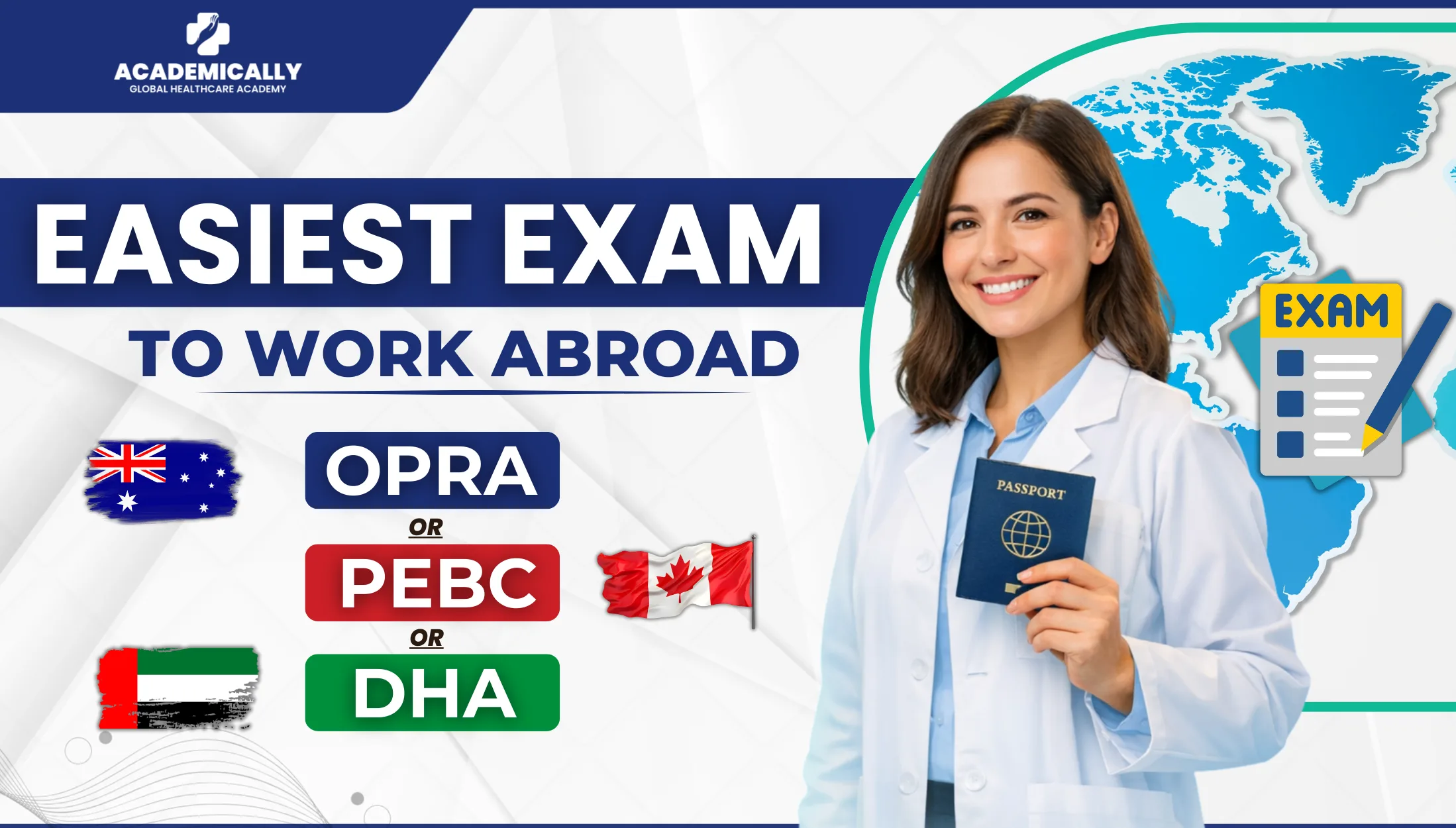
For many pharmacy graduates, working abroad is not just a dream. It is a serious career decision. Better pay, professional growth, international exposure, and structured healthcare systems make countries like Australia, Canada, and the UAE attractive options.
But one question comes up again and again: Which exam is the easiest – OPRA, PEBC, or DHA?
The answer depends on where you want to work and how much effort you are ready to invest. Let’s break this down clearly and honestly.
OPRA Exam – Australia
The OPRA exam stands for Overseas Pharmacist Readiness Assessment. The Australian Pharmacy Council conducts it for overseas-trained pharmacists who want to register and work in Australia.
This pathway applies if you completed your pharmacy degree in countries other than Australia, Canada, Ireland, New Zealand, the UK, or the USA.
What is OPRA exactly?
OPRA is part of the Knowledge Stream Skills Assessment process. It is required to:
- Apply for provisional registration with the Pharmacy Board of Australia
Exam Pattern
- Computer-based exam
- 120 multiple-choice questions
- Duration: 2.5 hours
- Focus: biomedical sciences, pharmaceutical sciences, and clinical sciences related to Australian pharmacy practice
It tests whether you meet Australian standards at entry level.
Cost
- Eligibility check: AUD 810
- Exam fee: AUD 2245
- Skills Assessment Outcome: AUD 300
Difficulty Level
OPRA is considered easy to moderate in difficulty. It is purely MCQ-based, which makes it less intimidating than exams with practical components. However, it requires strong theoretical understanding and knowledge aligned with Australian practice standards.
If you are comfortable with academic concepts and structured preparation, OPRA is manageable.
PEBC Exam – Canada
If you want to practise anywhere in Canada, you must clear the PEBC Qualifying Examination conducted by the Pharmacy Examining Board of Canada.
This is one of the most structured and rigorous pharmacy licensing exams globally.
PEBC Structure
The qualifying process has two main parts:
Part I – MCQ Examination
- Computer-based
- Single day exam
- Tests knowledge application, problem-solving, and professional judgment
- Each question assesses specific competencies
Part II – OSCE (Objective Structured Clinical Examination)
This is where PEBC becomes challenging.
- Conducted on a separate day
- Multiple stations simulating real-life pharmacy scenarios
- Involves interaction with standardized patients or healthcare professionals
- Assesses communication, collaboration, clinical reasoning, and patient counselling
An examiner observes and evaluates your performance using strict criteria.
Difficulty Level
PEBC is widely considered the most difficult among OPRA, PEBC, and DHA.
The reason is simple:
- It tests both theory and practical clinical skills
- The OSCE requires strong communication and real-time problem-solving
- It demands deep understanding of Canadian pharmacy standards
Preparation often takes 6 to 12 months. Many candidates need more than one attempt, especially for the OSCE.
However, clearing PEBC allows you to pursue licensure across Canadian provinces, making it highly rewarding in the long term.
DHA Exam – Dubai
The DHA exam is required to practise as a pharmacist in Dubai under the Dubai Health Authority.
It is mandatory if you want to legally work in Dubai’s healthcare sector.
How the DHA Process Works
Before booking the exam, you must:
- Create a Sheryan account
- Upload documents (degree, passport, experience letters, Good Standing Certificate)
- Complete Primary Source Verification through DataFlow
- Receive eligibility approval
Once eligible, you can book the exam through Prometric.
Exam Pattern
- Computer-based
- Multiple-choice questions
- Flexible booking system
- Conducted at Prometric centers worldwide
Unlike traditional exams, DHA does not have fixed annual exam dates. You select your preferred date based on slot availability.
Results are usually released within 2 to 5 working days.
Difficulty Level
DHA is generally considered easy.
Why?
- It is MCQ-based only
- No OSCE or practical station
- Flexible scheduling
- Faster overall process
Preparation usually takes 1 to 3 months, depending on your background.
Direct Comparison
Let’s compare them practically.
Exam Format
- OPRA: MCQ only
- PEBC: MCQ + OSCE (practical stations)
- DHA: MCQ only
Preparation Time
- OPRA: Around 4–6 months
- PEBC: 6–12 months or more
- DHA: 1–3 months
Difficulty Level (General Perception)
- Easiest: DHA
- Moderate: OPRA
- Most Difficult: PEBC
Country Scope
- OPRA: Australia
- PEBC: Canada
- DHA: Dubai
So, Which One Is the Easiest?
If we compare purely based on exam format, preparation time, and practical complexity, DHA may appear to be the easiest on paper. It is a computer-based MCQ exam with flexible booking and no OSCE component. The process is usually faster once your documents are verified.
However, there are important differences beyond just difficulty.
For OPRA (Australia), you will also need to meet English language requirements for registration. Clearing OPRA alone is not enough. You must prove English proficiency through an approved test before moving toward provisional registration. That adds an extra step compared to DHA.
At the same time, OPRA does not require prior work experience to apply under the Knowledge Stream pathway. This is a big advantage for fresh graduates or candidates without significant professional experience.
In contrast, DHA (Dubai) typically requires a minimum period of professional experience before eligibility approval. While the exam itself is simpler, the experience requirement can become a hurdle for newly graduated pharmacists.
Now let’s talk about PEBC (Canada). This is clearly the toughest route because of the OSCE component. It tests real-time clinical decision-making, communication skills, and patient interaction. It demands deeper preparation and strong practical ability.
So where does that leave us?
If you are looking at short-term ease and faster entry into the workforce, DHA may seem like the simplest option.
But if you are thinking long term migration stability, structured pathway, no mandatory prior experience requirement, and strong global recognition OPRA becomes a very strong choice. It may not be the easiest in terms of preparation, especially with the added English requirement, but strategically it offers long-term advantages.
PEBC remains the most demanding overall, both academically and practically.
In simple terms:
- Easiest exam format: DHA
- Most balanced long-term pathway without mandatory prior experience: OPRA
- Most challenging and rigorous: PEBC
The “easiest” exam depends on your current profile and your future goals.
Final Thoughts
Choosing an exam should not depend only on which one is easier.
Ask yourself:
“Where do I want to build my long-term career?"
“Am I ready for a practical clinical exam like OSCE?”
“Do I want faster entry into the workforce?”
- If your goal is quick international exposure, DHA is a practical choice.
- If your goal is Australia and migration through a structured pathway, OPRA is the right step.
- If you aim for Canada and long-term settlement, PEBC is challenging but highly rewarding.
There is no universally easy exam. There is only one exam that aligns best with your career vision.