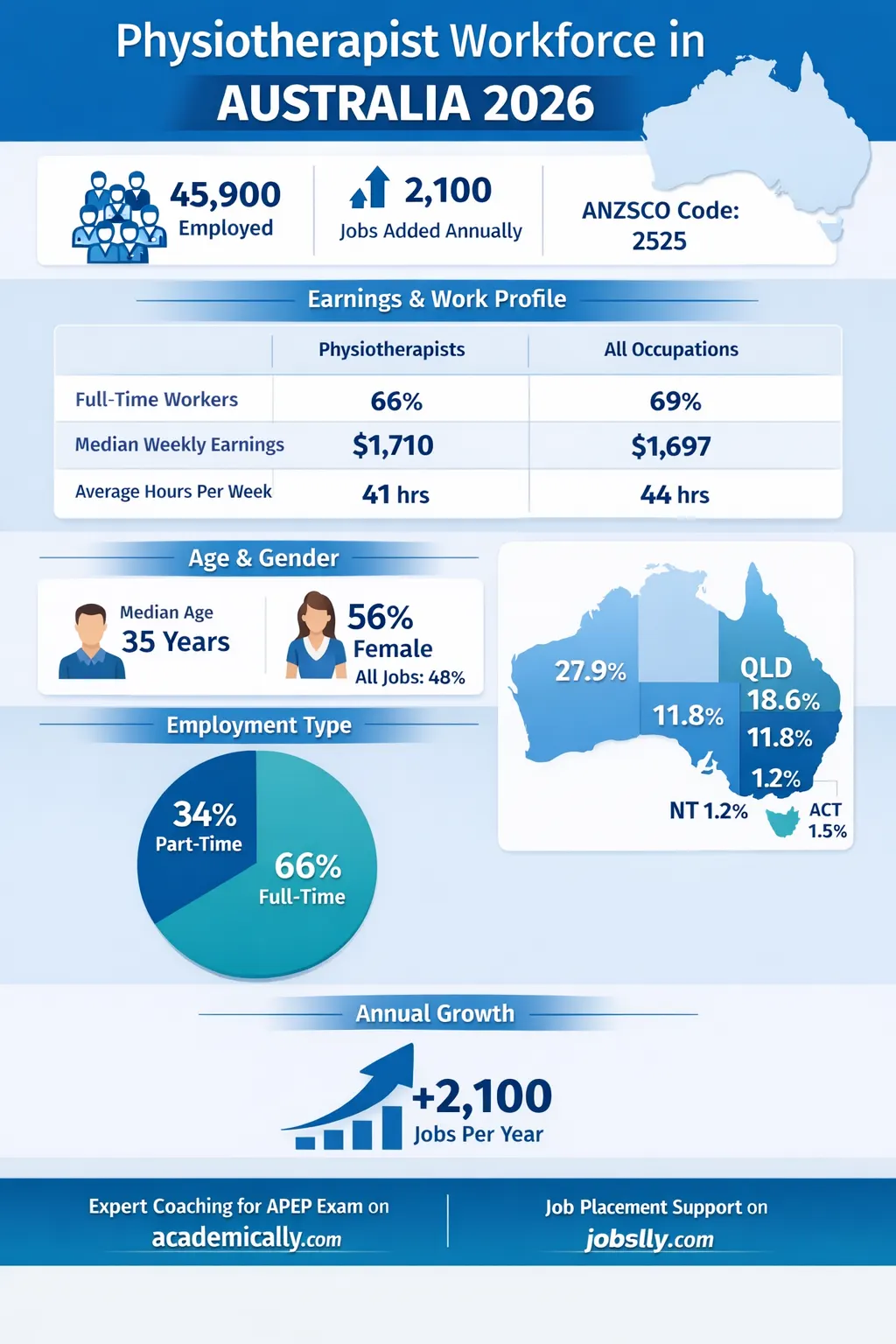
National workforce data says the current physiotherapy workforce is just over 45,900 practitioners. Each year, roughly 2,100 vacancies add up. Recent employment projections forecast a growth of 33.6 per cent between 2025 and 2035.
This is not marginal growth. It is a sustained, structural expansion. Physiotherapists in Australia fall under the skilled occupation list, and there’s a gruelling shortage for it.
If the trajectory continues, the profession will likely approach 48,000 to 49,000 practising physiotherapists by 2026.
But numbers alone do not tell the full story. Where those jobs sit, how they are funded, and who fills them matter just as much.
Why is the Growth so Big? Is there any Hidden Agenda?
Australia’s healthcare demand has shifted over the last decade.
The population continues to age, and with ageing comes mobility issues, falls prevention, joint replacements, chronic disease management, and long-term rehabilitation needs. Physiotherapists sit directly in that pathway.
The expansion of disability services under the NDIS has also reshaped allied health demand. Community-based care models require clinicians who can work outside traditional hospital settings.
There has also been a noticeable shift in patient behaviour. People seek earlier intervention. Sports participation remains high across age groups. Workplace rehabilitation still requires structured follow-up.
These are not temporary spikes. They reflect demographic and policy trends that will remain in place well beyond 2026.
Is there a Distribution Problem?
Australia does not face a blanket shortage everywhere. Instead, it faces a distribution challenge.
In Sydney and Melbourne, new graduates often compete for private musculoskeletal roles. Employers in these cities can afford to be selective. That creates the impression that the market is tight.
Drive a few hours outside those capitals and the situation changes. Regional Queensland, parts of rural New South Wales, Western Australia’s remote areas, and the Northern Territory continue to report allied health gaps. Workforce modelling in several states confirms the need for additional physiotherapists over the next decade.
For candidates willing to relocate, that imbalance creates opportunity.
In regional settings, hiring processes move faster. Employers often discuss relocation support early. Negotiation feels different because the need is clearer.
How much Salary does a Physiotherapist Earn?
The median weekly earnings of around AUD 1,710 provide a reference point. It reflects a broad mix of public and private sector roles.
Public health roles follow structured pay scales. Increments depend on experience and classification level. These positions offer stability and predictable progression.
Private practice can look different. Income may depend on patient volume, commission structures, or ownership stakes. Early-career earnings vary widely depending on clinic size and mentorship quality.
Regional employers frequently offer additional benefits. Some include salary loadings, relocation assistance, housing support, or professional development funding. In high-demand areas, experienced clinicians often secure stronger packages than their metropolitan peers.
International Physiotherapists and Migration
Australia has historically relied on internationally trained health professionals to support regional services. That pattern continues.
Physiotherapists remain eligible under skilled migration pathways. Employer sponsorship is more common in regional areas where documented workforce gaps exist.
The registration pathway requires assessment through the new Australian Physiotherapy Entry Pathway (APEP), an English language proficiency test, and national registration. The process demands intense preparation, but it remains achievable for well-qualified candidates because you can complete 80% of the registration process from the comfort of your home.
Demand evidence, particularly in regional areas, strengthens employer sponsorship cases.
Where the Work is Concentrated
Demand spans multiple settings. Aged care continues to grow alongside demographic ageing. Disability services remain a steady source of referrals. Public hospitals maintain consistent rehabilitation needs.
Private musculoskeletal clinics operate nationwide. Women’s health has seen noticeable growth in patient awareness. The profession no longer sits inside one narrow pathway. Flexibility remains one of its strongest advantages.
What are the Current Trends in the World of Physiotherapy?
Care delivery models are slowly evolving.
Hybrid consultations, where clinicians combine in-person treatment with remote follow-up, are more common than before. Data tracking tools influence outcome measurement. Chronic pain management has expanded into multidisciplinary models.
At the same time, clinic owners increasingly value business literacy. Scheduling efficiency, billing compliance, and patient retention matter alongside clinical skill.
The profession is growing, but expectations are becoming more complex.
What are some of the Challenges?
Growth does not bring down stress.
Private practice environments sometimes carry high productivity expectations. Rural placements can feel professionally isolating without structured supervision. Early-career clinicians often discover that university training did not fully prepare them for business realities.
Those realities do not weaken the profession’s outlook. They simply mean career planning requires thought.
Is Physiotherapy as a Career Worth It in 2026?
When you look at long-term projections, demographic demand, and regional shortages together, physiotherapy remains a stable and expanding career option in Australia.
It offers employment growth that exceeds many other fields. It provides geographic flexibility. It supports migration pathways. It allows progression into specialisation or business ownership.
The key variable is location and preparation.
Academically works with healthcare professionals preparing for licensing and registration aligned with the Australian workforce demand.
Our support includes structured exam preparation, academic mentoring, and guidance tailored to registration requirements. Cleared APEP? We will also help you find 100% verified jobs in India and beyond based on your qualification and expertise.
To Conclude with…
Physiotherapy as a career continues to expand in response to structural healthcare needs. With informed planning and flexibility, 2026 presents a genuine opportunity rather than uncertainty.