The stigma is loud. The science, and the salaries, tell a completely different story
A dinner table conversation with laughter and good food might just change into pin drop silence. The doctor in the family feels mentally burned out and finally gathered some courage to announce leaving clinical practice. The pin drop silence is not exactly confusion. It is a sort of judgement that carries preconceived notions by the society. A decade of education, sacrifice, and licensing exams feels somehow wasted if you are not standing in a clinic or operating theatre. This belief is costing brilliant healthcare professionals their peace, their potential, and their mental health.
However, scientific evidence and lived experiences of healthcare professionals say non clinical careers are as respectable and rewarding as clinical ones. Many healthcare professionals win big in non clinical careers like drug safety, medical affairs, and academics. How? Let's get to know more and feel inspired.
Burnout Among Healthcare Professionals in Clinical Career
Talented medical professionals are spending day and night working relentlessly in emergency departments. The prolonged working hours cause burnout at alarming rates.
The stigma keeps them following the same routine rigorously. Pharmacists in dispensary roles they have outgrown. It keeps foreign medical graduates in limbo, believing their only option is clearing one more exam. It keeps PG specialists trapped in 80-hour weeks. They grieve personal life that clinical practice has made impossible.
Take for an instance, Dr. Shweta had spent over a decade in Obstetrics and Gynaecology, an MBBS, MS, Fellowship in ART, teaching junior residents at Teerthanker Mahaveer University (TMU). She loved her work. But after ten years of being constantly available, she found herself asking a question she had never allowed herself to ask before: "What does my life look like if it belongs a little more to me?"
Does that question make someone a lesser doctor? Isn't it a very human question?
A peer-reviewed study published in BMC Medical Education (Kim et al., 2013), conducted across six Korean medical schools with 1,388 student respondents, found that students planning non-clinical careers thought about their career plans significantly more frequently than their clinical-track peers.
The study also found that a majority of all students, not just those considering non-clinical paths agreed that it is necessary for medical graduates to pursue careers outside clinical practice, and that medical schools need to better support this.
Interestingly, an exclusive feature published by the NEJM CareerCenter in 2019 highlighted that non-clinical opportunities for physicians have increased dramatically over the last two decades.
Areas like pharmaceutical drug development, medical technology, pharmacovigilance, utilisation management, regulatory affairs, health informatics, medical writing, hospital leadership, and public health now actively seek clinicians for their medical expertise and decision-making ability.
The report also noted that many doctors exploring these fields were not “giving up” medicine. But they are looking for work that felt more aligned with their personal goals, family life, intellectual interests, and long-term wellbeing.
The Demand for Non-Clinical Healthcare Professionals Has Never Been Higher: What's the Update from 2026?
The perception that non-clinical healthcare careers are "backup options" no longer reflects the reality of today's healthcare industry.
The global pharmaceutical, biotechnology, medical device, CRO, and digital health sectors are expanding rapidly, creating sustained demand for clinicians who understand medicine beyond textbooks. Medical Affairs, Pharmacovigilance, Clinical Development, Regulatory Affairs, Health Economics, Real World Evidence, Medical Information, and Clinical Research have become strategic functions rather than support departments.
Industry surveys continue to show Medical Affairs among the most sought-after physician functions within pharmaceutical companies because clinicians are uniquely positioned to communicate scientific evidence, engage with healthcare professionals, support clinical trials, and improve patient outcomes. In India, Medical Affairs and Pharmacovigilance consistently remain among the largest physician hiring divisions in the pharmaceutical industry.
The opportunity is equally visible in recruitment. Hundreds of Medical Affairs, Drug Safety, Pharmacovigilance and Regulatory Affairs positions are advertised across multinational pharmaceutical companies, CROs, and healthcare consulting firms every month, reflecting sustained industry demand rather than a temporary hiring trend.
Why is a Non Clinical Career Equally Respectable as Clinical One?
A study found something counter-intuitive about students drawn to non-clinical careers. They did not have weaker motivation for entering medicine. They were not less idealistic. They entered medicine for the same reasons as their clinical-track peers. It is to make a difference, to understand human biology, to contribute to healthcare.
What separated them was not ambition but the shape of it. They tended to find rote learning less engaging. They wanted to explore disciplines beyond a single patient interaction. They thought about their careers more often and more strategically than those heading into clinical practice.
That is not a profile of someone running away from medicine. That is a profile of someone thinking bigger than medicine's narrowest definition of itself. The same study found that more than 55% of candidates intend choosing non-clinical careers. No, it's not desperation or FMGE failure. The most common reason was personal interest in the field and a burning passion to do something different.
Another study further reinforced this idea through physicians who moved into non-clinical spaces while continuing to create meaningful healthcare impact.
Some transitioned into pharmacovigilance roles monitoring adverse drug reactions for global pharmaceutical companies. Others entered medical writing, healthcare leadership, clinical informatics, coaching, consulting, or preventive medicine.
Many described their decision not as “leaving medicine,” but as helping patients and healthcare systems on a much larger scale.
Wondering if your clinical background qualifies you for a role in Medical Affairs, Drug Safety, or Clinical Research? Several healthcare professionals have made this exact transition. You can too!
Common Myths About Non-Clinical Careers
Myth 1: "Only doctors who fail PG or licensing exams choose non-clinical careers."
Reality couldn't be further from the truth.
Many professionals entering Medical Affairs, Drug Safety, Clinical Development and Regulatory Affairs are experienced specialists, consultants, super-specialists, pharmacists, dentists, physiotherapists and researchers who voluntarily choose these careers after years of successful clinical practice.
Research published in BMC Medical Education found that students interested in non-clinical careers were not less motivated than future clinicians. Instead, they spent significantly more time thinking strategically about their careers and were driven primarily by genuine interest rather than academic inability.
Myth 2: "Leaving clinical practice means earning less."
This may have been true decades ago. Today, it often isn't.
The NEJM CareerCenter observed that physicians transitioning into pharmaceutical medicine, consulting, utilisation management, medical technology, and physician advisory roles frequently earn salaries comparable to clinical practice while gaining significantly better work-life balance.
International physician compensation in many non-clinical roles commonly ranges between US$160,000 and US$300,000 depending on experience and responsibility.
In India, pharmaceutical physician compensation has also evolved substantially. Published surveys have reported entry-level pharmaceutical physician salaries of ₹10-20 LPA, with senior managers commonly earning ₹30-40 LPA, and today's market frequently exceeds these ranges for experienced professionals in Medical Affairs, Clinical Development and Drug Safety.
Myth 3: "Non-clinical professionals don't impact patients."
A Drug Safety Physician who identifies a serious adverse event can influence medicine safety across millions of patients.
- A Medical Science Liaison helps doctors correctly interpret emerging evidence.
- A Clinical Development Physician contributes to bringing life-saving therapies to market.
- A Regulatory Affairs expert ensures medicines reaching patients meet global safety standards.
Their patients may never meet them personally, but the scale of their impact is often measured in countries rather than clinics.
Myth 4: "There isn't enough demand."
The data says otherwise.
Medical Affairs remains one of the highest-recruiting physician portfolios within India's pharmaceutical industry, while Pharmacovigilance continues expanding because of increasing global regulatory requirements, post-marketing surveillance obligations, biologics, biosimilars, and complex clinical trials.
Large pharmaceutical companies, CROs, medical device manufacturers and healthcare consulting firms continue hiring doctors, pharmacists, dentists and life science professionals into these roles throughout 2026.
Myth 5: "You'll stop being a healthcare professional."
A medical degree does not lose its value because your workplace changes.
Whether reviewing adverse drug reactions, supporting oncology clinical trials, educating physicians about new therapies, evaluating regulatory submissions or leading patient safety initiatives, your medical judgement remains central to the job.
Many professionals in Medical Affairs continue publishing research, speaking at scientific conferences, training healthcare professionals and contributing directly to treatment guidelines.
You haven't left healthcare. You've simply changed where your expertise creates the greatest impact.
Let's Hear it From the Candidates Who Took a Leap of Faith to Listen to Their Heart and Soul
Abstractions and statistics only go so far. What convinces people is lived experiences. Here are some of the journeys of healthcare professionals who stepped off the prescribed path and found something better waiting for them.
Dr. Laxmi Bhardwaj, MBBS, DNB

Dr. Laxmi was a doctor who had everything on paper. You name it. An MBBS, a DNB, financial stability, and genuine patient impact. But her child was growing up and she was barely present. Clinical practice, with its long hours and emotional weight, had become less a calling and more a constraint. Through Academically's Executive Programme in Clinical Drug Development, she earned Golden Honours in her course, scoring above 95% and bagged a Clinical Safety Physician role at Tata Consultancy Services at 32 LPA in less than 30 days. "A year ago, this would have seemed unrealistic", she exclaims. Now she is also positioned to convert her clinic into a clinical trial site, earning additional recognition as a Sub-Investigator and Principal Investigator.
Placed: Clinical Safety Physician, TCS, 32 LPA
Dr. Neha, MBBS, Fellowship in Pulmonology & Critical Care
Is there anything She can't do? A true embodiment of modern day Durga Maa, Dr. Neha was studying medicine in China while simultaneously teaching and running a small business. She was also managing ICU emergencies before leading a clinic in India. Dr. Neha’s journey has always been inspiring, how she utilised her experience and degree in medicine into entrepreneurship. Her Fellowship in Pulmonology and Critical Care sharpened her clinical instincts, while years of leadership taught her how to manage people, systems, and pressure with clarity. Through Academically’s Medical Affairs internship, she is now transitioning into the pharmaceutical industry with ambitions far beyond conventional practice. “I’m not just stepping into pharma as a doctor,” she says. “I’m entering with the mindset to build, innovate, and lead globally.”
Doctor, Entrepreneur, Medical Affairs Intern and a Woman of Substance
Dr. Salman Junaid, PharmD
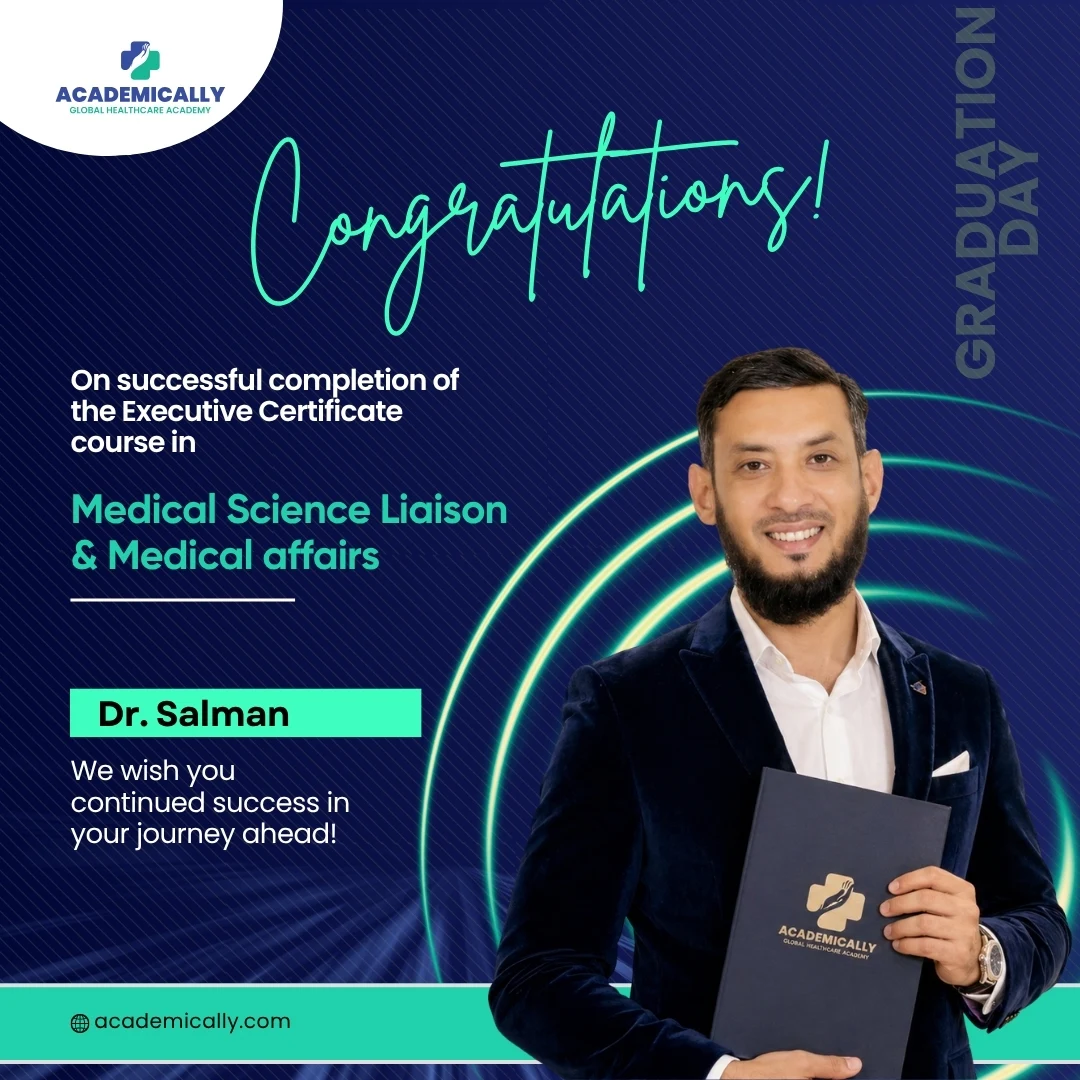
Dr. Salman had a decade of experience across clinical pharmacy and clinical research in India and Saudi Arabia. He came back from Jeddah knowing exactly what he wanted, Pharmacovigilance and Medical Affairs, but not how to get there. After enrolling in Academically's upskill course, the mock interviews, capstone project, and structured guidance connected his entire journey into a coherent professional identity. Within 30 days of completing the programme, he received an offer from Oviya Medsafe as a Pharmacovigilance Associate at 8 LPA. "I went all the way to Saudi Arabia to realise that what I was looking for was always here." he exclaimed with happy tears.
Placed:Pharmacovigilance Associate, Oviya Medsafe · 8 LPA
Dr. Vijetha, MBBS, Fellowship in Emergency Medicine
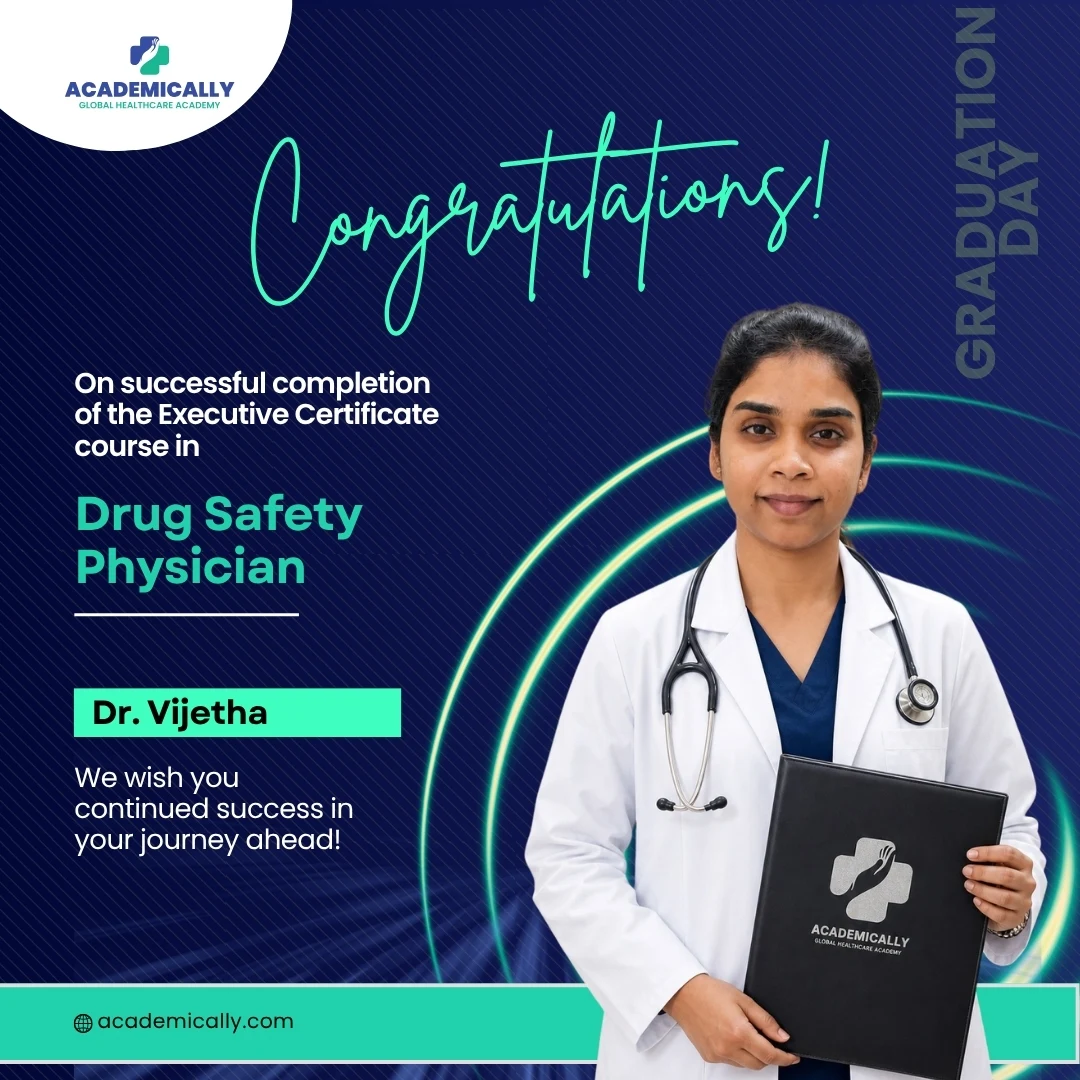
Four years in emergency departments across Andhra Pradesh in Pace Hospitals, Medicover, OMNI RK Hospital. Dr. Vijetha was flawless at her work, but emergency medicine takes something from you every single day. She wanted to trade the chaos of one patient at a time for ensuring the safety of medications reaching millions. Through Academically's Drug Safety Physician and Pharmacovigilance course, the experience she had accumulated managing adverse drug reactions in real emergencies became a direct professional asset, not an afterthought.
Placed: Drug Safety Physician Programme Graduate, Academically
Dr. Rose, BDS
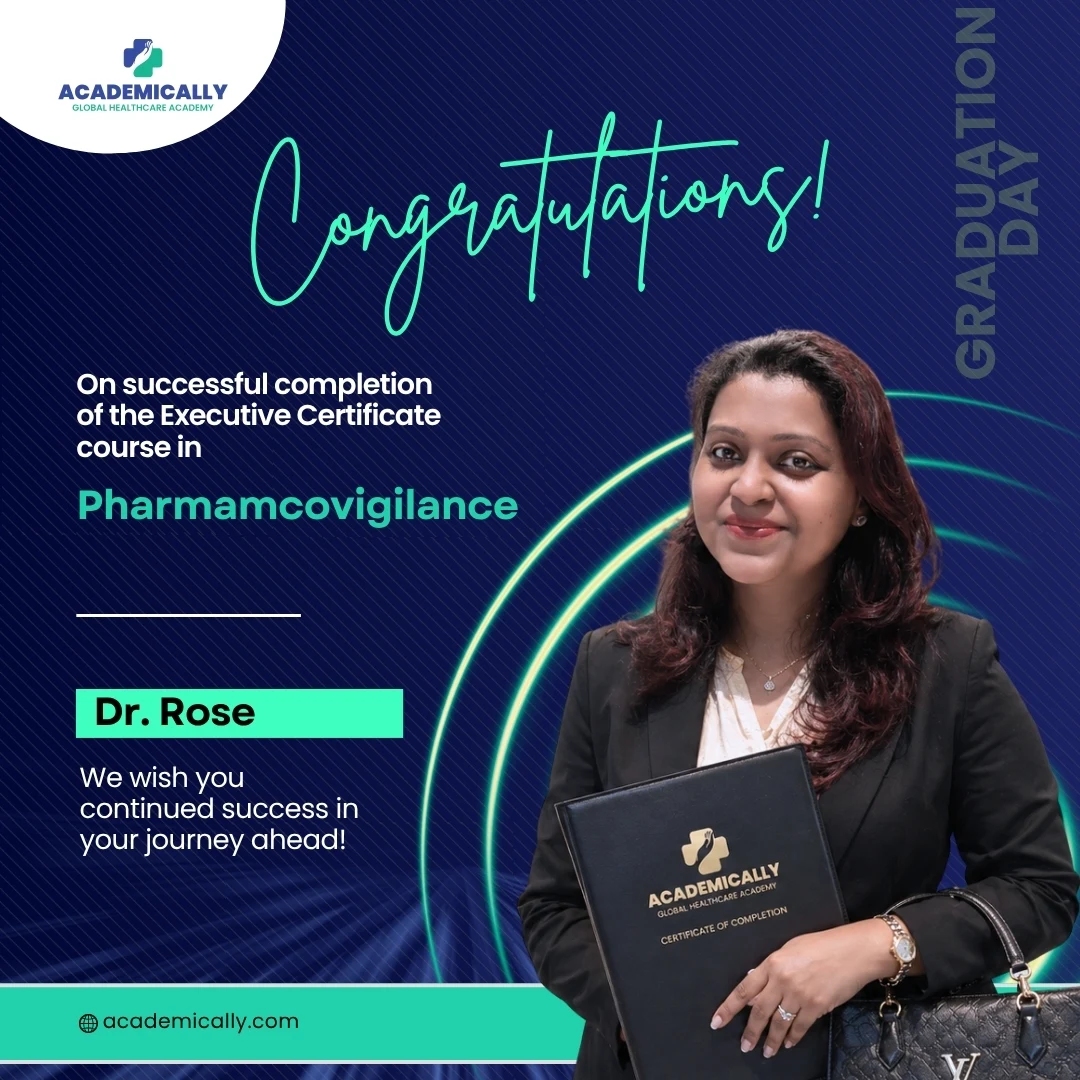
After earning her BDS from Government Dental College, Aurangabad, Dr. Rose worked in private clinics across Pune and Nashik before marriage and Army life changed everything. Frequent military postings, including Srinagar and Jammu Cantonment, made traditional dental practice impossible. Searching for a career that could move with her life, she got to know about a course on Drug Safety and Pharmacovigilance through Academically. Despite returning to studies after more than a decade, she found the transition deeply empowering. Today, she graduates with a Postgraduate Certification in Drug Safety and Pharmacovigilance, a career path that offers both professional growth and the possibility of remote work, something uniquely valuable for military families.
Placed: Postgraduate Certification Graduate, Drug Safety & Pharmacovigilance
Is a Non-Clinical Career Worth it? What's the Verdict?
Let us be honest about what "respect" means, and where it actually comes from.
Respect in clinical medicine comes from visible sacrifice. The long hours, the night duties, the weight of being someone's last hope. People can see it. They can name it. They have cultural scripts for it. The doctor who never sleeps is a familiar archetype.
Non-clinical respect is different. It might not honk aloud but the impact is felt for years to come. It comes from a pharmaceutical regulatory professional who catches a drug interaction signal before a safety alert is needed. It comes from a Medical Science Liaison who helps a community oncologist understand a clinical trial result and changes their prescribing approach. It comes from a Drug Safety Physician whose case narrative contributes to a label change that protects ten million patients.
The impact is enormous. The hours are generally more structured, career progression is well-defined, and compensation has become increasingly competitive.
Across India, experienced professionals in Medical Affairs, Clinical Development, Drug Safety and related pharmaceutical physician roles commonly progress into compensation brackets exceeding ₹25–50 LPA, while global opportunities can be substantially higher depending on geography, expertise and leadership responsibilities.
At the same time, employers increasingly offer hybrid work models, international collaboration, scientific leadership opportunities and significantly better work-life balance than many traditional hospital roles.
Your Clinical Background Is an Asset, Use it Cleverly, Not Stressing it Out
Academically's Executive Programmes in Medical Science Liaison, Drug Safety & Pharmacovigilance, and Clinical Drug Development are built for healthcare professionals who are ready to expand their impact.
Why Staying in the Wrong Clinical Career Can Cost More Than Leaving
Don't become the next tragedy by just staying with no progress. A specialist who has not genuinely engaged with their work in three years, is still showing up because leaving would mean explaining themselves. Somewhere a pharmacist is brilliant, analytical, curious BUT spending 8 hours a day dispensing prescriptions that require none of those qualities. A foreign medical graduate who has spent two years attempting one exam because no one told them there was another option.
NEJM CareerCenter observed that many physicians delay looking for alternative careers due to fear of judgement from mentors, peers, or family. Several doctors admitted they worried others would think they had “failed” or “gone to the dark side.”
But over time, many realised that the criticism was temporary while the personal and professional satisfaction they gained was long-term. Younger healthcare professionals, especially, look for flexibility, meaningful work, mental wellbeing, and public image.
Dr. Shweta put it simply: "After everything I have given to medicine, it is okay to finally build something for myself too." That is not being selfish or betrayal of medicine. That is medicine, finally, being fair to the person who chose it.
A non-clinical career in healthcare is not a step down, a detour, or a resignation letter to your ambitions. For the right person, at the right moment, it is the most professional thing you can possibly do.
In fact, many physicians who transitioned into non-clinical careers continue to describe themselves as deeply connected to patient care, just differently. It can be through drug safety, healthcare technology, policy, education, clinical research, or medical leadership. They are still influencing patient outcomes, often at a scale far larger than a single clinic or hospital room could allow.
The question was never whether non-clinical careers are respectable. The question is whether you are ready to stop asking for permission to pursue one.
Do you want to become the next big thing in your non clinical career? Don't worry, we will help you navigate your path.