Australia stands to be one of the most attractive destinations for physiotherapists worldwide. It is due to their high salary, work-life balance and one of the easiest registration pathways. There are more than 40,000 physiotherapists employed nationally. They enjoy a great work-life balance with continued annual growth.
In this blog, you will get to know how to become a physiotherapist in Australia. You will also receive updated information about the new entry pathway registration details. Stay tuned for career prospects and visa options in 2026.
Are Physiotherapists in Demand in Australia?
You can earn a huge salary as a physiotherapist in Australia. Recent data show an average annual income of approximately AUD 95,000. Experienced clinicians earn above AUD 100,000 to AUD 120,000 per year. The figures depend on location, experience, and specialisation. Regional areas pay more to their physios due to the shortage and high demand.
Demand is mainly strong in rehabilitation, geriatric care, sports medicine, and disability support services. Employers are actively seeking both domestic and internationally trained physiotherapists to fill critical skills gaps. This demand is reflected in ongoing recruitment and visa sponsorship opportunities, especially in regional and underserved areas of the country.
It means there are strong employment prospects nationally and regionally. Especially in musculoskeletal care, sports rehabilitation, community health, and aged-care settings.
Australian Physiotherapy Entry Pathway (APEP) for Overseas Trained Physiotherapists
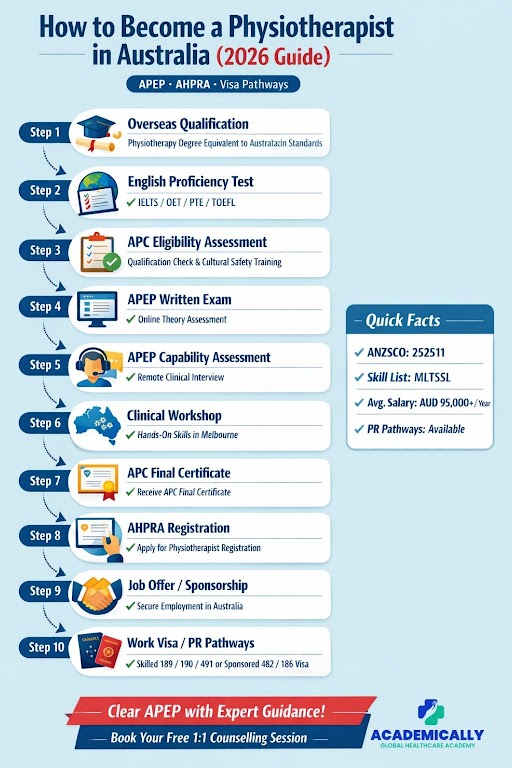
The Australian Physiotherapy Entry Pathway (APEP) has replaced the older Standard Assessment Pathway from 1 October 2025. It is the official entry pathway managed by the Australian Physiotherapy Council (APC) to assess the competence of internationally trained physiotherapists who wish to work and register in Australia.
APEP is designed to make the assessment process more accessible, efficient, and reflective of clinical practice in the Australian context. You can complete almost the whole of the registration process from the comfort of your home.
Key Stages of APEP
- Eligibility Assessment
You must provide documented proof of your overseas physiotherapy qualification and clinical experience. - Cultural Safety Training
It is a mandatory step in which you will demonstrate understanding of culturally safe practice in Australia. - Remote Written Assessment
A theory-based examination that evaluates your core physiotherapy knowledge according to Australian standards. - Capability Assessment
A remote, live, open-book oral exam that tests clinical reasoning, communication, and applied knowledge. This is a new feature of APEP.
Did you just see… You can complete most of the process online, from the comfort of your home, and there’s no clinical assessment like earlier.
5. Face-to-Face Clinical Workshop
A full-day practical workshop conducted in small groups in Melbourne. It mainly focuses on real-world clinical skills pertaining to Australian standards.
Once you successfully complete all stages, you receive a Final Certificate from the APC, confirming you meet the Australian physiotherapy practise standards.
Registration and Licensing With AHPRA
Do you want to practise as a licensed physiotherapist in Australia? Then it is essential to obtain general registration with the Australian Health Practitioner Regulation Agency (AHPRA).
Registration requires:
- A recognised qualification or APC Final Certificate
- Meeting AHPRA’s standards for English language proficiency and professional practice
- Demonstrating fitness to practise (health and professional indemnity requirements)
Once registered, you can work as an independent clinician in hospitals, private practices, community health, sports clinics, or aged-care facilities.
Skills Assessment and Classification- ANZSCO 252511
A physiotherapist (ANZSCO 252511) is classified as Skill Level 1. It means you must have a bachelor's degree or higher in physiotherapy and a positive Skills Assessment to qualify for skilled visas.
The Australian Physiotherapy Council (APC) is the official assessing authority for this occupation. It evaluates whether your education and experience meet the Australian standard.
A positive skills assessment is a prerequisite for Expressions of Interest (EOI) and visa lodgement under points-tested and sponsored immigration streams.
English Language Requirements
You must demonstrate competent English proficiency skills through one of the standard tests (IELTS, OET, PTE, TOEFL iBT). Standard minimum requirements are typically:
- IELTS: 7.0 overall with no band less than 7.0
- OET: B in all subtests and all skills except writing (C+ accepted)
- PTE Academic: 65 overall with minimum communicative scores (56 accepted in writing)
- TOEFL iBT: Total and section requirements as specified (Minimum total score of 94 and section requirements as specified)
Meeting high levels of English proficiency is important for both registration with AHPRA and scoring points for skilled migration.
Visa Options for Physiotherapists
Physiotherapists can pursue several visa pathways depending on their circumstances:
Skilled Migration Visas
- Subclass 189 – Skilled Independent (no sponsor required)
- Subclass 190 – Skilled Nominated (state/territory nomination)
- Subclass 491 – Skilled Work Regional (Provisional) (regional nomination)
Physiotherapists on the MLTSSL can apply for these visas, provided they have a positive skills assessment and meet Points Test requirements.
Employer-Sponsored Visas
- Subclass 482 – Temporary Skill Shortage
Allows work in Australia for up to four years with employer sponsorship. - Subclass 186 – Employer Nomination Scheme
A permanent residency pathway once you have worked under a temporary stream.
Temporary Graduate Visa
- Subclass 485 – Graduate Work
For recent graduates from Australian institutions on an Australian student visa. Physiotherapy graduates can use this to gain work experience.
Career Roles and Specialisations
Completed your registration? Congratulations! You can now apply to jobs as physiotherapists in Australia. These are some of the range of specialisations and career pathways you can explore.
Clinical Physiotherapist
Work in hospitals, outpatient clinics, private practices, rehabilitation centres, or community health services. Your daily focus will be patient assessment, therapy planning, and functional rehabilitation.
Sports Physiotherapist
Manage sports injuries and help athletes improve performance. These roles are especially prominent in Australia’s active sports culture.
Geriatric Physiotherapist
Support older adults to maintain strength, mobility, independence, and quality of life, particularly in aged-care facilities.
Pediatric Physiotherapist
Specialise in treating infants, children, and adolescents. Help alleviate developmental, neuromuscular, or orthopedic issues.
Occupational Physiotherapist
Focus on workplace health, ergonomics, injury prevention, and rehabilitation after workplace injuries.
Research and Academic Roles
Participate in research or teaching positions in universities or research institutions to help advance physiotherapy practice.
Average Salary and Job Openings
Physiotherapists in Australia earn competitive salaries that reflect qualification level, experience, and location:
- Average annual salary: Around AUD 90,000 to AUD 100,000+ (varies by state and role)
- Salaries can exceed this in senior clinical, specialised or managerial roles
According to recent workforce projections, there is a growing demand for physiotherapists across multiple settings, translating into thousands of job openings annually. The Australian Physiotherapy Council is inviting applications for overseas physiotherapists. It is the best time for you to make a decision.
Day-to-Day Roles and Responsibilities of a Physiotherapist
Physiotherapists play a multifaceted role in healthcare, including:
- Assessment: Evaluating movement, strength, flexibility, and functional limitations.
- Treatment Planning: Designing tailored treatment plans.
- Therapeutic Interventions: Manual therapy, exercises, modalities, and mobility training.
- Pain Management: Addressing chronic and acute pain conditions through evidence-based approaches.
- Rehabilitation: Supporting recovery post-injury or surgery.
- Education: Teaching patients and families about self-management and injury prevention.
- Collaboration: Working within multidisciplinary healthcare teams.
Tips for Success
- Prepare Early for APEP: Take a good APEP coaching that has experienced mentors, use official resources, expert-recommended books and connect with peers.
- Build Clinical Experience: Relevant experience strengthens both migration and employment prospects.
- Research Visa Streams: Points-tested visas like 189/190 require strong English scores and strategic points claims.
- Engage with Migration Professionals: Registered migration agents can provide personalised advice.
Conclusion
Becoming a physiotherapist in Australia in 2026 is an achievable and rewarding professional journey. With structured pathways like APEP, clear licensing standards and robust visa options, international physiotherapists have strong opportunities to build a long-term healthcare career.
Your success depends on careful planning, preparation for the competency assessments, meeting registration standards, and selecting the right visa pathway that aligns with your professional and personal goals. With the right strategy, you can establish a fulfilling physiotherapy career in Australia’s dynamic health system.