Thousands of Indian pharmacists choose Canada every year. The reason is simple: they get better career growth, pay, and work-life balance. So you are not alone on this journey.
The process is structured and transparent. The challenge lies in planning and finding the right strategy. In this guide, we’ll walk you through everything, step by step, on how to become a pharmacist in Canada from India.
Who Controls Pharmacy Licensing in Canada?
In Canada, pharmacists are certified by the Pharmacy Examining Board of Canada. It is the national body that evaluates your qualifications and conducts exams.
However, PEBC certification is not your final license. You also need provincial registration after PEBC for your province, like Ontario, BC, Alberta, etc.
The Big Picture: Your Journey in 5 Steps
Here’s the complete roadmap:
| Step | What You Do |
| 1 | Document Evaluation |
| 2 | PEBC Evaluating Exam |
| 3 | PEBC Qualifying Exam (Part 1 + Part 2) |
| 4 | Internship and Practical Training |
| 5 | Provincial Licensing |
Let’s break each step down.
Step 1: Document Evaluation
This is where your Indian degree is checked.
What you submit:
- Degree certificate
- Transcripts (sent by your university)
- Identity documents
- License (if applicable)
Fees (2026):
Document Evaluation- CAD 715 (INR 49,335)
Timeline insights:
- Processing can take weeks to months, depending on document submission
- Once approved, your eligibility is valid for 5 years to complete exams
This step is often underestimated. Delays usually happen because universities are slow in sending transcripts.
Step 2: Evaluating Exam
If you studied outside Canada (like India), you must take this exam.
What it tests:
- Basic pharmacy knowledge
- Clinical understanding
- Pharmaceutical sciences
Fees:
Evaluating Exam- CAD 910 (INR 62,790)
Key facts:
- Required for most Indian graduates
- Must pass to move ahead
This exam is not about memorising textbooks. It tests how you apply knowledge.
Step 3: PEBC Qualifying Exam- The Final Academic Barrier
This is your final certification exam, and it has 2 parts.
Part 1: MCQ Exam
- Computer-based
- Tests clinical decision-making and problem-solving
Part 2: OSCE (Practical)
- Real-life patient scenarios
- Communication + clinical skills
Fees:
| Exam | Fee (CAD) | Fee (INR) |
| Part 1 (MCQ) | $855 | 59,000 |
| Part 2 (OSCE) | $1,915 | 1,32,135 |
Total estimated cost: CAD 3,680 (INR
What nobody tells you is that the OSCE is where many candidates struggle. It’s less about knowledge and more about communication.
The English Problem Nobody Talks About
Even if you clear exams, communication matters.
In OSCE:
- You must speak clearly
- Show empathy
- Explain medications simply
Many Indian pharmacists fail not due to lack of knowledge, but due to communication gaps.
Exam Dates and Scheduling
- Exams are held multiple times a year
- You receive scheduling details after the application
- Booking is done via Prometric centres
Apply early because slots fill fast.
Step 4: Internship- Your Real Entry Into Canada
After exams, you must complete:
- Practical training hours
- Under a licensed pharmacist
This depends on the province (Ontario, BC, etc.). You can find part-time internships on healthcare job sites like Jobslly.
Step 5: Provincial License- Your Final Goal
Each province has its own regulatory body.
You will need:
- PEBC Certificate
- Internship completion
- Language test (IELTS often required)
- Jurisprudence exam (law + ethics)
Total Cost Breakdown in 2026
The plan to become a pharmacist in Canada from India requires an investment of both time and money. Let’s simplify your financial planning:
| Component | Estimated Cost (CAD) | Cost in INR |
| Document Evaluation | $715 | 49,335 |
| Evaluating Exam | $910 | 62,790 |
| Qualifying Exam Part 1 | $855 | 59,000 |
| Qualifying Exam Part 2 | $1,915 | 1,32,135 |
| Total | $3,680 CAD | 2,53,950 |
Add extra costs for:
- Study materials
- Coaching (optional)
- Travel and visa
Syllabus Snapshot
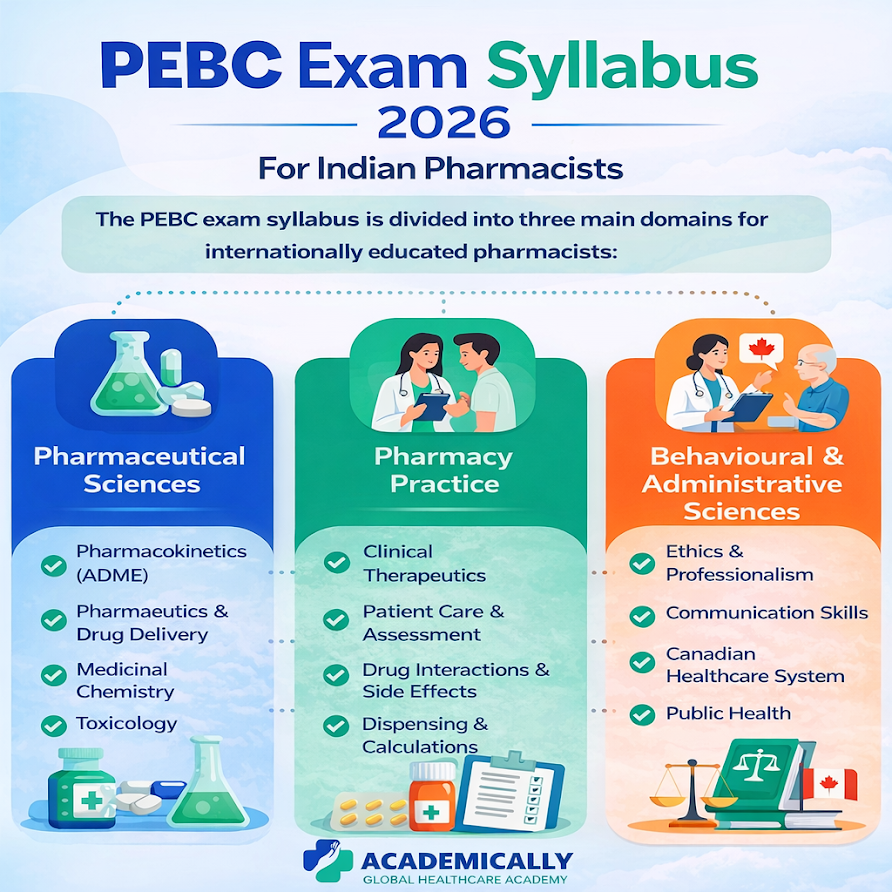
The PEBC exams focus on:
1. Pharmaceutical Sciences
- Pharmacokinetics (ADME)
- Pharmaceutics & drug delivery
- Medicinal chemistry
- Toxicology
2. Pharmacy Practice (50%+ weight)
- Clinical therapeutics (cardio, diabetes, infections, etc.)
- Patient assessment & care plans
- Drug interactions & adverse effects
- Calculations & dispensing
3. Behavioural & Administrative Sciences
- Ethics
- Communication skills
- Canadian healthcare system
- Public health & professionalism
The focus is on application, not rote learning.
Common Mistakes Indian Students Make
Let’s be honest, most delays happen because of these:
- Waiting too long after graduation
- Ignoring communication skills
- Not understanding Canadian practice style
- Poor document preparation
A Unique Insight
You’re not just clearing exams. You’re transitioning from an Indian pharmacist to a Canadian healthcare professional.
That means:
- Thinking clinically
- Communicating clearly
- Acting independently
How Long Does It Take?
| Stage | Time |
| Document Evaluation | 2–6 months |
| Exams | 6–12 months |
| Internship + Licensing | 6–12 months |
| Total | 1.5 – 3 years |
Here’s a practical timeline you can follow:
Months 1–3: Getting Started
- Research the process
- Create PEBC account
- Apply for document evaluation
- Contact university for transcripts
Challenge: Waiting and uncertainty begin here.
Months 4–6: Document Approval Phase
- Follow up with PEBC
- Track transcript delivery
- Start light preparation
Challenge: Delays from university or missing documents.
Months 7–9: Evaluating Exam Preparation
- Study core subjects
- Practice MCQs
- Focus on weak areas
Challenge: Adjusting to application-based questions.
Month 10: Evaluating Exam
- Attempt exam
Challenge: Exam pressure and unfamiliar patterns.
Months 11–13: Result + Recovery
- Wait for results
- If passed → move ahead
- If failed → re-strategize
Challenge: Anxiety during the waiting period for results.
Months 14–17: Qualifying Exam Preparation
- Deep focus on clinical scenarios
- Practice OSCE-style cases
- Improve communication skills
Challenge: Balancing knowledge + communication.
Month 18: Qualifying Exam Part 1
- Attempt MCQ
Months 19–20: OSCE Preparation
- Mock patient interactions
- Practice speaking clearly
Challenge: Confidence issues and nervousness.
Month 21: OSCE Exam
Months 22–24: Internship + Licensing
- Apply for internship
- Prepare for provincial requirements
Challenge: Finding placements and adapting to Canadian workplace culture.
Is It Worth It?
Yes, if you’re serious. Becoming a pharmacist in Canada is not quick or cheap. However, it is achievable. Thousands of Indian pharmacists have done it, and you can too.
Quick Checklist
- Apply for Document Evaluation
- Prepare for Evaluating Exam
- Clear Qualifying Exams (MCQ + OSCE)
- Complete internship
- Get provincial license
Aim for Canada in 2026
To become a pharmacist in Canada from India is a journey. It will test how consistent you are and your adaptability. On this journey, you’ll evolve into a healthcare professional who can think critically and communicate effectively. You are preparing to work in a completely different system.
There can be delays and moments of doubt. But each step you complete brings you closer to a stable and rewarding career. Thousands have done it before you, and with the right strategy, you can too.