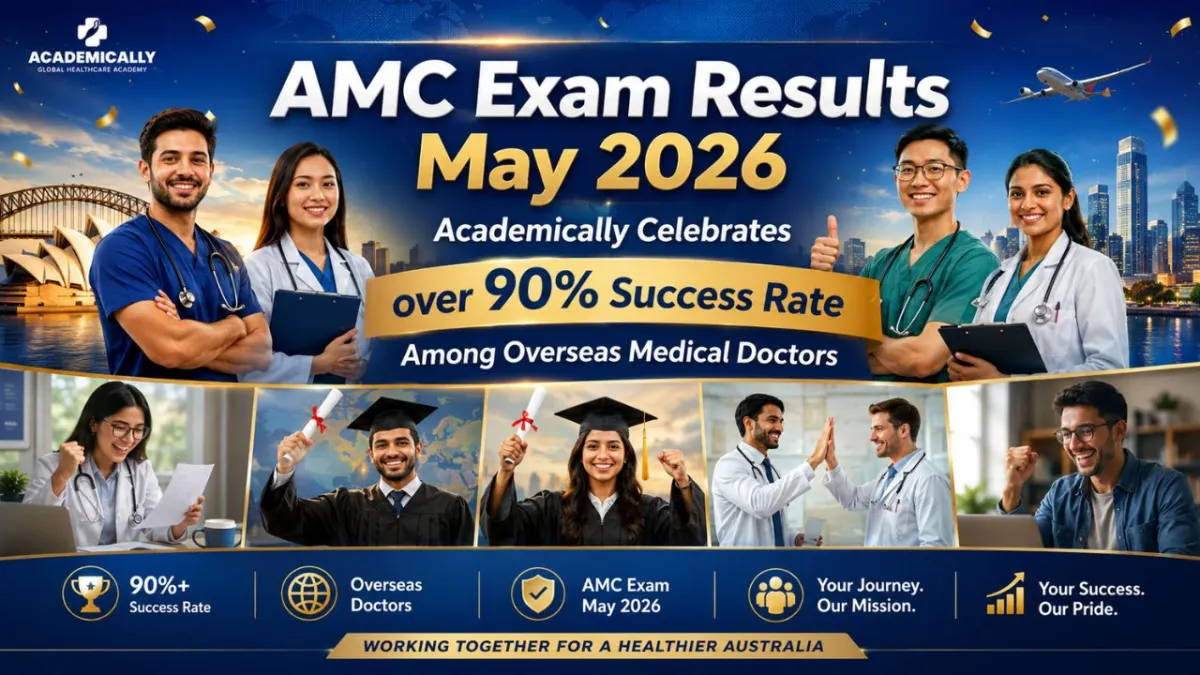
The AMC results for April- May 2026 are out, and across hospital corridors, midnight study desks, months and years of persistence have finally found their answer. More than 90% of our candidates have cleared the Australian Medical Council exam. Each success story exemplifies discipline, resilience, and stern determination.
Behind every “PASS” lies not just preparation, but months of steady effort, setbacks overcome, and the courage to keep showing up.
Every AMC result season arrives with the same mix of nerves and hope. Candidates balance ward rounds, family responsibilities, and the pressure of preparing for a licensing exam in a new country, all while refreshing their inboxes with controlled anxiety. Then the email arrives, and everything changes.
This May, that excitement echoed across OPDs, hospital wards, and homes across the globe. At Academically, we witnessed those moments first-hand through interviews conducted by Dr. Ssnegdha Sharma, our Academic Head for Medical Licensing Studies and Dr. Sonal, our Programme Manager for AMC Preparation Course with candidates who had just seen “PASS” appear on their screens.
Let's take a look at how they prepared, what changed in their approach this time, and why, if you are still on this journey, there is every reason to keep going.
What is the Success Rate of AMC Exam Candidates?
Academically has more than 90% success rate across all licensure exams including AMC exam's candidates. This isn't just a mere percentile. It is the result of months of disciplined work of candidates, faculties and programme managers. Candidates kept showing up inspite of long hospital shifts. The internal teams of Academically kept refining question banks, rolling out new-pattern MCQs, and developing mock tests that closely reflected the actual exam.
90%+
Candidates who qualified
150
MCQs in the actual exam
5
Months avg. preparation time
250+
Passing score on 0–500 scale
Earlier this year, the AMC raised its passing standard, which naturally created anxiety across the candidate community. The update triggered plenty of concern, but our preparation for that shift had already been underway through updated MCQ patterns, AI-based mock tests, and comprehensive papers built using the latest recalls from the AMC Exam February, March and April sessions.
The end result, as these doctors will show, was that they walked into the exam room already familiar with the style and demands of the paper.
How Indian Medical Doctors Passed AMC Exam April-May Session of 2026?
Dr. Ssnegdha Sharma, Academic Head of Medical Licensing Courses and Dr. Sonal, Programme Manager of AMC preparation course at Academically, spoke with our AMC candidates who cleared the April-May 2026 session with flying colours. Each one had a very different path, and each one offers something useful for aspirants preparing for the next round. Let's get inspired.
Dr. Nivedita: The Second Attempt That Changed Everything
A postgraduate doctor who had earned her MD with first class, Dr. Nivedita came to AMC with a strong academic background and the disappointment of a difficult first attempt. She missed the pass mark by only a few questions. “I lost it by three marks. I could have attempted one more question correctly and would have cleared it,” she shared. The difference between what she knew and what the exam demanded was not knowledge. It was method.
For her second attempt, Dr. Nivedita made a decision that many Indian medical graduates find hard to make: she moved theory away from the centre of her routine. Earlier, her preparation had been split 60% theory and 40% MCQs. For the retake, she reversed that balance. By January, she was solving nearly 200 questions a day, not to collect more content, but to train her mind to respond quickly, confidently, and without panic.
“My only aim was that my brain should not panic when I'm trying to solve a question. It should be like a normal day.”
Many aspirants spend their time gathering knowledge, but exam temperament matters just as much. Staying composed under pressure can improve both accuracy and judgment in high-stakes exams. When that mindset is built through repetition, mock practice, and revision, exam day starts to feel far less intimidating.
What changed the game for her most, she says, was differential diagnosis. AMC is known for offering two answers that both appear convincing. Instead of focusing on identifying the single correct-looking option, Dr. Nivedita began training herself to eliminate the wrong ones first.
She worked through areas like rheumatology, pulmonary embolism, and DVT, where symptoms overlap and the options can feel deceptively close, and built a mental framework based on ruling out rather than only trying to recognise the right answer.
She also spent a dedicated week on ethics, a subject that often surprises graduates from the Indian subcontinent. “We are not taught about transgender healthcare or sexual assault procedures the way Australia expects,” she said. To bridge that gap, she used Academically’s AMC Question Bank on public health and ethics, external reading, and Australian Medicine Handbook to understand the concepts based on the Australian healthcare system.
Dr. Juan Carlos: Recalls Are a Topic Map, Not a Cheat Sheet
Dr. Carlos finished his exam a full hour before time was up. In an exam where time pressure is often one of the biggest sources of stress, he was done by the 2.5-hour mark and already felt confident he would pass before the result arrived. That confidence came from one key lesson he had learned for his second attempt. Recalls are a topic map, not a question bank.
“I didn't follow the recall questions. I took the topic from the questions and read it, then practised questions from that topic. That is what helped me,” he explained. Many candidates treat recall posts on Telegram and in Discord as a list of likely questions to memorise.
Dr. Carlos understood that the AMC usually does not repeat exact questions. It repeats themes. Whenever he came across a recall related to something like small intestine obstruction, he used it as a prompt to revise the entire subject area, from pathophysiology to first-line investigation.
“The exam tests core topics, not exact repeated questions. When I read the full topic, that is how I got 50 repeated concepts.”
Depending only on recalls can leave gaps in understanding. A strong conceptual base across subjects makes it easier to recognise patterns and respond confidently to unfamiliar questions. When the core topics are clear, repeated ideas become easier to spot even when the wording changes.
Having trained in the Philippines and prepared for USMLE earlier, Dr. Carlos also gave one of the sharpest comparisons between the two exams we have heard. USMLE, he said, tends to frame questions in more complex ways and leans heavily on consolidated resources.
AMC, by contrast, is more direct in wording, but it compensates for that simplicity by testing procedural depth. “In AMC, they ask what is the first investigation, the next best investigation, the first-line treatment, the best treatment. You have to remember the entire SOP at every step.”
His advice for the final month before the exam was simple. Do not start new topics. Revise what you already know, and keep practising until the process becomes automatic.
Dr. Rehman Hakeem: Benefits of Having Study Group and Five Days of Intensive Revision for AMC Exam
A medical graduate from Qatar currently serving her service bond at a mission hospital, Dr. Rehman Hakeem began focused AMC preparation in January 2026 and sat for the exam in April 2026, giving him about five months of structured study alongside full-time clinical duties.
He worked through all recorded Academically classes at 2x speed, made detailed handwritten notes, and took time out for live sessions in between for real time expert insights. He, then returned to the platform's AI-backed mock exams in the final phase of preparation.
What strengthened both his preparation and confidence was the Academically Discord community of alumni, toppers, faculty, and registered medical experts. She connected with five or six other candidates. In the final five days before the exam, they held daily Google Meet revision sessions. These were not deep-dive sessions, but fast, practical revision runs that moved across topics quickly and kept the whole syllabus in view.
“That study partner will make a huge difference. Even one person will make a huge difference. That is the main thing that happened to me.”
Preparing alone can feel overwhelming, but even one reliable study partner can improve consistency, accountability, and confidence.
Regular discussions, quick revisions, and mock practice together help strengthen concepts and keep motivation steady throughout preparation.
He also relied heavily on grand tests as a decision-making tool. At one point, when she was considering pushing her exam date back, she took a grand test and scored around 75%. That score gave her the confidence to go ahead and book her slot. “The comprehensive second exam was majorly focused on the latest recalls,” she said. “It was like a life thing, it gave me a full revision of everything I needed in one sitting.”
Dr. Anoushka: 50 Days, Four Rounds of Mocks, and a Method Built on Repetition
Among all the stories we heard this session, Dr. Anoushka’s maybe the most useful for candidates who feel short on time. Working a 9-to-4 non-clinical job, she had just 50 days of focused preparation before her exam. In her early grand tests, she was scoring in the 49-52% range. She did not panic. She doubled down on what was already helping.
Her approach was simple but strict. She logged into the Academically dashboard and moved through the mocks, then revision, then more mocks. She completed the subject-wise mocks not once, but four times.
She also created her own compact notes from the mock explanations, usually three to four pages per topic, so that she could revise an entire subject in about an hour. She attempted every centennial test on the LMS, every comprehensive test, and every grand test available. By the time she sat the real paper, nothing felt unfamiliar.
“70 to 80% of my exams came from recalls. And the majority of what was tested, 80 to 90%, is what Academically has covered. There's no need to read every topic. Just cover the high-yield ones thoroughly.”
Smart preparation is all about choosing correctly where to spend your time. Instead of trying to cover everything, focusing on high-yield topics and recall-based revision can make a major difference. When that is paired with consistent practice and a structured approach, it helps you make the most of limited time.
What stood out most was how much faster she became in the exam through repetition. “If you read repeatedly, in the exam, within a fraction of a second, you can mark the question,” she said. “That fraction of a second gets you the correct or wrong answer.” There is a reason active recall through question practice works better than passive reading for this exam, and Dr. Sana proved it in real time.
When you learn from faculty with 20+ years of clinical experience who have followed the same road, qualified exams like AMC, USMLE, and PLAB (now UKMLA), and built their careers in their respective countries, you know you are in good hands.
The Ultimate AMC Exam Preparation Strategy: Tried and Tested by Passouts
Across the interviews, conducted independently with candidates from different backgrounds, timelines, and previous attempts, the same patterns kept appearing. Not because they were acquainted, but because the exam itself rewards those habits.
The five preparation principles that ran through every success story
Questions over theory: The AMC rewards application, not textbook memory. Strong MCQ practice builds exam-ready thinking more effectively than passive reading.
Differential diagnosis as a discipline: Success comes from eliminating wrong options, not just identifying the correct one, especially when the choices appear very similar.
Recall topics, not recall questions: Use recalls as signals for active topics. Revise the full subject area rather than memorising isolated questions.
AI-backed Mock tests as a compass: Grand tests and comprehensive exams help you evaluate readiness and make smart decisions like whether to proceed or reschedule.
Ethics needs dedicated time: Australian medical ethics is different. Focused preparation on consent, autonomy, and reporting is essential for IMGs.
Why the AMC Pathway is Worth Every Bit of Effort
None of these doctors went through this process for fun. They did it because Australia represents something genuinely worth working toward. High salary, quality of life, free healthcare facilities, PR benefits, a medical career with structure, respect, and reward that is difficult to find in many other settings.
An NHS doctor from the UK who qualified AMC exam, put it bluntly: “Abroad options were better for me. Coming to the UK, I don't think the NHS is very good, at least for now. Australia seemed like a better option.” A doctor who had her first-hand experience with the US healthcare environment, chose Australia deliberately citing: “The competition for residency is very high in the US. Many of my seniors have trying for two, three years to match. Then comes the H1-B Visa issues”
AMC vs USMLE vs PLAB
Here's a comparative study on three prominent licensing exams for medical graduates. Take a look to make an informed decision.
Factor | AMC (Australia) | USMLE (USA) | PLAB / UKMLA (UK) |
Full Form | Australian Medical Council | United States Medical Licensing Examination | Professional & Linguistic Assessments Board / UK Medical Licensing Assessment |
Country | Australia | United States | United Kingdom |
Primary Goal | Medical registration in Australia | Residency + medical licensure in USA | GMC registration in UK |
Conducted By | AMC | NBME + FSMB | GMC |
Main Pathway | AMC MCQ + AMC Clinical/WBA | Step 1 + Step 2 CK + Step 3 + Match | PLAB 1 + PLAB 2 / UKMLA |
Eligibility | MBBS equivalent recognized by AMC | Medical students/graduates | MBBS + English proficiency |
Internship Requirement | Usually required | Needed for licensing/residency | Accepted if internship completed |
English Test Needed | IELTS / OET / PTE | Usually not mandatory for exams | IELTS / OET mandatory |
Accepted English Exams | IELTS Academic, OET, PTE Academic | Program dependent | IELTS Academic, OET |
IELTS Requirement | Usually 7 in each band | Not fixed nationally | Usually 7.5 overall |
OET Requirement | Minimum Grade B | Not mandatory nationally | Grade B |
PTE Requirement | PTE Academic score 66 | Not standard | Not commonly accepted |
Number of Main Exams | 2 | 3 Steps | 2 |
Written Exam Pattern | AMC CAT MCQ: 150 MCQs, 3.5 hours | Step 1: 280 MCQs, 8 hours; Step 2 CK: 318 MCQs, 9 hours | PLAB 1: 200 MCQs, SBA, 2 hours |
Clinical Exam Pattern | AMC Clinical/WBA pathway | Step 3: Written + clinical assessment; 233 MCQs (7 hours) + 13 CSS cases | PLAB 2: 10–20 stations, 8–10 minutes each |
Exam Pattern Type | Computer-based MCQs + OSCE/WBA | MCQ-heavy + case simulations | MCQ + OSCE |
Difficulty Level | Moderate–High | Very High | Moderate |
Competition Level | Moderate | Extremely High | Moderate |
Average Preparation Time | 8–14 months | 1.5–3 years | 6–12 months |
Approximate Total Cost | AUD 8,000–15,000+ | USD 15,000–25,000+ | GBP 3,000–8,000+ |
Visa Sponsorship | Possible | Residency dependent | NHS sponsorship common |
Residency Required After Exams | Pathway dependent | Mandatory Match process | Usually not immediately |
Match System | No centralized Match | NRMP Match mandatory | Direct NHS applications |
Clinical Experience Needed | Helpful | Very important (USCE) | Helpful but less strict |
Research Importance | Moderate | Extremely important | Less important |
Observerships Needed | Helpful | Often crucial | Usually optional |
IMG Friendliness | High | Moderate–Low | High |
Acceptance Rate for IMGs | Fairly good | Highly competitive | Relatively good |
Work-Life Balance | Excellent | Tough during residency | Better than USA |
Doctor Salary (Starting) | High | Very high | Moderate–high |
Consultant Salary Potential | Very high | Extremely high | High |
Training Duration | Moderate | Long | Moderate |
PR/Settlement Opportunities | Excellent | Difficult immigration route | Good |
Citizenship Pathway | Comparatively easier | Long process | Moderate |
Healthcare System | Public-private hybrid | Insurance-based | NHS-based |
Typical Working Hours | Balanced | Intense | Moderate |
Burnout Risk | Moderate | High | Moderate |
Best For | Lifestyle + salary + PR | Prestige + specialization | Fast-track NHS entry |
Most Expensive Pathway | Medium | Highest | Lowest |
Fastest Route to Work | Moderate | Slowest | Fastest |
Global Prestige | High | Highest | High |
Licensing Authority | Medical Board of Australia | State Medical Boards | GMC |
Common IMG Specialties | GP, Psychiatry, Emergency | Internal Medicine, Family Medicine | NHS training pathways |
Residency Salary | Good | Good but workload heavy | Moderate |
Chances Without Research | Possible | Difficult in competitive branches | Very possible |
Typical Candidate Age | 24–35 | 23–35 | 24–35 |
Best Overall for PR | Australia | Difficult | UK/Australia better |
Best Overall Salary | High | Highest | Moderate |
Best Lifestyle | Australia | USA toughest | UK balanced |
Fastest ROI | UK | Variable | UK |
Easier for Average IMG | AMC/PLAB | Hardest | Easier than USMLE |
Do You Want to Become the Next Success Story?
Join international medical graduates who are already preparing with Academically's structured AMC MCQ course with live classes, recorded sessions, adaptive mock tests, and faculty with 20+ clinical experience.
What’s Next After the AMC MCQ Part I Exam?
The journey is far from over for our newly qualified candidates. But the path ahead is clear and each step is achievable. The immediate priorities are English proficiency certification (IELTS, PTE, or OET), followed by the AMC Clinical Exam (Part II). It is now conducted fully in-person in Melbourne. Once both parts are cleared, AHPRA registration and employment can be availed.
At Academically, we are also taking care of the next steps for our April-May session passouts. This week, they joined a live celebration session with the full cohort. Next week, they will attend a focused session with our faculties on CV writing, cover letter development, CPD activities, and job cycles in Australia. The goal is not just to pass the exam. The goal is to get you practising.
- Clear your English proficiency test (IELTS Academic/PTE/OET) if not already done.
- Begin clinical experience in emergency or casualty departments to prepare for AMC Part II. We also provide preparation programme for AMC clinical exam.
- Book your AMC Clinical Exam slot early. Slots fill up and scheduling can take time.
- Start building your Australian CV and professional network through healthcare-based job portals like Jobslly.
- Consider the Workplace-Based Assessment (WBA)/PESCI pathway if you want to begin working in Australia sooner.
Are You Preparing for AMC Part I for the Next Cohort?
If you read through these inspiring stories and found yourself identifying with the anxiety before results day, know that you are not alone. The self-doubt after a missed attempt, the difficulty of breaking old study habits, the feeling that everyone else has it figured out while you are still finding your footing, everyone of these doctors felt that too.
But, they cleared the exam with flying colours. The reason is not a mystery. They changed what was not working, used the right resources, and kept going.
The AMC is a moderately easy exam. Australia holds its registered doctors to a high standard, and that standard is reflected in the salary, working conditions, and the respect the profession carries. But it is also an exam worth sitting for. It teaches you far more than content as an IMG. Candidates who prepare with clarity and consistency can clear it, pass this medical licensure exam on their first attempt.