Some mornings start before the clinic lights come on. There is usually a moment, coffee in hand, screen still loading, where the physiotherapist looks at the day ahead and mentally maps the terrain. An ankle sprain. A chronic back complaint. A post-surgical review. Someone new who “just wants to understand what’s going on.”
By 9:00 am, the first patient is explaining why they cannot take more time off work.
This is what physiotherapy in Australia looks like in 2026. It is steady work. Quietly demanding. Rarely dramatic.
The Structure Behind the Scenes
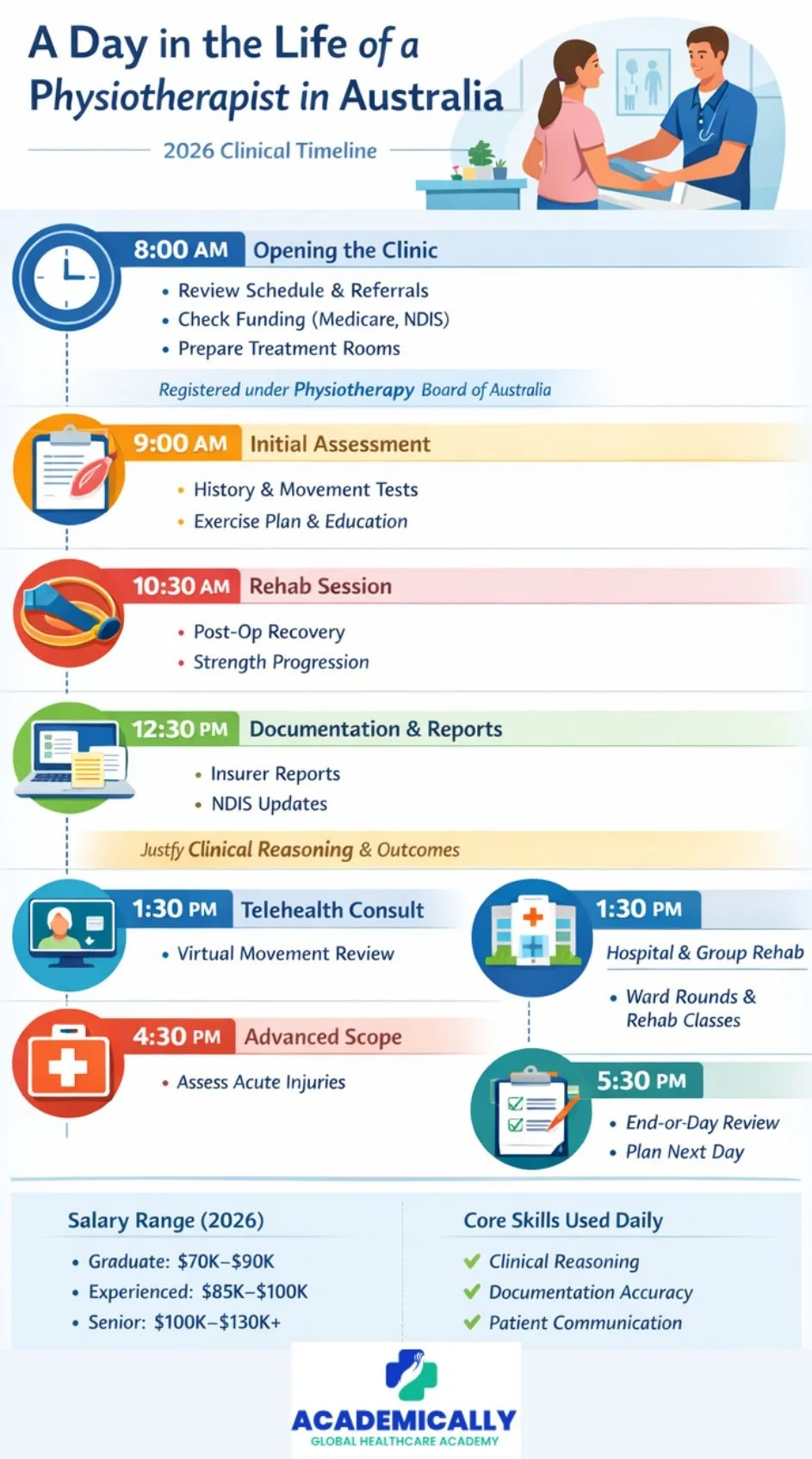
Every practising physiotherapist in Australia must be registered with the Physiotherapy Board of Australia, operating under the Australian Health Practitioner Regulation Agency.
That registration is not for keeping in your folders. It defines scope, ethical obligations, CPD requirements, and professional accountability. Without it, you do not practise. It is that simple.
Patients arrive through different systems, Medicare chronic disease plans, NDIS packages, workers' compensation schemes, motor vehicle claims, and private referrals. Each pathway shapes how care is delivered and, more importantly, how it is documented.
Documentation matters here. A great treatment session means little if the reporting does not reflect clinical reasoning clearly.
In a Private Physio Clinic
In a suburban setting, say Western Sydney, the day tends to move in tight blocks.
A young professional with neck pain from long hours at a desk. The conversation goes beyond symptoms. How do you sit? Do you move during the day? What does your sleep look like?
Assessment is methodical. Cervical rotation. Endurance testing. Functional tolerance.
The treatment plan is rarely elaborate. Three exercises, demonstrated carefully, often work better than ten written on a printout that will be forgotten in a bag.
Later, a patient recovering from ACL reconstruction arrives. Strength numbers have improved, but running still looks uneven. They show data from a smartwatch. It is helpful, but clinical observation still guides progression.
At some point, usually when the clinic quiets briefly, there is a report to finish. Insurers expect measurable outcomes and clear timelines. Ambiguity delays approvals. So wording gets adjusted. Twice.
This is the part of physiotherapy that rarely appears on social media. But it takes time. And focus.
In a Public Hospital
Hospitals feel different. There is less quiet. The day might begin with a ward round. A stroke patient needs a mobility review before discharge. The physiotherapist watches closely as the patient attempts to stand. Today, they need slightly less assistance than yesterday. That matters more than it sounds.
Later, a small osteoarthritis group meets for strengthening exercises. Education is woven into the session pacing, flare management, and long-term strategies. Patients need understanding, not just repetition.
By afternoon, a respiratory case requires careful progression. Too much exertion can set recovery back. Clinical judgement here is less about intensity and more about restraint.
Hospital physiotherapists work closely with nurses, doctors, and occupational therapists. Decisions are shared. Responsibility is shared, too.
Regional Australia
In regional or rural settings, the day can stretch in unexpected ways.
Telehealth reviews in the morning under NDIS plans. A drive to assess fall risk on a rural property. A school visit to review mobility goals for a child with developmental concerns.
Distances are longer. Roles are broader. Community relationships tend to be closer.
For overseas-trained physiotherapists, regional placements are sometimes more accessible initially, though preparation for Australian standards remains essential.
Evolving Roles
Advanced physiotherapy roles continue to expand, supported by the Australian Physiotherapy Association.
In some emergency departments, advanced practice physiotherapists assess acute musculoskeletal injuries independently within approved governance models. They collaborate on imaging decisions and initiate early management.
These positions require postgraduate training and experience. They are earned, not entry-level.
Salary and Stability
Physiotherapy remains a stable healthcare profession in Australia.
In 2026, approximate annual earnings are:
- AUD 70,000 to 90,000 for graduates
- AUD 85,000 to 100,000 for experienced clinicians
- AUD 100,000 to 130,000 or more in senior or specialised roles
Regional incentives may increase total income. Demand continues, particularly due to ageing populations and chronic musculoskeletal conditions.
For International Physiotherapists
To practise in Australia, overseas-trained physiotherapists must complete an assessment through the Australian Physiotherapy Council, followed by registration with AHPRA.
The process may include credential verification, written assessment, practical examination, and English language requirements. It evaluates more than theory. Communication clarity. Clinical reasoning. Ethical understanding within the Australian healthcare context.
Understanding documentation standards here is just as important as mastering technique. Academically supports physiotherapists preparing for this pathway through structured, case-based preparation aligned with Australian practice expectations, followed by job assistance. The focus is not on memorising answers, but on thinking within the framework local regulators expect.
Not every patient improves quickly. Some plateau. Some cancel repeatedly. Some return months later after ignoring advice.
Physiotherapists learn to absorb frustration without showing it. Burnout can happen, especially when administrative work spills into personal time. Many experienced clinicians now schedule documentation deliberately during the day rather than carrying it home.
The rewards are often subtle.
A patient walking confidently after weeks of hesitation. An older adult regaining independence. An athlete returning to sport safely rather than too soon.
These moments are quiet. But they stay with you.
To Conclude with…
A day in the life of a physiotherapist in Australia in 2026 is not defined by dramatic interventions. It is defined by steady reasoning, careful documentation, and consistent patient communication.
For those who prepare properly and understand the regulatory landscape, it offers stability, professional growth, and meaningful work even if it rarely looks glamorous from the outside.