
Australia has a way of making everyday life feel bigger.
You can finish work and be close to a spectacular coastline, spend a weekend walking through a national park, take your children to a spacious public park, or enjoy an outdoor family day without travelling for hours. Australia’s multicultural cities also bring together communities, cuisines and professional opportunities from around the world.
However, relocating to a new country requires attention to practical details.
Visas must be arranged, and once you arrive you’ll need to find housing, manage healthcare and insurance, and adapt to local living costs.
Here in this guide, I will explain the essential steps required for intern pharmacists and their families to settle into Australian life.
I will cover the latest visa rules, family inclusion, city living costs, education, and everyday logistics to make your move as smooth as possible.
Pharmacist Registration: AHPRA, the Pharmacy Board and APC
This is one area where you can easily become confused, so let's talk about this first.
If you completed your pharmacy qualification outside of Australia, passing the Overseas Pharmacist Readiness Assessment exam enables the Australian Pharmacy Council (APC) to issue a formal Skills Assessment Outcome(SAO), which is the official document required by the Department of Home Affairs to support your visa application.
However, passing the exam does not automatically guarantee a visa grant or permanent residency.
The assessment is simply the prerequisite step that validates your clinical knowledge for the migration and registration authorities.
To ultimately secure permanent residency and settle in Australia with your family without restrictions, you must complete the full professional pipeline.
That means using your exam results to secure provisional registration, completing a supervised internship in Australia, passing the final registration assessments, and securing a full-time pharmacist job.
Only through achieving full registration and employment can you transition into long-term residency and establish your life down under.
The Australian Pharmacy Council (APC) and the Pharmacy Board of Australia/AHPRA do not perform the same function.
| Feature / Aspect | Australian Pharmacy Council (APC) | Pharmacy Board of Australia & AHPRA |
| Core Role | Educational Assessment Authority (Evaluator & Examiner) | National Regulatory Body (Licensing & Law) |
| Main Responsibility | Evaluates if your overseas qualifications and clinical knowledge meet Australian academic standards. | Regulates registration, enforces professional standards, and legally licenses you to practice. |
| Primary Role for Interns | Conducts overseas skills assessments (OPRA exam) and the APC Intern Written Exam. | Grants Provisional Registration and officially approves your supervised practice arrangement. |
| Migration & Visas | Issues the official Skills Assessment Outcome needed for Australian Department of Home Affairs visa applications. | Has no role in visas or migration; deals strictly with practice registration inside Australia. |
| When to Interact | Step 1: Before starting work (credential assessment & entrance exams). Step 3: During internship (APC Intern Written Exam). | Step 2: After passing APC assessments, to get provisional registration & internship workplace approval. Step 4: After completing internship hours to get General Registration. |
| Supervised Practice Control | Sets the examination standard and competencies required during the internship. | Mandates that supervised practice cannot legally begin before provisional registration and practice arrangements are approved. |
| Final Deliverable | Certificates of Exam Completion & Skills Assessment Outcomes. | General Registration License (allowing independent, unsupervised practice). |
Think of it like this:
Pharmacy qualification
↓
APC assessment where applicable
↓
Visa/employment planning
↓
Pharmacy Board/APHRA registration
↓
Provisional registration + approved supervised practice
↓
Registration examination requirements
↓
Application for general registration
Important 2026 APC updateFrom 1 July 2026, eligible overseas-trained pharmacists who have already received an APC Skills Assessment Outcome can apply for renewal. APC says migration-purpose SAOs continue to have a three-year validity period, while the renewal policy can give eligible candidates additional time to organise visas and internship opportunities. |
Can An Intern Pharmacist Move To Australia With Family?
Your family options depend on the visa you hold.
Employer-sponsored and skilled visa pathways such as subclasses 407, 482 and 491 have their own rules for including eligible family members. The September 2026 announcement concerning family members of international students and Temporary Graduate visa holders is a separate development and should not be treated as a blanket restriction on families accompanying pharmacists on skilled or training visas.
| Visa Subclass | Primary Purpose | Inclusion |
Subclass 407 (Training Visa) | Workplace-based training required to complete your pharmacy internship and gain AHPRA registration. | If eligible, members of the family unit may accompany the primary applicant or apply later as subsequent entrants, subject to the visa requirements and conditions. |
Subclass 482 (Skills in Demand / TSS Visa) | Employer-sponsored work visa if a pharmacy group directly sponsors your employment. | If eligible, partners and dependent can generally be included as secondary applicants or may apply later as subsequent entrants, subject to the visa requirements. |
Subclass 491 (Skilled Work Regional Provisional) | State-nominated 5-year provisional visa to live and work in designated regional areas of Australia. | If eligible, members of the family unit who did not apply for the visa with you can apply to join you in Australia later as subsequent entrants. |
If you are relocating as an overseas-qualified pharmacist, you should know about the latest Australian visa changes.
Important Note: Under the Core Skills stream, the nominated occupation must be on the Core Skills Occupation List, the applicant must have the relevant skills and generally at least one year of relevant work experience, meet English requirements unless exempt, and satisfy the applicable salary requirements. The current Core Skills Income Threshold for nominations lodged from 1 July 2026 to 30 June 2027 is AUD 79,423. The employer must also meet the Annual Market Salary Rate requirements. |
What Are The Requirements For The Members?
To ensure visa approval for your family, the Department of Home Affairs strictly enforces three criteria:
a. Health Standards
b. Character Checks
c. Mandatory Health Cover (OVHC)
| Category / Requirement | Specific Rules & Official Details |
| Health Examinations | All accompanying family members must pass Australian immigration health assessments (medical checks and chest X-rays by approved panel physicians). |
| Character & Police Checks | Police clearance certificates are required for every family member aged 16+ from every country they have lived in for 12+ months in the last 10 years. |
| Health Cover (OVHC) | You must purchase and maintain private Overseas Visitor Health Cover for yourself and all family members for the duration of your visa. |
| Proof of Relationship | Must provide official government documentation such as Marriage Certificates, children's Birth Certificates, and joint financial/living evidence for de facto partners. |
| Schooling for Children | School-aged children can enrol in Australian schools. Temporary visa holders may be charged state-based tuition fees for public schools depending on the state/territory. |
Your appropriate route depends on your qualifications, occupation, skills assessment, experience, nomination or invitation and individual circumstances.
September 2026 Update: Healthcare Workers Now Have a Processing Priority
This is one of the most important recent changes for a pharmacist considering Australia.
From 19 September 2026, Ministerial Directions 121 and 122 replaced the previous skilled-visa processing priorities under Ministerial Direction 119.
Under Direction 121, applications for certain temporary skilled visas relating to healthcare, along with construction, teaching, agriculture, aquaculture, fishing, resources, law enforcement and defence interests, receive the highest listed priority.
Direction 122 establishes the corresponding priority framework for certain provisional and permanent skilled visas.
| It means | It does not mean |
| Eligible healthcare-related applications receive a policy processing priority | Automatic visa approval |
| The new directions apply from 19 September 2026 | Automatic visa eligibility |
| They affect the order in which certain applications are processed | Guaranteed processing time |
| Pharmacists may benefit where their application falls within the relevant healthcare priority | Guaranteed sponsorship or nomination |
So, if you are planning your move in 2026, this is worth knowing. But treat processing priority and visa eligibility as two different things.
Intern Pharmacist Salary in Australia
Salary matters when you are moving an entire household.
Intern Pharmacist Salary (During Internship)
During the supervised practice internship, as an overseas-qualified pharmacist you will be paid under the Pharmacy Intern classification of the Pharmacy Industry Award. The rates increase between the first and second half of training.
Let me explain it with a complete breakdown, for better understanding.
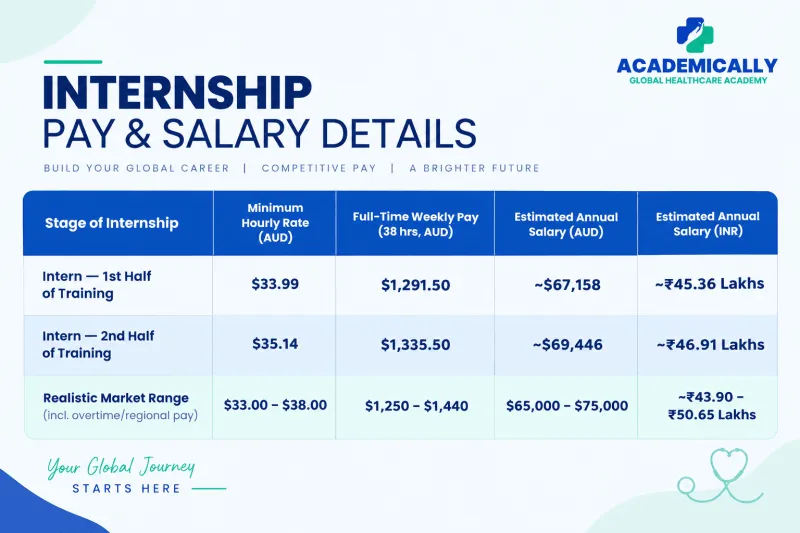
That is not all. You get paid for overtime. Because community pharmacies across Australia often trade 7 days a week and late into the evening, working these non-standard hours significantly boosts your actual take-home income.
The following penalty rates are applicable for intern pharmacists as well:
| Work Schedule | Award Pay Multiplier | 1st Half Intern Rate (AUD) | 2nd Half Intern Rate (AUD) |
| Mon–Fri (Standard Hours: 8:00 AM – 7:00 PM) | 100% (Base Rate) | $33.99/hr | $35.14/hr |
| Mon–Fri Evenings (7:00 PM – 9:00 PM) | 125% (+25% loading) | $42.49/hr | $43.93/hr |
| Mon–Fri Night (9:00 PM – Midnight) | 150% (+50% loading) | $50.99/hr | $52.71/hr |
| Saturday (8:00 AM – 6:00 PM) | 125% (+25% loading) | $42.49/hr | $43.93/hr |
| Sunday (7:00 AM – 9:00 PM) | 150% (+50% loading) | $50.99/hr | $52.71/hr |
| Public Holidays | 225% (+125% loading) | $76.48/hr | $79.07/hr |
The point is, your actual annual earnings can easily reach AUD $72,000 – $78,000+ (~₹48.6 to ₹52.7 Lakhs INR).
Choosing Where to Live: City or Regional Australia?
Now imagine your visa and professional plans are coming together.
The next decision is your postcode.
Sydney and Melbourne offer large multicultural communities and extensive services. Brisbane offers a warmer climate and outdoor lifestyle.
Adelaide, Perth and Canberra provide different combinations of employment, housing and family life. Regional Australia can also offer opportunities, particularly where your visa or employer pathway has a regional component.
The important point is simple: choose the life your family will actually live.
Cost of Living in Australia: Budget as a Family
Australia can offer an excellent lifestyle, but your household expenses will depend heavily on where you live and how your family lives.
| Budget area | Current official information/approach |
| Rent | ABS: national rental prices +3.6% year-on-year to July 2026 |
| Housing overall | ABS housing group +5.0% year-on-year to July 2026 |
| Food | ABS food and non-alcoholic beverages +3.2% year-on-year |
| Electricity | ABS electricity +6.1% year-on-year |
| Pharmacist earnings | Median full-time weekly earnings AUD 1,956 |
| Pharmacy Award pharmacist minimum | AUD 39.85/hour from 30 June 2026 |
| Childcare | CCS/3 Day Guarantee depends on eligibility |
| Schooling | Costs vary by state, visa and school |
Your personal budget should therefore include:
| Rent + utilities + groceries + transport + school + childcare + healthcare + professional expenses + emergency fund. |
Think about your first six months, not just your first month's salary.
Monthly Cost of Living Breakdown: Major City vs. Regional Australia
Below, I have made a realistic monthly cost-of-living budget breakdown for a family of three or four relocating to regional Australia versus a major city on an intern pharmacist salary.
| Expense Category | Major Capital City (Sydney / Melbourne) | Regional Australia (Regional NSW / VIC / QLD / WA) | Notes for Relocating Families |
| Housing Rent(2 to 3-bedroom unit/house) | $2,800 – $3,400 (~₹1.89 – ₹2.30 Lakhs) | $1,950 – $2,500 (~₹1.32 – ₹1.69 Lakhs) | Rent is the single largest savings in regional areas. Vacancy rates are tight nationwide, but regional rent is 25%–35% lower. |
| Groceries & Household Goods | $1,100 – $1,300 (~₹74,300 – ₹87,800) | $1,150 – $1,350 (~₹77,600 – ₹91,200) | Regional supermarket prices are comparable to capital cities, though specialty import items can cost slightly more. |
| Utilities & Internet(Electricity, Gas, Water, Wi-Fi, 2 Mobile SIMs) | $350 – $450 (~₹23,600 – ₹30,400) | $350 – $450 (~₹23,600 – ₹30,400) | Energy costs vary by season (heating in winter, air conditioning in summer). |
| Mandatory Family OVHC Health Cover(Visa Condition 8501) | $380 – $550 (~₹25,600 – ₹37,100) | $380 – $550 (~₹25,600 – ₹37,100) | Private health insurance cover for working visa holders (Subclass 407/482) for a family unit. |
| Transport & Commute(Car fuel, registration, insurance / public transit) | $300 – $450 (~₹20,200 – ₹30,400) | $400 – $550 (~₹27,000 – ₹37,100) | Major cities offer public transport, while regional locations almost always require a personal car for daily commuting. |
| Schooling / Dependent Education(Public school fees for temporary visa holders) | $300 – $700 (~₹20,200 – ₹47,200) | $0 – $350 (~₹0 – ₹23,600) | States like NSW and ACT charge temporary visa holders public school fees ($5,000–$8,000/yr per child), whereas some regional states reduce or waive these. |
| Miscellaneous & Living Expenses(Clothing, medical extras, family leisure) | $300 – $500 (~₹20,200 – ₹33,800) | $300 – $450 (~₹20,200 – ₹30,400) | Essential buffer for unexpected daily expenses, kids' activities, or local outings. |
| TOTAL ESTIMATED MONTHLY EXPENSE | AUD $5,530 – $7,350 (~₹3.73 – ₹4.96 Lakhs) | AUD $4,530 – $6,200 (~₹3.06 – ₹4.18 Lakhs) | Regional areas offer significantly better financial sustainability during the internship year. |
Don't Let Exam Retakes Drain Your Relocation Budget
Managing family living costs in Australia requires every dollar to work for you. With the exam fee at over AUD $2,200, retaking assessments or delaying your registration can quickly strain your savings.
Clearing your APC assessment on your first attempt is the fastest way to get internship-ready, and to start earning.
Academically provides targeted exam coaching and step-by-step registration support tailored for overseas pharmacists, helping you avoid costly delays.
Schools in Australia: Are Government Schools Free?
This is where you need to avoid a common assumption.
While Australian government (public) schools are publicly funded and generally tuition-free or low-cost for Australian citizens and permanent residents, public schooling is not automatically free for dependent children of temporary visa holders.
Education in Australia is administered at the state and territory level. Each state sets its own fee structure and exemption rules for temporary residents (such as holders of Subclass 407 Training Visas or Subclass 482 Skills in Demand Visas).
Before signing a lease, check
- The school's catchment area
- Your visa's education arrangements
- State-specific temporary-resident fees
- Enrolment documentation
- Transport
- Before- and after-school care
- School uniforms and other expenses
- Language support where required
So, yes, Australia has a strong publicly funded school system, but do not promise your family that public schooling will automatically be free simply because the school is government-run.
I am going to give you a brief overview of a few places:
| State / Territory | Fee Status | Estimated Annual Cost | Key Rule / Exemption |
| Victoria & Tasmania | Free | $0 | Standard local student rules apply; exempt from temporary resident tuition fees. |
| Western Australia | Charged | ~$4,000 per family | Flat fee covering all children; waived if family income is under $90,000/yr. |
| New South Wales | Charged | ~$5,600 – $6,400 per child | Fee increases with grade level (Primary vs. High School). |
| South Australia | Charged | ~$6,700 – $7,900 per child | Free if living in regional SA or if family income is under $75,000/yr. |
| Queensland | Charged | ~$12,000 per child | Charged via weekly tuition fees across most temporary visas. |
| ACT | Charged | ~$11,100 – $16,200 per child | High fees apply unless the primary visa holder meets specific occupation exemptions. |
Childcare and the 2026 Child Care Subsidy(CCS) Changes
Childcare becomes a very important part of your household budget.Thankfully, the Australian government has schemes for your child's health as well.
From 5 January 2026, the Australian Government introduced the 3 Day Guarantee.
All families eligible for the Child Care Subsidy can receive at least 72 hours of subsidised care per fortnight, equivalent to three days per week, regardless of activity levels.
But there is an important immigration condition.
CCS eligibility comes first
Services Australia says CCS has residence rules. A person generally needs to be an Australian citizen, permanent visa holder, Special Category visa holder or holder of certain specified temporary visas, with additional circumstances potentially applying.
Therefore:
Visa status
↓
CCS residence eligibility
↓
CCS entitlement
↓
Provider place
↓
Family's actual gap fee
| Important Note: The 3 Day Guarantee does not guarantee a childcare place, and families may still have to pay a gap fee. |
Healthcare and Medicare: Check Your Visa Before You Budget
Healthcare is another area where your visa matters.
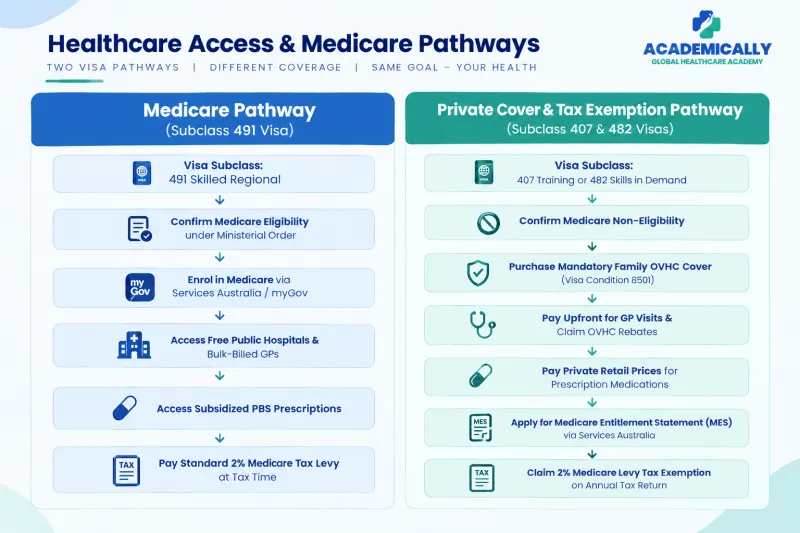
This distinction is particularly important for a family because healthcare costs can affect your relocation budget.
Your Spouse's Career Matters Too
Your relocation should not become a plan where one person builds a career and everyone else simply adjusts.
Before moving, sit down together and discuss your spouse's career.
Check their visa work rights, whether their occupation requires Australian registration, the availability of jobs in your chosen location and whether regional living could affect their opportunities.
If your spouse works remotely, your location options may be broader. If they need a local employer, a major city may offer a different employment environment.
The best family move is one that supports two adults and the children, rather than only the primary visa applicant.
Your First Month in Australia
The first month can feel chaotic.
Your family has arrived in a beautiful country, but you still need to create a routine.
Use this simple sequence:
Arrival
↓
Confirm accommodation
↓
Set up phone and banking
↓
Check visa conditions through VEVO
↓
Confirm Medicare/private-cover position
↓
Arrange school or childcare
↓
Learn local transport
↓
Start professional networking
↓
Build a weekly family routine
How Australia Can Become Home
At first, Australia may feel like a destination.
Then it slowly becomes your neighbourhood.
Your child knows the way to school. Your spouse finds a favourite café. You discover the pharmacy where you feel comfortable working. Sunday mornings become walks in the park. A beach trip stops feeling like tourism and becomes part of family life.
That is the real meaning of settling in.
Australia offers coastal beaches, parks, outdoor spaces, multicultural communities and a strong education and healthcare infrastructure. But, the lifestyle becomes easier to enjoy when you have planned the practical side properly.
Your objective should not simply be to get to Australia. It should be to arrive prepared enough that your family has room to enjoy the life you moved there to build.
Don't navigate the complex migration, exam, and registration process alone. Academically has helped hundreds of pharmacists successfully relocate and register in Australia with tailored exam preparation, documentation assistance, and step-by-step guidance.