
India has a large pharmacy education pipeline, with the Pharmacy Council of India listing thousands of approved pharmacy institutions and substantial annual admission capacity across degree programmes. For pharmacists looking beyond India, Australia remains an important international market, but entering the profession requires meeting Australian registration requirements.
Australia's pharmacist workforce continues to show critical shortage of pharmacists and other healthcare professionals. Jobs and Skills Australia classifies pharmacists as a regulated occupation and reports 46,300 people employed as pharmacists, with employment increasing by around 2,900 over the year. Its latest 2026 workforce data also continues to track recruitment conditions across occupations and regions, including ongoing differences between metropolitan and regional labour markets.
Pharmacists are also included among the occupations covered by Australia's current skilled-migration framework, including pharmacist occupations on the Core Skills Occupation List. However, being on an occupation list does not itself guarantee registration, employment or a visa. Candidates must separately meet professional-registration and migration requirements.
For Indian pharmacists, the Overseas Pharmacist Readiness Assessment is a key assessment step in the Australian Pharmacy Council's Knowledge Stream pathway. The exam can be taken at approved test centres in India, meaning eligible candidates do not have to travel to Australia just to sit for the Australian Pharmacists' Licensure Examination.
In this blog, we cover the eligibility of the Overseas Pharmacist Readiness Assessment, Indian test centres, fees, exam dates, syllabus, preparation and what happens after you pass, including the pathway towards Australian pharmacist registration and relevant migration options.
What is the Overseas Pharmacist Readiness Assessment?
The Overseas Pharmacist Readiness Assessment is a computer-based, multiple-choice examination conducted by the Australian Pharmacy Council (APC). For pharmacists who completed their pharmacy qualification outside Australia, Canada, Ireland, New Zealand, the UK or the USA, Overseas Pharmacist Readiness Assessment is the examination component of the APC Knowledge Stream assessment pathway.
The Australian pharmacist licensure examination assesses whether overseas-trained pharmacists have the required knowledge and understanding of the biomedical, pharmaceutical and clinical sciences underlying pharmacy practice in Australia. The exam contains 120 multiple-choice questions and candidates have 150 minutes to complete it.
The exam covers five content areas:
- Biomedical sciences: 20%
- Medicinal chemistry and biopharmaceutics: 10%
- Pharmacokinetics and pharmacodynamics: 10%
- Pharmacology and toxicology: 15%
- Therapeutics and patient care: 45%
Therapeutics and Patient Care therefore accounts for the largest share of the exam. It focuses on the clinical application of the biomedical, pharmaceutical and pharmacological knowledge covered in the other content areas, including dose calculations, primary healthcare, safe and effective medicine use, special populations, harm minimisation and health promotion.
Note: This is not an exam on Australian pharmacy legislation or practice standards. These Australia-specific practice requirements are assessed later in the registration pathway during the internship period. Questions are based on current, evidence-based information from sources such as peer-reviewed journals, clinical practice guidelines and textbooks. The exam tests remembering, comprehension and application, so preparation should go beyond memorising isolated facts and focus on understanding concepts and applying them to pharmacy-related problems.
Australian Pharmacist Licensure Exam Format at a Glance
Exam Component | Details |
| Exam format | Closed-book, computer-based examination |
| Test delivery | PearsonVUE test centres and APC-approved centres |
| Number of questions | 120 MCQs |
| Question format | 1 correct answer + 3 incorrect options |
| Exam duration | 150 minutes (2 hours 30 minutes) |
| Result | Pass / Unsuccessful |
| Numerical score | Not provided due to Rasch methodology of scoring |
| Exam sessions | Two remaining/confirmed 2026 sessions |
| Next exam window | 23–25 November 2026 |
| Results | 22 December 2026 |
The two 2026 Overseas Pharmacist Readiness Assessment sessions: 13-15 July and 23-25 November. As of September 2026, the 23–25 November session is the next available sitting, with registration open until 19 October 2026.
Step 1: Check Your Eligibility
Who can apply through the Knowledge Stream?
For the APC Knowledge Stream, your pharmacy qualification must have been completed outside Australia, Canada, Ireland, New Zealand, the UK or the USA.
Key documents can include:
- Pharmacy qualification- for Indians- BPharm/MPharm/PharmD
- Academic transcripts
- Passport and identity documents
- Registration- official
- Evidence relating to any name change, where applicable
- Certified translations where documents are not in English
Step 2: Complete the Initial Skills Assessment
Apply through the APC Candidate Portal for the Knowledge Stream eligibility check. The current fee is AUD 810. You will get your applications processed within five working days after receiving all required documentation, although candidates should allow up to four weeks for unforeseen circumstances. Submit the eligibility application at least eight weeks before the relevant exam registration closing date.
Once your eligibility is confirmed, you can proceed to Australian pharmacist registration through the Candidate Portal when registration for your selected session is open.
Step 3: Register for Overseas Pharmacist Readiness Assessment
After receiving confirmation that you are eligible, you can register for the Overseas Pharmacist Readiness Assessment. The current examination fee is: AUD 2,245 per attempt.
Step 4: Book the exam from India
Indian pharmacists can sit Overseas Pharmacist Readiness Assessment without travelling to Australia. Indian test-centre locations are in:
- Bangalore
- Chandigarh
- Chennai
- Hyderabad
- Jalandhar
- Ludhiana
- Mumbai
- New Delhi
- Noida
- Pune
- Ahmedabad (availability can vary by session)
- Kolkata (availability can vary by session)
Availability is not guaranteed at every centre for every session. Seats can fill up and venues may change, so candidates should check availability in the Candidate Portal before making travel or accommodation arrangements.
Upcoming 2026 Schedule
| Session | Exam Dates | Results Released |
| Session | 23-25 November 2026 | 22 December 2026 |
Overseas Pharmacist Readiness Assessment 2027 Dates (Estimated/Expected Cycles)
- March 2027 Session
- Registration Period: January-February 2027
- Exam Dates: 22-24 March 2027
- Results Released: May 2027
- July 2027 Session
- Registration Period: May-June 2027
- Exam Dates: Late July 2027 (e.g., 26-28 July)
- Results Released: TBC / August 2027
- November 2027 Session
- Registration Period: September-October 2027
- Exam Dates: 8-10 November 2027
- Results Released: TBC
Note: Exact official timelines and window allocations are subject to final confirmation directly through the Australian Pharmacy Council Portal.
Prepare According to the Current Syllabus
The current syllabus has five content areas, not three:
| Content Area | Approx. Share of Questions |
| Biomedical Sciences | 20% |
| Medicinal Chemistry and Biopharmaceutics | 10% |
| Pharmacokinetics and Pharmacodynamics | 10% |
| Pharmacology and Toxicology | 15% |
| Therapeutics and Patient Care | 45% |
Therapeutics and Patient Care is therefore the largest content area. It includes areas such as medication management, dose calculations, safe and effective medicine use, special populations, primary healthcare, harm minimisation and health promotion.
The exam content is developed from current evidence, including peer-reviewed literature, clinical practice guidelines and textbooks. Candidates should therefore focus on understanding and applying concepts rather than relying only on rote learning.
Step 5: Sit for the exam
It is important to appear at the Overseas Pharmacist Readiness Assessment at the designated exam centre on time and clear the exam.
If in any case you did not qualify the exam, you can resit for it again and clear the exam. Remember, there are multiple attempts for the Australian pharmacist's licensure exam so you don't need to be in fear.
Meet the English Language Requirements
After passing the exam, you can go for the English Proficiency test. English proficiency is relevant to the AHPRA/Pharmacy Board registration stage, rather than being an eligibility requirement. The National Boards updated their English-language requirements this year itself. For tests taken on or after that date, the current minimum scores include:
| English Proficiency Test for Pharmacists | Minimum Overall Score | Minimum Component Scores |
| IELTS Academic | 7.0 | Listening 7, Reading 7, Writing 6.5, Speaking 7 |
| OET | B | Listening 350, Reading 360, Writing 350, Speaking 360 |
| PTE Academic | 66 | Listening 66, Reading 66, Writing 56, Speaking 66 |
| TOEFL iBT | 94 | Listening 24, Reading 24, Writing 24, Speaking 23 |
Other accepted options include Cambridge C1 Advanced and C2 Proficiency. Candidates can, subject to the applicable rules, meet the standard using a maximum of two sittings within a 12-month period.
The National Boards accept multiple tests against the applicable English-language standard, and candidates should choose based on their own preparation, test format and circumstances.
What Happens After Passing Overseas Pharmacist Readiness Assessment?
Passing Overseas Pharmacist Readiness Assessment is an important milestone, but it does not by itself give you Australian pharmacist registration. The broader pathway involves:
Initial Skills Assessment
↓
Overseas Pharmacist Readiness Assessment
↓
APC Skills Assessment Outcome, if required for migration
↓
English-language requirements
↓
Provisional registration with Ahpra/Pharmacy Board
↓
Approved supervised practice / internship requirements
↓
Intern Written Exam and Oral Exam requirements
↓
General Registration
There is an important distinction between the APC Skills Assessment Outcome and Australian registration.
The APC Skills Assessment Outcome costs AUD 300 and can support a migration application. However, APC states that AHPRA does not require the Skills Assessment Outcome itself for registration purposes. Candidates should therefore not describe the AUD 300 document as a mandatory registration step in every case.
The exact registration timeline varies between candidates and should not be presented as a guaranteed 12-18 months. Supervised practice, exam scheduling, registration processing and individual circumstances can all affect the duration.
Pharmacist Salaries in Australia 2026-27
Pharmacists in Australia typically earn an average of AUD 90,000 to 110,000 annually, which translates to approximately INR 49 to 60 lakhs. While this income is indeed substantial, its real purchasing power varies significantly depending on your location within Australia and the specific type of pharmacy role you hold.
Pharmacist Salary in Australia by Career Stage
Salary in this field moves meaningfully with experience. Here is how it typically progresses.
| Career Stage | AUD (Annual) | INR (Approx.) |
| Intern Pharmacist | AUD 55,000 to 65,000 | INR 30 to 35 lakhs |
| Graduate or Newly Registered | AUD 70,000 to 80,000 | INR 38 to 44 lakhs |
| Registered (2 to 5 years) | AUD 85,000 to 105,000 | INR 46 to 57 lakhs |
| Senior Pharmacist (6+ years) | AUD 110,000 to 130,000 | INR 60 to 71 lakhs |
| Pharmacy Manager | AUD 120,000 to 145,000 | INR 65 to 79 lakhs |
| Pharmacy Owner | AUD 150,000+ | INR 82 lakhs+ |
State by State Salary Differences
The location where you reside significantly influences your pharmacist's salary, as higher wages in major urban centers help offset the elevated cost of living. Below is a list of Australian cities offering the highest earnings for registered pharmacists.
| City | State | AUD (Annual) | INR (Approx.) |
| Sydney | NSW | AUD 127,400 | INR 70 lakhs |
| Melbourne | VIC | AUD 122,000 | INR 67 lakhs |
| Perth | WA | AUD 120,400 | INR 66 lakhs |
| Brisbane | QLD | AUD 119,000 | INR 65 lakhs |
| Canberra | ACT | AUD 118,000 | INR 64 lakhs |
| Newcastle | NSW | AUD 115,000 | INR 63 lakhs |
| Mackay | QLD | AUD 109,600 | INR 60 lakhs |
| Sunshine Coast | QLD | AUD 98,600 | INR 54 lakhs |
Visa and PR Pathways After the Australian Pharmacist Licensure Examination
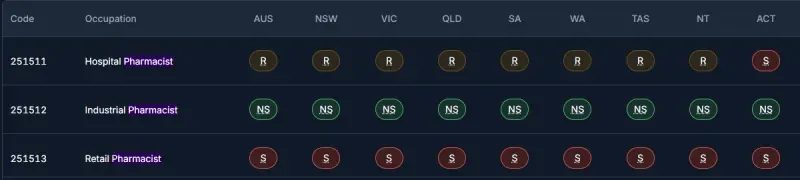
Australia's migration framework has changed. The current Core Skills Occupation List (CSOL) includes:
- Hospital Pharmacist: ANZSCO 251511
- Industrial Pharmacist: ANZSCO 251512
- Retail Pharmacist: ANZSCO 251513
Your migration pathway depends on factors such as:
- Your occupation and skills assessment
- Australian pharmacist registration and/or registration progress
- English proficiency
- Age and points, where applicable
- Employer sponsorship, where applicable
- State or territory nomination, where applicable
- The requirements of the specific visa subclass
Potential visa pathways can include employer-sponsored and points-tested options, but eligibility must be checked against the rules applying to the relevant visa at the time of application.
A New Visa Update Every OPRA Aspirant Should Know
Australia introduced important migration changes, including changes to skilled-visa processing priorities. Healthcare has been placed in the highest processing-priority group for certain skilled visa applications.
Australia’s 2026-27 visa changes affect several routes relevant to international healthcare professionals. Family visa restrictions mean most new student and graduate visa holders cannot bring family members, with exceptions including PhD students and certain Pacific and ASEAN arrangements. Visitor visas will generally carry a No Further Stay condition, making onshore visa switching more restricted. Working Holiday Maker visas are also becoming more competitive, with ballots for second- and third-year places. Meanwhile, existing healthcare professionals and families are not required to leave because of these reforms. For students and healthcare workers planning Australia, visa strategy now needs to be considered alongside registration, study and migration requirements.
| Visa / Area | Update | Key Point for Healthcare Professionals |
| Skilled visas | Healthcare is in the highest processing priority group alongside construction, teaching, agriculture, aquaculture, fishing and resources | Eligible healthcare applications can receive priority processing |
| Student visas | Secondary applicants restricted on most new student visas, with limited exceptions | Can affect healthcare professionals planning to study in Australia with family |
| Graduate visas | Family/secondary applicant restrictions introduced as part of the visa-hopping reforms | Important when planning study → graduate visa pathways |
| Visitor visas | No Further Stay condition to be attached to future visitor visas | Visitor visas cannot generally be used to switch to another visa while in Australia |
| Working Holiday Maker | Ballot system for years 2 and 3, linked to regional work requirements | Relevant mainly to eligible young professionals; India is among countries using ballot arrangements |
| Skilled migration priorities | New priorities apply to temporary, provisional and permanent skilled visa processing | Priority processing does not mean automatic visa approval or PR; eligibility and other requirements still apply |
Overseas Pharmacist Readiness Assessment Cost from India
| Expense | Cost (AUD) | Cost (USD) | Cost (INR) |
| Initial Skills Assessment | 810 | 570 | ₹54,659 |
| Licensure Exam Fee | 2,245 | 1,580 | ₹1,51,493 |
| Skills Assessment Outcome | 300 | 211 | ₹20,244 |
| English Test (IELTS/OET/PTE) | 300–450 (estimated) | 211–317 | ₹20,244–₹30,366 |
| Documentation & Verification | 100–200 (estimated) | 70–141 | ₹6,748–₹13,496 |
| Coaching / Preparation Course (Optional) | Variable | Variable | Variable |
| Visa, Travel & Relocation (Post-OPRA) | Variable | Variable | Variable |
Estimated Total Investment
| Total Estimated Cost | AUD | USD | INR |
| Minimum Estimate | 3,755 | 2,642 | ₹2,53,387 |
| Higher Estimate | 5,000+ | 3,518+ | ₹3,37,400+ |
Note: Currency conversions are approximate and based on current mid-market rates. Actual amounts may vary depending on exchange rates, bank charges and payment-provider fees.
How Much Time Does it Take to Clear the Australian Pharmacist Licensure Exam 2026
| Stage | Approximate Duration |
| Initial Skills Assessment | 6–12 weeks |
| Exam Preparation | 4–8 months |
| Exam & Results | 4–6 weeks after the exam |
| English Language Test (if not already completed) | 1–2 months (can run concurrently) |
| AHPRA Registration Process | 2–4 months |
| Internship/Supervised Practice & Intern Exams | 6–12 months |
| Total Journey from India to Registration | Approximately 18–24 months |
Key Takeaway: Most Indian pharmacists should plan for a total investment of AUD 3,755–5,000+ and a realistic timeline of 18–24 months from starting the APC process to becoming eligible to practise as a pharmacist in Australia.
Five Mistakes Indian Pharmacists Make
- Skipping the Initial Skills Assessment: Confirm your qualification meets the Knowledge Stream requirements before paying the AUD 810 eligibility fee.
- Relying only on Indian textbooks: Australian Pharmacist Licensure exam assesses biomedical, pharmaceutical and clinical sciences using current, evidence-based resources. Use up-to-date guidelines and references alongside your core textbooks.
- Leaving English requirements until later: Check your English-language requirement early and plan it alongside your licensure exam preparation rather than waiting for exam results.
- Ignoring exam registration and test-centre planning: Australian Pharmacist Licensure exam seats can fill up, and registrations close about a month before the exam. Book early, especially if you need a specific Indian test centre.
- Underestimating Therapeutics and Patient Care: This remains the largest content area at 45%, making clinical application and case-based practice essential.
Academically Global's Australian Pharmacist Licensure Exam preparation programme includes:
- 120+ hours of live and recorded sessions
- AI-powered mock tests for computer-based exam practice
- AMH-aligned clinical case studies and scenario-based questions
- Mentorship from AHPRA-registered Australian pharmacists
- Handouts, PDF notes and 1-on-1 doubt-clearing sessions
- Alumni, faculty and peer community support
- Guidance on internship, registration and visa pathways
- Eligible candidates can also apply for the Dr. Akram Ahmad Scholarship (DASSHP)
The programme is designed to support candidates from licensure exam preparation through the wider Australian pharmacist registration pathway.