
When I started exploring non-clinical career options in pharma, I realised that having a pharmacy degree does not mean your career has to remain limited to a traditional pharmacy or dispensary setting.
As Dr. Akram Ahmad puts it, pharmacists do not always have to spend extremely long hours in a pharmacy for relatively low earnings. A pharmacy degree can open doors far beyond dispensing medicines, particularly when healthcare professionals are willing to explore the wider non-clinical sector.
I strongly agree with this perspective. Your pharmacy degree gives you something that many industries value: a strong foundation in healthcare, medicines, pharmacology, clinical concepts, and patient care. The key is learning how to apply that knowledge in a different professional environment.
One area I find particularly interesting is the pharmaceutical industry, where careers such as Medical Affairs and Market Access allow healthcare professionals to use their scientific background while moving into strategic, evidence-driven roles.
Both areas focus on science, work closely with teams and help bring medicines to patients. However the day‑to‑day activities are markedly different.
That is why I believe a graduate in pharmacy should not first ask, "What jobs are available in Medical Affairs or Market Access?". Instead, ask "What kinds of challenges do I want to solve every day?”
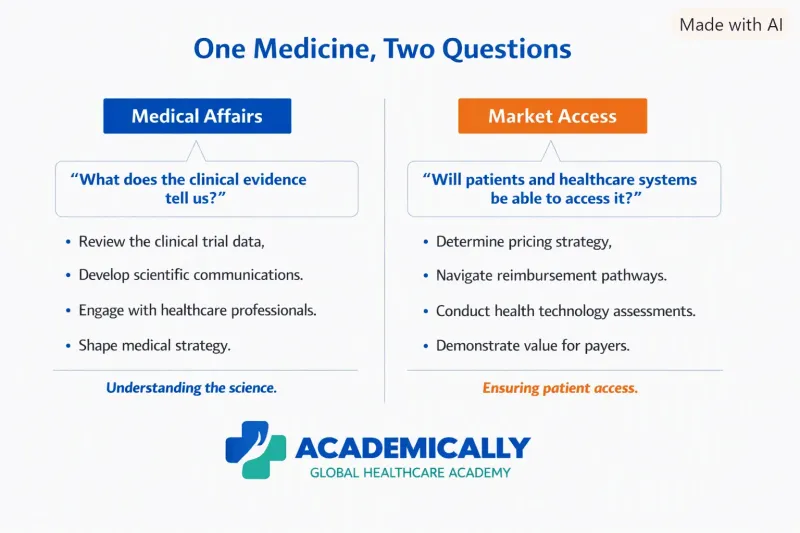
Medical Affairs focuses on scientific evidence, medical strategy, engagement with healthcare professionals and responsible use of medicines.
Market Access focuses on treatment value, pricing and reimbursement healthcare systems, payers and factors that affect medicines’ availability to patients.
In this guide, I will explain in detail about Medical Affairs and Market Access- what the roles involve, what skills matter, how to pursue them and where Medical Affairs and Market Access overlap.
Medical Affairs vs Market Access at a Glance
| Medical Affairs | Market Access |
| Focuses on scientific and medical evidence | Focuses on access, value and reimbursement |
| Works closely with HCPs, KOLs and researchers | Works with payers, HTA bodies and healthcare stakeholders |
| Medical strategy | Access strategy |
| Scientific communication | Value communication |
| Publications & medical information | Pricing & reimbursement |
| Evidence generation | HEOR / payer evidence |
| Clinical and therapeutic knowledge | Healthcare economics and market knowledge |
We can differentiate between Medical Affairs and Market Access role with one simple example:
What Does a Medical Affairs Professional Actually Do
I would describe Medical Affairs as the function that links science with real‑world clinical practice.
A Medical Affairs professional may work on communication, medical strategy, evidence generation, publications, medical information, investigator‑initiated research or field medical activities. The specific responsibilities can vary depending on the role and company.
A few common positions include:
Pharma/ Life-Science Graduate
↓
Medical Affairs Associate/ Medical Information Associate/ Medical Writer
↓
MSL/ Senior Associate
↓
Medical Advisor/ Medical Manager
↓
Senior Medical Manager
↓
Head of Medical Affairs/ Medical Director
- Medical Science Liaison (MSL): Builds relationships with healthcare professionals and key opinion leaders, discusses clinical evidence, gathers field insights and supports scientific exchange.
- Medical Information Specialist: Responds to scientific and medical questions using balanced and compliant evidence.
- Medical Writer: Develops scientific and clinical content such as publications, manuscripts, reports and other medical documents.
- Medical Advisor: Supports medical strategy, scientific guidance, evidence generation and cross‑functional decision‑making.
- Evidence Generation Professional: Helps identify evidence gaps and contributes to real‑world evidence outcomes research, studies and other evidence‑generation activities.
What Does Market Access Actually Involve
Market Access becomes easier to understand when I think about what happens after a medicine has demonstrated clinical value.
A pharmaceutical company cannot simply assume that regulatory approval automatically translates into broad patient access. Different healthcare systems have different reimbursement structures, payer expectations, pricing rules, HTA processes and evidence requirements.
Market Access professionals may therefore work on areas such, as:
- Pricing and reimbursement strategy
- Health technology assessment
- Payer research and engagement
- Value proposition development
- Market and healthcare‑system analysis
- Access strategy
- Evidence requirements
- Patient-access considerations
- Coordination with HEOR and other evidence teams
How a Medicine Moves Toward Patient Access
Clinical evidence → Regulatory Approval → Health Technology Assessment → Pricing Strategy → Reimbursement Decision → Healthcare-System Access → Patient Access
Market Access connects clinical value with the economic and healthcare-system requirements that influence access.
Which Skills Do Pharma Graduates Need
A pharmacy degree can give a strong foundation, but I would not assume that the degree alone prepares someone for either career.
| Skills for Medical Affairs | Skills for Market Access |
| Clinical research | Health economics |
| Scientific writing | HEOR fundamentals |
| Literature review | Data interpretation |
| Medical communication | Pricing and reimbursement |
| Therapeutic-area knowledge | HTA |
| KOL engagement | Healthcare-system knowledge |
| Evidence interpretation | Strategic thinking |
| Presentation skills | Market research |
| Compliance awareness | Stakeholder management |
Shared skills:
Evidence appraisal, Communication, Data interpretation and Cross-functional collaboration
A Clinical Experience That Shaped My Career Thinking
During my dental internship, I once treated a patient with multiple chronic conditions and several ongoing medications. Before beginning treatment, I had to carefully review her medical history, assess potential risks, discuss the case with seniors, and adapt the treatment plan.
I realised that I particularly enjoyed the evidence, analysis, and decision-making behind patient care. Later, when I explored Medical Affairs, I recognised those same skills in a non-clinical setting.
That experience helped me understand that moving beyond clinical dentistry does not mean leaving my healthcare knowledge behind—it means applying it in a different way.
A healthcare degree gives you scientific knowledge, but an employer may also want to see evidence of these above mentioned skills.
Academically’s Medical Affairs Certification Course is designed specifically around that transition. The programme covers Medical Affairs fundamentals, therapeutic-area understanding, clinical trials and evidence generation, HTA, medical information and scientific communication, KOL management, insights generation, publication and scientific writing, and practical capstone work.
Academically also lists practical components such as capstone projects, clinical-trial simulations, scientific communication, KOL engagement, career support, CV and LinkedIn building, mock interviews, and soft-skills training.
That practical layer can help a fresher explain their capabilities more convincingly during interviews.
Salman Junaid, a Pharm.D graduate, spent six years working in clinical research in Hyderabad across Phase II and Phase III trials. He later moved to Jeddah, Saudi Arabia, where he worked as a pharmacist and gained valuable international experience.
His time abroad helped him recognise that his long-term interests lay beyond traditional pharmacy practice. He wanted to explore Medical Affairs and Medical Science Liaison opportunities and build a career that made greater use of his clinical and pharmaceutical knowledge.
His counselling experience with Academically helped him connect his clinical research, pharmacovigilance interests, and international experience into a clearer career direction. Mock interviews strengthened his confidence, while a practical capstone project helped him demonstrate relevant industry skills.
He eventually secured a role as a Pharmacovigilance Associate at Oviya Medsafe with an 8 LPA package.
Salman’s journey shows that moving into a non-clinical pharma career does not mean starting from scratch. Your existing healthcare experience can become a strong foundation when paired with the right skills, positioning, and career strategy.
Medical Affairs vs Market Access: Which Background Fits
I would avoid thinking that one degree automatically belongs to one career.
Do you enjoy....
Clinical evidence + Scientific literature? → Medical Affairs
Speaking with HCPs/ KOLs? → Medical Affairs
Scientific writing and medical communication? → Medical Affairs
Healthcare economics and data? → Market Access
Pricing and reimbursement? → Market Access
HTA and payer strategy? → Market Access
Strategic business+ healthcare decisions? → Market Access
Neither path requires abandoning the individual’s background. Both require the individual to translate that foundation into industry-specific skills.
Medical Affairs vs Market Access Career Growth
Career paths differ from one company to another. Both Medical Affairs and Market Access can lead to more strategic roles.
A Medical Affairs professional can move through positions such as:
Medical Information Associate → Field Medical Associate → MSL → Senior MSL → Medical Advisor → Medical Manager → Senior Medical Affairs leadership.
Market Access may progress through roles such as:
Market Access Analyst → Market Access Associate → Market Access Manager → Senior Manager → Director → Head of Market Access
Professionals can also branch into HEOR, pricing and reimbursement value strategy, commercial strategy or healthcare consulting depending on their experience.
I would therefore focus on career growth in terms of skills gained rather than merely counting promotions. Building a therapeutic‑area foundation, evidence skills, stakeholder management, data literacy and strategic thinking can create mobility across adjacent pharma functions.
How to Search for Pharma Jobs
Learning the skills is half of the career transition.
The next challenge is finding vacancies without spending hours switching between individual company career pages.
That is where I see value in a healthcare‑focused platform such as Jobslly.
Jobslly currently brings together different non-clinical job opportunities and describes its platform as covering healthcare hiring across pharma, biotechnology, CROs and multiple Indian locations.
Its Medical Affairs job resources also highlight the importance of communication, KOL engagement, clinical‑data interpretation and interview preparation.
I would use a platform like this strategically than applying randomly.
Search by role title → read the job description carefully → identify the recurring skill requirements → tailor the CV accordingly → Apply for jobs → Track applications
Instead of:
Pharma Jobs❌
Search specifically for:
Medical Affairs Associate ✅
Medical Information Associate ✅
MSL ✅
Medical Writer ✅
HEOR Analyst ✅
Market Access Associate ✅
Pricing and Reimbursement Associate ✅
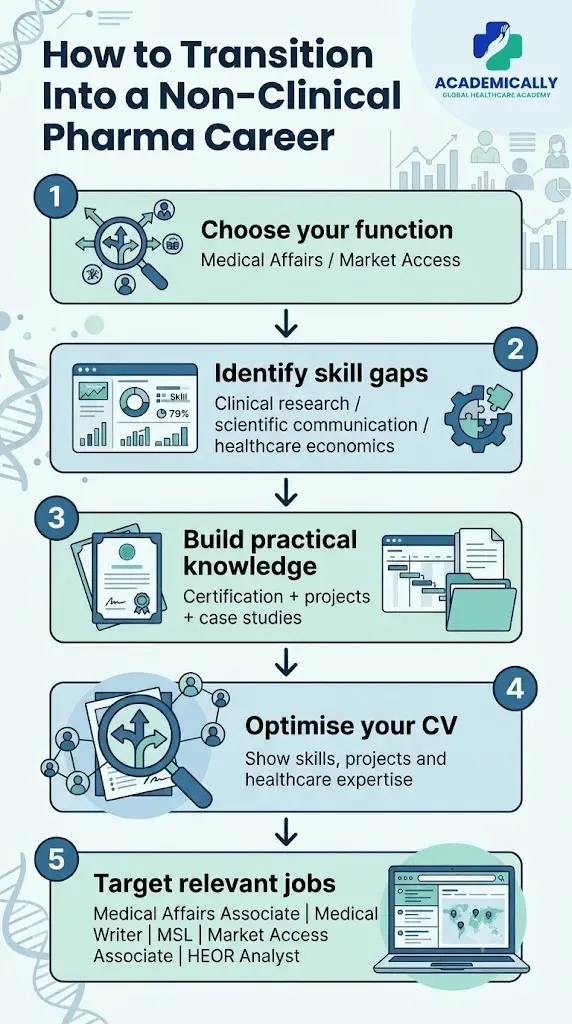
How to transition into a Non-Clinical Pharma Career
Can Healthcare Graduates Move Between Medical Affairs and Market Access
Yes there can be crossover.
The strongest bridge is often evidence.
Medical Affairs professionals may increasingly work with RWE, HEOR evidence‑generation plans and payer‑relevant evidence.
Market Access professionals also need to understand clinical evidence because payer decisions are not based purely on price.
That means gaining skills in research, real‑world evidence, health economics, scientific communication, data interpretation and stakeholder engagement can create useful flexibility.
I would not think of the two careers as separate highways. They are like connected routes, within the same pharmaceutical ecosystem.
Medical Affairs vs Market Access: Career Snapshot
| Factor | Medical Affairs | Market Access |
| Science intensity | High | High |
| Clinical evidence | High | Moderate–High |
| Healthcare economics | Moderate | High |
| Scientific communication | High | Moderate–High |
| Payer interaction | Lower | High |
| HCP/KOL interaction | High | Moderate |
| Data/analytics | Moderate–High | High |
| Strategic focus | High | High |
| Potential crossover | HEOR/RWE/Clinical/ Regulatory | HEOR/RWE/Pricing/ Strategy |
Final Takeaway
When I look at the Medical Affairs vs Market Access career question, I would not start with salary, job‑title prestige or what looks popular on any job platform.
I would start with the type of work that I want to do over and again.
If you enjoy asking, "What does the evidence say and how do we communicate it responsibly?" then Medical Affairs is a path to explore.
If you naturally ask, "What is the value of this treatment, who pays for it and what evidence supports reimbursement?" then Market Access is the relevant direction.
Medical affairs can be especially attractive to healthcare professionals who want to stay close to science, clinical evidence, scientific communication and other healthcare professionals.
Market access can suit professionals who're interested in healthcare economics, payer strategy, reimbursement, HTA, pricing, policy and the larger healthcare system.
My biggest takeaway is that neither medical affairs nor market access is simply a career for someone leaving clinical practice. Both are pharmaceutical functions that require their own knowledge base.
The smartest transition is therefore not to leave your healthcare degree behind. It is to build industry‑specific skills on top of that degree.
That is how a B.Pharm, M.Pharm, PharmD, medical, dental, biotechnology or life‑science background can become more than a qualification on a CV. It can become the foundation, for a non‑clinical pharma career.