
Market Access Careers in Pharma: A Complete Guide for Healthcare Graduates

Written by

Dr Aditi Chandra

Co-Author

Dr. Akram Ahmad
Market Access Careers in Pharma Skills, Career Guide and Salary
4 min

Summary:

Market Access sits at the intersection of science, healthcare economics, evidence, policy and commercial strategy. For healthcare graduates, it can offer a rewarding route into the pharmaceutical and healthcare industry, allowing them to apply their clinical knowledge without remaining in patient-facing practice. Market Access professionals support decisions around pricing, reimbursement and access and help to demonstrate the value of medicines and healthcare technologies to payers, providers and patients. Their work generally entails analysis of clinical and economic evidence, understanding of healthcare policies, evaluation of results and working with cross-functional teams. This book describes the role of Market Access professionals, the skills sought by companies, the typical career pathways and qualifications that can boost your profile. It also covers how experience in Medical Affairs, Clinical Drug Development, HEOR, RWE and clinical research can be a great basis for a career in Market Access.

Key Takeaways  

  • Market Access connects medicines with reimbursement and patient access.
  • HTA, HEOR, pricing and reimbursement are core areas.
  • Clinical and healthcare knowledge can be highly relevant.
  • Analytical, communication and commercial skills matter.
  • Medical Affairs and Clinical Drug Development offer useful transferable skills.

Imagine a breakthrough drug passing every clinical trial with flying colours, winning regulatory approval, and then... sitting on a shelf because healthcare systems refuse to pay for it.

It happens more often than you think. 
Why? Because regulatory approval is only half the battle; patient access is the other.

Once a drug proves safe and effective, healthcare systems ask harder commercial questions: What value does it add? How does it compare to existing treatments? What is the cost burden? Will payers reimburse it?

This critical intersection is where Market Access enters the picture.
For a doctor, pharmacist, dentist, life-science graduate or healthcare professional considering a move into pharma, this creates an interesting career possibility: you can use your understanding of medicine while moving closer to strategy, evidence and healthcare decision-making.

What Is Market Access in Pharma?  

Market Access is the function that helps pharmaceutical products achieve appropriate access within healthcare systems.

In practical terms, professionals work on questions surrounding:

  • Pricing
  • Reimbursement
  • Health Technology Assessment
  • Health Economics and Outcomes Research (HEOR)
  • Value communication
  • Evidence generation
  • Payer and stakeholder needs
  • Market and policy analysis
  • Launch strategy

Market Access therefore sits between several parts of the pharmaceutical ecosystem.

A simplified pathway looks like:

Drug development → Clinical evidence → Regulatory approval → HTA/value assessment → Pricing & reimbursement → Patient access

These stages are connected, but they are not interchangeable.

Regulatory authorities primarily assess whether a medicine meets the requirements for approval. Market Access focuses on the evidence and strategy needed to support access within healthcare systems.

The FDA's drug development framework, for example, involves preclinical work, clinical research and regulatory review before a medicine can be approved for sale.

Market Access comes into the broader commercial and healthcare-system conversation around what happens after or increasingly, alongside the development and approval process.

Major Career Areas Within Market Access  

1. Health Economics & Outcomes Research (HEOR)  

  • HEOR assesses the economic and real-world value of healthcare interventions. Depending on your role, you may work with:
  • Health results
  • Value for money
  • Impact on budget
  • Economic model
  • Data in the real world
  • Comparative effectiveness
  • Literature reviews
  • Synthesis of Evidence
  • Analytic ability

2. Health Technology Assessment  

  • HTA evaluates healthcare technologies using structured evidence.
  • The European Commission describes HTA as incorporating medical, economic, social and ethical considerations.
  • Healthcare graduates can find this particularly interesting because the work requires you to understand clinical evidence while also considering how healthcare systems make decisions.

3. Pricing & Reimbursement  

Pricing and reimbursement professionals work on questions such as:

  • How should a product be positioned?
  • What evidence supports its value?
  • What reimbursement environment does it enter?
  • How does the product compare with alternatives?
  • What payer considerations could influence access?

The exact frameworks differ by country, so global Market Access professionals need strong awareness of healthcare-system differences.

4. Value Communication  

A major part of Market Access is communicating why a medicine represents value.

That requires more than knowing the science.

You must be able to translate complex clinical and economic evidence into a clear argument for different stakeholders.

5. Real-World Evidence  

Clinical trials provide important evidence, but healthcare decision-making can also require understanding how treatments perform in broader real-world settings.

This creates overlap between Market Access, RWE, clinical research, biostatistics and evidence generation.

What Skills Do You Need for a Market Access Career?  

Several skills repeatedly appear across Market Access work.

SkillWhat It Involves in Market Access
Scientific & Medical KnowledgeDiseases, therapeutic paths, clinical outcomes and medical terminology. Having a healthcare background might be a great starting point to develop Market Access expertise.
Critical ThinkingInterpretation of evidence and data, including clinical data, epidemiology, statistics, health economics, outcomes research, evidence synthesis, and economic modelling
CommunicationsCommunicating complex scientific and economic evidence clearly to stakeholders of varied professional background through writing, presentations and debates.
Commercial AwarenessUnderstanding how healthcare decisions affect pharmaceutical companies, payers, providers and patients. Market Access requires both scientific and business understanding.
Management of ProjectsManaging projects with various participants, time frames, sources of proof and deliverables. Good deadline management and continual learning also help career growth.
Stakeholder ManagementWorking with Medical Affairs, Regulatory Affairs, Clinical Development, Commercial teams, HEOR specialists and external consultants. Strong cross-functional communication and collaboration is a must.

Can Healthcare Graduates Enter Market Access?  

Yes.

A healthcare or life-science qualification can provide useful scientific context, but you need additional knowledge in areas such as:

  • Health economics
  • HTA
  • Pricing and reimbursement
  • HEOR
  • RWE
  • Evidence generation
  • Healthcare policy
  • Pharmaceutical strategy

The entry route can also vary according to the employer and role.

Market Access recruitment guidance commonly identifies backgrounds in life sciences and related disciplines, while noting that there is no single universal credential checklist.

How Medical Affairs Skills Connect With Market Access  

This is where the career paths become particularly interesting.

Medical Affairs and Market Access are different functions, but they share several capabilities.  

Medical AffairsMarket Access
Clinical evidenceClinical and economic evidence
Scientific communicationValue communication
Stakeholder engagementPayer/stakeholder engagement
Evidence generationEvidence generation
RWERWE/HEOR
Disease-area knowledgeDisease and treatment landscape
Clinical trial understandingEvidence interpretation

Academically's current Executive Programme in Clinical Drug Development includes clinical trials and evidence generation, Health Technology Assessment, scientific communication and stakeholder-related learning. The overlapping skills can be useful if you are exploring adjacent pharmaceutical functions.

How Clinical Drug Development Skills Connect With Market Access  

The connection becomes clear when you look at the entire medicine lifecycle.

Clinical Drug DevelopmentMarket Access
How do we generate reliable evidence?How can that evidence support healthcare decisions?
Focuses heavily on clinical development and evidence generation.Focuses on value, access and healthcare decision-making.
Studies safety, efficacy, outcomes and patient populations.Interprets evidence alongside economic, clinical and healthcare-system considerations.
Generates clinical and real-world evidence.Uses evidence to understand and communicate the value of a product.
Looks at evidence throughout drug development.Looks at how evidence can contribute to access and value decisions.

Academically's non clinical courses cover clinical trials, regulatory affairs, Medical Affairs, biostatistics, medical writing, RWE and post-market studies.

These areas can support a transition because Market Access professionals need to understand evidence quality, clinical outcomes and the wider product-development lifecycle.

However, you would still need to deliberately build Market Access-specific competencies

Market Access Career Salary in India

Career LevelTypical ExperienceCommon RolesIndicative Annual Salary in India
Fresher / Entry Level0–2 yearsMarket Access Analyst, Associate, Junior Consultant₹4–8 LPA
Mid-Level3–7 yearsMarket Access Consultant, Senior Associate, Manager₹8–20 LPA
Senior Level8–12+ yearsSenior Manager, Senior Market Access Lead₹20–35 LPA
Leadership Level12–15+ yearsAssociate Director, Director, Head of Market Access₹30–50+ LPA

Where Can You Find Market Access Jobs?  

The Market Access role is a little bit about casting a wider net than just one search term. Because this field sits right at the intersection of medicine, economics, and business strategy, titles vary depending on the type of organisation hiring.

Opportunities exist across pharmaceutical companies, biotech startups, contract research organisations (CROs), specialised healthcare consultancies, and health system organisations.

Key title combinations to search for:

  • Market Access Analyst or Market Access Associate
  • HEOR Analyst(Health Economics & Outcomes Research)
  • HTA Analyst(Health Technology Assessment)
  • Pricing Analyst
  • RWE Analyst(Real-World Evidence)

Beyond generic job sites, keep an eye on specialised life-science portals like Jobslly. It's a helpful resource if you're building a non-clinical healthcare profile. It has job listings specifically for healthcare graduates and also provides CV assistance.

The main goal is to search broadly enough to uncover positions where your clinical or scientific background gives you an immediate edge over standard business applicants.

Final Thoughts  

Is Market Access a Good Career for Healthcare Graduates?  

Yes. It can be a strong option if you enjoy evidence, strategy, healthcare systems and problem-solving more than direct patient care.

Market Access focuses on why healthcare systems should consider a treatment valuable and worth funding. If you have a background in pharmacy, or medicine, you already hold transferable skills. Addressing knowledge gaps in HTA, HEOR, pricing, and reimbursement is how you turn a healthcare degree into a thriving pharmaceutical career.


About Us

Academically is a global Ed-Tech healthcare platform, led by Dr. Akram Ahmad (PhD in Medicine, University of Sydney, Global Healthcare Career Coach) and his expert team, that helps pharmacists, doctors, dentists, physiotherapists, and other allied healthcare professionals to achieve their career goals in India and abroad. We provide complete career guidance, like skill assessment, Visa, PR and coaching for International licensure exams such as AMC, Overseas Pharmacist Readiness Assessment, APEP, ADC, DHA, SPLE, OCANZ COE and more for countries like Australia, New Zealand, Gulf countries, the US, the UK, and Canada. We have trained more than 10,000+ students across 88+ countries, with a 90%+ success rate on international healthcare licensure exams. We are India’s first healthcare Ed-Tech platform to introduce AI-based mock tests, to help students study smarter and track progress effectively. Beyond exam preparation, we also offer job assistance programmes, such as Upskill by Academically, covering clinical drug development and medical affairs. To help you land your dream job, we have recently launched our job platform Jobslly by Academically, only for healthcare professionals for both India and abroad.

FAQs

1. What is Market Access in the pharmaceutical industry?

Market Access is the pharmaceutical function concerned with helping medicines achieve appropriate access within healthcare systems. It can involve pricing, reimbursement, HTA, HEOR, evidence generation, value communication and stakeholder strategy. The exact responsibilities differ by organisation and geography, but the common objective is to support informed healthcare-system decisions about the value and use of a medicine

2. Can doctors work in Market Access?

Yes. Doctors can bring valuable clinical knowledge to Market Access, particularly when roles involve clinical evidence, disease areas, treatment pathways or stakeholder communication. However, clinical expertise alone is usually not enough. You may need to develop additional knowledge in health economics, HTA, reimbursement, pricing, evidence synthesis and healthcare-system decision-making to become competitive for Market Access-specific positions.

3. Can pharmacists work in the Market Access?

Your pharmacy expertise is even more helpful when you can apply your medicine understanding to healthcare decision-making. To transition successfully, however, you should build additional skills in areas such as HTA, HEOR, pricing, reimbursement and evidence interpretation. Your pharmacy background becomes more valuable when you can connect medicine knowledge with healthcare decision-making.

4. What qualifications are required for Market Access jobs?

There is no single qualification that guarantees entry into Market Access. Employers may recruit candidates from life sciences, pharmacy, medicine, public health, health economics and related disciplines. Some specialised positions may prefer postgraduate training or relevant experience. What matters is whether you can demonstrate the scientific, analytical, communication and healthcare-system knowledge required for the specific role.

5. What skills are most important for a Market Access career?

Analytical thinking, scientific understanding, communication, healthcare-system knowledge, stakeholder management and project management are important. Depending on the role, you may also need knowledge of HEOR, HTA, economic evaluation, pricing and reimbursement, RWE and evidence synthesis. Strong candidates increasingly need to connect clinical evidence with the practical questions faced by healthcare decision-makers.

6. Is Market Access the same as Medical Affairs?

No. They are separate pharmaceutical functions, although they frequently collaborate. Medical Affairs focuses heavily on scientific exchange, evidence generation, medical strategy and relationships with scientific stakeholders. Market Access focuses more directly on value, HTA, pricing, reimbursement and healthcare-system access. Because both functions work with evidence and stakeholders, skills can transfer between them.

7. HEOR and Market Access: Same or Different?

HEOR is strongly associated with Market Access and is frequently situated within or adjacent to Market Access organizations, although organizational structures vary from company to company. HEOR might include the analysis of healthcare outcomes and economic value (e.g., cost effectiveness, budget impact). These analyses can feed into wider evidence packages and decisions around reimbursement and availability.

8. Will my experience in Clinical Drug Development assist me make the transition to Market Access?

So you should add Market Access particular expertise, rather than believing your prior experience inherently qualifies you for Market Access responsibilities. You should therefore add Market Access-specific knowledge rather than assuming your existing experience automatically qualifies you for Market Access roles.

9. Do I need an MBA to work in Market Access?

Not always. An MBA can be advantageous for certain commercial/strategic roles but is not a blanket requirement for Market Access employment. Depending on the role, specialised knowledge of health economics, HTA, HEOR, healthcare systems and pharmaceutical strategy may be more directly relevant. Always assess the requirements of the specific positions you want to target.

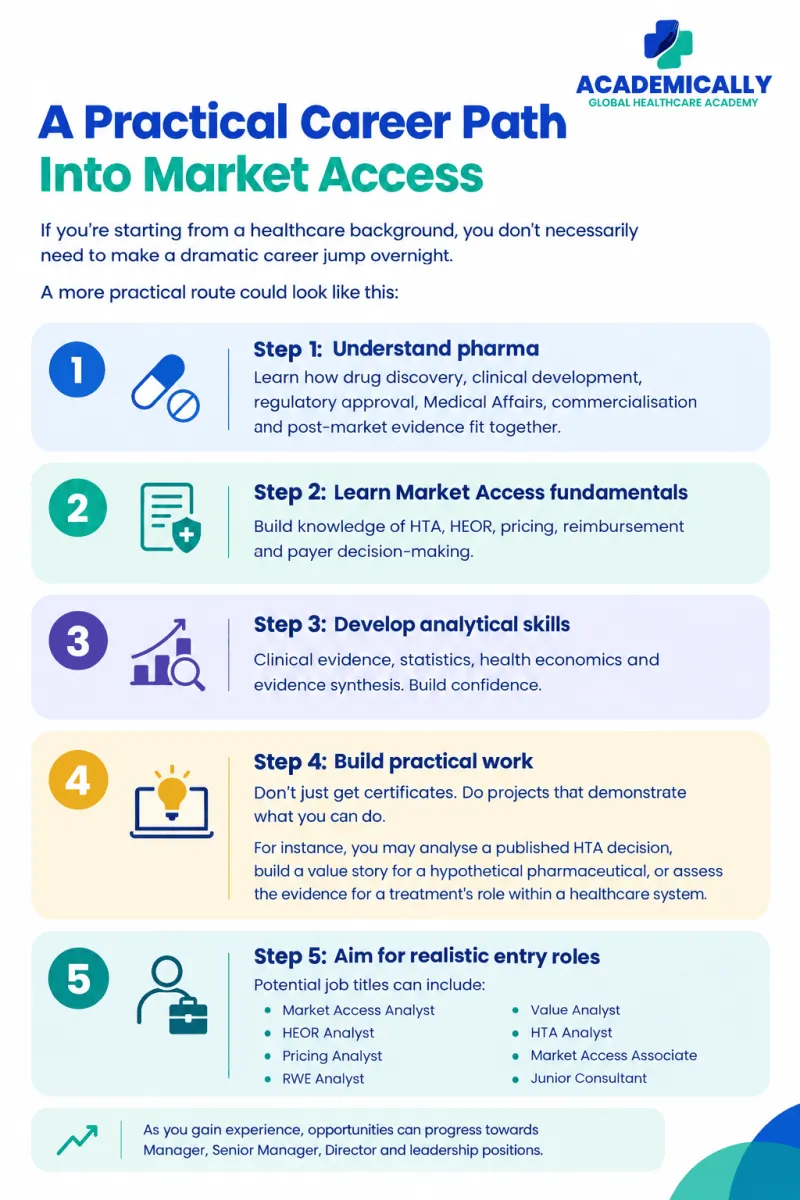
10. How to get into Market Access career as a fresher?

First, comprehend the pharmaceutical lifecycle, then acquire core knowledge of HTA, HEOR, pricing and reimbursement. Develop practical skills in evidence-analysis and produce projects that reflect your expertise. Target entry-level Market Access, HEOR, RWE, HTA or analyst positions rather than waiting for a job titled exactly "Market Access Manager." Your first role is about building relevant experience.

Dr Aditi Chandra
Dr Aditi Chandra

Medical Content Writer Intern

BDS

about the author

BDS, PGDip Hospital & Healthcare Management(Symbiosis University), Fellow in Endodontics( Saveetha University), Fellow in Aesthetic Dentistry (Greifswald University).
Dr Aditi is a dentist with over four years of clinical and healthcare experience, combining expertise in dentistry, healthcare management, medical communication, and content development. 
Beyond clinical practice, Dr Aditi has experience creating evidence-based healthcare content, design patient education materials, and digital health communications. Her work is grounded in scientific research, with a strong focus on translating complex medical information into clear, accessible, and engaging content for diverse audiences. She is also skilled in healthcare marketing, workflow optimisation, and strategic communication.
Currently, Dr Aditi serves as a Medical Content Creator Intern at Academically Global, where she develops educational content for healthcare professionals, students, and international licensing aspirants. She is committed to delivering accurate, up-to-date, and research-backed information that empowers readers to make informed educational and career decisions.

Build a Successful Global Healthcare Career

100% secure & confidential.

Academically

Get Complete Details & Expert Guidance

Our experts will contact you soon

Free guidance • No spam • No obligation

Students
Trusted by 50,000+ healthcare aspirants