
A patient comes to a pharmacy with a prescription, a few symptoms and a medical history that includes two existing conditions. The question asks you to identify the most appropriate treatment. You recognise the medicines, understand the conditions and know the relevant pharmacology. Yet, when you look at the four answer options, most of them seem equally reasonable.
This is where many candidates find themselves spending more time than necessary on an OPRA question.
The difficulty is not always a lack of pharmaceutical knowledge. Sometimes, the challenge is understanding what the question is actually asking, identifying which patient details matter, and connecting those details to the safest clinical decision.
OPRA case based questions require candidates to work with the information presented rather than simply recognise a drug name or recall a definition. A single detail, such as the patient's age, kidney function, current medication or duration of symptoms, can change how the entire question should be interpreted.
However, there is an important distinction to understand before preparing for these questions. The Overseas Pharmacists Readiness Assessment (OPRA) assesses biomedical, pharmaceutical and clinical science knowledge through multiple-choice questions. Its therapeutics and patient care component accounts for 45% of the exam, while questions across all five content areas assess different levels of cognitive ability.
This means rote learning clinical cases alone will not be enough. You need to understand the science behind medicines, recognise relevant clinical information and apply that knowledge when a question presents a patient scenario.
In this blog, you will get to know how to approach OPRA case based questions systematically, recognise important clinical clues, remove unsuitable answer options and practise clinical reasoning without second-guessing every decision.
Understand What the OPRA Exam Tests Before Attempting Case Questions
Before learning how to interpret a patient scenario, understand how the OPRA exam is structured. This gives you a clearer picture of where clinical reasoning fits into your preparation. The current OPRA exam format goes like this:
| Exam detail | Current OPRA format |
| Exam format | Computer-based, closed-book |
| Number of questions | 120 |
| Question format | Multiple-choice questions |
| Answer options | Four options, one correct answer |
| Exam duration | 150 minutes |
| Delivery | Approved test centres |
| Scheduled breaks | No scheduled break |
| Scored questions | 90% |
| Unscored questions | 10% |
The exam gives you approximately 75 seconds per question on average. This is calculated by dividing the total exam time by the number of questions. It is not an individual time limit, so you can spend more time on difficult clinical scenarios and pharmaceutical calculations.
How much of the exam involves therapeutics and patient care?
The APC divides the exam into five content areas.
| Content area | Weightage |
| Biomedical sciences | 20% |
| Medicinal chemistry and biopharmaceutics | 10% |
| Pharmacokinetics and pharmacodynamics | 10% |
| Pharmacology and toxicology | 15% |
| Therapeutics and patient care | 45% |
Therapeutics and patient care represents the largest content area. It covers the clinical application of knowledge from the other four areas, including medicine selection, patient assessment, dose calculations, special populations, monitoring and health promotion.
This is why practising OPRA case based questions is important. A single patient scenario may require you to combine knowledge of pathophysiology, pharmacology, pharmacokinetics and medicine safety.
There are three cognitive ability levels of preparation:
- Remembering or recall: 55%
- Comprehension or understanding: 30%
- Application: 15%
These figures show that clinical application is not the only skill being assessed. A candidate still needs a strong foundation in pharmaceutical sciences and the ability to interpret concepts correctly.
If you are still deciding where to begin, our guide on how to prepare for the OPRA exam, including recommended courses and study material can help you organise your revision around the examination blueprint instead of studying randomly.
Important: The OPRA exam assesses the biomedical, pharmaceutical and clinical sciences underlying pharmacy practice. Australian and New Zealand-specific legislation and practice standards are addressed in later stages of the registration pathway, rather than being the focus of the OPRA exam.
What Are Case-Based Questions in the OPRA Exam?
A case-based question presents information about a patient, their medical history, symptoms, medicines, investigation results or treatment requirements. You are then asked to identify the most appropriate answer using your pharmaceutical knowledge.
Not every question will contain a long patient history. Some may include only a few clinical details before asking you to identify a drug interaction, recognise an adverse reaction or recommend an appropriate treatment consideration.
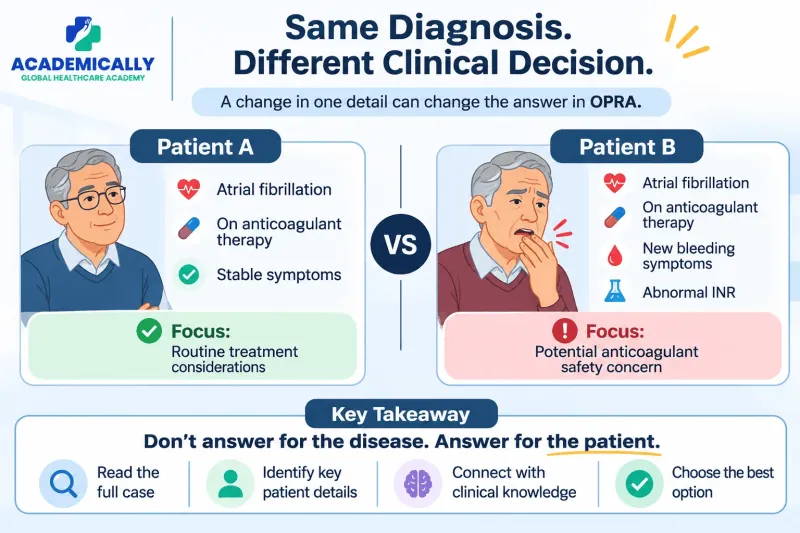
For example, consider a patient who:
- Is 68 years old.
- Has a history of atrial fibrillation.
- Takes an anticoagulant regularly.
- Reports new bleeding symptoms.
- Has an abnormal coagulation result.
The question may not directly ask you to explain how the anticoagulant works.
Instead, it may ask you to identify the most appropriate management consideration. To answer correctly, you need to recognise the clinical problem, understand the medicine's mechanism, assess the significance of the reported symptoms and interpret the investigation result.
This is what makes OPRA clinical reasoning questions different from definition-based questions. A candidate who remembers the mechanism of action of an anticoagulant may still struggle if they cannot connect that knowledge to the patient's current condition.
3 common ways clinical information can be presented
1. Direct patient scenarios
These questions provide a short description of a patient and ask you to make a clinical interpretation. They may involve a patient presenting with symptoms, taking an existing medicine or experiencing a suspected adverse drug reaction.
2. Clinical information combined with investigation results
These questions may include laboratory values, physiological measurements or other clinical findings. You must understand what the values indicate and whether they change the suitability or safety of a treatment.
3. Treatment and medicine-related scenarios
These questions assess whether you can identify an appropriate medicine, recognise an unsuitable option, understand a dosing consideration or identify a clinically important interaction. The important point is that the question is not necessarily asking for the treatment you have seen most frequently. It is asking for the answer that best fits the information provided.
How to Read OPRA Case-Based Questions: A Step-by-Step Method
One of the most effective ways to approach a clinical scenario is to break it into smaller parts. Rather than trying to understand the entire case at once, establish what the question requires and then connect the relevant details. Use the following method whenever you encounter OPRA case based questions.
Step 1: Read the actual question before analysing the entire case
Start with the final sentence of the question. This tells you what information you need to extract from the scenario.
Ask yourself:
- Is the question asking for a diagnosis or a clinical interpretation?
- Does it require you to identify a medicine or its mechanism?
- Are you expected to assess the safety of an existing treatment?
- Does it ask for an appropriate dose or monitoring parameter?
- Is it asking for the MOST appropriate or LEAST appropriate option?
For instance, a case may describe a patient with hypertension, diabetes, impaired renal function and several medicines. However, the final question may only ask which medicine requires a dosage review.
You do not need to investigate every condition in equal detail. Your task is to identify the information relevant to the medicine or clinical decision being tested. This simple habit can prevent you from spending too much time analysing details that do not influence the answer.
Step 2: Identify the patient profile
Once you understand the question, establish who the patient is. Certain patient characteristics can significantly influence medicine selection, safety and treatment outcomes. Pay particular attention to:
- Age: Is the patient an older adult or a child?
- Pregnancy or breastfeeding: Could the medicine affect the patient or infant?
- Existing health conditions: Are there conditions that alter medicine safety?
- Renal function: Could impaired kidney function affect drug elimination?
- Hepatic function: Could liver dysfunction affect drug metabolism?
- Allergies: Is there a known allergy or previous adverse reaction?
- Current medication: Could there be an interaction or therapeutic duplication?
Do not assume that a medicine suitable for one patient will automatically be appropriate for another with the same condition.
For example, two patients may have the same infection but different allergies, renal function and medical histories. Their appropriate treatment considerations may therefore differ. When working through OPRA patient care questions, think about the individual rather than treating the disease in isolation.
Step 3: Identify the main clinical problem
A patient scenario may contain several symptoms, conditions and medication details. Your next task is to identify the central issue being tested. Try summarising the case in one sentence. For example:
- An older patient taking an anticoagulant has developed bleeding symptoms.
- A patient with reduced kidney function is taking a medicine that requires renal consideration.
- A patient is experiencing symptoms after starting a new medicine.
- A patient is not following the prescribed treatment schedule.
This one-line summary helps you avoid getting distracted by secondary information. It also gives you a starting point for connecting the patient's circumstances with the relevant pharmacology.
Step 4: Separate important details from background information
Not every detail in a clinical scenario carries the same importance.
A case may include the patient's age, occupation, family history, previous illness, current medication and recent investigation results. Only some of these details may be necessary to answer the question.
Consider the following example:
A 72-year-old patient taking multiple medicines presents with dizziness. Their medical history includes hypertension, type 2 diabetes and impaired renal function.
The question asks which patient factor is particularly important when reviewing a recently prescribed medicine that is primarily eliminated through the kidneys.
The key detail is renal function.
The patient's age and medical history provide context, but renal impairment is the detail most directly connected to the question.
Train yourself to distinguish between:
- Essential information: Directly influences the answer.
- Supporting information: Helps establish the clinical context.
- Distracting information: Does not materially change the decision being tested.
This is a particularly useful technique when dealing with lengthy OPRA clinical reasoning questions.
Step 5: Connect the clinical condition with pharmacology
Once you have identified the main problem, recall the relevant pharmaceutical principles.
Ask yourself:
- What is the underlying physiological or pathological process?
- Which drug class or medicine is relevant?
- How does the medicine work?
- How is it absorbed, distributed, metabolised and eliminated?
- What contraindications, precautions or adverse effects should be considered?
- Does the patient's medical history change the treatment decision?
For example, if a patient has impaired renal function, you should consider how renal elimination affects medicine exposure and whether dose adjustment or additional monitoring may be necessary.
If a patient is experiencing symptoms after starting a medicine, consider whether the symptoms could represent an adverse drug reaction, a drug interaction or progression of the underlying disease.
The more comfortably you can connect pharmacology with clinical information, the easier it becomes to approach unfamiliar patient scenarios.
Step 6: Evaluate all four answer options
Do not immediately select an option because it sounds familiar. Read all four alternatives and evaluate each against the patient's circumstances. A useful approach is to eliminate options that:
- Contradict the information provided.
- Ignore a significant contraindication.
- Introduce an unnecessary medicine.
- Fail to address the clinical problem.
- Are inconsistent with the patient's age or medical condition.
- Represent an inappropriate response to the severity of the symptoms.
You may find that two options appear reasonable. In such situations, identify which one answers the actual question more precisely.
Remember, the OPRA exam requires ONE correct answer. The objective is not to select a treatment that could potentially be used in some clinical circumstances. It is to identify the option best supported by the information in the given scenario.
Step 7: Recheck the wording before submitting your answer
Before selecting an answer, return to the final sentence. Look for words such as:
- MOST appropriate
- LEAST appropriate
- CORRECT
- INCORRECT
- NOT recommended
- FIRST-line
The APC specifically states that these determiners are bold and capitalised in its exam questions to draw candidates' attention to the type of response expected. Missing one of these words can lead to a completely different answer.
For example, when a question asks for the LEAST appropriate medicine, selecting the option that represents the most commonly used treatment is a mistake, even when your pharmacological knowledge is correct.
Develop the habit of checking the question's requirement before committing to an answer.
Step 8: Make your decision and move forward
Once you have identified the relevant clinical facts, evaluated the alternatives and checked the question wording, select your answer. Avoid repeatedly changing your choice without identifying a specific reason.
Second-guessing can consume valuable exam time, especially when you have already worked through the clinical information logically.
If you genuinely cannot decide between two options, mark the question for review using the available exam tools, where permitted by the platform, and return to it after completing the questions you can answer more confidently.
The goal is to maintain a steady pace rather than allow one challenging scenario to affect the remaining exam.
Clinical Clues You Should Never Overlook
The difference between a correct and incorrect response often comes down to one small detail in the patient history. When practising OPRA case based questions, become familiar with the following clinical clues.
A. Patient age
Age can influence medicine metabolism, elimination, sensitivity to medicines and the likelihood of adverse effects. Older adults may have multiple medical conditions, take several medicines and experience age-related changes in renal function.
Children also require particular consideration because medicine doses may depend on body weight, age or other patient-specific parameters. If a case mentions that the patient is elderly or is below 12 years of age, consider whether this information affects the treatment being discussed.
Do not automatically assume that age makes a medicine unsuitable. Establish whether it changes the medicine's safety, dose or monitoring requirements.
B. Renal and hepatic function
Renal and hepatic function are particularly important when interpreting medicine-related scenarios.
The kidneys are responsible for eliminating many medicines and their metabolites. Reduced renal function can increase drug exposure and the risk of toxicity, depending on the medicine. Similarly, hepatic impairment may alter the metabolism of medicines that depend on liver enzymes.
When a question provides creatinine clearance, estimated kidney function or liver function results, ask whether the value is relevant to the medicine being considered. The APC's exam blueprint specifically includes calculations of creatinine clearance, pharmacokinetic evaluation and dose individualisation in renal and hepatic dysfunction.
Do not memorise renal and hepatic adjustments without understanding the underlying reason.
C. Current medicines and possible interactions
A patient's existing medication list can reveal problems that are not immediately obvious from their symptoms. Consider the following possibilities:
- Two medicines may produce similar pharmacological effects.
- One medicine may increase the concentration of another.
- An enzyme inhibitor may alter the metabolism of a co-administered medicine.
- A combination may increase the risk of bleeding, sedation or another adverse outcome.
- A newly introduced medicine may interfere with established therapy.
When dealing with drug interactions, identify whether the interaction is pharmacokinetic or pharmacodynamic.
This distinction helps you understand whether a medicine affects the absorption, metabolism or elimination of another drug, or whether the two medicines produce interacting effects within the body.
D. Allergies and previous adverse drug reactions
A documented medicine allergy is not merely background information. It may make a particular treatment unsuitable and require consideration of another option.
However, distinguish between an allergy, an adverse drug reaction and an expected side effect. For instance, a patient reporting nausea after taking a medicine may have experienced an adverse effect. A patient developing features suggestive of an immediate hypersensitivity reaction requires a different level of concern.
The Australian Commission on Safety and Quality in Health Care's Medication Safety Standard highlights the importance of documenting medicine allergies and adverse drug reactions and making this information available to healthcare professionals.
This is why you should never overlook allergy history when reading patient-related questions.
E. Pregnancy and breastfeeding
Pregnancy and breastfeeding can change medicine selection because treatment decisions may affect the mother, developing baby or breastfed infant.
When a scenario mentions pregnancy or lactation, consider whether the medicine is suitable for that population, whether alternatives are available and whether additional specialist advice is necessary.
The APC explicitly includes medicine precautions and contraindications in pregnancy and breastfeeding within the therapeutics and patient care content area.
Avoid making assumptions based only on the drug class. The specific medicine, dose, duration and stage of pregnancy may all matter.
F. Symptoms, onset and duration
The timing of symptoms can help establish whether a patient is experiencing an adverse drug reaction, an acute illness or a worsening pre-existing condition. Ask yourself:
- When did the symptoms begin?
- Did they start after a new medicine was introduced?
- Have they become progressively worse?
- Are there symptoms indicating a serious condition?
- Is the patient experiencing an expected effect or an unusual reaction?
For example, a patient who develops sudden breathing difficulty after taking a medicine needs a different clinical assessment from someone experiencing mild, longstanding nausea. Do not focus exclusively on the medicine when the symptoms themselves suggest an urgent clinical problem.
G. Laboratory values and investigation results
Laboratory findings can provide important information about the patient's condition and treatment suitability. Depending on the scenario, relevant results may include:
- Blood glucose.
- Serum electrolytes.
- Serum creatinine.
- Estimated glomerular filtration rate.
- International normalised ratio.
- Liver function tests.
- Drug concentrations.
You need to understand what the values represent, what an abnormal result may indicate and how it relates to the medicine being assessed. Always pay attention to the units and reference information supplied in the question. Never treat a numerical result as meaningful without considering the clinical context.
How Clinical Reasoning Connects Different OPRA Content Areas
One common preparation mistake is studying each subject independently and assuming that a clinical scenario will only test therapeutics. In practice, the knowledge areas are interconnected. Understanding these relationships makes it easier to approach OPRA clinical reasoning questions because you can identify the underlying subject being tested.
| OPRA content area | How it may appear in a patient scenario |
| Biomedical sciences | Recognising the physiological or pathological basis of symptoms |
| Medicinal chemistry and biopharmaceutics | Understanding formulation, solubility and drug absorption |
| Pharmacokinetics and pharmacodynamics | Interpreting metabolism, elimination, half-life and drug concentrations |
| Pharmacology and toxicology | Identifying mechanisms, adverse effects, toxicity and interactions |
| Therapeutics and patient care | Applying pharmaceutical knowledge to patient-specific medicine decisions |
For example, a question involving a patient with impaired renal function who is taking a medicine requiring dose individualisation may combine:
- Biomedical knowledge of kidney function.
- Pharmacokinetic understanding of drug elimination.
- Pharmacological knowledge of the medicine.
- Therapeutic judgement regarding safe and effective treatment.
Similarly, a patient experiencing an adverse reaction after starting a new medicine may require you to understand the medicine's mechanism, identify the suspected reaction and assess its clinical significance.
Your preparation should therefore focus on understanding concepts rather than memorising isolated answers.
Practical Examples: How to Break Down Patient Case Questions
The best way to become comfortable with case-based questions is to practise analysing realistic clinical situations. The following are original illustrative practice scenarios. They are not reproduced OPRA exam questions and should not be treated as an official APC question bank.
Example 1: A patient taking an anticoagulant
Clinical scenario:
A 70-year-old patient with atrial fibrillation has been taking warfarin for several months. During a follow-up consultation, the patient reports unusual bleeding from the gums. Their INR is above the intended therapeutic range.
Question:
Which aspect of the patient's current condition requires the greatest attention when assessing the safety of ongoing treatment?
How to approach it:
Start by identifying the medicine. Warfarin is an anticoagulant, so its therapeutic use involves managing clotting risk while avoiding excessive anticoagulation.
Next, identify the important clinical clues:
- The patient is an older adult.
- They are taking long-term anticoagulant therapy.
- They have developed bleeding symptoms.
- Their INR is above the intended therapeutic range.
The combination of bleeding symptoms and an elevated INR is clinically significant. The key issue is not simply remembering warfarin's mechanism of action. It is understanding what the clinical findings mean for patient safety.
What this example teaches:
When answering anticoagulant-related scenarios, connect the medicine's mechanism with the investigation results and the patient's symptoms.
Do not select an answer solely because it mentions the drug's pharmacology. The question may be assessing your ability to interpret a potential safety problem.
Example 2: Renal impairment and medicine selection
Clinical scenario:
A 66-year-old patient with type 2 diabetes has recently been diagnosed with declining renal function. They are taking several medicines for their existing medical conditions. Their healthcare provider is reviewing the current medication regimen.
Question:
What is the most important pharmacokinetic consideration when reviewing medicines that undergo significant renal elimination?
How to approach it:
Identify the central problem first: declining renal function. Then connect it with pharmacokinetics.
Think about:
- How a medicine is eliminated from the body.
- Whether reduced renal clearance could increase systemic exposure.
- Whether the medicine requires dose adjustment.
- Whether monitoring is needed to reduce the risk of toxicity.
The question does not necessarily require you to identify every medicine the patient takes. It tests whether you understand how an alteration in renal function can affect drug disposition.
What this example teaches:
When interpreting OPRA case based questions involving renal impairment, focus on the relationship between kidney function, drug clearance and individualised dosing.
Example 3: A medicine-related adherence problem
Clinical scenario:
A patient with type 2 diabetes has been prescribed a twice-daily insulin regimen. However, the patient regularly administers only one dose because they find the schedule difficult to maintain. Their fasting blood glucose readings remain consistently high.
Question:
Which treatment consideration should be prioritised when assessing the patient's medication regimen?
How to approach it:
The first clue is the patient's adherence problem. The second clue is the consistently high fasting glucose.
Rather than immediately assuming that the patient needs a higher dose, consider whether the existing regimen is practical and whether the treatment schedule is contributing to poor glycaemic control.
Evaluate the relationship between insulin action, timing, adherence and the patient's reported glucose pattern.
What this example teaches:
A medicine may be pharmacologically appropriate but ineffective in practice when the patient cannot follow the prescribed regimen. Clinical reasoning involves understanding both how a medicine works and how the patient uses it.
Common Mistakes to Avoid While Answering OPRA Clinical Reasoning Questions
Even candidates with a strong pharmaceutical background can lose marks because of avoidable errors. Here are some common mistakes to address during preparation.
Mistake 1: Reading without identifying the question's objective
Some candidates read the entire patient history before understanding what is being asked. This can create unnecessary mental workload.
What to do instead: Read the final question first, identify its requirement and then extract the relevant clinical information.
Mistake 2: Choosing an answer based on familiarity
You may recognise a medicine used commonly for a particular condition. However, the patient may have a contraindication, interaction or other clinical factor that makes it unsuitable.
What to do instead: Evaluate every answer against the patient profile. Familiarity does not automatically mean appropriateness.
Mistake 3: Ignoring negative information
Information such as the absence of a symptom, a normal investigation result or a documented allergy can influence the answer. For instance, an option may appear appropriate until you consider a negative finding that rules out its use.
What to do instead: Review the entire scenario for positive and negative clinical findings.
Mistake 4: Confusing adverse effects with the underlying condition
Not every symptom reported by a patient represents progression of their disease. Some symptoms may be associated with their treatment, an interaction or an adverse drug reaction.
What to do instead: Consider the timing of symptom onset, recently introduced medicines and the known adverse-effect profile of the drug.
Mistake 5: Spending too long on one difficult question
A challenging scenario can tempt you to repeatedly reconsider the same alternatives. This is particularly problematic when the exam has 120 questions and only 150 minutes.
What to do instead: Follow a consistent elimination method, make your best-supported decision and move forward. Return to difficult questions when time permits.
Mistake 6: Memorising case answers rather than understanding the reasoning
Memorising a question bank can help with familiarity, but it becomes less useful when an unfamiliar patient profile changes the clinical context.
What to do instead: After every practice question, explain why the correct option is appropriate and why each alternative is less suitable.
This develops transferable clinical reasoning skills.
How to Practise OPRA Case-Based Questions Effectively
Practising questions is important, but the way you review them determines how much you learn. Instead of simply counting how many questions you answer correctly, focus on understanding why you made a particular choice.
Follow a topic-wise approach
Start with the content areas that contribute to the exam blueprint. A practical sequence is:
- Review the relevant biomedical and pathophysiological concepts.
- Understand the mechanisms of commonly used drug classes.
- Study pharmacokinetic principles, including ADME and dose individualisation.
- Revise adverse effects, contraindications and drug interactions.
- Apply the knowledge to therapeutics and patient care scenarios.
- Review ethical considerations, relevant laws and regulations, and country-specific professional standards to support ethical decision-making in healthcare practice.
This sequence helps you build the scientific foundation required to interpret clinical situations.
Maintain a clinical reasoning error log
After completing practice questions, record the mistakes you make. A simple table can help:
| Question type | Your mistake | What to revise |
| Renal impairment | Ignored renal clearance | Pharmacokinetics and dose adjustment |
| Drug interaction | Considered only one medicine | Drug metabolism and interactions |
| Adverse reaction | Confused side effect with allergy | Pharmacology and toxicology |
| Patient adherence | Focused only on increasing dose | Therapeutics and medicine use |
| Clinical assessment | Missed a key symptom | Pathophysiology and patient assessment |
Revisit this log every few days. Over time, you may notice that your mistakes are concentrated in certain topics or arise from repeated reading habits. Addressing those patterns is more useful than repeatedly attempting questions without analysing your performance.
Practise with a timer
Since the OPRA exam provides 150 minutes for 120 questions, time management needs to become part of your preparation.
Start by practising without a timer so that you can develop a sound reasoning process.
Once you become comfortable, introduce timed sessions.
Use the following progression:
- Begin with shorter sets of 10 to 15 questions.
- Progress to sets of 30 questions.
- Attempt mixed-topic practice sets.
- Complete full-length timed mock exams.
Aim to maintain an average of approximately 75 seconds per question across your practice sessions.
Once you are comfortable with topic-wise practice, try a timed assessment to see how you handle unfamiliar questions under exam conditions. A free OPRA exam mock test for pharmacists planning to work in Australia can help you evaluate your current readiness before committing to a full revision cycle.
Review the explanation, not just the answer
Every practice question should teach you something. When reviewing your answer, ask:
- Why is this option correct?
- What makes the other options unsuitable?
- Which clinical clue influenced the decision?
- Which pharmaceutical principle was being assessed?
- Could the answer change if the patient profile were different?
This final question is particularly valuable. It encourages you to understand how clinical decisions depend on patient-specific information.
Using Practice Questions to Improve Your OPRA Preparation
Candidates sometimes spend considerable time collecting multiple question banks without following a structured revision process.
A better approach is to use practice material that helps you understand the exam format, identify knowledge gaps and develop the ability to apply concepts.
The APC provides official sample content to familiarise candidates with the question format and the range of content areas. Its sample document, updated on 30 July 2026, includes both direct knowledge questions and patient-related scenarios.
It also carries an important disclaimer: the sample questions are no longer used in live exams, and the APC cannot guarantee the continued accuracy of all published answers because pharmacy practice guidance may change.
Use the document to understand question construction, not to predict the actual exam paper.
Once you have familiarised yourself with the official format, you can build your practice around additional questions and explanations.
Working through structured OPRA sample questions and answers can help you test your subject knowledge and practise identifying the clinical information that matters.
The value of a practice question is not limited to whether you get it right. It also depends on whether you understand the reasoning behind the answer and can apply the same principle to another patient scenario.
How to Build Stronger Clinical Reasoning Before Exam Day
Strong performance in clinical questions comes from a combination of subject knowledge, interpretation and regular practice. You do not need to approach every scenario with a complicated framework. You need a consistent process that works even when the question contains unfamiliar medicines or patient conditions. Consider these habits during your preparation.
- Connect mechanisms with clinical outcomes. Do not learn drug mechanisms in isolation. Understand how the mechanism relates to the medicine's therapeutic action, adverse effects and contraindications.
- Practise interpreting numbers. Become comfortable with relevant laboratory parameters, physiological values, renal function calculations and dosage calculations. Pay attention to metric units.
- Revise special populations. Give adequate attention to older adults, children, pregnancy and breastfeeding. The APC specifically includes these areas in its therapeutics content.
- Read medicine-related information carefully. The official question construction standards refer to TGA-approved ingredient names, accepted medicine terminology and SI units. Familiarity with these conventions can reduce avoidable confusion.
- Use evidence-based references. The APC recommends preparing with current peer-reviewed journals, clinical practice guidelines and textbooks. The Australian Commission on Safety and Quality in Health Care and the Therapeutic Goods Administration are useful official sources for understanding Australian medicine terminology and safety principles.
- Assess your mistakes honestly. A wrong answer should tell you what to improve. Do not simply move to the next question after looking at the answer key.
For candidates who need a more organised revision routine, a structured OPRA Exam Preparation Course can provide a framework for revisiting the exam subjects, strengthening pharmaceutical concepts and practising their application. The important consideration is to ensure that your preparation covers the full OPRA blueprint rather than focusing exclusively on patient scenarios.
Consistency matters more than trying to master everything in one sitting. You can also learn how another overseas pharmacist approached preparation, clinical application and revision in this OPRA exam success story of an Indian pharmacist:
Academically Global is the first to introduce OPRA coaching that too since its initial KAPS days with constant mentorship by Dr. Akram Ahmad, the founder himself who's led the life that you are going to. Once you enrol into our preparation course, you can attend live lectures by OPRA-qualified pharmacists who hold active AHPRA registration and are settled in Australia.
A Quick Checklist Before Answering Any OPRA Patient Care Question
Use this checklist during your practice sessions until the steps become familiar.
| What to check | Questions to ask yourself |
| Question requirement | What exactly am I being asked to identify? |
| Patient profile | Does age, pregnancy or medical history affect the answer? |
| Main problem | What is the central clinical issue? |
| Symptoms | Are there signs suggesting an adverse reaction or serious condition? |
| Current medicines | Could an interaction or contraindication be involved? |
| Investigation results | Are the values clinically relevant to the question? |
| Pharmacology | Do I understand the medicine's mechanism and effects? |
| Answer options | Have I eliminated alternatives that do not fit? |
| Question wording | Am I answering MOST, LEAST, CORRECT or INCORRECT? |
The purpose of this checklist is to create a repeatable reading habit. With enough practice, you will be able to apply the same reasoning process without consciously going through every step.
Conclusion
Reading a patient scenario correctly is just as important as knowing the pharmaceutical concepts behind it.
The most effective approach to OPRA case based questions is to understand the clinical requirement, identify the patient's relevant characteristics, recognise the central problem and connect the information with the appropriate pharmaceutical principles.
Do not assume that a longer patient history necessarily means a more difficult question. Often, the answer becomes much clearer once you recognise the one or two details that directly influence the clinical decision.
Build your foundation across all five OPRA content areas, practise unfamiliar scenarios, review your mistakes and develop the habit of evaluating every answer in the context of the patient.
With consistent preparation, OPRA clinical reasoning questions become less about guessing between four options and more about applying what you already know to the information in front of you.