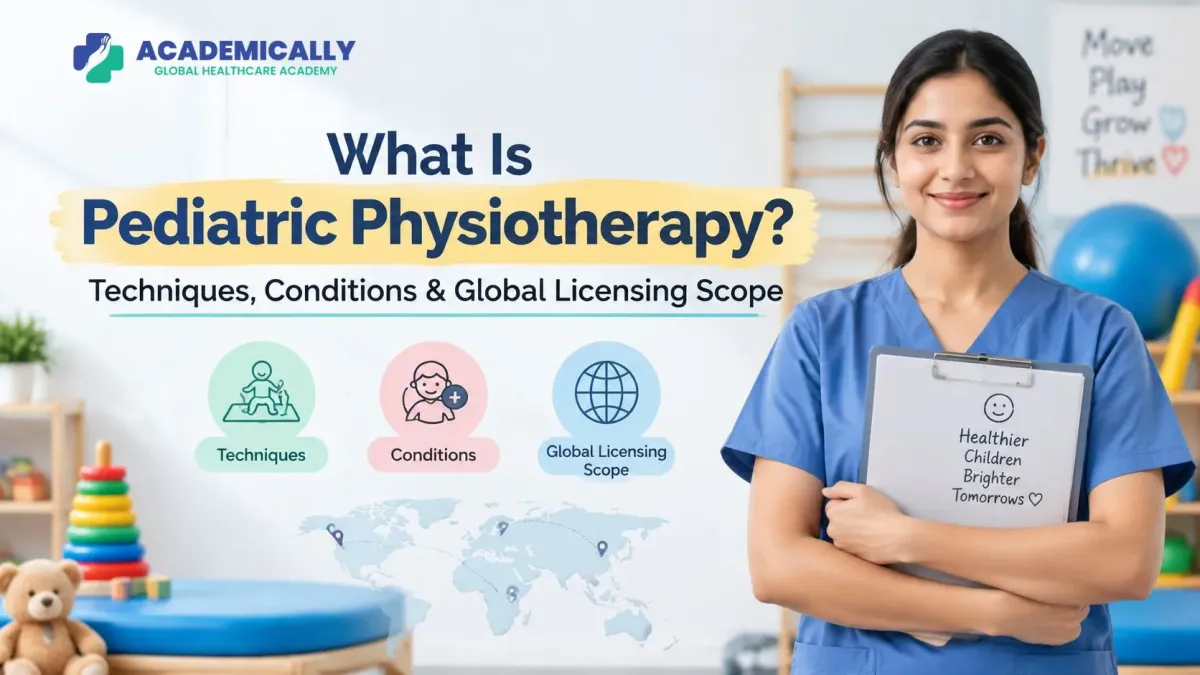
Pediatric physical therapy is the specialized, evidence-based management of neonates, toddlers, children, and teenagers facing physical limitations from injury, disease, genetic variations, or developmental delays.
While adult rehabilitation largely focuses on restoring lost capacity after an injury or illness, pediatric physical therapy is proactive and developmental. Clinicians assess emerging milestones, adapt therapeutic strategies to sudden skeletal growth spurts, and optimize gross motor capabilities. Practitioners evaluate primitive reflex integration, muscle tone, postural control, and gait biomechanics, framing exercises as motivating games to build lifelong functional independence.
Pediatric vs. Adult Physiotherapy: Clinical Distinctions
Understanding the operational boundaries of this specialty highlights its unique complexity:
| Clinical Feature | Adult Rehabilitation | Pediatric Rehabilitation |
| Skeletal Mechanics | Fused epiphyseal plates; fixed bone geometry | Open growth plates; vulnerable to apophyseal avulsions and progressive torsional deformities |
| Central Nervous System | Mature neural pathways; targeted restoration | Rapidly evolving neuroplasticity; focus on preventing abnormal compensatory synergies |
| Primary Goal | Return to pre-injury status, ergonomic stability | Milestone acquisition, contracture prevention, functional classroom/play participation |
| Assessment Batteries | Functional Independence Measure (FIM), standard goniometry, Berg Balance | Standardized normative tools (AIMS, GMFM-88/66, PDMS-2, BOT-2) |
| Delivery Model | Patient-directed exercise regimens | Multi-agency, family-centered care integrated with caregivers, teachers, and pediatricians |
Conditions Managed in Pediatric Practice
Pediatric clinicians manage varied conditions across four primary physiological pillars:
PEDIATRIC REHABILITATION PILLARS
│
┌──────────────────┬─────────────┴─────────────┬──────────────────┐
▼ ▼ ▼ ▼
Neuromuscular Congenital & Ortho Developmental Adolescent / Sports
• Cerebral Palsy • Torticollis & Plagiocephaly • Motor Delays • Scoliosis (Schroth)
• Spina Bifida • DDH & Clubfoot • Dyspraxia (DCD) • Osgood-Schlatter
• SMA & DMD • Arthrogryposis • Toe Walking • Spondylolysis
| Domain | Conditions Managed | Primary Clinical Interventions |
| Neuromuscular | Cerebral Palsy (GMFCS I–V), Spina Bifida, Spinal Muscular Atrophy (SMA), Duchenne Muscular Dystrophy (DMD) | Spasticity management, dynamic standing frames, transfer training, contracture prevention protocols |
| Congenital & Orthopedic | Congenital Muscular Torticollis (CMT), Plagiocephaly, Developmental Dysplasia of the Hip (DDH), Talipes Equinovarus (Clubfoot) | SCM gentle passive stretching, active cervical positioning, tummy-time coaching, post-Ponseti casting management |
| Developmental & Coordination | Gross motor delay, Idiopathic Toe Walking (ITW), Developmental Coordination Disorder (DCD) | Vestibular/proprioceptive stimulation, motor sequencing drills, calf complex lengthening, dynamic orthoses |
| Adolescent Musculoskeletal | Adolescent Idiopathic Scoliosis (AIS), Sever’s Disease, Osgood-Schlatter, Spondylolysis | 3D curve-specific exercise (Schroth), eccentric load management, kinetic chain stabilization |
| Cardiorespiratory | Cystic Fibrosis (CF), Bronchopulmonary Dysplasia (BPD), post-cardiac surgery recovery | Airway clearance techniques (PEP mask, autogenic drainage), thoracic mobility drills, play-based aerobic conditioning |
Evidence-Based Techniques in Pediatric Care
Pediatric treatment sessions look like unstructured playtime to an outside observer, but every movement is clinically engineered:
- Neurodevelopmental Treatment (NDT): Hands-on therapeutic key points of control to guide transitional postures (e.g., side-sitting to quadruped) and inhibit atypical reflex posturing.
- Task-Oriented Motor Training: High-repetition, meaningful motor tasks paired with direct visual and environmental feedback to promote cortical neuroplasticity.
- Serial Casting and Orthotics: Application of progressive fiberglass casts to restore ankle dorsiflexion, coordinated with the prescription of Solid, Hinged, or Supramalleolar Ankle-Foot Orthoses (AFOs/SMOs).
- Play-Infused Therapeutic Exercise: Agility circuits, obstacle courses, and therapeutic ball work engineered to challenge eccentric muscle control, dynamic balance, and postural endurance.
- Assistive Technology Prescription: Specifying and adjusting adaptive strollers, prone standers, robotic gait-trainers, and power-mobility chairs to optimize social engagement.
- Aquatic Therapy: Hydrotherapy tanks and heated pools reduce gravity's impact, normalize resting muscle tone, and encourage safe balance reactions.
Red Flags: When Is a Pediatric Referral Warranted?
Early identification of developmental abnormalities preserves musculoskeletal alignment and accelerates cognitive-motor links.
DEVELOPMENTAL MOTOR RED FLAGS (BIRTH TO WALKING)
│
┌────────────────────────────────┴────────────────────────────────┐
▼ ▼
0 to 6 Months 7 to 18 Months
• Strong, persistent head tilt to one side • Inability to sit unsupported by 9 months
• Consistent fist clenching; no hands to mouth • Asymmetric crawling (dragging one side)
• Severe head lag on pull-to-sit • W-sitting exclusively with trunk collapse
• Extreme stiffness (extensor thrust) or floppiness • Not pulling to stand by 12 months
• Persistent primitive reflexes (ATNR, Moro) • Inability to walk independently by 18 months
│ │
└────────────────────────────────┬────────────────────────────────┘
▼
Immediate Pediatric Physiotherapy Comprehensive Assessment
Why Pediatric Physiotherapy Is Critical in Global Licensing Exams
Candidates sitting for overseas licensure often underestimate the weight given to pediatric rehabilitation. International regulators emphasize this area because treating pediatric patients demands high-stakes clinical reasoning, strict safety vigilance, and complex multi-agency communication.
Examiners frequently deploy pediatric vignettes to test whether a candidate can think beyond adult orthopedics and adapt safely to a growing physiological system.
PEDIATRIC CLINICAL VIGNETTE TESTING TARGETS
│
┌──────────────────┬────────────┴────────────┬──────────────────┐
▼ ▼ ▼ ▼
Pathology & Stages Growth Mechanics Safety Screening Ethics & Safeguarding
• GMFCS levels • Epiphyseal plate risk • Red flags • Assent vs. consent
• Primitive reflexes • Milestone age windows • Non-accidental • Multi-agency reports
1. Australia: APEP (Australian Physiotherapy Entry Pathway)
Administered by the Australian Physiotherapy Council (APC) for AHPRA registration, the APEP Written and Clinical assessments emphasize pediatric care:
APC Check ➔ Cultural Safety ➔ Written Exam ➔ Capability (Case-Scenario Based) ➔ Clinical Workshop ➔ AHPRA License
- The Clinical Triggers: Cases involve Congenital Muscular Torticollis associated with cranial asymmetry, screening for hip dysplasia (Barlow/Ortolani tests), GMFCS staging for Cerebral Palsy, and adolescent scoliosis.
- Exam Focus: Australian examiners heavily weight family-centered goal setting, culturally safe communication, and coordinated care pathways aligned with Australia’s National Disability Insurance Scheme (NDIS).
2. USA: NPTE (National Physical Therapy Examination)
The Federation of State Boards of Physical Therapy (FSBPT) sets strict pediatric criteria across multiple-choice questions:
FCCPT Evaluation ➔ State Board Approval ➔ TOEFL ➔ Pass NPTE ➔ State Law Exam ➔ State License
- The Clinical Triggers: Exact chronological milestone ranges (e.g., pincer grasp, sitting, cruising), reflex integration windows, orthotic prescriptions (KAFO vs. AFO indications), and contraindications in conditions like Down Syndrome (atlantoaxial instability).
- Exam Focus: Multi-system questions connecting cardiopulmonary parameters with pediatric vitals and neuromuscular conditions.
3. Canada: PCE (Physiotherapy Competency Examination)
The Canadian Alliance of Physiotherapy Regulators (CAPR) integrates pediatric presentations into both written and provincial clinical evaluations:
CAPR Verification ➔ Language Test ➔ Context Course ➔ Competency Exam ➔ Provincial License
- The Clinical Triggers: Assessment of Idiopathic Toe Walking, postural balance reactions, Clubfoot rehabilitation, and respiratory treatments for Cystic Fibrosis.
- Exam Focus: Ethical assent versus guardian consent, Canadian healthcare system navigation, and caregiver education plans.
4. UK & Gulf Licensing (HCPC, DHA, DOH, SCFHS)
- United Kingdom (HCPC): Scrutiny applications require demonstrated pediatric competence, evidence of child safeguarding training, and experience in developmental assessments.
HCPC Application ➔ Clinical Proof ➔ IELTS Academic ➔ HCPC Scrutiny ➔ HCPC Registration
- Middle East (Prometric): Licensing tests (DHA, MOH, SCFHS) feature scenario questions on motor delays, Erb's Palsy management, and congenital hip dislocation.
DataFlow (PSV) ➔ Authority Approval ➔ Prometric Exam ➔ Eligibility Letter ➔ License Activation
Global Licensing Exam Comparison
| Target Destination | Regulatory Body | Examination Pathway | Core Pediatric Scenarios Tested |
| Australia | Australian Physiotherapy Council (APC) | APEP (Eligibility → Written → Clinical) | GMFCS classification, Barlow/Ortolani tests, milestone delays, NDIS-style family goal writing |
| USA | FSBPT / State Boards | NPTE (225 MCQs) | Reflex integration timelines, pediatric vitals, scoliosis bracing rules, muscular dystrophy management |
| Canada | CAPR / Provincial Colleges | PCE Written & Clinical Components | Clubfoot management, respiratory clearance in CF, gross motor testing batteries, caregiver safety |
| United Kingdom | Health and Care Professions Council | HCPC Scrutiny Pathway | Life-span rotational competencies, pediatric safeguarding protocols, multi-agency team reasoning |
| UAE / Saudi Arabia | DHA, DOH, SCFHS | Prometric / Pearson VUE | Milestone age identification, brachial plexus injury (Erb's/Klumpke's), congenital orthopedic screening |
Fast-Tracking Your International Physiotherapy Career
Transitioning from domestic practice to a licensed, practicing physiotherapist in Australia, the US, the UK, or Canada is a multi-step journey. The clinical reasoning required by international examiners differs significantly from rote memorization.
Succeeding on high-stakes assessments like the APEP Written and Clinical Assessments requires systematic coaching tailored to international regulatory expectations. Specialized platforms support international physiotherapists through this process:
- Targeted Syllabus Mastery: Comprehensive modules dissecting pediatric, neurological, cardiorespiratory, and musculoskeletal cases mapped to APC and FSBPT blueprints.
- Interactive Clinical Case Studies: Simulated scenarios that develop the clinical reasoning, prioritization, and communication patterns evaluated by overseas examiners.
- Full-Length Mock Exams: Realistic, timed simulations of the APEP, NPTE, and DHA exams with analytical scoring to target knowledge gaps before test day.
End-to-End Guidance: From initial credential evaluations to exam scheduling and clinical preparation, structured programs help candidates avoid costly paperwork delays and resits.
Career Scope for Pediatric Physical Therapists
Understanding what is pediatric physiotherapy reveals a clinical specialty with immense real-world impact and high global mobility. Driven by expanded public investments in early intervention, growing survival rates for complex premature infants, and strong support structures for children with disabilities, certified pediatric clinicians are in demand worldwide.
Whether your aspiration is leading early-intervention programs under Australia's NDIS, running private pediatric practices in the UK, or treating complex patients in world-class children's hospitals in the US, mastery of pediatric rehabilitation is essential. It provides both clinical expertise and the foundational knowledge needed to pass your international licensing exams.