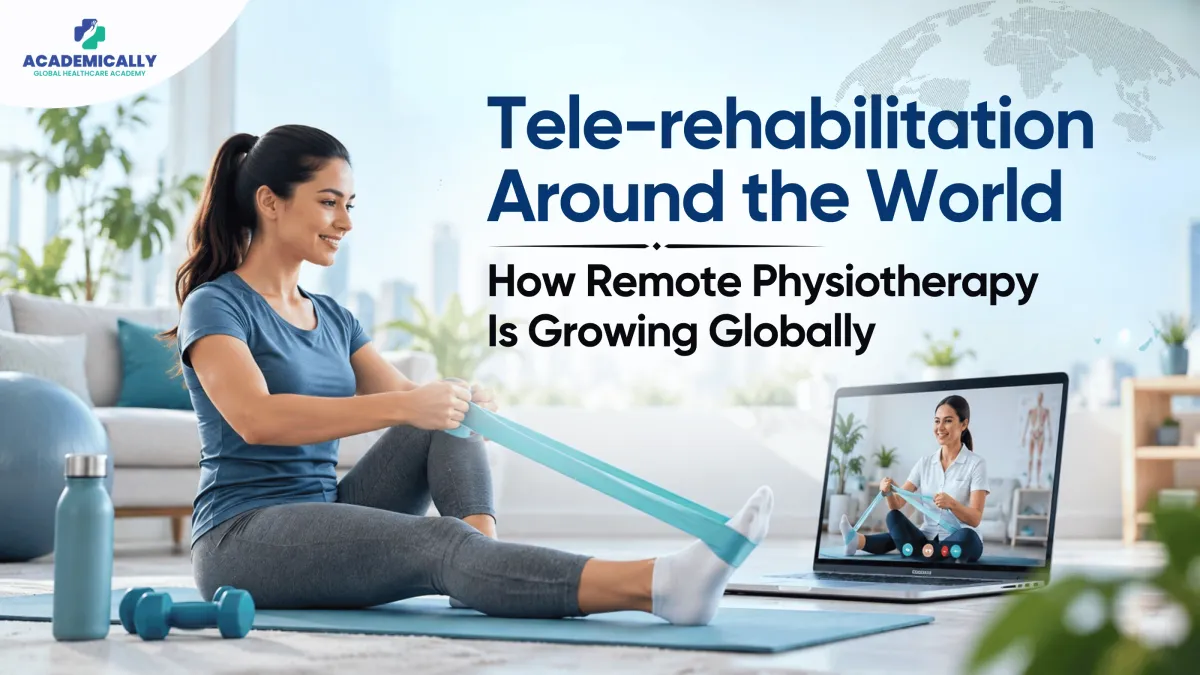
The 2026 telerehabilitation ecosystem operates on a spectrum from live, real-time consultation to passive, continuous monitoring. Clinicians now build robust "digital therapeutic alliances" using the following modalities:
│ The Telerehabilitation Ecosystem │
▼ ▼ ▼
┌──────────────────┐ ┌──────────────────┐ ┌──────────────────┐
│ Synchronous │ │ Asynchronous │ │ Remote Patient │
│ (Real-Time) │ │ (Store & Forward)│ │ Monitoring (RPM)│
│ • HD Video Calls │ │ • App-based HEPs │ │ • Wearable IMUs │
│ • Live pose │ │ • Secure messaging│ │ • Smart insoles │
│ tracking │ │ • Video uploads │ │ • Automated logs │
└──────────────────┘ └──────────────────┘
Synchronous Video with Markerless Computer Vision
Basic video calls have been entirely replaced by specialized, highly secure physical therapy platforms powered by artificial intelligence.
- Dynamic Pose Estimation: Using just the patient's smartphone, tablet, or laptop webcam, the software maps a 3D skeletal wireframe over the patient's body in real time. As the physiotherapist watches the screen, the system automatically calculates joint angles, multi-planar range of motion (ROM), and movement velocity.
- Real-Time Compensatory Alerts: If a patient is compensating for a weak gluteus medius by hiking their hip during a single-leg stance, the software highlights the anatomical asymmetry in red, allowing the therapist to correct it instantly.
Virtual Reality (VR) & Gamified Exergaming
Virtual Reality has moved out of specialized research labs and directly into patients' living rooms, serving as a massive driver of treatment adherence particularly in neurological and orthopedic recovery.
- Immersive Neuro-Rehabilitation: Patients recovering from a stroke or traumatic brain injury (TBI) can wear consumer VR headsets to perform functional reaching or balance tasks in a simulated environment. The VR system provides immediate visual and auditory feedback, stimulating neuroplasticity and motor relearning without the physical risk of falling.
- Gamification for Pain Management: For chronic low back pain or severe knee osteoarthritis, VR environments immerse the patient in game-like scenarios. This sensory immersion distracts central pain pathways and reduces kinesiophobia (fear of movement), encouraging patients to push past psychological barriers safely.
Asynchronous "Store-and-Forward" Biomechanical Analysis
Because synchronous calls can be difficult to schedule across time zones, asynchronous care has skyrocketed.
- Automated Form Correction: Patients record themselves performing their prescribed home exercise programs (HEPs) and upload the video to a secure portal. The AI immediately analyzes the footage, applying biomechanical overlays to the video before the physiotherapist even views it.
- Therapist Annotation: The physiotherapist reviews the footage at their convenience, leaving timestamped voice notes or drawing visual on-screen corrections (e.g., "Keep your lumbar spine neutral here") to correct the patient's form before their next workout.
Remote Therapeutic Monitoring (RTM) via Smart Wearables
Integrated wearables provide continuous "ecological" data—tracking exactly how a patient moves in the real world, rather than just during a structured exercise session.
- Continuous Sensors: Wearable inertial measurement units (IMUs), smart knee sleeves, and connected insoles log daily adherence, step symmetry, and joint loading throughout the day.
- Closed-Loop Haptic Feedback: In advanced setups, wearables do more than just record data; they physically intervene. For example, if a patient with Parkinson's disease experiences a "freezing of gait" episode, a smart ankle wearable detects the halt and delivers a rhythmic haptic vibration to cue the patient to step forward, effectively breaking the freeze.
Digital Triage & AI Navigators
Before a patient ever connects with a physiotherapist via video, artificial intelligence steps in to manage clinical safety and workflow.
- Automated Red Flag Screening: Digital triage systems utilize branching clinical algorithms to evaluate a patient's initial subjective symptoms. They are designed to rule out severe medical emergencies (like cauda equina syndrome, undiagnosed fractures, or deep vein thrombosis) and determine whether the patient is clinically safe for remote telerehabilitation or if they require an immediate in-person medical referral.
Why Digital Care is Tested In Global Licensing Exams
Global health regulators quickly realized that treating a patient through a screen introduces unique clinical risks. Consequently, regulatory bodies have embedded digital health safety directly into their core competencies.
│ Telehealth Competencies on Global Exams │
▼ ▼ ▼
│ Patient Safety │ │ Data & Privacy │ │ Jurisdiction │
│ • Fall risk check│ │ • Secure networks│ │ • Cross-border │
│ • Emergency SOPs │ │ • Cloud consent │ │ licensing rules│
│ • Triage limits │ │ • No public Wi-Fi│ │ • Local state laws│
When sitting for your international board exams, you will not be tested on how to fix a software glitch. You will be tested on:
- Safety and Fall Prevention: How to instruct a patient to clear their living room of tripping hazards and secure a chair before beginning a remote balance assessment.
- Emergency Escalation: Verifying the patient’s exact physical address at the start of a call in case you need to dispatch emergency medical services (e.g., if the patient experiences chest pain).
- Cross-Border Jurisdiction: Understanding that you must hold a valid license in the province, state, or territory where the patient is physically located at the time of the consultation, regardless of where your clinic is headquartered.
Major Global Licensing Pathways
If you are an internationally educated physical therapist (IEPT), here is how tele-rehabilitation will show up on your specific credentialing pathway:
Australia: APEP (Australian Physiotherapy Council) & AHPRA
Because Australia possesses one of the most dispersed rural populations in the world, the Australian Physiotherapy Council (APC) considers telehealth an essential service delivery model.
- The Exams: In the APEP clinical assessments (OSCEs), you may be required to simulate a telehealth consultation.
- Key Focus: You must demonstrate excellent verbal communication skills, safely guide a patient through a remote physical assessment (e.g., instructing a patient on how to self-palpate their AC joint), and explain the limits of what you can assess via video.
APEP Pathway
- Eligibility Assessment & Cultural Safety: Paper-based review of your degree + mandatory 6-hour online cultural safety training.
- Written Assessment: Online multiple-choice exam covering MSK, Neuro, and Cardio.
- Capability Assessment : 1.5-hour remote oral exam testing clinical reasoning.
- Clinical Workshop: 1-day, face-to-face practical assessment in Melbourne.
- AHPRA Registration: Apply for your General Registration license.
United Kingdom: HCPC Standards of Proficiency
The HCPC recently overhauled its standards to mandate that registrants can safely deliver technology-supported care. The National Health Service (NHS) relies heavily on digital MSK pathways to manage waitlists.
- The Exams/Portfolio: When applying to the HCPC, your evidence of practice must demonstrate an understanding of digital exclusion (ensuring elderly or low-income patients who lack internet access aren't left behind) and strict adherence to UK-GDPR regarding digital data storage.
HCPC Route
- Document Mapping: Submit detailed university transcripts and CPD logs proving UK equivalence.
- HCPC Scrutiny: Assessors review your portfolio against UK-GDPR and digital health standards (No written exam usually required).
- Test of Competence: Only required if assessors find gaps in your portfolio.
- NHS Registration: Receive your HCPC pin and apply for Band 5/6 jobs.
United States: The NPTE
In the US, the expansion of CPT billing codes for telehealth and Remote Therapeutic Monitoring (RTM) has institutionalized virtual care. The American Physical Therapy Association (APTA) has even published dedicated Clinical Practice Guidelines on telerehabilitation.
- The Exams: The NPTE will test you heavily on HIPAA compliance in a digital setting and appropriate patient selection. (e.g., Is a patient with severe vestibular dysfunction and a high fall risk appropriate for an unsupervised telehealth balance screen? Answer: No).
NPTE Pathway
- Credential Evaluation: Verification that your degree matches a US Doctorate (DPT) standard (via FCCPT).
- State Approval & English Test: Pass TOEFL (if applicable) and get approval from your target state board.
- NPTE Written Exam: Pass the 225-question exam (including the new EMR Scenario-Based Items).
- Jurisprudence Exam: Pass a state-specific law and ethics exam.
Canada: CAPR & Provincial Regulatory Colleges
The Canadian Alliance of Physiotherapy Regulators (CAPR) assesses your foundational knowledge, but the provincial colleges (like the College of Physiotherapists of Ontario) regulate telehealth practice.
- The Exams: Expect ethics scenarios addressing cross-provincial treatment. For example, if you are licensed in British Columbia but your patient travels to Alberta for a month, can you legally treat them via Zoom? (Answer: It depends on Alberta's specific cross-border tele-practice registry rules).
The Gulf Region (DHA, HAAD, MOH, Prometric)
The UAE and Saudi Arabia are rapidly expanding "Smart Healthcare" initiatives, integrating telehealth with medical tourism and elite sports rehabilitation.
- The Exams: Prometric exams for DHA or HAAD frequently include questions on the integration of digital health apps, culturally sensitive remote communication, and digital patient confidentiality within the region's specific legal frameworks.
- DataFlow (PSV): Primary Source Verification of your degrees and work history.
- Eligibility Check: Submit DataFlow to your target health authority (e.g., DHA in Dubai).
- Prometric Exam: Pass a computer-based clinical exam (includes robotics and digital rehab scenarios).
- Licensing: Use the Unified PQR and an employer sponsor to activate your license.
Passing international licensing exams requires more than textbook knowledge it demands an understanding of updated clinical frameworks, safety guidelines, and region-specific healthcare protocols.
Real-World Clinical Adoption Across the Globe
To succeed in a global market, you must understand how these models function practically in tier-one healthcare systems:
Australia: Conquering the Geography
In Australia, permanent Medicare funding items for telehealth were introduced following the pandemic. Physiotherapists use "hybrid" models for patients in remote mining towns or Indigenous communities. A patient might travel to a major city like Perth for their initial post-operative consultation and brace fitting, but complete their 12-week rehabilitation protocol entirely via synchronous telehealth, dramatically reducing travel burden.
United Kingdom: NHS Digital First Pathways
The UK NHS utilizes a "Digital First" approach for MSK conditions. A patient with knee osteoarthritis will interact with a digital triage app that assesses their symptoms. If conservative management is indicated, the patient is prescribed an app-based, 6-week exercise program featuring educational modules and symptom tracking. A physiotherapist monitors their progress asynchronously, only stepping in for a live video call or face-to-face visit if the patient flags a lack of progress.
Canada: Occupational & Ergonomic Tele-Assessments
Canadian physiotherapists extensively utilize telerehab for ergonomic assessments. Instead of driving to a patient's workplace, the therapist conducts a video call where the patient positions their webcam to show their home office or industrial workstation. The therapist provides real-time biomechanical corrections and prescribes postural interventions seamlessly, billing through provincial workers' compensation boards.
Clinical Safety & Red Flags
The greatest challenge in tele-rehabilitation and the number one reason candidates fail clinical telehealth OSCEs—is failing to recognize when telehealth is inappropriate.
Regulatory bodies require the Human-in-the-Loop model. The physiotherapist must continuously critically appraise whether the digital platform is serving the patient safely.
When to Escalate to In-Person Care:
- Undiagnosed Red Flags: If a patient reports bilateral paresthesia, sudden bowel/bladder changes, or unrelenting night pain via a tele-screen, you cannot adequately perform a physical neurological workup over video. You must escalate to an in-person medical evaluation immediately.
- High Fall Risk: Treating severe neurological conditions or acute vestibular disorders over video poses an extreme fall risk unless a trained caregiver is physically present in the room to guard the patient.
- Severe Cognitive Impairment: Patients with advanced dementia or severe traumatic brain injuries may not be able to follow multi-step on-screen directions, rendering synchronous telehealth ineffective and frustrating.
- Need for Manual Therapy: If a patient is experiencing a severe grade III joint restriction that explicitly requires manual joint mobilization to progress, telehealth has reached its therapeutic ceiling.
Elevate Your International Journey with Academically
The transition from a traditional, manual-therapy-focused clinical background to a modern, digital-ready international practitioner can feel like a steep climb. Understanding the nuances of cross-border jurisdiction, telehealth fall-prevention protocols, and digital MSK triage is just as important as knowing your anatomy.
At Academically, our mission is to empower internationally educated physiotherapists to bridge this gap. Our expert faculty understands exactly how these modern competencies are tested on the APEP, HCPC, and Gulf board exams.