Step-by-Step Guide to DPA & MMM Regional Jobs in Australia

Written by

Dr. Akram Ahmad

Co-Author

Dr. Ssnegdha
DPA & MMM Regional Jobs in Australia
3 Min

Summary:

DPA and MMM classifications are important for overseas-trained doctors planning regional careers in Australia. Under Section 19AB, many IMGs face a 10-year Medicare moratorium, which can be reduced by working in eligible locations. DPA mainly applies to GPs, while DWS applies to other medical specialists. The MMM system ranks locations from MMM 1 metropolitan areas to MMM 7 very remote communities. Higher MMM locations may offer greater incentives and faster moratorium reduction. Before accepting a job, IMGs should verify the location through the official Health Workforce Locator, understand their registration pathway, identify legitimate employers, and confirm visa and Medicare eligibility together. This guide explains how to assess regional opportunities and avoid common mistakes when choosing DPA, DWS and MMM jobs.

Key Takeaways

  • Verify the location first. Check DPA/DWS and MMM status before accepting a job. 
  • Understand your pathway. Registration, Medicare eligibility and visa requirements are connected. 
  • Explore regional incentives. Remote roles may offer financial benefits and faster moratorium reduction.  
  • Choose jobs strategically. Compare location, eligibility, salary, lifestyle and long-term career goals.

Preparing for AMC before you start your Australia job search?
Academically Global's AMC Coaching helps IMGs prepare with structured classes, practice questions, and real exam guidance.
→ Explore AMC Coaching with Academically Global

Why This Matters

You already know Australia needs doctors. But here's what trips most IMGs up: not every job counts. If you sign a contract without checking its DPA/DWS and MMM status first, you could end up unable to claim Medicare benefits for years. This guide explains the rules simply, and gives you the exact steps to find a job that actually works in your favour.

The Key Terms, Explained Simply

TermWhat It Means
Section 19AB (10-Year Moratorium)A rule that restricts where overseas-trained doctors can work and still claim Medicare benefits, for up to 10 years.
DPA — Distribution Priority AreaUsed mainly for GPs. If a location is DPA-classified, working there counts toward your moratorium.
DWS — District of Workforce ShortageSame idea as DPA, but for other medical specialists (non-GP).
MMM — Modified Monash ModelAustralia's official remoteness scale, from MMM 1 (major city) to MMM 7 (very remote).

What "Medicare benefits" actually means in practice: When we say a restricted doctor can't "claim Medicare benefits," it doesn't mean they can't work, it means they can't bill Medicare for patient consultations. This mainly affects general practice and private specialist clinics, where patients rely on a Medicare rebate (or bulk billing) to see a doctor affordably. Without that access, almost no patient will pay the full consultation fee out of pocket, so starting your own GP or private specialist practice outside an approved DPA/DWS location isn't realistic. However, this restriction doesn't apply to hospital jobs, as a JMO, RMO, or registrar, you're paid a salary by the hospital, not through Medicare billing, so you can work in these roles almost anywhere in Australia regardless of your moratorium status. This is exactly why most IMGs start with hospital-based roles first, then move into GP or private specialist practice once they're working in an eligible location or their moratorium reduces.
DPA - Distribution Priority Area: This mainly applies to GPs. If a town or suburb is classified as a DPA, it means that location is officially short on GPs, so the government allows you to bill Medicare there while you're still serving your 10-year moratorium. In simple terms: working in a DPA town is "allowed" work; working outside one isn't, for Medicare billing purposes.
Example: Say a GP from overseas is restricted under the moratorium. If they take a job in Dubbo (a DPAclassified
town), they can bill Medicare and treat patients normally, that job is valid, moratoriumcompliant work. But if the same doctor takes a GP job in a Sydney suburb that isn't DPA-classified, they can't bill Medicare there at all, so that job isn't realistic for them until their moratorium ends.
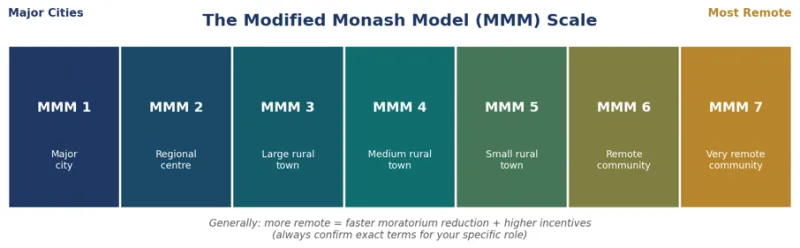
The MMM scale — the more remote the location, the more it generally counts toward reducing your moratorium.

MMM Levels With Real Examples

The official classification is based on population size and distance from larger towns, not just "how it feels." Here's what each level looks like in practice, with well-known locations for each (source: Australian Government Department of Health, MMM 2023).

MMM LevelWhat It MeansExample Locations
MMM 1 — Metropolitan

Major cities — about 70% of Australia's population lives here.

Sydney, Melbourne, Brisbane, Perth, Adelaide, Canberra

MMM 2 — Regional Centres

Regional areas in or within 20km of a town with 50,000+ people.

Newcastle, Wollongong, Ballarat, Toowoomba, Albury, Bunbury

MMM 3 — Large Rural Towns

In or within 15km of a town with 15,000–50,000 people.

Dubbo, Lismore, Yeppoon, Busselton

MMM 4 — Medium Rural Towns

In or within 10km of a town with 5,000–15,000 people.

Port Augusta, Charters Towers, Moree

MMM 5 — Small Rural Towns

All other inner/outer regional areas not covered above.

Moruya, Renmark, Mount Buller

MMM 6 — Remote Communities

Remote mainland areas, and small remote islands close to shore.

Alice Springs, Lightning Ridge, Bruny Island

MMM 7 — Very Remote Communities

Very remote areas, and islands more than 5km offshore.

Coober Pedy, Longreach, Thursday Island

Tip: a town's MMM level can change when population data is updated (the model is revised periodically), so always confirm the current classification on the Health Workforce Locator rather than relying on a list like this one for your final decision.

The 4-Step Action Plan

1. Check the Health Workforce Locator — verify any address's DPA/DWS and MMM status yourself, using the official tool, before you apply anywhere.

2. Match your registration pathway — Standard Pathway (AMC 1 + 2 / Workplace-Based Assessment) or Competent Authority Pathway, depending on your qualifications.

3. Find direct employers — go straight to state health services (NSW Health, Queensland Health, WA Country Health Service) and Rural Workforce Agencies (RWAV, RDN) rather than generic job boards.

4. Confirm visa + 19AB exemption together — a good employer handles your visa nomination (482 / 494 / 491) and your Medicare billing eligibility as one package, not separately.

Not sure which pathway fits your qualifications?

Our counsellors can map out your AMC and registration pathway based on where you're starting from.

Why Choose a Regional Role? The Incentives

BenefitWhat It Looks Like
Relocation grants

Many regional health services cover part or all of your relocation costs.

Rural retention payments

Extra financial incentives for doctors who stay long-term in regional/remote areas.

Faster PR pathway

Regional roles, especially under subclass 491, often lead to permanent residency faster.

Lifestyle

Lower cost of living, tighter-knit communities, and often better work-life balance than busy metro hospitals.

Common Mistakes to Avoid

  • Signing a contract before verifying the location's DPA/MMM classification yourself.
  • Comparing salaries without accounting for regional cost-of-living differences — a lower number can go further.
  • Assuming a recruiter's claim about eligibility is accurate without checking the Health Workforce Locator directly.

Ready to start your AMC journey the structured way?
Join Academically Global's AMC Coaching — trusted by thousands of IMGs preparing for Australia.


About Us

Academically is a global Ed-Tech healthcare platform, led by Dr. Akram Ahmad (PhD in Medicine, University of Sydney, Global Healthcare Career Coach) and his expert team, that helps pharmacists, doctors, dentists, physiotherapists, and other allied healthcare professionals to achieve their career goals in India and abroad. We provide complete career guidance, like skill assessment, Visa, PR and coaching for International licensure exams such as AMC, Overseas Pharmacist Readiness Assessment, APEP, ADC, DHA, SPLE, OCANZ COE and more for countries like Australia, New Zealand, Gulf countries, the US, the UK, and Canada. We have trained more than 10,000+ students across 88+ countries, with a 90%+ success rate on international healthcare licensure exams. We are India’s first healthcare Ed-Tech platform to introduce AI-based mock tests, to help students study smarter and track progress effectively. Beyond exam preparation, we also offer job assistance programmes, such as Upskill by Academically, covering clinical drug development and medical affairs. To help you land your dream job, we have recently launched our job platform Jobslly by Academically, only for healthcare professionals for both India and abroad.

FAQs

What is the difference between DPA and DWS?

DPA applies mainly to GP roles. DWS applies to other medical specialties. Both work on the same principle — the location is classified as short on doctors, so working there counts toward your 10-year moratorium.

Does working in a more remote (higher MMM) location help me faster?

Generally, yes — more remote locations often reduce the moratorium period faster and may include extra incentives. Exact terms vary by role, so always confirm specifics for your situation.

How do I check if a job is DPA or DWS eligible?

Use the official Health Workforce Locator tool — enter the address and it shows you the current classification. Always verify this yourself before signing anything.

Which visa subclasses are commonly used for regional doctor roles?

482, 494, and 491 are the most common, depending on the role and your employer's sponsorship pathway.

Is a regional job a lesser option compared to a metro job?

Not at all — many IMGs find regional roles offer better pay relative to cost of living, faster PR pathways, and a better lifestyle, alongside a faster moratorium reduction.

What is the 10-year moratorium and who does it apply to?

It's the period under Section 19AB during which most overseas-trained doctors (and some other categories of doctor) can only access Medicare benefits if they work in a location classified as a district of workforce shortage. It applies from the date you're first registered to practise in Australia, and runs for up to 10 years unless you qualify for an exemption or reduction.

Can I reduce or exempt myself from the 10-year moratorium?

Yes, in some cases — through specific exemption categories (such as certain scholarship or bonded return-of-service schemes) or by accumulating time in eligible DPA/DWS locations, which can count toward reducing the remaining period. Rules are detailed and case-specific, so check your own eligibility with the Department of Health or a registered migration/relocation advisor.

What's the difference between the Standard Pathway and the Competent Authority Pathway?

The Standard Pathway generally requires passing the AMC Part 1 (MCQ) and Part 2 (clinical) exams, or a Workplace-Based Assessment (WBA). The Competent Authority Pathway is for doctors who are already specialists registered in a recognised comparable country (such as the UK, Ireland, Canada, or the US), and usually involves a shorter assessment process.

Do rural and remote jobs pay less than city jobs in Australia?

Not usually — base salaries are often comparable or higher once you include rural loading, relocation grants, and retention bonuses, and the lower cost of living in regional areas means your take-home pay often stretches further.

How long does it take to find a DPA or DWS job as an IMG?

This varies widely based on your specialty, registration pathway progress, and visa situation. Having your registration pathway mapped out and using the Health Workforce Locator early — before you start applying — significantly speeds up the process.

Does MMM classification affect my visa eligibility too?

Yes, in some cases. Certain regional visa subclasses (like 494 and 491) are tied to specific MMM-classified locations, and some of these pathways offer faster routes to permanent residency specifically because the role is in a regional or remote area.

Where can I find genuine DPA/DWS job vacancies?

Go directly to the source rather than generic job boards: state health department career sites (NSW Health, Queensland Health, WA Country Health Service, etc.) and Rural Workforce Agencies such as RWAV (Victoria) and RDN (Rural Doctors Network, NSW) post verified regional vacancies and can also advise on location eligibility.

I'm still preparing for my AMC exams — should I worry about DPA/MMM yet?

It helps to understand the basics early, since your long-term location strategy affects which jobs you'll target once you're registered. But your immediate priority should be clearing your AMC pathway — DPA/DWS/MMM planning becomes actionable once you're closer to applying for registration and jobs.

Dr. Akram Ahmad
Dr. Akram Ahmad

BPharm, PharmD, PhD (University of Sydney, Australia)

about the author

Dr. Akram Ahmad, PhD, is a clinical pharmacist, researcher and healthcare educator with more than 14 years of teaching and research experience across India, Malaysia and Australia. He completed his PhD at the Faculty of Medicine and Health, University of Sydney, where his research focused on medication safety and health outcomes, and has authored over 110 peer-reviewed publications in international journals.

He is the founder and CEO of Academically Global, a healthcare education company that has supported more than 10,000 doctors, dentists, pharmacists, nurses and physiotherapists across 88 countries, and of Jobslly, a healthcare careers platform. He is a TEDx speaker and has been featured on JioHotstar and Wikipedia, and has mentored healthcare professionals in both university and industry settings.

Dr. Ahmad writes and speaks on two areas in particular: international licensing pathways for healthcare professionals, including the AMC (Australia), USMLE (USA), OPRA (Australia and New Zealand), PEBC (Canada), PSI (Ireland) and DHA/MOH (Gulf) examinations, and non-clinical career transitions into pharmacovigilance, Medical Affairs/MSL, clinical research, medical writing and regulatory affairs.

His goal with every article is simple: to give healthcare professionals accurate, practical information about global career options that no one taught them in college.

Build a Successful Global Healthcare Career

100% secure & confidential.

Academically

Get Complete Details & Expert Guidance

Our experts will contact you soon

Free guidance • No spam • No obligation

Students
Trusted by 50,000+ healthcare aspirants