
Congratulations on conquering the Australian Physiotherapy Entry Pathway (APEP). Navigating the Eligibility Assessment, the grueling Written Assessment, and the high-pressure Capability Assessment is an incredible feat. You have officially proven your clinical expertise. Now, you are holding a contract for your first Australian physiotherapy role.
But for many international physiotherapists especially those with specialized backgrounds in areas like neurological rehabilitation or complex musculoskeletal care this is where a new kind of anxiety sets in.
How do I navigate the Australian job market?
Am I being low balled?
How do I advocate for my worth when my local Australian experience is technically zero, even though my overseas experience is vast?
In the Australian healthcare system, salary negotiation is never just about the base number, it is about the entire employment contract. Negotiating a high base salary is useless if hidden contract clauses regarding visas, independent contracting, or AHPRA supervision end up costing you thousands of dollars.
This definitive, comprehensive guide breaks down exactly how to transition from an APEP candidate to a confidently negotiated, fairly compensated registered physiotherapist in Australia.
The 2026 Salary Landscape: Where Do You Fit?
Before you can negotiate, you must understand the baseline. As of late 2026, starting annual salaries for physiotherapists in Australia generally sit between $70,000 and $95,000 AUD (plus 12% mandatory Superannuation). However, this varies wildly depending on your chosen clinical environment.
It is crucial to remember that as an overseas-trained professional, you might be classified as a "new graduate" by Australian employers, but you should not settle for the absolute bottom of the pay scale if you bring years of international clinical experience.
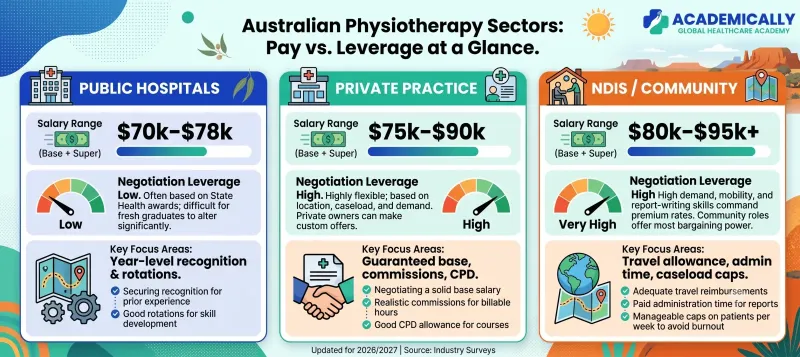
The Public Hospital System (State Health)
- Expected Salary: $70,000 – $78,000 AUD base.
- The Vibe: Highly structured, fantastic for mentorship, multidisciplinary exposure, and ticking off your core rotations (cardiorespiratory, MSK, neurology).
- Negotiation Leverage: Low. Public hospital salaries are governed by strict State Awards. Your pay grade is tied directly to your recognized years of service.
- What you can negotiate: While you cannot change the base rate, you can negotiate to have your overseas experience formally recognized by HR so you enter at a "Year 2" or "Year 3" pay grade rather than "Year 1."
Private Practice (MSK and Sports)
- Expected Salary: $75,000 – $90,000 AUD base.
- The Vibe: Fast-paced, heavily reliant on patient retention, and offers high earning potential for driven clinicians.
- Negotiation Leverage: High. Private clinic owners have total discretion over what they pay you. They often use complex compensation models, such as a base salary plus a commission structure once you hit a certain billing target.
The NDIS (National Disability Insurance Scheme) & Community Care
- Expected Salary: $80,000 – $95,000+ AUD base.
- The Vibe: Mobile therapy, working with complex neurological (e.g., stroke, traumatic brain injury), pediatric, and genetic conditions in patients' homes or community centers.
- Negotiation Leverage: Enormous. The demand for NDIS providers is astronomical. Because this role requires high autonomy, driving, and complex report writing, employers offer premium base salaries to attract talent. If you have a background in neurological physiotherapy, you are incredibly valuable in this sector.
The Employment Type Trap: TFN vs. ABN
This is the number one financial trap for overseas-trained allied health professionals. When you receive a contract, especially in private practice, you must check your employment status. Are they hiring you as an Employee (providing a Tax File Number or TFN) or as an Independent Contractor (requiring an Australian Business Number or ABN)?
The "Sham Contracting" Illusion: An employer might offer you a highly attractive "$55 per hour" or a "50% fee split" as an independent contractor (ABN). On paper, this looks far superior to a $40 per hour Employee (TFN) salary.
However, out of that ABN "salary," you are legally responsible for paying:
- Your own 12% Superannuation (retirement fund).
- Your own income tax.
- Your own professional indemnity insurance.
- Your own sick leave (if you catch a cold, you earn $0).
- Your own annual leave (if you take a 4-week holiday, you earn $0 for a month).
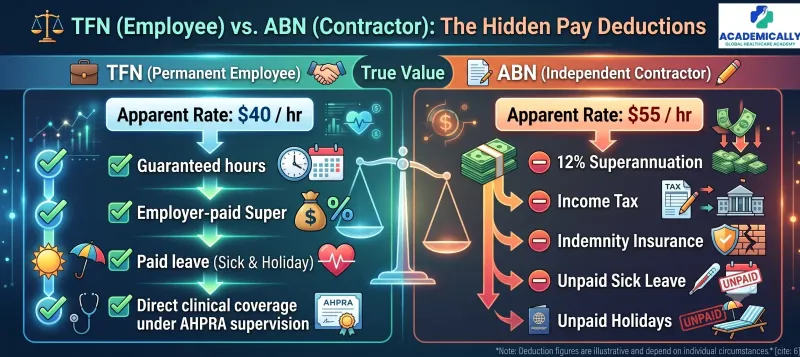
Furthermore, as an AHPRA Level 1 supervised practitioner (which most overseas physios are initially), it is legally precarious to operate as an "independent" contractor, because you require direct clinical supervision. Earning $40/hr as a permanent TFN employee where the employer pays your Superannuation, guarantees your hours, and provides paid leave is far safer and often financially superior in your first year
The Negotiation Rule: Always push for permanent full-time Employee (TFN) status to protect your baseline income while you adjust to the Australian system.
Decoding the October 2026 Award Changes
In Australia, the Fair Work Commission sets the absolute minimum legal pay rates across industries. For physiotherapists, this is governed by the Health Professionals and Support Services Award (MA000027).
As of the October 1, 2026 updates, allied health pay rates underwent a major overhaul. Pay is now strictly tied to the Australian Qualifications Framework (AQF) level of your degree and your years in the profession.
Why this matters for your negotiation: If you are newly registered in Australia, an employer might try to default your pay to the absolute minimum "Level 1 - 1st Year" rate. However, if you spent three years working in specialized neurological rehabilitation in your home country, you are not a first-year practitioner.
You must legally map your international years of experience to the new Award brackets. If you hold a Master of Physiotherapy (which aligns with AQF Level 9) and have three years of overseas experience, your legal minimum wage floor is significantly higher than a fresh domestic bachelor's graduate. Do not let a clinic ignore your experience simply because it occurred offshore.
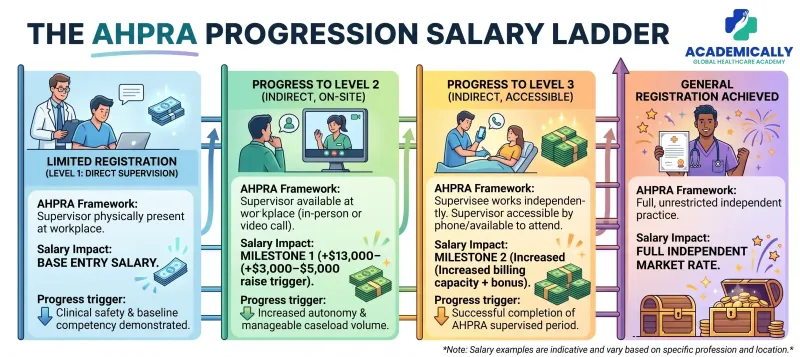
AHPRA Supervised Practice & Your Salary Schedule
Passing the APEP grants you eligibility, but not instant General Registration. Most overseas physios must start on Limited Registration for Supervised Practice. AHPRA dictates your supervision levels, ranging from Level 1 (direct, in-room supervision) to Level 4 (indirect/remote).
Because Level 1 and Level 2 supervises cannot operate completely independently, employers often use this as justification to offer lower starting salaries arguing that a senior physio must sacrifice their own billable time to supervise you.
The Negotiation Tactic: Acknowledge the cost of supervision, but protect your future earnings. Do not sign a static 12-month contract at a low rate. Instead, negotiate a tiered salary structure tied directly to your AHPRA progression.
You should insert a clause stating: "Upon AHPRA granting progression to Level 2 supervision, the base salary will increase by $4,000. Upon progression to Level 3/General Registration, the base salary will increase by an additional $5,000." This guarantees that as you become more profitable for the clinic, your compensation scales automatically.
The Visa Sponsorship Trap: Claw-backs and Relocation
If you require a Subclass 482 (Skills in Demand/TSS) visa or a 186 (Employer Nomination Scheme) visa, the employer is taking on a financial burden to sponsor you.
The Illegal Clawback: Many clinics will attempt to insert a "clawback" clause into your contract stating: "If the employee resigns within 24 months, they must repay the $8,000 visa sponsorship and SAF levy fees."
Under Australian law (specifically regulations overseen by the Department of Home Affairs and the Fair Work Ombudsman), it is illegal for an employer to ask a 482 visa holder to pay, reimburse, or "claw back" any costs associated with business sponsorship or nomination, including the Skilling Australians Fund (SAF) levy. You cannot legally be forced to repay these specific employer obligations.
The Legal Clawback (And How to Handle It): However, employers can lawfully ask you to repay secondary costs if you leave early, such as flights, temporary accommodation, or third-party migration agent fees they covered on your behalf.
The Negotiation Tactic: Moving to Australia is expensive. Rather than just fighting clawback clauses, proactively negotiate a Relocation Allowance (commonly $3,000–$5,000 for regional clinics or high-demand NDIS roles) to offset your initial rental bond and setup costs. If they require a repayment clause on the relocation allowance, negotiate for it to depreciate monthly (e.g., you owe 100% if you leave in month one, but only 50% if you leave in month six, and 0% after twelve months).
Restraint of Trade (Non-Compete Clauses)
Overseas candidates, eager to secure their visa and job, often sign contracts blindly without looking at the termination clauses. Private practices typically embed a "Restraint of Trade" clause stating you cannot work as a physiotherapist within a specific geographic radius of their clinic for a certain period (e.g., 6 to 12 months) after you resign.
Why this is dangerous: If you sign a contract with a 15km restraint radius in a regional town, you might lock yourself out of the only other three clinics in the area. If you sign a 10km restraint in Sydney or Melbourne, you have effectively locked yourself out of half the city's job market.
The Negotiation Tactic: Australian courts generally view overly broad restraints as unenforceable, but you do not want to go to court. Negotiate this down before you sign. A 2km to 3km radius is standard and reasonable in major metropolitan areas, protecting the clinic's immediate patient base without destroying your future career mobility.
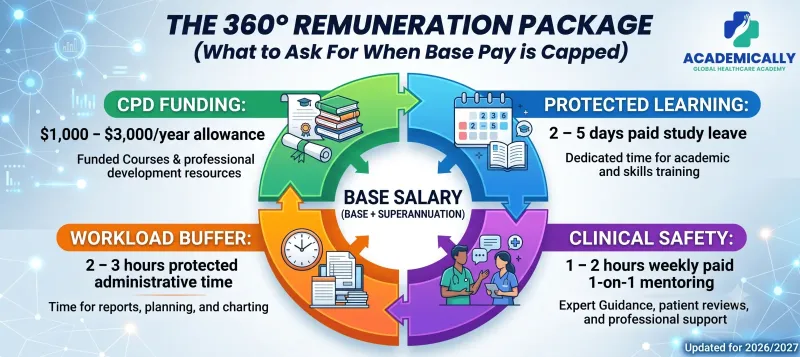
The "Total Package" Perks
In your first year in Australia, professional support will impact your long-term career trajectory far more than an extra $2,000 in base pay. If an employer is completely rigid on the salary figure (which occasionally happens in larger corporate networks), pivot your negotiation to these crucial, tax-free benefits:
- CPD (Continuing Professional Development) Allowance: Australian professional courses are expensive. Ask for $1,000 to $3,000 annually to pay for external courses. If you have a background in Neuro, ask for funding to complete specific Australian-based vestibular or advanced stroke rehabilitation workshops.
- Paid Study Leave: Request 2 to 5 days of paid leave specifically for attending CPD courses so you do not have to burn your recreational annual leave.
- Protected Mentoring Time: Negotiate for 1 to 2 hours of paid, blocked-out weekly 1-on-1 time with a senior physio. Do not accept a vague "open door policy." You need dedicated time to review complex cases, audit your clinical notes, and navigate the intricacies of Australian funding schemes (Medicare, WorkCover, NDIS).
- Admin Time (Crucial for NDIS): If you take an NDIS role, negotiate for 2 to 3 hours of blocked admin time per week. NDIS Assistive Technology and progress reports are notoriously dense. You do not want to be writing reports at 8 PM on a Friday unpaid.
The Negotiation Playbook: Professional Templates
Negotiating is expected in the Australian private sector. Employers do not withdraw offers just because you ask for a better package—provided you ask professionally, respectfully, and in writing. Wait until they send the official contract; once they have chosen you, you have the leverage.
Here are the templates you need to address the traps discussed above.
Template A: Pushing Back on ABN Status for TFN
Use this if a clinic offers you an independent contractor role, but you want the security of being an employee.
Subject: Contract Review - [Your Name] - Employment Structure
Hi [Clinic Owner/Manager Name],
Thank you so much for sending through the contract. I am incredibly excited about the opportunity to join the team and start contributing to the clinic's caseload.
In reviewing the contract, I noticed the position is structured as an Independent Contractor (ABN). Given that I will be starting under AHPRA Level 1 supervised practice, which requires direct clinical oversight, operating as a true independent contractor presents some regulatory complexities. Furthermore, as I transition into the Australian healthcare system, I am looking for the stability of a permanent Employee (TFN) arrangement.
Would you be open to restructuring this offer as a full-time TFN employee role? I am highly committed to building a long-term patient base here, and I believe an employee structure aligns better with the supervised onboarding process.
I would love to find a way to make this work and get started as soon as possible.
Warm regards,
[Your Name]
Template B: Tying Pay to AHPRA Supervision Progression
Use this if the initial base salary is low due to the burden of Level 1 supervision.
Subject: Job Offer - [Your Name] - Salary Structure
Hi [Clinic Owner/Manager Name],
Thank you for the offer to join [Clinic Name]. I thoroughly enjoyed meeting the team and am very excited about the opportunity to utilize my background in [e.g., neurological rehabilitation and complex case management] with your patients.
I completely understand that starting on AHPRA Level 1 supervision requires an investment of time from your senior team, which is reflected in the initial base salary offer of [Amount].
To ensure we have a structure that rewards my progression toward independent practice, would you be open to including a tiered salary review clause? Specifically, I propose a salary adjustment to [Higher Amount] once AHPRA grants me Level 2 supervision, and a subsequent review once General Registration is achieved.
I am confident in my ability to progress quickly through these stages and become a highly profitable asset to the clinic. Let me know if you are open to this addition.
Best,
[Your Name]
Template C: Negotiating the Restraint of Trade Clause
Use this to reduce a massive non-compete radius that threatens your future mobility.
Subject: Contract Finalization - [Your Name]
Hi [Clinic Owner/Manager Name],
I have reviewed the contract and am ready to sign and begin the visa/AHPRA paperwork. I am thrilled with the CPD and mentorship structure we discussed.
There is just one minor detail I would like to amend before signing. Clause [Number] outlines a Restraint of Trade radius of 15km for 12 months. Given that we are located in a dense metropolitan area, a 15km radius covers a massive portion of the city.
Would you be willing to reduce this to a more standard 3km radius for 6 months? My intention is to build a long and successful career with [Clinic Name], but reducing this radius gives me peace of mind regarding my long-term visa security and mobility in Australia.
Once this is updated, I will sign and return the contract immediately.
Thank you for your understanding,
[Your Name]
Final Thoughts
Securing a job in Australia after the APEP process is a testament to your clinical excellence. Do not let the fact that you are "new to Australia" diminish the years of hard work, patient care, and specialized knowledge you cultivated in your home country.
Understand your legal minimums under the Fair Work Award, protect yourself from illegal visa claw backs, demand TFN status while under supervision, and ensure your salary scales as your AHPRA restrictions lift. By negotiating these structural contract elements upfront, you secure not just a job, but a thriving, financially stable, and legally protected career in Australian healthcare.
Passing the APEP was the hard part finding a transparent, high-paying job shouldn't be. Jobslly by Academically goes beyond a standard job board by offering structured career guidance, resume building, and placement support specifically for healthcare professionals.
Track all your applications in one secure dashboard and get matched with pre-screened employers who value your international experience.