
You already know what happens to a patient inside a hospital. But what happens after those patients leave that hospital?
Do they continue taking the medicine? Does the treatment work as expected in older patients or people with comorbidities? What happens when patients miss doses, switch therapies or receive treatment outside the strict conditions of a clinical trial?
That is where real-world evidence becomes important.
For healthcare professionals considering a non-clinical career, this creates an interesting opportunity: your clinical knowledge can become the foundation for a career that is much more focused on data, research and evidence generation.
What Is a Real-World Evidence Analyst?
A Real-World Evidence Analyst analyses healthcare data generated outside traditional controlled clinical trials and helps convert that information into meaningful evidence.
The underlying workflow is simple to understand:
| Real-World Data → Data Preparation → Analysis → Evidence → Healthcare Decision |
Real-world data can come from electronic health records (EHRs), insurance and claims databases, patient registries, prescribing and dispensing records, patient-reported outcomes, healthcare-utilisation data and digital health technologies such as wearable devices.
An RWE Analyst may therefore investigate questions such as:
| “Which patients are actually receiving this treatment?” |
| “How long do patients remain on therapy?” |
| “Are there differences in outcomes between treatment groups?” |
| “What adverse events appear after a medicine is used widely?” |
| “How does treatment utilisation vary across patient populations?” |
This is also why RWE should be viewed as part of a wider evidence-generation ecosystem. An RWE professional who understands how real-world data connects with clinical research, post-market surveillance, pharmacovigilance and medical decision-making can develop a broader understanding of the pharmaceutical industry.
For healthcare graduates who want structured exposure to these connected areas, Academically’s Clinical Drug Development program includes dedicated learning in RWE and post-market studies, pharmacovigilance and drug safety, clinical data management and biostatistics.
What Does an RWE Analyst Do?
The exact responsibilities depend on the employer and seniority, but the job usually combines healthcare research, analytics and communication.
| Area of Work | What the Analyst May Do |
| Data preparation | Clean, structure and validate healthcare datasets |
| Study design | Support retrospective or prospective observational studies |
| Data analysis | Analyse treatment patterns, outcomes, utilisation and safety |
| Statistical work | Apply appropriate statistical methods to answer research questions |
| Research | Review literature and compare findings with published evidence |
| Quality review | Check datasets, analyses and outputs for accuracy |
| Reporting | Prepare tables, figures, dashboards, reports or presentations |
| Stakeholder communication | Explain analytical findings to clinical and business teams |
This means an RWE Analyst is not simply someone who sits and “looks at data.” The analyst has to understand what the data represents, whether it is reliable, which analytical approach is appropriate and what the findings actually mean.
What Does a Typical Day Look Like?
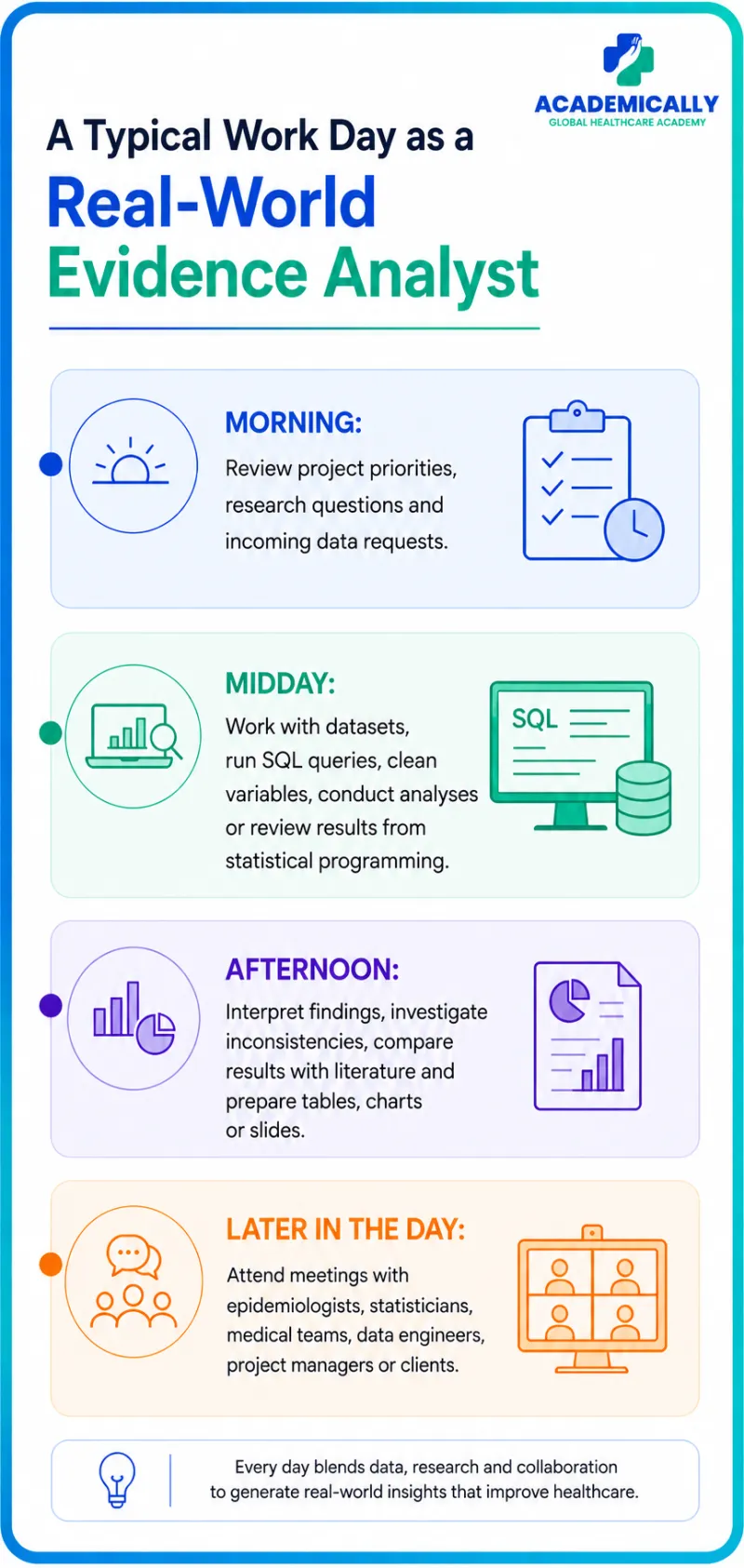
This role is a good fit for someone who enjoys a combination of independent analytical work and collaborative problem-solving.
RWE Analyst vs Clinical Research
The two fields overlap, but the questions and data environments are different.
| Clinical Research | Real-World Evidence |
| Data collected under a defined research protocol | Data generated during routine healthcare |
| Controlled study environment | Everyday clinical practice |
| Strict inclusion and exclusion criteria | Broader and more heterogeneous patient populations |
| Focuses strongly on efficacy and safety under study conditions | Can examine effectiveness, utilisation, outcomes and safety in practice |
| Often prospective | May be retrospective, prospective or use existing databases |
| Designed research dataset | Often more complex and heterogeneous data |
It is also important not to oversimplify the distinction. RWE does not “replace” clinical trials. Rather, it can complement trial evidence by answering questions that may emerge across wider and longer-term use of a treatment.
Understanding both sides can be useful for someone building a career in the pharmaceutical industry. Clinical development helps explain how evidence is generated through trials, while RWE helps examine what happens when treatments are used in broader patient populations. This connection is reflected in industry-focused training as well. Academically's Clinical Drug Development programme covers clinical trial phases, biostatistics, PV, and RWE/post-market studies.
What Skills Do You Need for RWE Analyst Career?
A successful real world evidence analyst career requires a combination of healthcare knowledge, research methodology and technical skills.
Core healthcare and research skills
You should understand:
- Medical terminology and disease areas
- Basic pharmacology
- Clinical outcomes
- Epidemiology
- Pharmacoepidemiology
- Observational study designs
- Research methodology
- Bias, confounding and interpretation of evidence
Technical skills
The technical requirements become increasingly important as roles become more analytical.
- SQL is useful for querying and extracting information from large databases.
- R, SAS or Python may be used for statistical analysis and programming.
- Excel remains useful for data checking, summaries and everyday analysis.
- Power BI or Tableau can help with visualisation and communicating findings.
- Healthcare coding knowledge such as that of systems and vocabularies such as ICD, CPT, HCPCS, LOINC and MedDRAcan also matter.
Important note: If you are planning to work across adjacent pharmaceutical functions rather than limiting yourself to pure RWE analytics, understanding industry workflows becomes even more valuable. Medical Affairs and related pharmaceutical functions interact with clinical evidence, safety information, medical information and scientific communication. Exposure to these areas can help healthcare graduates understand how different teams use and communicate evidence across the drug-development lifecycle.
Soft skills
Do not underestimate communication.
An analyst may need to explain a complicated finding to a medical affairs professional, project manager or client who is not a statistician. That means writing, presentation, attention to detail and logical problem-solving are important parts of the job.
Can MBBS, BDS, BPharm and Other Healthcare Graduates Enter RWE?
Yes!
An MBBS, BDS, BPharm, PharmD, nursing, life-sciences or allied-health background can provide valuable domain knowledge. You already understand disease mechanisms, clinical terminology, medicines, patient pathways and treatment decisions.
The technical gap is usually in areas such as:
| Healthcare degree → Research methodology → Statistics → SQL → R/SAS/Python → RWE projects |
This is also why RWE career can be attractive for healthcare professionals.
Instead of discarding your medical background when moving away from clinical practice, you can build a second skill layer on top of it.
That second layer does not necessarily have to be limited to programming. Depending on the career direction you want to take, it can include research methodology, evidence generation, clinical-trial understanding, scientific communication, healthcare analytics and pharmaceutical-industry workflows.
This is one reason structured programmes such as those offered by Academically can be useful for healthcare graduate: they can help connect an existing clinical foundation with the practical skills and industry context required for non-clinical roles
For some healthcare graduates, the most practical entry point may therefore be an adjacent role such as medical data abstraction, clinical data analysis, epidemiology support, pharmacovigilance, healthcare analytics or research operations, followed by movement into more specialised RWE work.
A Practical Career Path in RWE
There is no universal ladder, but a realistic progression can look like this:
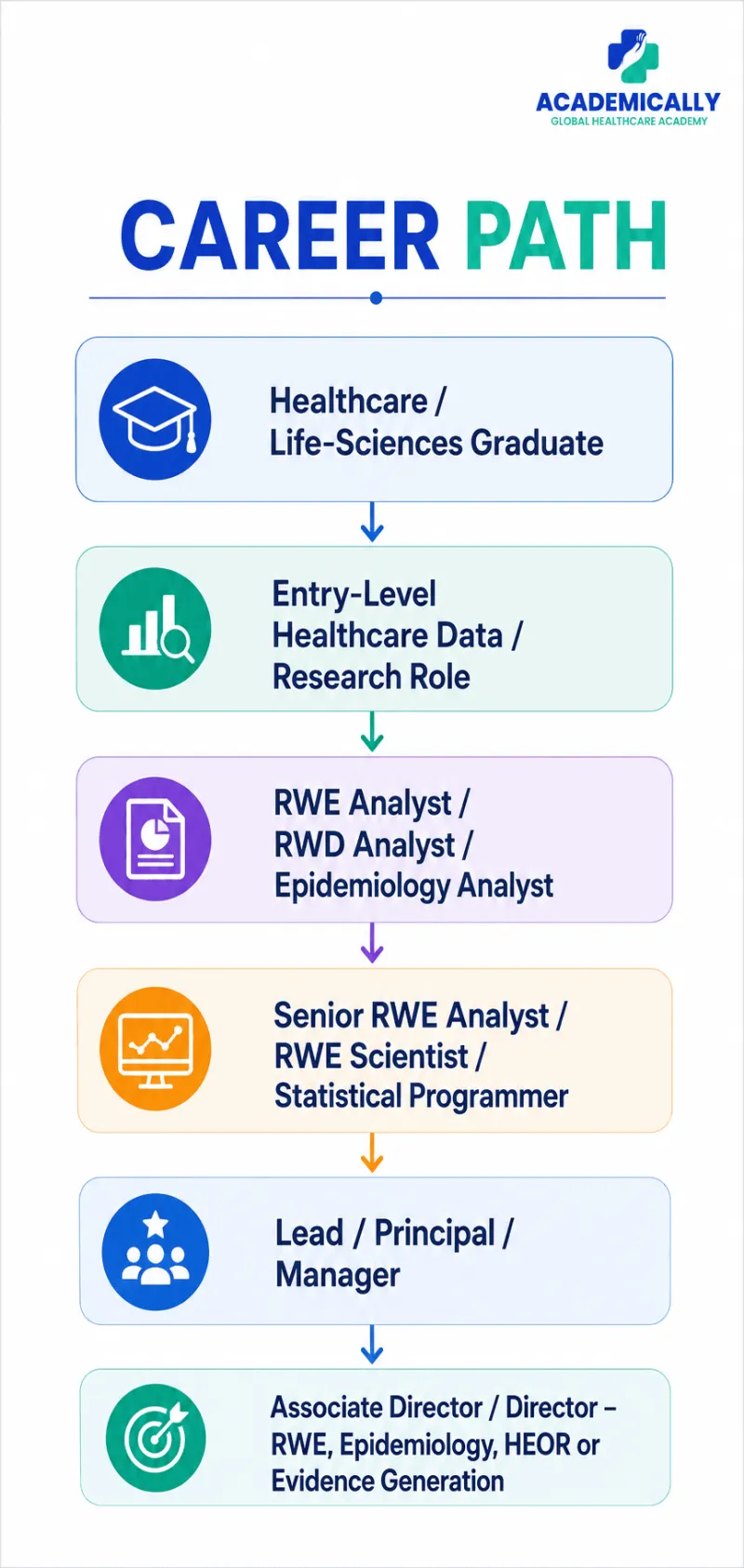
The title can change from company to company.
What Are the Career Growth Opportunities?
With experience, you can move toward:
1. RWE Analytics
Focus on datasets, programming and quantitative analysis.
2. Epidemiology / Pharmacoepidemiology
Focus more heavily on study design, population research, treatment safety and disease patterns.
3. HEOR
Work on healthcare costs, outcomes, value and reimbursement-related evidence.
4. Biostatistics
Develop deeper expertise in statistical methods and study analysis.
5. Medical Affairs / Evidence Generation
Translate evidence into medical strategy and scientific communication.
6. RWE Consulting
Work across multiple pharmaceutical clients and projects.
Senior roles can increasingly involve study strategy, protocol development, stakeholder management, methodological decisions and oversight of junior analysts rather than only performing the analysis yourself.
RWE Analyst Salary in India
RWE salaries can vary considerably depending on your experience, technical skills, educational background, location, therapeutic-area knowledge and the type of organisation you work for.
As your responsibilities grow, your earning potential can also increase, particularly when you develop specialised skills in areas such as statistical programming, epidemiology, advanced analytics, HEOR or RWE study design.
| Career Stage | Indicative Public Market Evidence |
| Entry-level RWE Analyst | Around ₹4–8 LPA |
| RWE analytics/data-science roles | Around ₹8–15 LPA |
| Experienced/Senior RWE roles | Can move substantially higher depending on expertise, employer and scope |
For finding jobs which match your skill set, you can try, Jobslly. It is a healthcare-focused job portal, that can help you find relevant healthcare opportunities and understand the skills employers are asking for across different roles.
Why Is RWE Growing Now?
There are several reasons the field is becoming more relevant.
1. Healthcare is producing more digital data
India's digital-health infrastructure has expanded dramatically.
The Government of India's Ayushman Bharat Digital Mission reported 96.43 crore ABHA numbers and more than 110 crore health records linked with ABHA as of August 12, 2026, alongside more than 5.47 lakh registered health facilities and over 10.50 lakh healthcare professionals.
This does not mean that every ABDM record automatically becomes an RWE dataset. It does mean that India's healthcare system is becoming increasingly digital, interoperable and capable of generating longitudinal health information.
2. Pharma increasingly needs evidence beyond trials
The FDA states that increased availability and analysis of real-world data has expanded the potential for robust RWE to support regulatory decisions. The EMA also maintains dedicated guidance around RWD, RWE, data quality and registry-based studies.
International harmonisation is moving forward too. The ICH M14 guideline on planning, designing and analysing pharmacoepidemiological studies using real-world data for medicine safety was adopted and entered implementation in 2025.
Together, these developments are creating more opportunities for professionals who can combine healthcare knowledge with data and research skills.
This also explains why learning RWE in isolation may not always be enough for long-term career development. Understanding how RWE connects with clinical development, PV, post-market studies and Medical Affairs can give you a more complete view of how evidence is generated and used across the pharmaceutical lifecycle. That is why exploring these areas in greater depth through relevant non-clinical courses can support your long-term career goals.
What Challenges Does an RWE Analyst Face?
RWE sounds straightforward until you start working with the data.
Real-world datasets can be incomplete, inconsistent or collected for purposes other than research. Different healthcare systems may use different formats. Patient records may have missing information. Coding may differ. Treatment groups may not be directly comparable.
This is why an RWE Analyst needs more than software skills.
You must understand data quality, bias, confounding, study design, privacy and appropriate interpretation.
Who Is a Good Fit for an RWE Career?
RWE may suit you particularly well when you enjoy healthcare but do not want your career to depend entirely on patient-facing work.
You may enjoy the field if you like:
Healthcare + Data You enjoy understanding medical questions and analysing information. |
Research + Problem Solving You like asking why a pattern exists rather than simply reporting the pattern. |
Technology + Science You are willing to learn SQL, statistical software and data workflows. |
Independent Work + Collaboration You can focus on detailed analysis while also discussing findings with multidisciplinary teams. |
For a healthcare professional, the biggest advantage is your clinical context.
A data analyst may know how to query a dataset, but a clinician may more quickly recognise why a particular outcome, treatment pattern or patient subgroup matters.
How Can You Start?
You do not need to learn everything at once.
Start with the foundations concept, then build epidemiology and observational-study concepts. After that, learn SQL and one statistical programming tool such as R or SAS. Finally, work on small projects involving healthcare datasets and learn how to communicate findings clearly.
A simple progression is:
| Healthcare background ↓ RWD & RWE fundamentals ↓ Epidemiology & study design ↓ SQL ↓ R / SAS / Python ↓ Healthcare coding & data standards ↓ Portfolio project ↓ Job |
Some of these technical and analytical skills may not be part of your core professional degree curriculum.
That is where targeted online learning can help you bridge the gap. Academically's non-clinical courses can help healthcare professionals build skills in areas such as data analysis, research, healthcare analytics and other non-clinical career pathways, so you can move from simply understanding healthcare to working with healthcare evidence.