
As a physiotherapist, your days are defined by giving. You give physical energy to mobilize patients, emotional energy to guide them through painful recoveries, and mental energy to navigate complex clinical reasoning. But what happens when the tank runs dry?
In 2019, the World Health Organization officially recognized burnout as an occupational phenomenon. For healthcare professionals particularly in high-touch, physically demanding fields like physical therapy, burnout is not just a buzzword; it is a clinical crisis.
Whether you are a new graduate feeling the crush of an unexpected caseload, or a seasoned neuro-physiotherapist dealing with compassion fatigue, understanding how to protect your workplace wellbeing is non-negotiable.
This comprehensive guide will break down the root causes of physiotherapist burnout, outline the warning signs, and provide evidence-based strategies for clinicians and clinic owners to foster a healthier work environment. Furthermore, we will explore how taking control of your career trajectory, whether through non-clinical roles or global licensing can reignite your passion for healthcare.
The Anatomy of Physiotherapist Burnout
Before we can prevent burnout, we have to understand what we are fighting. Burnout is not simply "having a bad day at the clinic." It is a state of emotional, physical, and mental exhaustion caused by excessive and prolonged stress.
Burnout vs. Normal Stress vs. Compassion Fatigue
It is easy to confuse these terms, but they require different interventions:
| Condition | Primary Characteristic | How it feels in the Clinic |
| Normal Stress | Over-engagement | You feel anxious about finishing your documentation on time, but you still care about the outcome. |
| Compassion Fatigue | Emotional depletion | You absorb the trauma and pain of your patients (especially common in neuro and pediatrics) until you feel emotionally numb. |
| Burnout | Disengagement | You feel cynical. You no longer care about the documentation, and you view patients as tasks rather than people. |
For physiotherapists, burnout is uniquely multi-dimensional. You are not just sitting at a desk; you are performing manual therapy, supporting patient body weight, and acting as a sounding board for patients dealing with life-altering diagnoses.
Causes of Burnout in Physical Therapy
Why are so many brilliant physiotherapists leaving the profession within their first five years?
The answer lies in systemic workplace stressors.
The Physical Toll
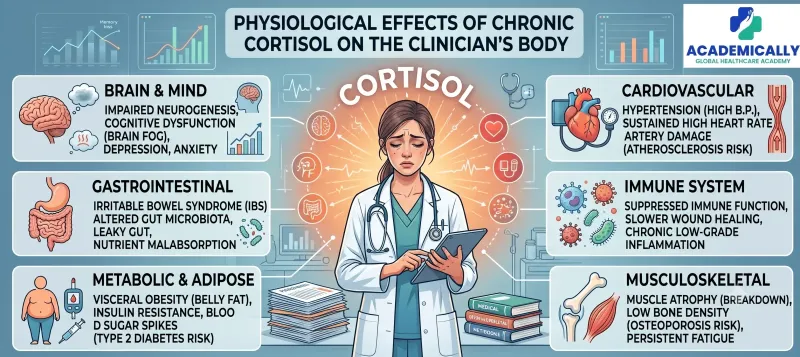
Unlike many medical professions, physiotherapy is intensely physical. Performing continuous manual therapy, lifting patients, and demonstrating exercises takes a massive toll on the musculoskeletal system. Over time, clinicians often develop their own chronic pain issues, which directly accelerates emotional exhaustion.
The Documentation Burden
"Treating the patient is the easy part; treating the chart is the nightmare." The modern healthcare landscape demands rigorous, time-consuming documentation. When clinicians are double-booked and forced to take notes home, the boundaries between work and life dissolve entirely.
Lack of Autonomy and Career Stagnation
Many physiotherapists hit a career ceiling early on. When you are seeing a high volume of patients with little control over your schedule and no clear path for professional advancement, cynicism takes root.
Toxic Productivity Clinic Cultures
In clinics driven purely by volume and billing targets, patient care suffers—and so does the therapist. When management prioritizes the number of units billed over patient outcomes, therapists experience a profound moral injury.
The 3 Stages of Burnout: Recognizing the Red Flags
Burnout doesn't happen overnight. It is a slow fade. Recognizing these stages in yourself or your colleagues can help stop the cycle before it requires a total career change.
Stage 1: The Honeymoon Phase (and the Onset of Stress)
You start a new role with high energy and optimism. However, as the caseload builds, you begin to skip your lunch breaks to catch up on notes. You tell yourself, "It's just a busy week."
Stage 2: Chronic Stress and Frustration
The "busy week" becomes the norm.
- Physical signs: You wake up exhausted even after a full night's sleep. You might experience headaches, gastrointestinal issues, or tension in your neck and shoulders.
- Emotional signs: You feel irritable with patients who ask too many questions. You dread Sunday nights.
- Professional signs: Your clinical creativity drops. Instead of designing tailored rehab programs, you start handing out generic exercise sheets.
Stage 3: Full-Blown Habitual Burnout
At this stage, exhaustion is chronic. Cynicism dominates your worldview. You may begin calling in sick frequently, experiencing severe anxiety, or actively looking for a way out of the profession entirely.
Actionable Burnout Prevention Strategies for Physiotherapists
If you are waiting for the healthcare system to fix itself, you will be waiting a long time. Protecting your wellbeing requires radical, proactive self-care.
Ruthless Boundary Setting
Boundaries protect your time and energy for the things that matter most.
- Leave work at work: Set a strict cut-off time for documentation. If it is not done by 5:30 PM, it waits until tomorrow.
- Learn to say no: You cannot pick up every extra weekend shift or take on every complex case. Guard your days off fiercely.
Micro-Breaks and "Oasis Moments"
You do not need a two-week vacation to reset your nervous system. Implement "Oasis Moments" throughout your day. Take 5 minutes between patients to step outside, breathe deeply, or simply sit in silence without looking at a screen.
Ergonomic Self-Care
You teach ergonomics to your patients, it is time to apply it to yourself. Adjust your plinth height for every single patient. Use your body weight, not just your upper body strength, for manual therapy. Protect your joints, because your body is your instrument.
Optimize Sleep and Nutrition
Sleep deprivation is the fast track to burnout. Aim for 7–9 hours of consistent sleep. Furthermore, fuel your body properly; relying on caffeine and sugary snacks between patients leads to massive energy crashes by 3:00 PM.
Reconnect with Your "Why"
When was the last time you felt truly proud of a patient's progress? Write down your clinical "wins." Reflecting on the positive impact you have on human lives can act as a buffer against administrative frustrations.
Case Study: From Compassion Fatigue to Career Revival - Aisha’s Journey to Australia
To truly understand how a change in environment can reverse burnout, let’s look at a real-world scenario that reflects the journey of many international physiotherapists.
The Clinician: Aisha, a highly skilled Neurological Physiotherapist with four years of experience in her home country.
The Struggle: Working in a high-volume neuro-rehabilitation center, Aisha was treating up to 20 patients a day. The physical toll of performing maximum-assist transfers with stroke patients and the emotional weight of compassion fatigue left her completely depleted. Despite her advanced master's degree, her salary had plateaued, and the hospital culture rewarded overtime rather than efficiency. By year four, she was suffering from chronic lower back pain and severe Sunday-night anxiety. She was ready to leave healthcare entirely.
The Turning Point: Instead of quitting the profession, Aisha decided to change her system. She set her sights on Australia , a country known for its strict, supportive healthcare regulations, mandated annual leave, and highly competitive remuneration for allied health professionals. The Intervention: Navigating the Australian Health Practitioner Regulation Agency (AHPRA) and the Australian Physiotherapy Council (APC) licensing pathways can be overwhelming. Aisha enrolled in Academically’s Australian Physiotherapy Equivalency Pathway (APEP) preparation course. By dedicating her evenings to structured, guided study, she passed her Written Assessment on the first attempt and felt confident tackling the Clinical Assessment.
The Outcome: Today, Aisha works in a private neuro-rehab clinic in Melbourne. Her caseload is capped at 10 patients per day, giving her ample time for complex clinical reasoning and thorough documentation. Her clinic provides a dedicated professional development budget, and she has a rigid 38-hour work week. By leveraging the right educational support to transition her license globally, Aisha didn't just save her career , she rediscovered her passion for neurological physiotherapy
The Employer's Role: Building a Culture of Wellbeing
Burnout is not just an individual failure of resilience; it is largely an organizational issue. Clinic owners and HR managers must take active steps to protect their teams, or they will face the massive financial costs of high staff turnover.
- Reasonable Scheduling: Stop double-booking. Allow adequate time for evaluations and built-in administrative blocks for documentation.
- Regular Check-Ins: Do not wait for an annual review. Managers should have monthly 1-on-1s to ask, "How is your caseload feeling? What barriers are you facing?"
- Flexible Working Arrangements: Offer four-day work weeks, flexible start times, or the ability to do telehealth administrative work from home.
- Foster Clinical Mentorship: New graduates are at the highest risk for burnout. Implement structured mentorship programs where junior staff can discuss complex cases without fear of judgment.
Beating Burnout Through Career Evolution
Sometimes, no amount of yoga, sleep, or boundary-setting can fix a fundamentally broken job. If you love healthcare but are burning out in your current environment, it is time to pivot. You are not stuck.
Take Your Skills Global
Are you frustrated by the pay ceiling or workplace culture in your home country? Relocating to countries like Australia, the UK, or the Middle East can offer significantly better compensation, mandated annual leave, and a superior work-life balance.
Exams like the Australian Physiotherapy Council (APC) assessment or the Saudi Prometric Exam can seem daunting, but they are the gateway to a healthier career. By utilizing structured pathways such as the comprehensive preparation courses offered by Academically you can navigate these licensing exams smoothly.
Beating Burnout Through Non-Clinical Career Transitions
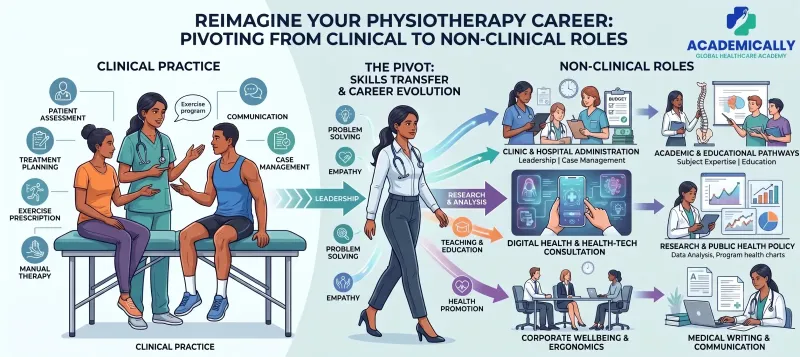
If you still love the science of physical therapy but your body and mind can no longer handle the rigors of direct patient care, leaving the clinic does not mean leaving the industry. Your background equips you with elite clinical reasoning, a deep understanding of human anatomy, and high-level empathetic communication.
Here is a deep dive into how you can pivot your physiotherapy degree into lucrative, low-stress, non-clinical roles.
1. Healthcare Medical Content Writing & Editing
In the digital age, health platforms, rehab clinics, and digital health startups are desperate for content created by actual medical professionals, not just marketers.
- The Day-to-Day: As a medical writer, you might spend your week writing search-optimized blogs on musculoskeletal health, auditing educational websites for clinical accuracy, or scripting short-form educational videos and reels for digital health platforms.
- Why it Cures Burnout:Medical writing is often fully remote, offering ultimate flexibility. You can structure your work hours around your family life rather than a clinic's schedule. It entirely removes the physical strain of manual therapy while allowing you to educate thousands of patients globally with a single article.
2. Clinical Data Management & Health Tech Development
The rise of wearable technology and digital health apps has created a massive demand for clinicians who understand the end-user. Software engineers know how to code, but they need physiotherapists to tell them how a human body actually moves and recovers.
- The Day-to-Day: You could be consulting for a tech company, helping to design interactive patient tools—like a carb-fueling calculator for triathletes or an AI-driven posture-correction app.
- Why it Cures Burnout: This role allows you to engage with the cutting edge of healthcare innovation. It is highly analytical, project-based, and heavily relies on your existing clinical knowledge without requiring you to treat a single patient manually.
3. Medical Science Liaison (MSL) or Clinical Educator
Pharmaceutical companies, medical device manufacturers, and continuing education platforms need subject matter experts to act as a bridge between their products and the clinical world.
- The Day-to-Day: An MSL or Clinical Educator travels (or works virtually) to train other healthcare professionals. For example, you might train hospital staff on the proper use of a new robotic exoskeleton for spinal cord injury rehabilitation, or you might present clinical trial data at medical conferences.
- Why it Cures Burnout: This path is excellent for extroverted physiotherapists who love teaching and presenting but want to escape the 30-minute patient treadmill. It offers a corporate salary structure, expense accounts, and significant upward mobility.
4. Healthcare Administration & Clinical Auditing
If you have a strong eye for detail and a desire to improve systemic clinic issues, shifting into management or compliance is a highly stable route.
- The Day-to-Day: Clinical auditors review patient charts, treatment pathways, and clinic protocols to ensure they meet national healthcare standards. They identify inefficiencies and design better systems for patient flow.
- Why it Cures Burnout: You get to be the person who fixes the toxic productivity cultures that cause burnout in the first place. You are operating at a macro level, improving the workplace environment for dozens of other therapists.
You Are the Most Important Patient
As a physiotherapist, you spend your life rehabilitating others. But your career cannot be built on the ashes of your own wellbeing.
Recognizing the signs of burnout early, setting aggressive boundaries, demanding better from employers, and being open to radical career shifts are all vital steps in protecting your future. Whether you choose to optimize your current clinical practice, move overseas for a better quality of life, or transition into a non-clinical role, remember that you are in the driver's seat.
Whether you are looking to take your clinical skills overseas for better pay and work-life balance, or you are ready to pivot into a lucrative non-clinical role, Academically is your dedicated global healthcare education partner. Our expert career advisors specialize in helping physiotherapists and allied health professionals navigate their next big career move.