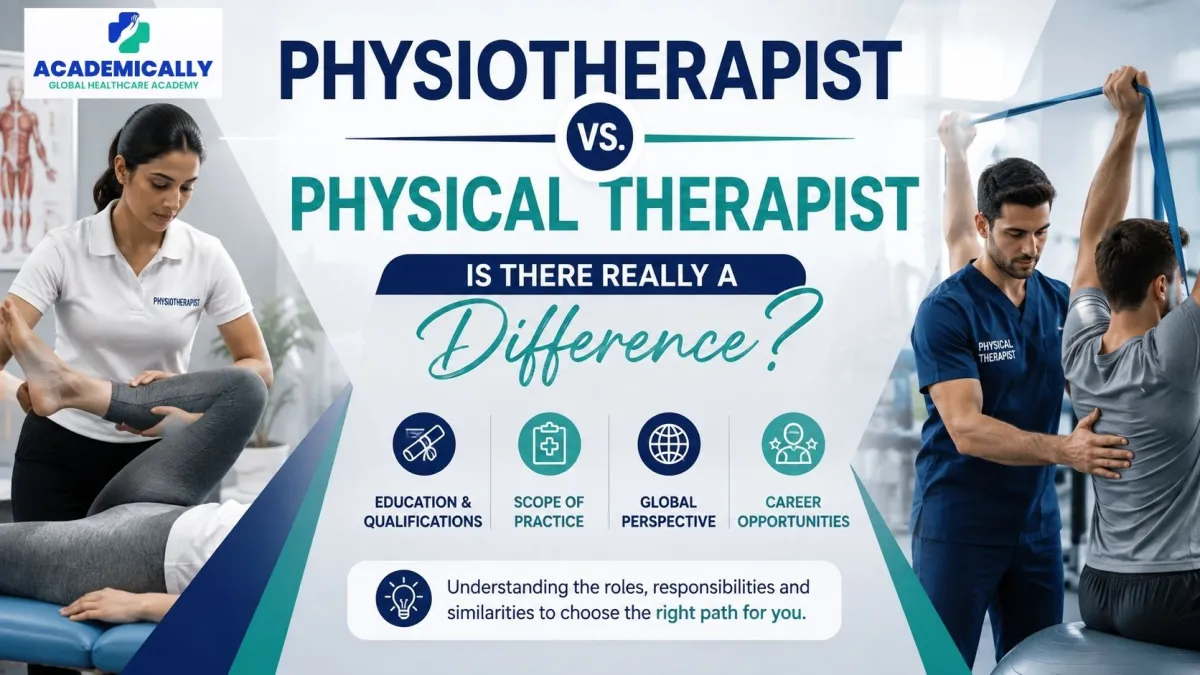
Physiotherapist vs Physical Therapist: Is There Really a Difference?

Written by

Dr. Rukhsar Jabbar

Co-Author

Tahreem Mirza
Physiotherapist vs Physical Therapist What’s the Difference
Updated On : Sep 02, 2026 3 min

Summary:

"Physiotherapist" and "physical therapist" refer to the exact same licensed healthcare profession. The difference is purely geographic: "physical therapist" is standard in the U.S., while "physiotherapist" is used across Australia, Canada, the UK, and Asia. Despite regional degree variations, such as a Doctor of Physical Therapy (DPT) in the U.S. versus a Bachelor's or Master's (BPT/MPT) abroad, both roles deliver identical evidence-based care.

We were unable to process some of the images.

A female physiotherapist in blue scrubs provides hands-on guidance to an older male patient's arm, inside a clean and bright modern clinic setting. image credit - Google Gemini

Key takeaways

  • "Physical therapist" is the standard term used in the United States, whereas "physiotherapist" is used across Australia, Canada, the UK, Europe, India, and Asia.
  • Despite differing job titles, clinicians in both regions utilize the same evidence-based techniques, including manual therapy, joint mobilization, dry needling, targeted therapeutic exercise, and movement re-education. 
  • U.S. physical therapists earn a Doctor of Physical Therapy (DPT) degree, while international physiotherapists typically hold a Bachelor of Physiotherapy (BPT) or Master of Physiotherapy (MPT/MSc). 
  • Foreign-trained physiotherapists can practice in the U.S. after completing a credential evaluation with the FCCPT and passing the NPTE exam. Similarly, those aiming to practice in Australia must clear the APEP pathway to register with AHPRA. 
  • Depending on local regulations, scope of practice varies. For instance, specifically trained physiotherapists in regions like the UK can directly order diagnostic imaging (X-rays, MRIs) and prescribe certain anti-inflammatory medications.

Clinically speaking, No. Both physiotherapists and physical therapists are licensed movement specialists trained to diagnose physical impairments, rehabilitate injuries, and restore mobility. The distinction is strictly geographic: "physical therapist" is the standard title in the United States, while "physiotherapist" is used across Australia, Canada, the UK, Europe, India, and Asia.

When booking care for joint pain, sports injuries, or post-surgical rehabilitation, seeing two different titles, physiotherapist and physical therapist, often leads patients and healthcare professionals to wonder if one credential offers higher medical standing, greater hands-on skill, or a broader scope of care.

To evaluate any movement specialist confidently, you need to understand how regional naming rules, clinical degrees, scope of practice, and global registration frameworks actually work.

Terminology & Geographic Variations 

The difference between physiotherapy and physical therapy comes down to regional

Feature / MetricPhysical Therapist (US)Physiotherapist (Australia, Canada , UK , Global )
Primary regionUSAustralia, UK, Canada, Asia ,India
Standard Entry DegreeDoctor of physical therapyBPT / MPT /M.Sc
Regulatory AuthorityState Licensing Boards / FSBPTAHPRA (Australia), HCPC (UK),CAPR ( Canada)
Direct AccessVaries by StateStandard in most public and private systems
Prescribing RightsExtremely limitedAvailable in specific regions e.g UK with post graduate training
Core Clinical FocusMusculoskeletal, Neuro , Sports, RehabMusculoskeletal , Neuro ,Cardiorespiratory, Rehab

This table shows side-by-side comparison of Physical Therapists and Physiotherapists, detailing key differences in regional terminology, degrees, licensing bodies, and scope of practice.

Decoding Credentials: DPT vs. BPT / MPT / MSc 

In the United States, entry-level programs require a Doctor of Physical Therapy (DPT): a three-year postgraduate doctorate focusing heavily on differential diagnosis, autonomous decision-making, and primary care screening.

Internationally, practitioners typically earn a Bachelor of Physiotherapy (BPT) or a Master of Physiotherapy (MPT / MSc).

While degree acronyms differ, international degrees are rigorously clinical. In practice, lasting patient outcomes depend on clinical reasoning, hands-on skill, and individual care models not just the letters following a therapist’s name.

Scope of Practice & Clinic Care Models 

Legal guidelines dictate what a therapist can perform without a physician's oversight:

•Direct Access & Imaging: In direct-access regions, therapists evaluate patients without a medical doctor’s referral. In countries like the UK, specifically trained physiotherapists can directly order diagnostic imaging (X-rays, MRIs) or prescribe specific anti-inflammatory medications.

•1-on-1 Care vs. High-Volume Mills: A clinic's care model impacts recovery far more than its name. High-volume chain clinics frequently pass patients to tech aides after 10 minutes of therapist contact. Quality practices prioritize continuous, 1-on-1 care integrating advanced modalities like dry needling, laser therapy, and personalized movement analysis.

Global Mobility & International Licensing 

Because core clinical foundations are identical worldwide, movement specialists enjoy exceptional global career mobility. According to workforce data from the Australian Health Practitioner Regulation Agency (AHPRA), internationally qualified healthcare practitioners account for a significant portion of the Australian health workforce, where registered physiotherapists earn competitive average annual salaries exceeding $95,000 AUD.

However, practicing abroad requires clearing local regulatory pathways:

1. Practicing in Australia (AHPRA & APEP)

We were unable to process some of the images.

A young physiotherapy student performs a clinical assessment on a patient's neck under the observation of an examiner taking notes at an APC Assessment Centre. image credit - Google Gemini

Overseas-trained physiotherapists must complete the Australian Physiotherapy Entry Pathway (APEP) to register with the Australian Health Practitioner Regulation Agency (AHPRA). The APEP assessment evaluates real-world clinical reasoning, risk management, and Australian healthcare standards over rote memorization.

Targeted APEP Preparation: Navigating Australian clinical thresholds requires structured preparation. Academically Global Private Limited provides comprehensive APEP exam preparation, offering 14 weeks of live training led by AHPRA-registered faculty, 4,000+ domain-specific practice questions, and complete documentation support to help foreign candidates clear written and clinical stages on their first attempt.

Global Employment Platforms: Once registered, securing international roles is simplified through specialized platforms like Jobslly ( India's first healthcare based job portal ), which connects healthcare professionals with skill development resources, visa guidance, and global job listings.

2. Practicing in the United States (FCCPT & NPTE)

Foreign-educated physiotherapists who wish to work in the U.S. must submit their academic credentials for evaluation through the Foreign Credentialing Commission on Physical Therapy (FCCPT) to verify equivalence to a U.S. DPT before sitting for the National Physical Therapy Examination (NPTE).

3.Middle East & Gulf Licensing Exams

Dubai Health Authority (DHA Exam) – Dubai, UAE: Required for physiotherapists seeking clinical licensure strictly within the Emirate of Dubai.

Department of Health (DoH / HAAD Exam) – Abu Dhabi, UAE: Mandatory assessment for practice in Abu Dhabi and Al Ain.

Ministry of Health (MOH Exam) – UAE: Covers practice across the Northern Emirates, including Sharjah, Ajman, Ras Al Khaimah, and Fujairah.

Saudi Commission for Health Specialties (SCFHS / Saudi Prometric) – Saudi Arabia: The required licensing exam to practice as a registered physiotherapist across public and private hospitals in Saudi Arabia.

Department of Healthcare Professions (DHP / QCHP) – Qatar: Prometric-based evaluation for physiotherapists aiming to work in Qatar's healthcare sector.

Oman Medical Specialty Board (OMSB Prometric) – Oman: Official licensing exam for healthcare practitioners relocating to Oman.

National Health Regulatory Authority (NHRA) – Bahrain: Registration exam required for clinical practice in Bahrain.

How to Choose the Right Specialist: Patient & Career Checklist 

Whether evaluating a local clinic or planning an overseas practice transition, focus on these core criteria:

Dedicated 1-on-1 Time: Ensure sessions are spent directly with a licensed clinician rather than divided among multiple patients or aides.

Root-Cause Movement Analysis: Look for comprehensive physical evaluations that assess total bio-mechanics rather than treating localized pain in isolation.

Verified Regulatory Compliance: Verify that your practitioner is fully licensed by their regional board (e.g., AHPRA, FSBPT, HCPC) or enrolled in recognized credentialing pathways for international practice.

Ultimately, whether you call yourself a Physical Therapist or a Physiotherapist, the core passion remains the same: restoring movement, function, and improving quality of life.

While the terms are often used interchangeably worldwide, in Australia, using the title "Physiotherapist" requires registration through a specific regulatory process to ensure Australian standards are met.

If your goal is to practice in Australia, navigating pathways like the APEP (Australian Physiotherapy Eligibility Program) can feel overwhelming. At Academically Global, we specialize in simplifying that journey.

About Us

Academically is a global Ed-Tech healthcare platform, led by Dr. Akram Ahmad (PhD in Medicine, University of Sydney, Global Healthcare Career Coach) and his expert team, that helps pharmacists, doctors, dentists, physiotherapists, and other allied healthcare professionals to achieve their career goals in India and abroad. We provide complete career guidance, like skill assessment, Visa, PR and coaching for International licensure exams such as AMC, Overseas Pharmacist Readiness Assessment, APEP, ADC, DHA, SPLE, OCANZ COE and more for countries like Australia, New Zealand, Gulf countries, the US, the UK, and Canada. We have trained more than 8,000 students across 30+ countries, with a 90%+ success rate on international healthcare licensure exams. We are India’s first healthcare Ed-Tech platform to introduce AI-based mock tests, to help students study smarter and track progress effectively. Beyond exam preparation, we also offer job assistance programmes, such as Upskill by Academically, covering clinical drug development and medical affairs. To help you land your dream job, we have recently launched our job platform Jobslly by Academically, only for healthcare professionals for both India and abroad.

FAQs

Q: Is physiotherapy the same as physical therapy?

Yes. Both titles refer to the same licensed healthcare profession. The difference is geographic terminology: 'physical therapy' is used in the U.S., while 'physiotherapy' is standard across Australia, Canada, the UK, Europe, and Asia.

Q: Can a physiotherapist practice as a physical therapist in the United States?

Yes. Foreign-trained physiotherapists can practice in the U.S. after completing a credential review via the FCCPT, meeting state licensing requirements, and passing the National Physical Therapy Examination (NPTE).

Q: What is the fastest way for an overseas physiotherapist to work in Australia?

The standard route requires completing the Australian Physiotherapy Entry Pathway (APEP) assessment. Enrolling in structured prep programs through Academically Global aligns candidates with AHPRA clinical reasoning standards, significantly speeding up the licensing process.

Q: Can physical therapists or physiotherapists prescribe medication?

In the U.S., physical therapists generally cannot prescribe medication. In specific international jurisdictions, such as the UK, physiotherapists with specialized postgraduate training earn independent prescribing rights.

Q.What exams are required for a physiotherapist to practice in Dubai or Saudi Arabia?

To practice in the Gulf region, you must complete DataFlow credential verification and pass the respective regional licensing exam—such as the DHA for Dubai, DoH/HAAD for Abu Dhabi, MOH for the Northern Emirates, or SCFHS for Saudi Arabia. Preparation platforms like Academically Global offer targeted training to help candidates pass these Prometric-based exams on their first attempt

Q.What is DataFlow (Primary Source Verification), and why is it mandatory for GCC licenses?

DataFlow is an international primary source verification (PSV) process used by health authorities in the UAE, Saudi Arabia, Qatar, and Oman. It directly verifies your educational degrees, transcripts, employment history, and professional licenses with the issuing universities and employers to prevent fraudulent credentials.

Q.How long does the APEP assessment process take for Australia?

The complete Australian Physiotherapy Entry Pathway (APEP) timeline usually takes 6 to 12 months. This includes initial eligibility assessment by the Australian Physiotherapy Council (APC), preparation for and completion of the written assessment, followed by the clinical assessment stage.

Q.Can a candidate with a Bachelor of Physiotherapy (BPT) practice in Australia or the U.S.?

Yes. A Bachelor of Physiotherapy (BPT) degree qualifies you to apply for international licensing. For Australia, you clear registration via the APEP pathway. For the United States, your degree must undergo an equivalence evaluation via the FCCPT before taking the National Physical Therapy Examination (NPTE).

Q.How can international physiotherapists find healthcare jobs after clearing their exams?

Once licensed, practitioners can use specialized international employment portals like Jobslly to browse verified job openings, connect directly with global hospital networks and private sports clinics, and receive assistance with visa sponsorship and onboarding.

Q.What are the most in-demand physiotherapy specialties worldwide?

The highest demand globally is in Musculoskeletal & Sports Injury Rehabilitation, Neurological Rehabilitation (stroke/Parkinson's care), Orthopedic Post-Op Rehab, Geriatric Movement Care, and Cardio-respiratory Therapy.

Created On : Sep 01, 2026
Dr. Rukhsar Jabbar
Dr. Rukhsar Jabbar

Medical Content Writer Intern

MPT Physiotherapy (Neurology)

about the author

Rukhsar Jabbar  is a dedicated medical writer and clinical researcher specializing in neurological rehabilitation and evidence-based healthcare communication. She formulates research-driven digital content, educational articles, and patient-centric literature aimed at translating complex clinical evidence into accessible health insights. With clinical expertise in Physiotherapy  and health content creation, Rukhsar has published across international digital health platforms, including Datelinehealth Africa

(DLHA) and Klarity Health. Her work focuses on bridging the gap between scientific literature  

and public health literacy, empowering readers through actionable healthcare knowledge.

Build a Successful Global Healthcare Career

100% secure & confidential.

Academically

Get Complete Details & Expert Guidance

Our experts will contact you soon

Free guidance • No spam • No obligation

Students
Trusted by 50,000+ healthcare aspirants