
Everyone talks about the Australian Pharmacist Licensure exam, the registration, where to find pharmacy jobs, and what salary you might expect in Australia. But one part deserves more attention: the actual job interview.
You can pass assessments, polish your CV, and still freeze when an employer asks, “Tell me about yourself,” follows with a clinical scenario, then throws in a curveball.
That can feel especially uncomfortable when you trained overseas. You already know pharmacy. Now show that you can apply your knowledge safely, communicate clearly, manage pressure, and adapt.
I’m going to help you prepare for the interview with some sample questions and how to navigate bouncer questions which you weren’t expecting.
Let’s begin!
What Australian Pharmacy Employers Want to See
Your interviewer is not checking whether you know a medicine. They want to understand how you think when patient safety, time pressure, communication, or teamwork becomes difficult.
You should have the motivation, dispensing accuracy, customer care, emergencies, workflow, and judgement.
| Competency Assessed | What Your Answer Should Demonstrate |
| Clinical Judgement | You identify risk before acting and evaluate patient history. |
| Patient Safety | You verify prescriptions, escalate concerns, and document accurately. |
| Communication | You explain complex clinical ideas in simple, empathetic terms. |
| Teamwork | You collaborate respectfully with technicians, prescribers, and peers. |
| Adaptability | You are proactive and eager to master local guidelines and software. |
Key Note: Do not hide your experience. Translate it into transferable skills and explain what you are still learning.

Before the Interview: Prepare These Five Things
1. Know your registration status
Be ready to explain your Australian pathway clearly. The Australian Pharmacy Council (APC) currently offers Knowledge and Competency Streams:
- Knowledge Stream: Includes the Overseas Pharmacist Readiness Assessment (OPRA).
- Competency Stream: Includes the Competency Assessment of Overseas Pharmacists (CAOP).
- Registration and supervised practice requirements sit directly with the Pharmacy Board of Australia and AHPRA.
If you are still navigating your licensure preparation or need structured support for the OPRA or CAOP exams, exploring Academically’s Australian Pharmacist Exam Courses can give you the clinical depth and confidence needed to impress Australian employers.
2. Research the pharmacy
Review its services, patient mix, website, and advertisement. Prepare one genuine reason you want the role.
3. Refresh practical knowledge
Revise counselling, prescription checking, interactions, referrals, medication safety, and unfamiliar medicines.
4. Prepare five stories
Have real-life examples ready covering:
- Teamwork & collaboration
- Conflict resolution
- Patient communication challenge
- An error or near-miss
- Handling heavy workload/pressure
5. Practise speaking
Write keywords, not scripts. Natural answers usually sound stronger than memorised paragraphs.
Common Pharmacist Job Interview Questions Australia
Question 1- “Tell me about yourself.”
Do not give your entire life story. Use this structure:
Present: your Australian pathway.
Past: relevant pharmacy experience.
Future: why this role fits your next step.
Sample approach: “I’m an overseas-trained pharmacist with patient-facing pharmacy experience. My background has built my dispensing, counselling, and communication skills. I’m now focused on applying those skills in Australia, learning local systems quickly, and contributing safely to your team.”
Question 2- “Why do you want to work in this pharmacy?”
Show you researched the employer.
| Avoid | Better |
| “I need a job in Australia.” | “Your patient-focused services interest me.” |
| “It is close to my house.” | “The role matches my interest in ongoing patient care.” |
| “I heard you are hiring.” | “I was drawn to the role’s focus on counselling and teamwork.” |
Question 3- “How do you prevent dispensing errors?”
Do not simply say, “I am careful.” Outline your systematic checking protocol:
- Prescription Verification: Confirm patient details, prescriber credentials, and legal validity.
- Clinical Check: Evaluate dose, strength, directions, drug interactions, allergies, and patient history.
- Physical Selection: Match the product barcode, active ingredient, and expiry date.
- Label & Safety Warnings: Ensure clear, unambiguous patient instructions.
- Final Check & Pause: Take a intentional pause before final clearance. If anything looks incorrect, pause and clarify rather than assume.
Question 4- “What would you do if you were unfamiliar with a medicine?”
This tests safety and humility.
Sample answer:“I would not guess. I would assess the patient and prescription, use a reliable medicines information source, consult an experienced pharmacist when needed, and explain any delay professionally.”
Question 5- “What would you do with an angry patient?”
Listen, acknowledge the concern, establish facts, explain what you can and cannot do, and seek a safe solution. If a clinical or legal boundary applies, patient safety and professional obligations come first.
Clinical Scenario Questions to Practise
Scenario questions are harder because you cannot memorise one perfect response. Show safe reasoning.
| Scenario | Strong response should include |
| Prescription seems inappropriate | Verify, assess, clarify with prescriber |
| Unfamiliar medicine | Gather information before recommending |
| Suspected medicine misuse | Stay non-judgemental; assess and follow requirements |
| Medical emergency | Prioritise safety and emergency response |
| Medicine unavailable | Check options and communicate next steps |
| Dispensing error | Protect patient, escalate, document, prevent recurrence |
Australian interview resources include questions about inappropriate prescriptions, emergencies, suspected misuse, shortages, and workflow improvement.
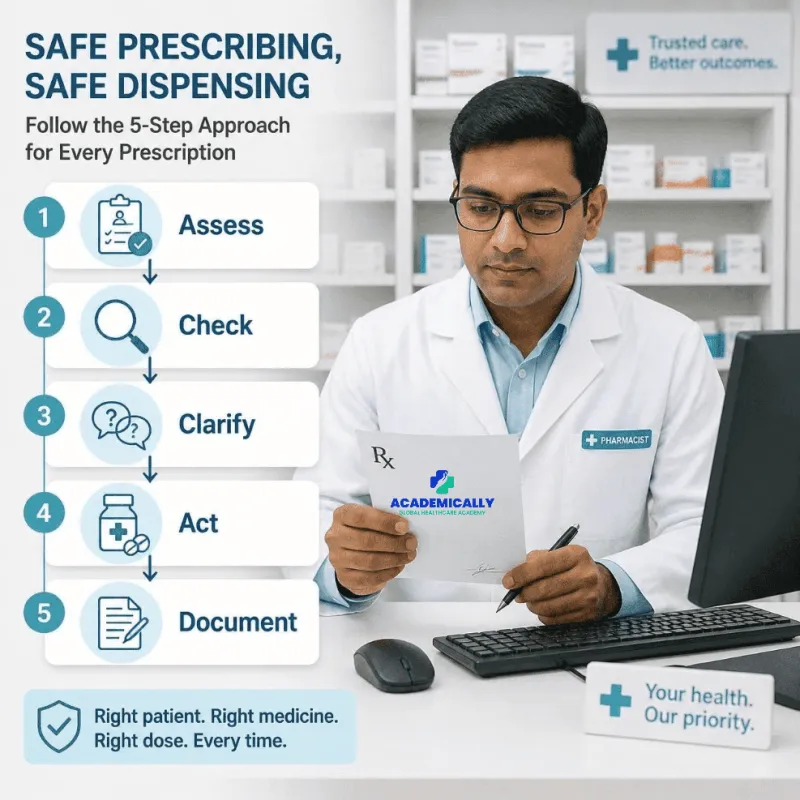
Mastering Clinical Reasoning for Australia
Clinical scenarios in job interviews mirror the clinical judgement tested in Australian licensure exams. If you want to strengthen your clinical problem-solving skills and ensure you pass your exams on the first attempt, check out Academically's Australian Pharmacist Exam Preparation Course.
Use the STAR Method for Experience Questions
When asked, “Tell me about a time when…”, use STAR:
| Step | What to say |
| Situation | Briefly explain what happened |
| Task | State your responsibility |
| Action | Focus on what you personally did |
| Result | Give the outcome and lesson |
Instead of saying, “I handled a difficult patient,” explain the cause, your communication, action, and result.
STAR also helps you explain experience from another healthcare system clearly.
Bouncer Questions You May Not Expect
1. “What is your weakness?”
Approach: Choose a genuine professional development area you are actively improving. Avoid fake weaknesses like "I work too hard."
Sample Answer:"Initially, adapting to new dispensing software slowed down my workflow speed. To overcome this, I spent extra time mastering shortcuts and standard procedures, balancing accuracy with efficiency."
2. “What if you disagree with another pharmacist?”
Approach: Focus on evidence, respect, and patient safety. Discuss the issue privately, listen open-mindedly, consult official guidelines together, and escalate through proper channels if safety is compromised.
3. “Why should we hire you if you trained overseas?”
Approach: Do not become defensive. Highlight pharmacy knowledge, communication, adaptability, diverse-patient experience, and willingness to learn local systems.
4. “What if you do not know the answer?”
Approach:"I would be honest about needing to verify the information. I’d consult Australian reference tools or consult a colleague to ensure the patient receives safe, accurate advice."
How to Discuss Limited Australian Experience
Do not apologise for your background. Use this formula:
What I have done + what it taught me + how it transfers + what I am learning.
For example: “My previous role involved high-volume dispensing and patient counselling. It taught me to prioritise safely while communicating clearly. I understand Australian practice has its own systems, so I am learning those processes and welcome supervised feedback.”
The Pharmacy Board’s current capability framework emphasises safe, person-centred care and the knowledge, skills, attitudes, and behaviours expected in pharmacy practice.
Tip: If you are unsure how to translate your overseas background into Australian standards, utilizing Jobslly’s expert consultations and CV curation support can help you frame your past achievements clearly for prospective employers.
Questions You Should Ask the Interviewer
Asking thoughtful, well-prepared questions at the end of your interview demonstrates genuine interest in the pharmacy's operations and professional culture. It also gives you valuable insight into whether the team's workflow and onboarding support align with your personal career goals.
| Question | Why it helps |
| “What would success look like in the first few months?” | Shows you think beyond getting hired |
| “How do you support pharmacists new to your systems?” | Clarifies onboarding |
| “What are the busiest parts of the day?” | Reveals workflow |
| “How does the team approach medication safety?” | Shows safety awareness |
Final Interview Checklist
Before the interview, check your registration documents, CV, references, location, and clothing.
Practise aloud:
Your introduction.
Why this pharmacy?
Your registration status.
One medication-safety example.
One difficult-patient example.
One teamwork example.
One mistake or learning example.
Three questions for the interviewer.
You are not proving you know everything. Show that you practise safely, communicate professionally, recognise limits, and keep learning.
Ready to Practice Pharmacy in Australia?
Navigating APC exams, AHPRA registration pathways, and job interviews in a new country can feel complex.
Whether you need CV curation, 1-on-1 career consultations, and placement support through Jobslly, or structured clinical training for your exams, getting the right guidance saves time and builds confidence.
Academically can help you by providing you with expert guidance on your registration pathway, exam strategies, and career roadmap in Australia! The faculty who mentor you have been in the same shoes. Now they are well settled and earning comfortably in Australia.
Let's kickstart your career together.