
If you’re sitting the AMC CAT MCQ, here’s something that catches a lot of international doctors off guard: roughly one in every eight questions is about paediatrics. That’s a big slice of the paper to leave to chance. Plenty of candidates pour months into medicine and surgery, then treat AMC paediatrics preparation as an afterthought, skimming it in the final week and hoping for the best.
Good AMC paediatrics preparation doesn’t have to be complicated. It needs to be focused, built around Australian guidelines, and practised with real questions rather than just read from a textbook. This guide to AMC paediatrics preparation covers what to study, which resources are actually worth your time, and how to practise so the knowledge sticks on exam day.
Why AMC Paediatrics Preparation Needs Its Own Plan
AMC Part 1 is a computer adaptive test with 150 multiple-choice questions over 3.5 hours. Every question has five options and one best answer, and once you’ve answered, you can’t go back. According to the AMC’s published blueprint, Child Health makes up 12.5% of the exam, the same weight as women’s health, mental health and population health.
The paper is integrated, so you won’t find a tidy “paediatrics section.” A child with a limp might sit between a question on heart failure and one on antenatal screening. That mix is exactly why AMC paediatrics preparation can’t wait until the last fortnight. Your brain needs regular practice switching from a toddler to a 70-year-old without losing the thread.
Vital signs, normal ranges and even the way a disease looks all change with age. The exam expects you to know that.
What the AMC Child Health Content Actually Covers
The AMC defines child health broadly. It runs from fetal development and the transition to life outside the womb, all the way to the end of adolescence. That includes growth, development, common and serious illness, and recognising developmental disability.
The AMC also says most questions reflect common clinical conditions in the Australian community. The ones that matter most are those that are life-threatening, critical to safe practice, important for a good outcome, or relevant to public health. In plain words: learn the common things really well, and learn the dangerous things even better.
You’ll be tested the way a junior doctor is tested. Work out the diagnosis, choose the right investigation, pick the best next step, know when to escalate. That changes how you approach AMC paediatrics preparation: reason through scenarios instead of reciting facts. So AMC paediatrics questions rarely ask “what is X?” They ask “what would you do now?”
The Core Topics to Study
You don’t need every rare syndrome. You need a firm grip on the presentations that come up again and again. Use this table as your starting checklist for AMC paediatrics preparation.
| Area | What to focus on |
| Growth and development | Milestones by age, red flags for delay, growth charts, failure to thrive |
| Newborn | Neonatal jaundice, resuscitation basics, feeding problems, congenital conditions |
| Respiratory | Bronchiolitis, croup, asthma, pneumonia, inhaled foreign body |
| Fever and infection | The febrile child, sepsis, meningitis, UTI, Kawasaki disease, common rashes |
| Gastro and surgical | Gastroenteritis and dehydration, pyloric stenosis, intussusception, appendicitis |
| Emergencies | Anaphylaxis, seizures, head injury, poisoning, burns |
| Bones and joints | The limping child, septic arthritis versus transient synovitis, hip dysplasia |
| Child protection and adolescents | Red flags for non-accidental injury, neglect, mandatory reporting, confidential care for teens |
| Immunisation | The Australian schedule, catch-up basics, contraindications |
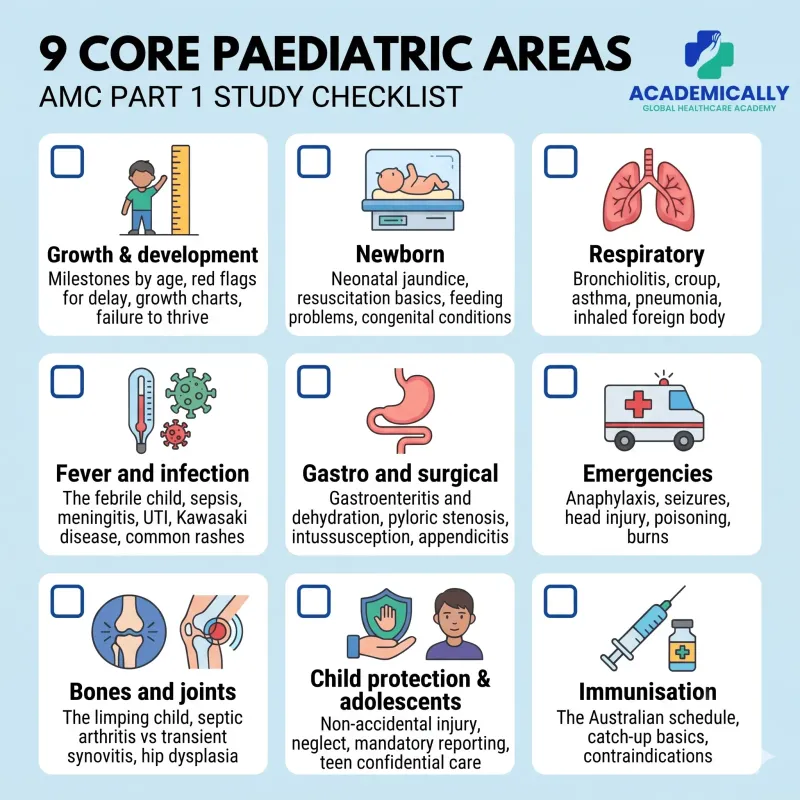
For each condition, ask yourself four things. How does it present at different ages? What’s the first investigation? What’s the first-line treatment? And what red flag turns it into an emergency?
A few quick examples show how this works. Bronchiolitis is managed with supportive care, and bronchodilators or steroids aren’t routine. Croup responds to a dose of oral dexamethasone. Pyloric stenosis gives you projectile, non-bilious vomiting in a young infant, with a hypochloraemic metabolic alkalosis on the bloods. In anaphylaxis, intramuscular adrenaline comes first, before anything else. Notice the pattern: one clear presentation, one clear next step. That’s the level AMC paediatrics questions tend to test, and it’s the level your AMC paediatrics preparation should aim for.
Resources Worth Your Time
Not every resource is equal, and paediatric practice varies from country to country. Good AMC paediatrics preparation leans on a few reliable sources, not a dozen half-read ones. Stick to sources that reflect what’s done in Australia.
- AMC Examination Specifications. Read the booklet on the Australian Medical Council website first. It explains the blueprint, the CAT format and the content areas, and the AMC also offers practice material for candidates. Check the site for what’s current.
- Royal Children’s Hospital Clinical Practice Guidelines. The RCH guidelines are free, written for Australian practice, and cover bronchiolitis, croup, febrile children, dehydration and plenty more. They’re probably the single best free tool for AMC paediatrics preparation.
- The Australian Immunisation Handbook. The official handbook is the source for the national schedule and catch-up rules.
- Therapeutic Guidelines. If you have access, Therapeutic Guidelines shows the antibiotic and drug choices Australian clinicians actually use.
- Raising Children Network. The Raising Children Network explains milestones in plain language, which makes them easier to remember.
A quick word of caution. Notes shared on file-sharing sites are often outdated, unreferenced or written for a different country’s guidelines. Use them for ideas if you like, but check anything important against the sources above.
If you’d rather not build the plan alone, a structured course can help. Academically’s AMC Exam Preparation Course covers the AMC MCQ syllabus with live and recorded classes and AI-driven mock tests. That mix makes it easier to keep your AMC paediatrics preparation on schedule and to try AMC paediatrics questions under exam conditions.
How to Plan Your Paediatrics Revision for AMC
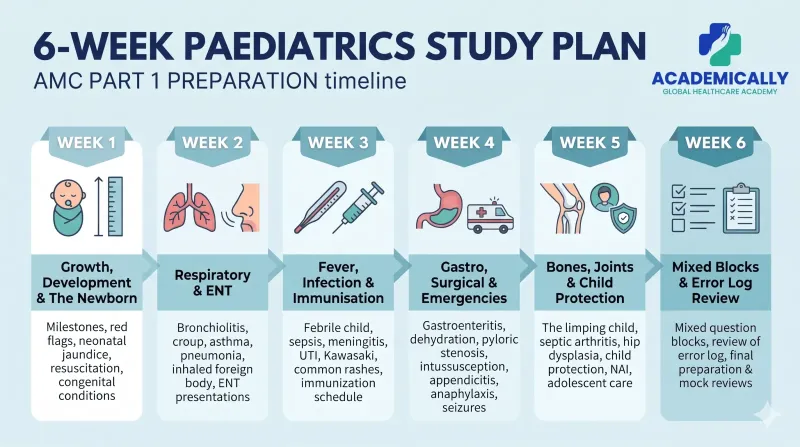
The best approach is little and often. Two or three short paediatrics sessions a week will beat one giant weekend binge, because spaced repetition is what moves facts into long-term memory. Here’s a simple six-week AMC paediatrics preparation plan you can fit around your other subjects:
- Week 1: Growth, development and the newborn
- Week 2: Respiratory conditions and ENT presentations
- Week 3: Fever, infection and immunisation
- Week 4: Gastro, surgical problems and emergencies
- Week 5: Bones and joints, child protection, adolescent health
- Week 6: Mixed question blocks and a full review of your error log
Don’t try to memorise textbooks. Make one-page summaries for each condition, and use flashcards for the things that are pure recall, such as milestones and the immunisation schedule. Paediatrics revision for AMC works best when you keep a running list of the questions you got wrong and why.
If you’ve only got four weeks, compress the plan, but don’t drop the question practice. Your paediatrics revision for AMC should always include a few AMC paediatrics questions from week one, not just at the end.
How to Practise AMC Paediatrics Questions
Reading builds familiarity. Questions build exam skill. You need both, and both belong in your AMC paediatrics preparation from the start.
Start questions early. Don’t wait until you’ve “finished” the content. Doing AMC paediatrics questions in the first week shows you what you don’t know long before the exam does.
Read the stem like a detective. In paediatrics, the age, weight, vital signs and immunisation status are rarely there by accident. A fever in a three-week-old is a completely different problem from a fever in a three-year-old.
Practise in mixed, timed blocks. The real paper doesn’t sort by specialty. At 150 questions in 3.5 hours, you’ve got roughly 84 seconds per question, so train yourself to commit to an answer and move on.
Sit at least one full-length mock. In your last two weeks, do a full 150-question, 3.5-hour session so the pacing and the no-going-back rule feel normal. AcadPrep, Academically’s AMC mock series, offers full-length mocks in the AMC exam format. Whichever mocks you pick, check that they include AMC paediatrics questions set in an Australian context.
Always read the explanation. Even when you’re right. Understanding why the other four options are wrong teaches you more than the right answer does.
Keep an error log. Write down each wrong answer, the reason you missed it (knowledge gap, misread stem, or rushed), and the one-line fix. Review it every week. This is the habit that separates candidates who steadily improve from those who just do thousands of questions.
Say your reasoning out loud. For a tricky child scenario, talk through it: what’s the likely diagnosis, what’s the dangerous alternative, what’s the first step? It sounds silly, but it mimics what the exam wants from you.
Try to find AMC paediatrics questions written in an Australian context, with Australian drug names, guidelines and the national immunisation schedule. A bank that follows UK or US practice can quietly teach you the wrong answer.
Common Mistakes in AMC Paediatrics Preparation
These slip-ups quietly drag down AMC paediatrics preparation for a lot of candidates, and most are easy to fix.
- Treating children as small adults. Always think weight-based dosing and age-specific normal ranges.
- Leaving paediatrics until the end. Spread it out so it’s fresh and regularly tested.
- Ignoring child protection and adolescent health. These topics blend clinical judgement with ethics and communication, and they’re easy marks once you know the principles.
- Skipping immunisation. It’s pure recall, and it’s very testable.
- Memorising without reasoning. AMC paediatrics questions reward the best next step, not trivia.
- Using guidelines from another country. Australian practice can differ, so check the RCH and national sources.
Final Thoughts
Paediatrics is one of the more manageable areas of the AMC Part 1 exam, if you give it a plan. Learn the blueprint, focus on the common and the dangerous, use Australian sources, and practise AMC paediatrics questions from the start. Your AMC paediatrics preparation doesn’t need to be perfect, it just needs to be consistent. Steady AMC paediatrics preparation, a few focused hours a week, is far more effective than a last-minute scramble.
Before you begin, take a look at the AMC’s own exam documents and pick one reliable question source. Then start your first paediatrics block this week. Future you, sitting in the test centre, will be glad you did.
Paediatrics can show up in the AMC clinical exam too, where you may be asked to take a history from a parent, explain a diagnosis or counsel a family. Once your Part 1 revision is on track, Academically’s AMC Clinical Exam Preparation Course is a natural next step.