When most people think of nurses today, they often picture hospitals, night shifts, patients, giving injections, emergency rooms and standing for hours. Nursing is more than that- there’s a world beyond the bedside care.
I say this as a dentist who has also explored the transition from a clinical healthcare career into the non-clinical side of healthcare. My own experience made me realise something important: your professional degree does not have to define only one career path. The clinical knowledge you gain can be used in writing, research, drug safety, healthcare tech, medical operations and more.
That is exactly why I believe nurses with a BSc Nursing, GNM, or MSc Nursing should look beyond the conventional hospital career ladder.
Today many industries like pharmaceuticals, CROs, health-tech companies, insurers, medical communication firms and research institutes has created opportunities where nursing knowledge can be used without spending every working day at the bedside.
The job market now includes non-clinical roles like clinical research, informatics, medical writing, utilization review, quality assurance, healthcare operations and pharmaceutical roles as common pathways beyond traditional bedside training.
What Are Non-Clinical Jobs for Nurses?
I would define non-clinical jobs for nurses as healthcare careers where your nursing knowledge remains useful, but your primary responsibility is no longer direct bedside patient care.
That difference matters.
A non-clinical career doesn’t mean leaving healthcare. Instead, nurses can use their skills to support larger healthcare systems like:
- research studies
- medicine development
- technology products
- medical information or
- healthcare decision-making.
Some roles still require clinical knowledge and communication with doctors or healthcare teams. Others focus more on documentation, analysis, writing, coordination, technology or operations.
The right choice depends less on your nursing qualification alone and more on what you enjoy doing.
Why Are Nurses Exploring Careers Beyond the Bedside?
For many nurses, bedside care is something they care deeply about but the problem often comes from the structure of bedside work:
- The rotating long shifts
- Physical demands
- Repetitive responsibilities
- Limited flexibility and
- Limited growth in bedside roles can be tough.
A non-clinical career can change the nature of the work. Some positions provide office-based, hybrid, or remote opportunities, although work arrangements always depend on the employer and role. Current career resources specifically identify fields such as medical writing, informatics, utilization review, and health-tech work as possible alternatives to bedside nursing.
The most important point is this: you are not wasting your nursing degree by moving away from the bedside. You are transferring your clinical expertise into a different healthcare function.
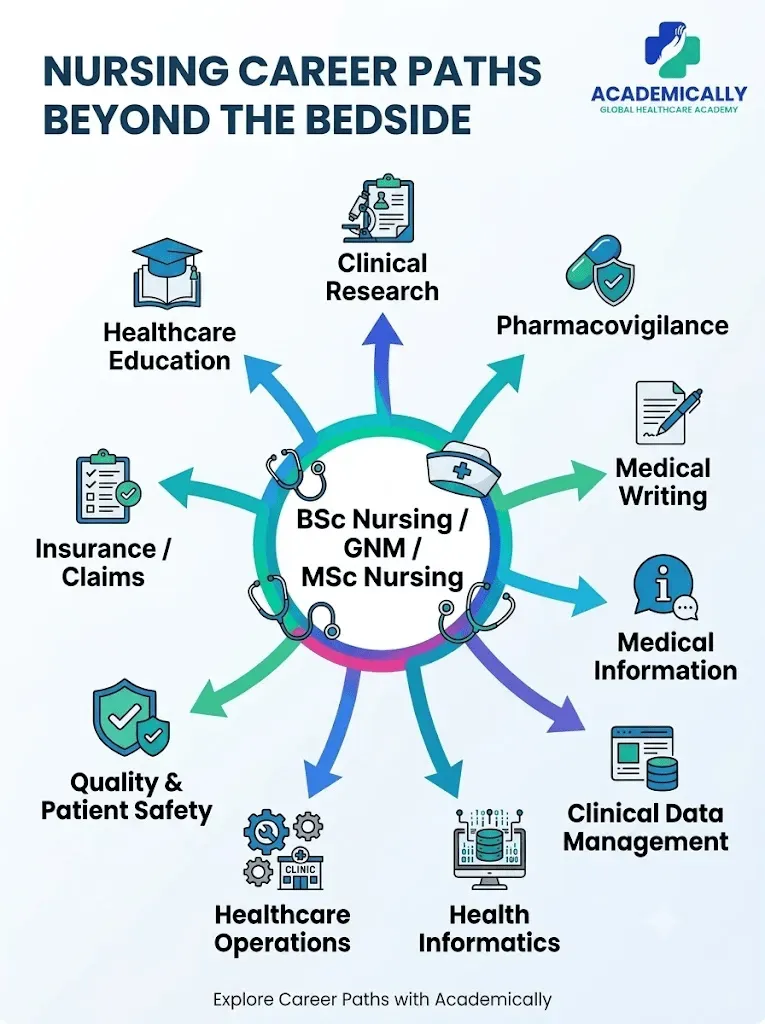
Non-Clinical Jobs for Nurses to Explore
1. Clinical Research Coordinator
Clinical research is one of the most natural transitions because nurses already understand patients, clinical workflows, medical terminology, documentation, and healthcare protocols.
A Clinical Research Coordinator may support activities such as:
- study documentation
- participant coordination
- protocol implementation
- site communication and
- study-related records
Nursing graduates can grow by learning Good Clinical Practice (GCP), research methods, trial documents and regulations.
ICH E6(R3) is the global guideline for clinical trials. It focuses on protecting participants improving trial quality and ensuring data.
Entry-level titles may include:
- Clinical Research Coordinator
- Clinical Trial Assistant
- Clinical Research Assistant
- Clinical Project Assistant
Academically's current clinical drug development programme explicitly states that nursing graduates can enter this pathway, with training designed around industry-relevant skills.
2. Pharmacovigilance and Drug Safety
Pharmacovigilance focuses on monitoring and evaluating the safety of medicines.
It includes:
- documenting adverse events
- handling safety data
- reviewing medical cases
- signal related activities and
- reporting safety issues.
I find this role especially interesting for nurses because their clinical experience helps them understand symptoms, understand history and recognize medication side effects practically.
Possible roles may include:
- Drug Safety Associate
- Pharmacovigilance Associate
- Safety Data Associate
- Pharmacovigilance Specialist
Additional training in ICSR processing, MedDRA, causality concepts, safety regulations, and pharmacovigilance workflows can make your profile more relevant to industry employers.
Academically offers training in Drug Safety and Pharmacovigilance. It covers ICH guidelines, case processing, signal detection, risk management and regulatory submissions.
3. Medical Writing
Medical writing is another path I would seriously recommend exploring when a nurse enjoys research and communication.
Your nursing education already gives you exposure to anatomy, physiology, pathology, pharmacology, treatment approaches, and patient care. The missing piece is usually the professional writing skill required by healthcare organisations.
Medical writers can work on:
- Scientific articles
- Patient education content
- Clinical documents
- Research summaries
- Regulatory papers
- Medical communications
- Educational content
Academically’s Medical Writing programme teaches clinical, regulatory, scientific and publication writing. It also includes portfolio building and writing practice.
My biggest advice here is simple: do not assume that being good at English automatically makes you a medical writer. Writing for healthcare is a specialised skill. Build samples, learn evidence-based writing, understand references, and create a portfolio.
4. Medical Information Associate
Medical Information professionals provide evidence-based information about medicines and healthcare products.
The work can involve
- responding to scientific questions
- reviewing source materials
- preparing standard responses
- maintaining information resources and
- supporting internal teams.
A nursing background can be valuable because nurses already understand how doctors and patients communicate about topics. This route may suit nurses who enjoy reading, research, documentation, and structured communication more than highly creative content writing.
5. Clinical Data Management
Clinical trials collect lots of data from patients and studies.
Clinical Data Management makes sure that data is collected, organized, checked, cleaned and stored properly.
A nurse who enjoys details, spreadsheets, documentation, systems, and analytical work may find this field attractive.
Important skills can include:
- EDC systems,
- data cleaning,
- database basics,
- query handling,
- clinical terms and
- CDISC standards.
Academically includes Clinical Data Management among its non-clinical programmes and they teach EDC systems, database design and CDISC standards.
6. Health Informatics and Digital Health
Healthcare today depends heavily on electronic records, clinical software, digital tools and technology-enabled care.
This opens doors for nurses who understand both healthcare and technology.
Nurses have a unique advantage here because they understand what actually happens during patient care. That knowledge can help when organisations design clinical software, implement electronic health records, improve workflows, or train healthcare teams.
Possible roles include:
- Clinical Informatics Associate
- Health Informatics Specialist
- EHR Implementation Specialist
- Clinical Application Specialist
- Digital Health Associate
7. Healthcare Operations and Coordination
Hospitals, health-tech firms, insurers and healthcare startups need professionals who understand healthcare processes and can manage people, documents, schedules and processes.
Nurses can explore roles like:
- Healthcare Operations Executive
- Clinical Operations Coordinator
- Patient Operations Associate
- Program Coordinator
- Healthcare Process Associate
This path suits those who like organizing, teamwork, communication and problem-solving.
A clinical background helps if the company needs someone who truly understands how healthcare works in practice.
8. Quality, Patient Safety and Accreditation
Quality and patient safety create another important non-bedside pathway.
Nurses may contribute to areas such as:
- documentation audits
- quality improvement
- policy implementation
- incident analysis
- patient-safety initiatives
- accreditation preparation and
- compliance activities.
Hospitals and healthcare groups need people who know both quality systems and real clinical work.
This path is good for nurses with hospital experience who want to work at a systems level.
9. Insurance, Claims and Utilization Review
Insurance companies and healthcare organizations hire people to check records and decide if treatments or claims meet certain rules.
Roles can include:
- Medical Claims Reviewer
- Utilization Review Associate
- Clinical Documentation Reviewer
- Healthcare Claims Analyst
- Medical Review Associate
This path suits nurses who like reviewing documents and making decisions based on records.
10. Healthcare Education and Instructional Design
Nurses who love teaching do not necessarily have to become full-time nursing faculty. They can work in corporate training, healthcare education, e-learning, instructional design, patient education, simulation or professional learning.
They can create:
- training modules
- educational presentations
- clinical learning materials
- onboarding guides
- healthcare courses or
- digital educational content.
This is an especially interesting path for nurses who enjoy explaining things and building clear useful presentations.
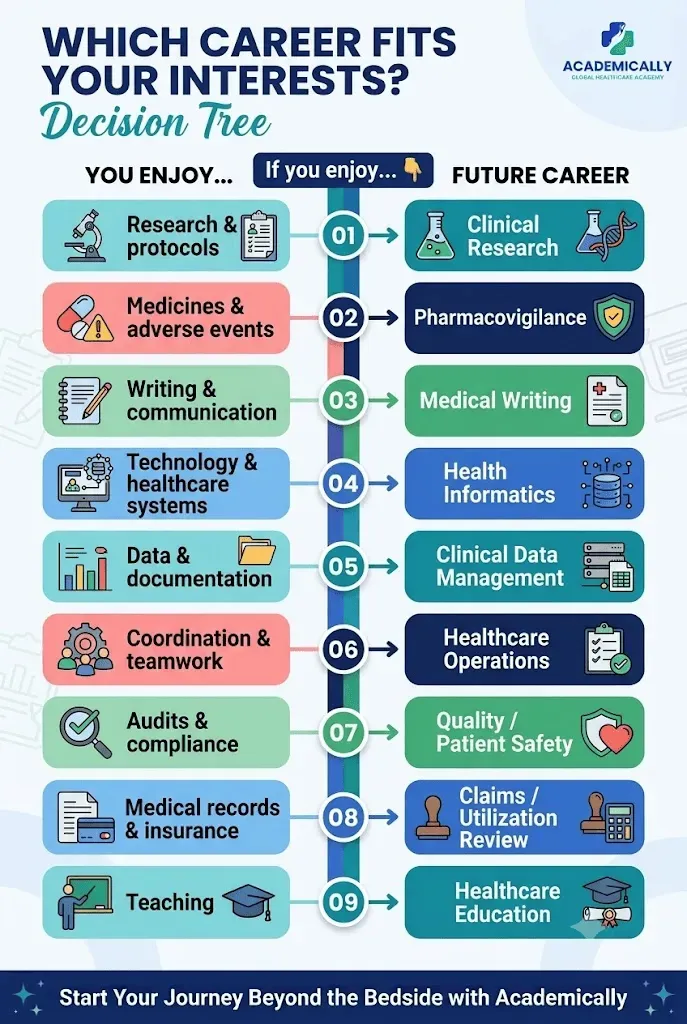
Which Non-Clinical Path Fits BSc, GNM and MSc Nurses?
I wouldn’t pick a career based on the degree name.
Your qualification matters, but your skills, experience, and target role matter just as much.
| Background | Career areas to explore |
| BSc Nursing | Clinical research, pharmacovigilance, medical writing, medical information, health-tech, quality, operations |
| GNM | Clinical coordination, healthcare operations, selected research/support roles, quality, claims, health-tech support |
| MSc Nursing | Research, education, quality, clinical research, healthcare operations, informatics, leadership-oriented roles |
There is no one-size-fits-all when it comes to eligibility for -clinical jobs. Employers have expectations. Some prefer a bachelor’s or master’s degree, while others focus more on experience and real skills.
That is why sending the CV to every non-clinical role will not work. It will not get you noticed.
Skills Nurses Should Build Before Making the Switch
I have seen many nurses rush into career transitions by collecting certificates without building the right skills. That approach rarely pays off.
A better way is to pick one target job then go backward and learn what that job really needs. For example:
| Target Role | Core Skills |
| Clinical research | GCP, clinical trial documentation, research methodology, and regulatory basics. |
| Pharmacovigilance | ICSRs, MedDRA, adverse-event processing, and safety reporting. |
| Medical writing | scientific writing, literature review, referencing, editing, and portfolio development. |
| Health-tech | health informatics, Excel, data interpretation, EHR concepts, and digital health knowledge. |
The key point is this: your CV must show that you can do the job. Not just say you took a course.
My own shift from dentistry to medical content writing taught me something important. Knowing healthcare is only half part of the journey. Understanding industry norms and what employers want is just as important.
Academically now offers a range of non-clinical programmes. These include Clinical Drug Development, Clinical Research, Pharmacovigilance, Medical Writing, Clinical Data Management, HEOR, Medical Affairs and Market Research.
Their programmes are designed with industry in mind. They come with job support and training. Completing them gives you 180 CPD points for five years.
Real Career Transition: From Clinical Practice to Pharmacovigilance
While exploring non-clinical jobs for nurses and other healthcare professionals, I think real career journeys can often explain the possibilities better than a simple list of job titles.
Dr. Pragya, now a Pharmacovigilance Specialist at Accenture, with a reported package of ₹17 lakh per annum, is one such example. She shared that clinical practice did not feel like the right long-term path for her. What interested her more was understanding the science behind drug safety—why medicines fail and how adverse reactions are identified and monitored.
Her turning point came when she discovered Academically. According to her experience, the programme went beyond theoretical learning, with sessions led by industry professionals and exposure to experts from organisations including Eversana and Pfizer. She also highlighted the value of personalised tutorials, which helped her move from uncertainty to greater confidence about entering pharmacovigilance.
I find her journey particularly relevant because it shows that moving away from conventional clinical practice does not mean moving away from healthcare. Your clinical understanding can become the foundation for a career focused on medicine safety, research, and healthcare industry processes.
How To Find Non-Clinical Jobs
Getting trained is step one. The next step is finding the job.
Jobslly is a job platform built for healthcare professionals where you can look for roles in pharma, clinical research, pharmacovigilance, medical affairs and related fields.
It has dedicated categories for nurses and filters for non -clinical jobs, remote work, hybrid options and other types. I particularly like the idea of searching by function rather than only by profession.
Instead of searching only for “BSc Nurse jobs,” also search terms such as:
- Clinical Research Coordinator
- Drug Safety Associate
- Pharmacovigilance Associate
- Medical Writer
- Clinical Data Associate
- Healthcare Operations
- Clinical Documentation Reviewer
- Health Informatics
- Medical Information
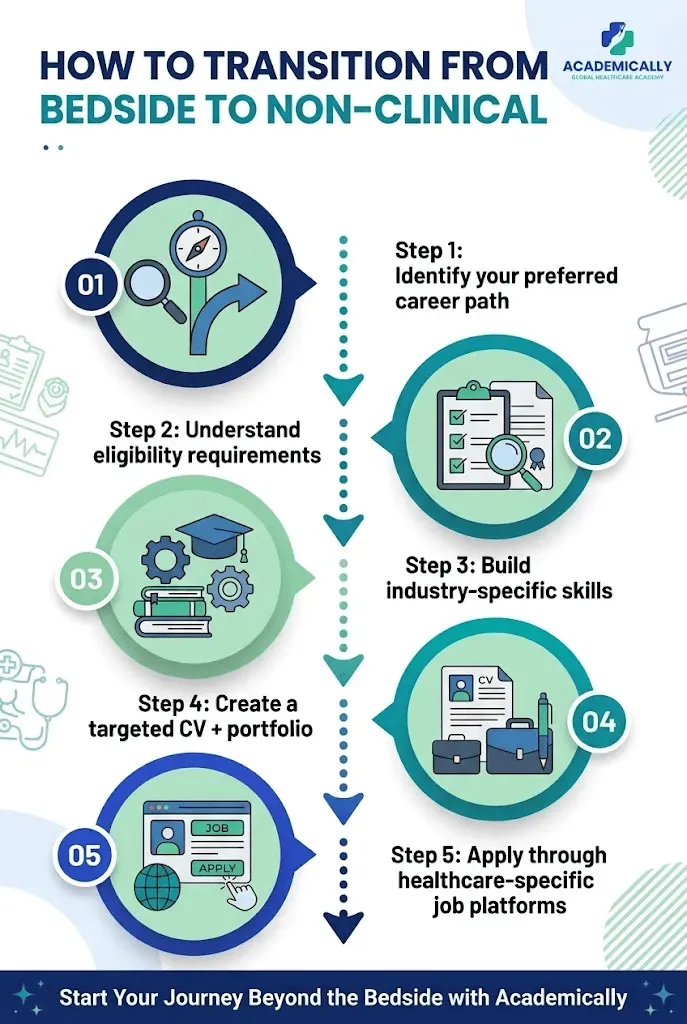
Nurse Career Transition Checklist
Before transitioning yourself to non-clinical field do take a look at following checklist:
☐ Choose one target career
☐ Check eligibility requirements
☐ Learn relevant industry terminology
☐ Complete targeted upskilling
☐ Build 2–3 relevant work samples
☐ Update LinkedIn headline
☐ Create a targeted CV
☐ Search healthcare-specific vacancies
☐ Apply consistently
☐ Prepare for interviews
This checklist helps you avoid months of job hunting.
My own career change as a dentist showed me one truth: moving into a non-clinical role does not erase your healthcare identity. It changes where you use that identity.
Final thoughts
The nursing profession has never been limited to the hospital bedside, even though that is often how it is presented to students.
Today, non-clinical jobs for nurses can span:
- Clinical research
- pharmacovigilance
- medical writing
- medical information
- clinical data management
- health informatics
- quality, insurance, healthcare operations and education.
Your BSc, GNM or MSc Nursing qualification gives you a clinical foundation. That is the foundation you need to succeed in these roles. The next challenge is learning how to turn that background into the language of the industry.
The best career transition for nurses is not about leaving nursing behind. It is about finding a role where your nursing knowledge, communication skills, clinical understanding and professional experience matter.
Sometimes the next chapter of a healthcare career doesn't begin when you leave healthcare. It begins when you realise healthcare opens more doors than the one you walked through.