Let’s be honest about something. Plenty of women in healthcare love the work and still can’t picture going back to it the way it was. Emergency calls at 2 AM, long ward rounds, a roster that changes on short notice: all of that is hard with a toddler at home. It usually isn’t about losing interest in medicine. The schedule just doesn’t fit anymore.
The good news is that healthcare has a big non clinical side. A doctor can work on drug research without a single OPD. A pharmacist can end up in drug safety. A dentist might drift into medical communications, and a nurse can move into clinical operations or quality teams.
If you’re looking into non clinical careers for women healthcare maternity break situations, “what jobs exist” is the easy part. The harder question is which ones give you real growth and a workload you can live with.
What the law says about returning to work in India
Your rights matter as much as your career choice. India’s four labour codes, including the Code on Social Security, 2020, came into effect on 21 November 2025. According to the government’s explanation:
- Eligible women can get up to 26 weeks of maternity benefit, generally if they worked at least 80 days in the 12 months before delivery.
- Work from home may be allowed after leave when the job permits and both sides agree.
- Two nursing breaks a day are allowed until the child is 15 months old.
- Establishments with 50 or more employees must provide crèche facilities, subject to the rules.
Source: Ministry of Labour and Employment and PIB, November 2025.
Work from home isn’t automatic. It depends on the establishment, the rules and the type of job, so check with your HR team or the labour authority.
Demand and Growth of Healthcare and Pharmaceutical Industry Across the World
Hospitals are only one corner of the industry. Pharma companies, research organisations, health-tech startups, insurers and medical communication agencies all hire people who understand medicine.
India’s pharmaceutical industry reached a turnover of ₹4,71,898 crore in FY 2024–25 and has grown about 9.5% a year since FY 2020–21, according to the Department of Pharmaceuticals’ Annual Report 2025–26. A market that size needs people for research, regulation, safety monitoring and medical information.
Other countries show a similar pattern. Jobs and Skills Australia projects health care and social assistance employment to grow 22.9% between May 2025 and May 2035. The US Bureau of Labor Statistics expects 24% growth in medical and health services management and 16% for health information technologists and medical registrars over 2025 to 2035. Those countries show that demand for healthcare skills isn’t limited to bedside care.
India’s Periodic Labour Force Survey reported a female labour force participation rate of 34.8% among women aged 15 and above in August 2026. That figure doesn’t isolate mothers returning from leave, but it explains why the topic keeps coming up.
What you get out of all this: your medical knowledge stays useful, and you may not need daily patient contact.
Non Clinical Roles for Women that are Worth looking at
Not all of these are equally flexible. Some come with fixed office hours, some with travel, and some with late calls to teams in other time zones. Read the descriptions closely.
1. Medical affairs and MSL roles
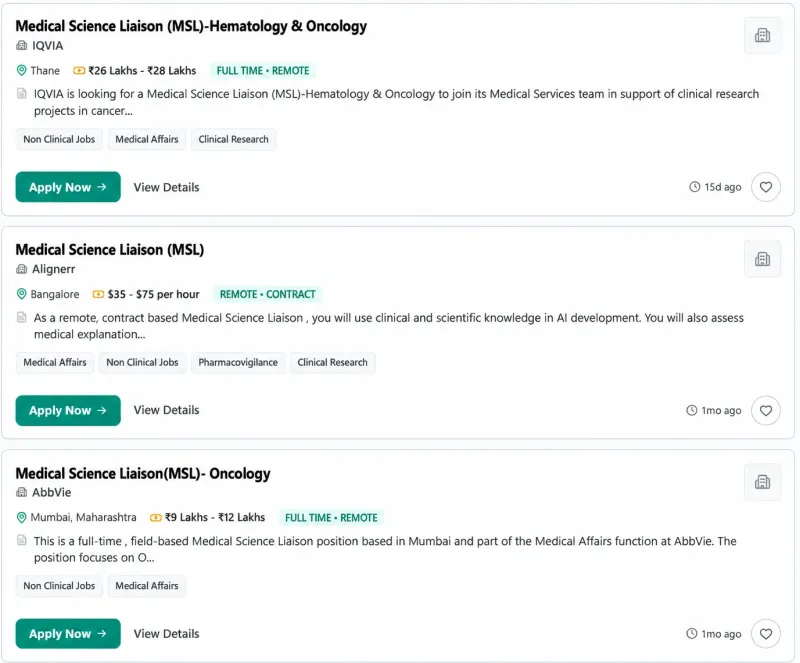
If you want to stay close to the science without practising, this is probably the most obvious fit for doctors and pharmacists. Medical affairs teams help pharma and biotech companies explain their data accurately. You’d review evidence, build presentations, answer medical queries from clinicians and support product education.
A Medical Science Liaison needs to meet specialists, attend conferences and travel to hospitals. It is mostly on-site however, with experience and excellent clinical knowledge one often gets hybrid/remote roles which is ideal for new mothers. Medical information roles on the same team are often more flexible, and some are hybrid.
You’d typically need an MBBS, PharmD or MPharm, plus comfort with reading trials and presenting to a room of experts.
2. Clinical research
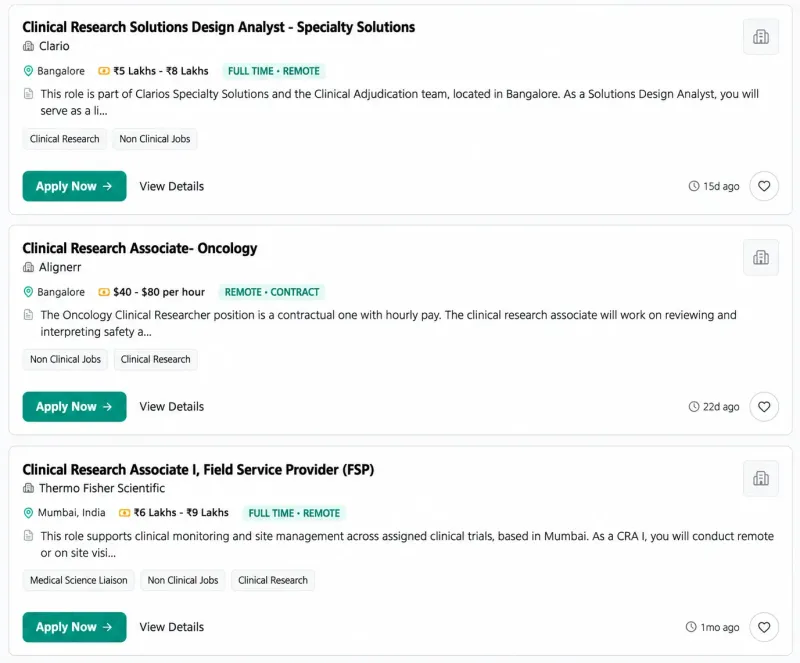
Here you aren’t treating patients. You’re helping run the studies that test new drugs and vaccines: planning, coordinating, monitoring and documenting. Job titles include Clinical Research Associate, Clinical Research Coordinator, Clinical Trial Associate and Clinical Trial Manager.
Junior roles are mostly paperwork and coordination. Senior ones manage timelines, site performance and compliance. Documentation work can be hybrid or even remote, but monitoring visits mean travel.
Doctors, pharmacists, nurses, dentists and life-science graduates all move into this. Brush up on Good Clinical Practice, trial protocols and informed consent before you apply. A maternity break is a decent window to do that.
3. Pharmacovigilance
Every medicine is tracked for safety after it reaches the market. Pharmacovigilance teams read adverse event reports, judge their medical significance and keep safety paperwork in order. You’ll see titles like Drug Safety Associate, Safety Medical Reviewer and Aggregate Reporting Specialist.
Eligibility depends on the employer, but MBBS, PharmD, BPharm and MPharm graduates are regularly hired. You’d want to learn MedDRA coding, safety databases and the relevant regulations.
One thing to ask about during interviews: shifts. If the team supports patients in the US or Europe, you may be on rotational or overlapping hours, and that can undo the flexibility you were hoping for. For someone who’s been out of industry for a while, it’s a structured, fairly well-defined way back into medical thinking.
4. Regulatory affairs and quality assurance
Nothing reaches the market until it meets regulatory standards. Regulatory affairs staff prepare submissions, maintain records, follow changes in the rules and deal with the authorities. Quality assurance makes sure processes and documents meet standards.
Pharmacists and pharma science graduates are the usual candidates, along with doctors who’ve worked in research or manufacturing. Expect to study guidelines, GMP and GCP. Documentation-heavy roles can sometimes be done from home, while manufacturing QA and inspections can’t. It suits people who like detail and clear rules.
5. Medical writing
If you enjoy reading studies and explaining them in plain language, look here. Medical writers produce manuscripts, education material, product documents, patient leaflets and website content for pharma firms, agencies, publishers and digital health companies.
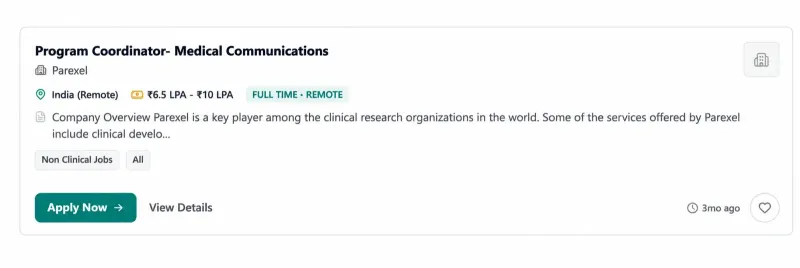
It’s also one of the easier fields to find remote work in, since it’s all computer-based. Deadlines still belong to the client, though, and some weeks get busy. Doctors, dentists, pharmacists, nurses and life-science graduates with strong writing do well. Build skills in literature review, referencing and editing.
6. Health economics and outcomes research (HEOR)
Treatments aren’t judged only on whether they work. Cost matters, and so do patient outcomes over time. HEOR professionals analyse costs, review evidence, run literature searches and help with market access strategy. Titles include HEOR Analyst, Real-World Evidence Analyst and Market Access Analyst.
It suits people who like numbers and research methods. Public health and life-science graduates fit as well as clinicians. Study epidemiology, biostatistics and evidence synthesis. Analysis work can be remote or hybrid, but client presentations add meetings.
7. Healthcare data and health information
Records need to be accurate, and someone has to check them. Jobs here include Clinical Data Management Associate, Medical Coding Specialist, Clinical Documentation Specialist and Healthcare Quality Analyst.
The BLS projects 16% growth for health information technologists and medical registrars from 2025 to 2035. Nurses and other clinicians often fit well, though some roles ask for specific certifications. Some work is remote, while other jobs require secure on-site systems.
8. Healthcare administration and clinical operations
Hospitals and health programmes need people who keep teams and processes running. Titles include Healthcare Operations Executive, Clinical Operations Manager, Medical Programme Coordinator and Quality Management Specialist.
Clinicians with some leadership experience do best here. Project-support jobs can be hybrid, but running a hospital department usually ties you to a location.
So which one is the most flexible?
Honestly, none of them guarantees it. A remote medical writer may control her day better than an MSL on the road. Then again, a hospital administrator with fixed hours can have a more predictable week than someone running global drug safety operations. Judge the job’s actual duties, not its title.
| Career | Typical setup | Watch out for |
| Medical writing | Remote or hybrid | Deadlines |
| Pharmacovigilance | Remote or hybrid | Shifts, global teams |
| Regulatory affairs | Hybrid or office | Compliance deadlines |
| Clinical research | Hybrid or office | Site visits |
| Medical affairs | Hybrid or field | Travel |
| HEOR | Remote or hybrid | Project deadlines |
| Healthcare data | Remote or hybrid | Data security |
| Administration | Mostly office | Operational demands |
Do you need another qualification?
Sometimes, and it’s most useful if you’ve never worked in pharma. A clinical degree is a foundation, but it doesn’t prove you understand how medical affairs, drug development or regulation work in practice. Employers expect that knowledge. An MBBS graduate aiming for medical affairs should know how companies weigh evidence and communicate with clinicians. A pharmacist heading into drug development should understand how trials run and how a medicine moves from lab to market.
Academically Global's non clinical courses online are a great start after your MBBS/BDS/PharmD degree to gain industry insights, hands on capstone projects, interview preparation and job assistance. Their expert team consists of globally licensed healthcare professionals and experienced industrial professionals who have gone down the same path.
Getting ready, step by step
You probably don’t need another degree. What helps is knowing which of your skills carry over, finding out what your target field expects and filling the gaps.
- Start with what you need. A lot has changed since you last worked. Maybe you need regular hours, or remote work until childcare settles. Write it down and split it into must-haves and nice-to-haves. Remote might be a must, while the job title is only a preference. That list saves you from applying to jobs that won’t work.
- Connect old experience to new roles. A doctor who interpreted clinical findings has a story for medical affairs or writing. A pharmacist who caught medication problems can speak to drug safety. A nurse who coordinated care and records can point to clinical research or quality management. Pick three or four real examples and build your CV around them.
- Learn what the vacancies ask for. Pick one path, then read ten job ads for it and note the repeated requirements. You’ll find that GCP, MedDRA or literature review comes up again and again. Learn those first.
- Write the career break plainly. It’s an event on your timeline, not a skills gap. Something like this is enough: Career Break, 2023–2026. Took a planned break following childbirth. Refreshed knowledge of medical affairs, scientific communication and pharma industry practice before returning to work. You don’t owe anyone a longer explanation.
- Apply selectively. Mass applying wears you out. Read each description for office days, travel, rotating shifts and international calls. In interviews, don’t say you want an easier job. Say how the role lets you use your healthcare background in a new setting.
Where to look for remote and hybrid jobs
Once you’ve picked a direction, search beyond hospitals. Look at pharma companies, CROs, medical communication agencies, health-tech firms and research organisations. Read each listing for remote, hybrid or flexible-hour terms. Jobslly lets you filter healthcare roles by working style.
Search by exact title instead of typing “healthcare jobs”. Try Medical Affairs Associate, Drug Safety Associate, Medical Writer, Clinical Research Associate, Regulatory Affairs Executive or Clinical Data Management Associate. Check eligibility before you apply, because some employers want prior industry experience or certification.
Success Stories of Women in Healthcare Taking a Leap
Dr. Shruti Vinod Ugemuge: from family physician to Accenture
After 15 years as a family physician, Dr. Shruti Vinod Ugemuge (MBBS, SRTR Medical College, Ambejogai, 2010) decided to look beyond clinical practice. She now works at Accenture with a package of ₹21 LPA, proof that long clinical experience can still open doors outside the hospital, in corporate healthcare roles.
Dr. Laxmi Bhardwaj: clinical and business training combined
Dr. Laxmi Bhardwaj built a successful career as an MBBS, DNB doctor and also holds an MBA. She moved into non clinical roles and was placed at Tata Consultancy Services and Fresenius Kabi, with packages of ₹32 LPA and ₹18 LPA. Her story shows how clinical and business training can work together.
Dr. Charmi Kosaraju: from anaesthesia to Bajaj General Insurance
Dr. Charmi Kosaraju (MBBS, MD) spent five years in anaesthesia, a field that taught her the responsibility of protecting a patient’s life. She has since moved into a non clinical role at Bajaj General Insurance, with a package of ₹13 LPA. Her move shows that specialist experience carries real value beyond the operating theatre.
To Conclude with
Coming back after a break takes more planning than a normal job change. Your priorities have probably shifted, and your old role may not fit anymore.
That doesn’t shrink what you know. Healthcare knowledge carries into pharma research, medical affairs, drug safety, regulation, writing and administration. Start with the non clinical careers for women healthcare maternity break options that match your background and your day-to-day reality, refresh the skills that role asks for, fix your CV and apply where the setup actually works.
You don’t have to rebuild everything. You build on what you already have and point it somewhere that suits this stage of life.