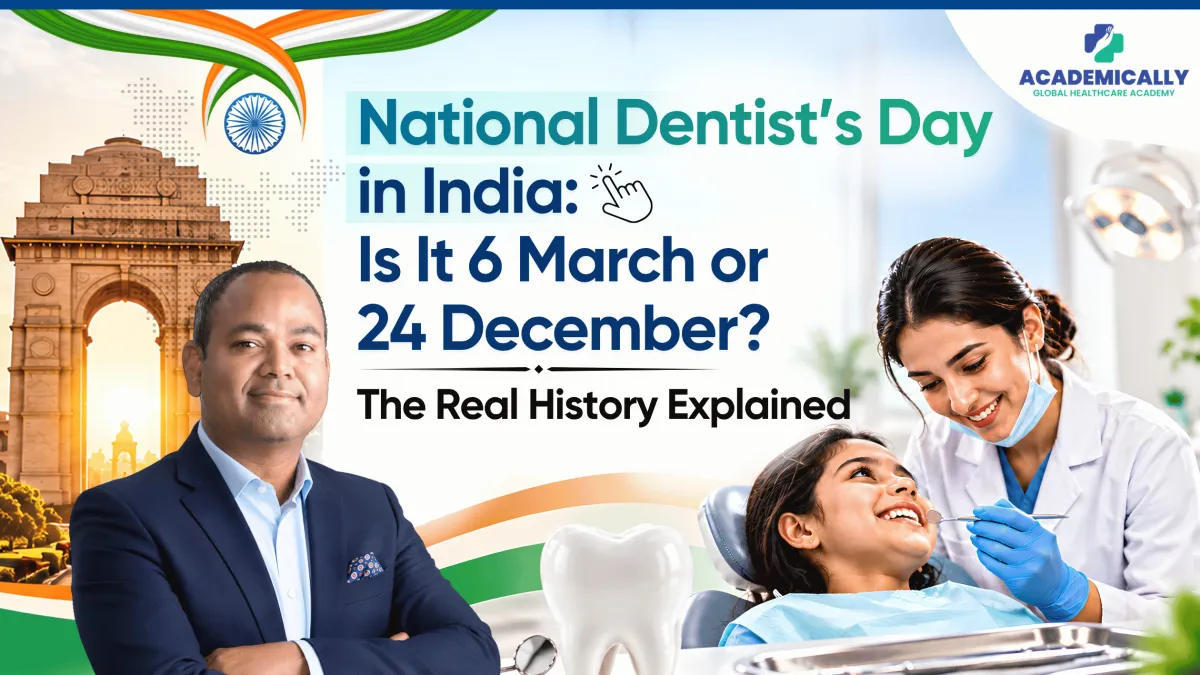
Every year I get the same question from dental students, working dentists and dental colleges across India: When is National Dentist’s Day actually celebrated in India, 6 March or 24 December?
It is interesting to note that both dates are mentioned online without a clear explanation about why there is a difference. Many websites say 6 March while the professional dental association in India celebrates 24 December in honour of a remarkable pioneer.
I am Dr. Akram Ahmad, founder of Academically Global. I believe knowing our profession means knowing the people, institutions and milestones that shaped it. National Dentist’s Day is not simply another date for social media greetings. It is an opportunity to recognise the foundations of Indian dentistry and reflect on how much work remains to improve access to oral healthcare.
Let me clarify the date confusion, introduce you to the man behind India’s observance, and explain why the real story matters to every dental professional.
When Is National Dentist’s Day in India?
The Indian Dental Association (IDA) designated 24 December as National Dentist’s Day in India in 2016. This is to remember the birth anniversary of Dr. Rafiuddin Ahmed, who was born on that day in 1890.
The 6 March date is connected with Dentist’s Day in the United States. The reason for this date in the US is not clear. It was also used in India before the IDA picked 24 December, which is linked to the country's own dental history. IDA made this decision at its Central Council Meeting in Jaipur on 17 January 2016.
If your college, clinic or student group is planning something for the National Dentist Day make sure to choose 24 December as your main date.
6 March vs 24 December: What Is the Difference?
The confusion becomes easier to understand when we separate the internationally reported observance from India’s association-designated day.
| Point of comparison | 6 March | 24 December |
| Background | Associated with Dentist’s Day in the United States | Designated by the Indian Dental Association in 2016 |
| Historical connection | No established connection to a specific Indian dentistry pioneer | Birth anniversary of Dr. Rafiuddin Ahmed |
| India-specific significance | Widely reported and observed | Directly connected to Indian dental history |
| Institutional context | Recognised as a US observance; its origins are unclear | Recognised by the IDA as National Dentist’s Day in India |
| Best use for India-focused events | Can be acknowledged as an international observance | Preferred for IDA aligned National Dentist’s Day activities |
My advice to dental institutions is straightforward: communicate the date accurately, explain why it matters, and use the occasion to promote oral health rather than limiting the celebration to greetings and photographs.
Who Was Dr. Rafiuddin Ahmed, the Father of Modern Dentistry in India?
When you hear the term "Father of Modern Dentistry " your mind might think of Dr. Greene Vardiman Black, the influential American dentist known for his contributions to operative dentistry, cavity classification, and dental materials.
India has its own important person: Dr. Rafiuddin Ahmed (1890–1965).
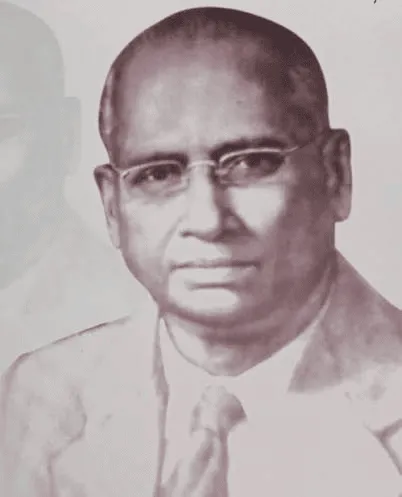
- Born 24 December 1890 in Bardhanpara, Bengal (in present-day Bangladesh).
- Graduated from Aligarh Muslim University in 1908, then travelled to the United States and earned his Doctor of Dental Surgery from the University of Iowa in 1915
- Practised at the Forsyth Dental Infirmary for Children in Boston before returning to India in 1919.
- Founded Calcutta Dental College in 1920, India's first dedicated dental college, and served as its Principal for 30 years, until 1950.
- Launched the Indian Dental Journal in 1925, editing it for over two decades.
- Established the Bengal Dental Association in 1925, later renamed the Indian Dental Association (IDA), and served three terms as its President.
- Played a key role in drafting the Bengal Dentists Act of 1939, among India's earliest dental regulations.
- Served as the first elected President of the Dental Council of India (1954–1958).
- In 1964, became the first Indian dentist to receive the Padma Bhushan.
- Later entered public life, serving in the West Bengal cabinet (1950–1962) as Minister of Agriculture, Community Development, Co-operation, Relief and Rehabilitation.
In 1949, he donated Calcutta Dental College to the West Bengal government, it was renamed Calcutta Dental College, and later Dr. R. Ahmed Dental College and Hospital in his honour. One detail that surprises most people: Fatima Jinnah, sister of Muhammad Ali Jinnah, was among its early students.
From One Dental College to Hundreds: How Indian Dentistry Grew
The growth of Indian dental education offers a striking illustration of how far the profession has progressed since 1920.
Dr. Ahmed started with a college that had just eleven students and now we have hundreds of dental colleges and thousands of new chances for training.
| Metric | Figure |
| Total dental colleges in India | 370+ |
| Government dental colleges | 55 |
| Private dental colleges | 274 |
| Total BDS seats per year | 28,016 |
| Government BDS seats | 4,058 |
| Private BDS seats | 23,958 |
| Registered dental surgeons in India (total, all years) | 300,000+ |
Nevertheless, the broader lesson remains clear: Indian dentistry has grown enormously in educational capacity and professional reach.
However, this leads to a more important question. Has the expansion of dental education translated into adequate access to dental care for the population?
India’s Dental Care Gap: Why More Dentists Do Not Automatically Mean Better Access
Only around 6–7% of Indians experiencing a dental problem seek help from a dentist. These are reported estimates, not a replacement for a nationally representative oral-health survey. However, they highlight an important concern about treatment-seeking behaviour and access.
Think about the difference. India has hundreds of dental colleges and many dentists but many people still wait to get professional care when they have a dental problem.
Several barriers may contribute to this gap, including:
- the cost of treatment
- limited availability of services in some areas
- low oral-health awareness
- fear of dental procedures, and
- the belief that a dental visit is necessary only when pain becomes severe.
These are potential contributing factors; the reported 6 to 7% figure alone does not establish how much each factor contributes. From a public-health perspective, this is precisely why preventive dentistry matters.
A dental problem identified early may be easier to manage than one left untreated until it causes significant pain or complications. Regular dental assessment, age-appropriate oral-hygiene education, and timely professional advice can help people make informed decisions about their oral health.
The main idea is that having more number of dental professionals is only one part of the answer. We also need:
- public awareness
- preventive education
- accessible services
- stronger relation between dental professionals and their communities
That is why I think National Dentist’s Day should be more than celebrating the profession. It should be a time to think about what we're doing to make dental care easier for everyone.
How Can Dental Colleges, Dentists and Students Celebrate National Dentist’s Day?
The day should offer value to patients, students and the public. Here are some ideas for schools and professionals to celebrate 24 December.
If you are a dental college or student association
Organize a free dental check-up camp for the community
Work with local groups to offer appropriate screenings and education on oral health, especially in places that need help. Make a plan to refer people who need further assessment or treatment.
Conduct oral health sessions in schools
Teach children about brushing and cleaning between their teeth appropriately. Explain why it is important to take care of their teeth. Change the activities to match the age of the children.
Host a clinical case study competition
Ask BDS and MDS students to present cases, explain their diagnostic reasoning, discuss treatment options, and reflect on clinical outcomes. Academically Global’s experts can help you upskill for such type of competition, emphasising on case-based learning and professional skill development and this will help you understand how scientific healthcare knowledge is used in practical life.
Invite practising dentists for a professional session
Topics could include emerging dental techniques, ethical patient communication, clinical documentation, postgraduate opportunities, and international registration routes.
If you run a dental practice
Think about offering a designated day focused on preventive care. Share information about oral health through your clinic’s communication channels and thank your dental team publicly.
Only share pictures of patients or treatment results with their permission, following privacy rules.
A simple patient-education post explaining when to seek dental assessment can be more useful than a generic celebratory graphic.
If you are a member of the public
Make the dental appointment you have been waiting for. Learn how to take care of your teeth, help kids develop healthy habits, and encourage others to see a dentist if they have dental problems.
A thank you message to your dentist is also a thoughtful way to recognise the people who help maintain your oral health.
A Message to Dental Students and Graduates: Your Career Can Extend Beyond the Clinic
As a founder working with healthcare professionals, I also see National Dentist’s Day as an opportunity to recognise the different paths available to dental graduates. I believe your BDS or MDS degree can be the beginning of several professional opportunities. The important thing is to identify your goal and develop the skills, examination readiness, or additional qualifications that your chosen pathway requires.
At Academically Global, we help dentists explore international licensing examination preparation and non-clinical healthcare career training, depending on their interests and eligibility.
Planning to Practise Dentistry Abroad? Explore International Licensing Pathways
Working as a dentist in another country requires more than a recognised dental degree. You may need to complete credential assessments, licensing examinations, registration procedures, and other requirements established by the relevant regulatory authority.
Australia: Australian Dental Council (ADC) Exam Preparation Course
Dentists who want to explore practising in Australia can consider Academically Global’s ADC Exam Preparation Course.
The programme offers structured examination preparation through live and recorded sessions, study materials, mock tests, and individual feedback from expert trainers. It is designed to help internationally qualified dentists strengthen their knowledge and prepare systematically for the ADC examination.
This structure can be particularly useful if you are balancing clinical work with exam preparation and need a clear study plan, regular practice, and guidance on difficult topics.
The Gulf region: Explore dental licensing examination preparation
Dentists interested in the Middle East can also explore Academically Global’s Gulf Region Dental Licensing Exam Preparation Course. It covers licensing examination preparation for destinations including the UAE, Saudi Arabia, Oman, Qatar, Kuwait, and Bahrain.
These programmes can help candidates organise their preparation and build familiarity with the relevant examination content. However, eligibility, experience requirements, registration, and employment depend on the applicable regulator and individual circumstances. In the similar manner there are many other international career opportunities available for dentists to take their career global.
Interested in a Non-Clinical Career?
Clinical practice remains an important career option, but it is not the only way to contribute to healthcare. Depending on their qualifications, experience, interests, and additional training, dental graduates may explore non-clinical opportunities in medical and dental content writing, clinical research, healthcare education, scientific communication, and other non-clinical fields.
Academically Global’s non-clinical upskilling courses can help dentists understand how scientific knowledge is communicated within pharmaceutical and healthcare organisations. It also introduces skills that extend beyond clinical practice, including evidence interpretation, professional scientific communication, and medical strategy.
To conclude with
My advice is to use this occasion of National Dentist Day, to assess not only how far you have come, but also what you want to build next—whether that means strengthening your clinical skills, pursuing further education, contributing to research, or investigating a different healthcare career pathway.
At Academically Global, we support healthcare professionals and dental graduates in exploring professional development opportunities and international registration pathways. Eligibility and the steps involved depend on the individual’s circumstances and the applicable regulator requirements.