
If you’re looking to practice pharmacy in Australia, you’re stepping into one of the most advanced healthcare systems in the world.
But beyond the great quality of life, actually leaping into Australian practice requires navigating a fair bit of regulatory terrain. You need to know exactly what’s expected of you on day one so you can provide safe, high-quality care.
That’s where the National Competency Standards Framework for Pharmacists comes in. Published by the Pharmaceutical Society of Australia, think of this framework as the master rulebook for the entire profession.
I have talked about the framework's structure, its core practice domains, and its real-world applications in the following article. I hope it helps you. I've written it in simple layman's terms for easy understanding while giving you the most accurate information possible.
What is the National Competency Standards Framework?
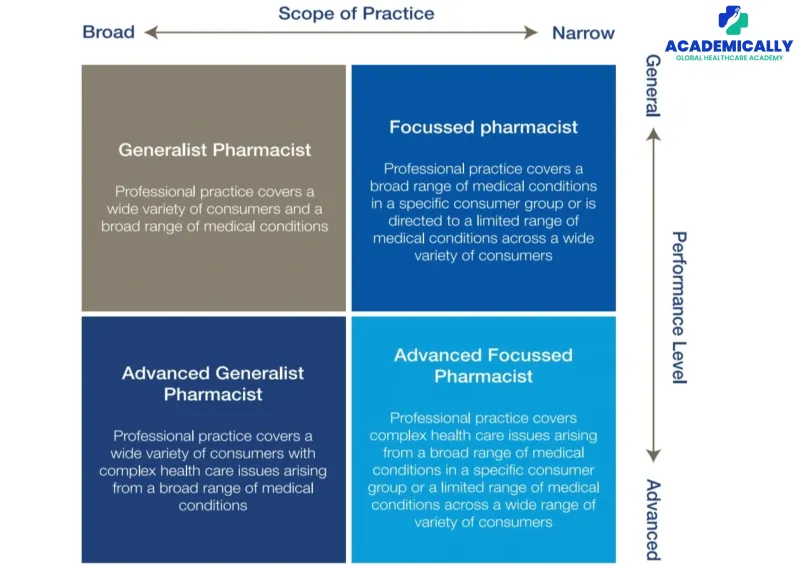
Australia offers varied pharmacy careers. Across these settings, pharmacists need shared expectations for safe and effective practice.
The National Competency Standards Framework for Pharmacists in Australia, describes those capabilities. Pharmaceutical Society of Australia(PSA) is its custodian on behalf of the profession and defines competency standards through knowledge, skills, attitudes and attributes that enable practice.
Whether you are getting your degree in Australia, moving from overseas and figuring out how your credentials transfer, this document sets the standard. It shapes university courses, handles registration benchmarks, and defines what good practice looks like every time you step behind the counter.
Bridging the gap between your overseas qualifications and Australian competency expectations often starts with passing mandatory registration exams. Enrolling in a structured Australian Pharmacist Exam Preparation Course helps you align with these national standards from day one.
The Framework uses a matrix. Universal standards apply across practice; other standards focus on medicines management, leadership, education or research.
| Framework element | Meaning |
| Domain | Broad area of professional responsibility |
| Standard | Capability expected within that area |
| Enabling competency | Specific capability supporting a standard |
| Performance criterion | Observable behavior showing competence |
| Evidence example | Practical evidence that can support demonstration |
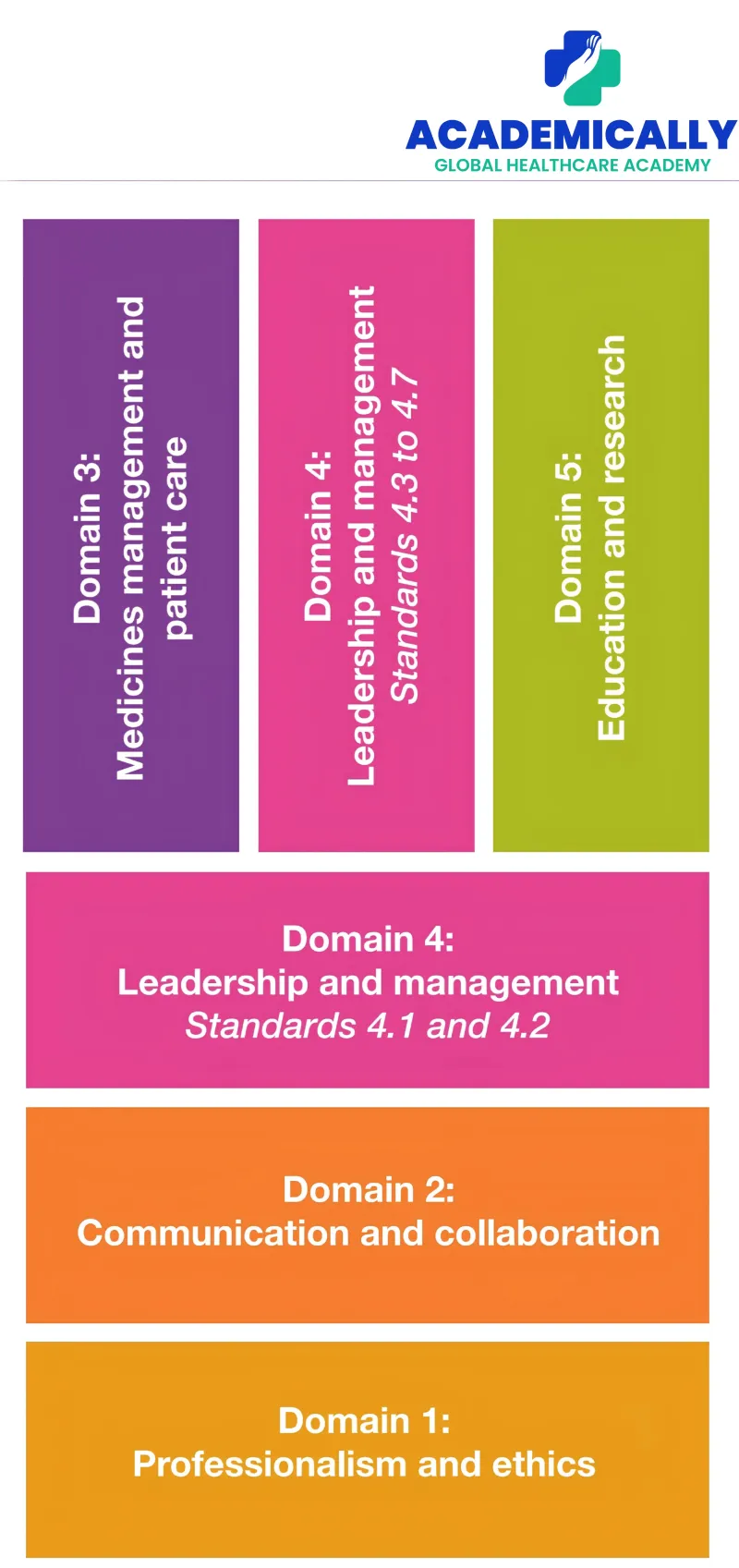
| Framework Axis | Associated Practice Domains | Scope of Application | Operational Purpose |
| Horizontal Axis | Domain 1, Domain 2, Domain 4 (Partial) | Applies universally to all registered pharmacists | Establishes baseline ethics, legal compliance, communication, and personal leadership. |
| Vertical Axis | Domain 3, Domain 5, Domain 4 (Remaining) | Applies selectively based on practice scope | Governs patient care interventions, medication compounding, research, and organizational management. |
Analysis of the Five Core Practice Domains
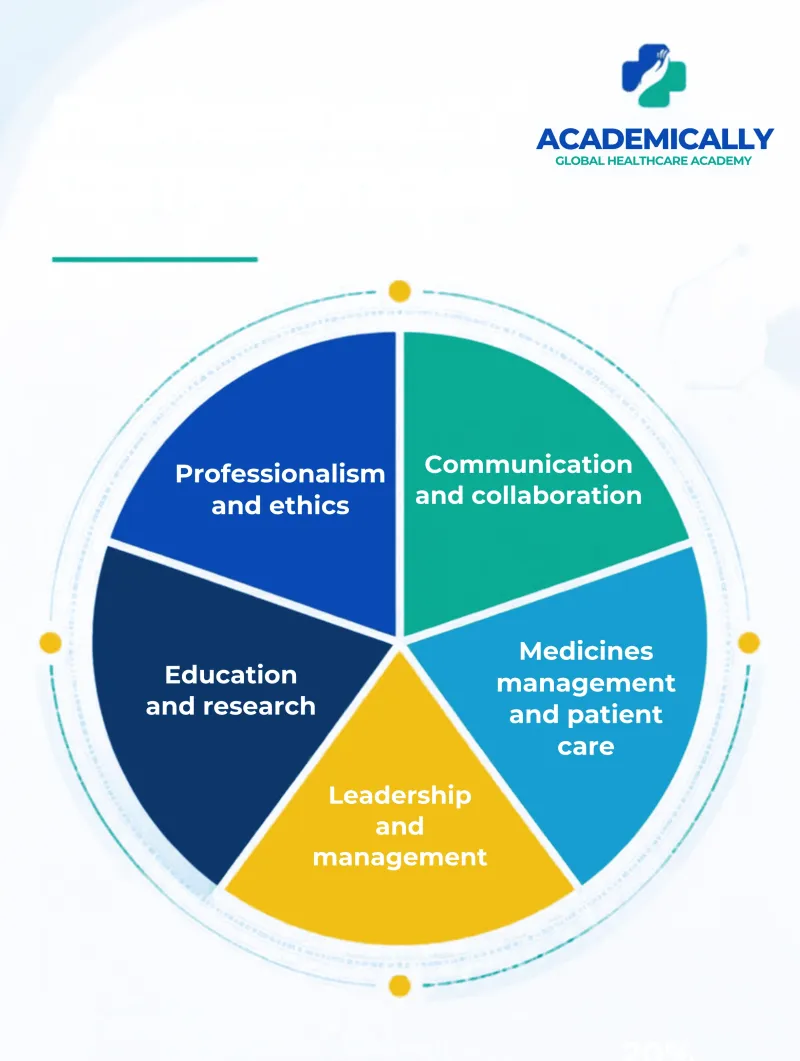
The framework structures all professional capabilities into five interconnected practice domains. Here are the five domains at a glance:
| Domain | Main focus | Examples |
| Professionalism and ethics | Ethical, lawful and accountable practice | Privacy, responsibility, quality |
| Communication and collaboration | Patient-centred communication and teamwork | Counselling, consultation |
| Medicines management and patient care | Safe and effective medicine use | Assessment, dispensing, monitoring |
| Leadership and management | Self-leadership and service leadership | Planning, resources, governance |
| Education and research | Teaching, learning and evidence | Training, research, critical appraisal |
Domain 1: Professionalism and ethics
Domain 1 provides the professional foundation. The framework identifies these standards as universal, meaning they apply across pharmacists and professional activities.
| Standard | What it covers |
| 1.1 Uphold professionalism in practice | Professional role, accountability, conduct and responsibility |
| 1.2 Observe and promote ethical standards | Recognising, managing and promoting ethical practice |
| 1.3 Practise within applicable legal framework | Law, privacy, confidentiality and informed consent |
| 1.4 Maintain and extend professional competence | Scope of practice and professional development |
| 1.5 Apply expertise in professional practice | Knowledge, judgement, autonomy and accountability |
| 1.6 Contribute to continuous improvement in quality and safety | Risk, incidents and quality improvement |
In practice, this means knowing your limits, protecting information, responding to errors, following applicable law and keeping knowledge current.
Domain 2: Communication and collaboration
| Standard | What it covers |
| 2.1 Patient-centred, culturally responsive partnership | Rights, preferences, values and culturally responsive care |
| 2.2 Collaborate with professional colleagues | Teamwork, consultation and inter professional practice |
| 2.3 Communicate effectively | Appropriate communication and checking understanding |
| 2.4 Address problems through interpersonal communication | Problem analysis, engagement and follow-up |
The framework emphasises dignity, diversity, shared decision-making and patient engagement, including culturally responsive care for Aboriginal and Torres Strait Islander people.

For international pharmacy graduates, fulfilling Domain 2 demands strong English language proficiency to communicate clearly with patients and healthcare teams. Meeting regulatory standards often starts with passing recognized proficiency tests. Enrolling in a dedicated English Proficiency test course helps overseas candidates achieve the scores required by the Australian Pharmacy Council and AHPRA for registration.
Domain 3: Medicines management and patient care
Domain 3 covers the medicine-use journey from assessment and planning through implementation, monitoring, quality use and health promotion.
| Standard | What it covers |
| 3.1 Patient-centred medication management | Information gathering, needs assessment and planning |
| 3.2 Implement the medication management plan | Administration, dispensing, prescribing, counselling and continuity |
| 3.3 Monitor and evaluate medication management | Clinical review, outcomes and documentation |
| 3.4 Compound medicines | Formulation, resources, risk controls, preparation and labelling |
| 3.5 Support Quality Use of Medicines | Medicine-use review and evidence-based use |
| 3.6 Promote health and well-being | Health literacy, promotion and public health |
Pharmacy competency extends beyond supply to assessment, counselling, monitoring and public health. Compounding also covers non-aseptic, aseptic and hazardous preparations, risk management and documentation.
Domain 4: Leadership and management
Leadership is not limited to formal management titles. Pharmacists can show leadership through self-management, service improvement, teamwork, planning and organisational responsibility.
| Standard | What it covers |
| 4.1 Show leadership of self | Reflection, emotional awareness, motivation and innovation |
| 4.2 Manage professional contribution | Systems, priorities, productivity and progress |
| 4.3 Show leadership in practice | Vision, innovation, change, coaching and mentoring |
| 4.4 Participate in organisational planning and review | Operational planning, business planning and workforce planning |
| 4.5 Plan and manage physical and financial resources | Finances, environment, materials and efficiency |
| 4.6 Plan, manage and build human resource capability | Recruitment, supervision and staff development |
| 4.7 Participate in organisational management | Governance, projects, standards and risk |
The framework recognises that any pharmacist can show leadership, regardless of position.
Domain 5: Education and research
Domain 5 recognises pharmacists as educators, lifelong learners and users of evidence.
| Standard | What it covers |
| 5.1 Deliver education and training | Planning, teaching, CPD and linking education with practice |
| 5.2 Participate in research | Partnerships, evidence gaps, evaluation and research projects |
| 5.3 Research, synthesise and integrate evidence into practice | Finding, appraising, applying and communicating evidence |
A pharmacist may demonstrate this domain through teaching, research, literature review or evidence-based service changes.

A quick overview of all the domains
| Domain Title | Total Standards | Universal Standards (Horizontal Axis) | Role-Specific Standards (Vertical Axis) |
| Domain 1: Professionalism and Ethics | 6 Standards | Standards 1.1, 1.2, 1.3, 1.4, 1.5, 1.6 | None (Entirely Universal) |
| Domain 2: Communication and Collaboration | 4 Standards | Standards 2.1, 2.2, 2.3, 2.4 | None (Entirely Universal) |
| Domain 3: Medicines Management and Patient Care | 6 Standards | None | Standards 3.1, 3.2, 3.3, 3.4, 3.5, 3.6 |
| Domain 4: Leadership and Management | 7 Standards | Standards 4.1, 4.2 | Standards 4.3, 4.4, 4.5, 4.6, 4.7 |
| Domain 5: Education and Research | 3 Standards | None | Standards 5.1, 5.2, 5.3 |
Putting these competencies into practice can be challenging. If you are preparing for your exams, you can benefit from mock tests which focuses on bridging the gap between textbook knowledge and practical requirements outlined across all five domains.
How can pharmacists use the framework?
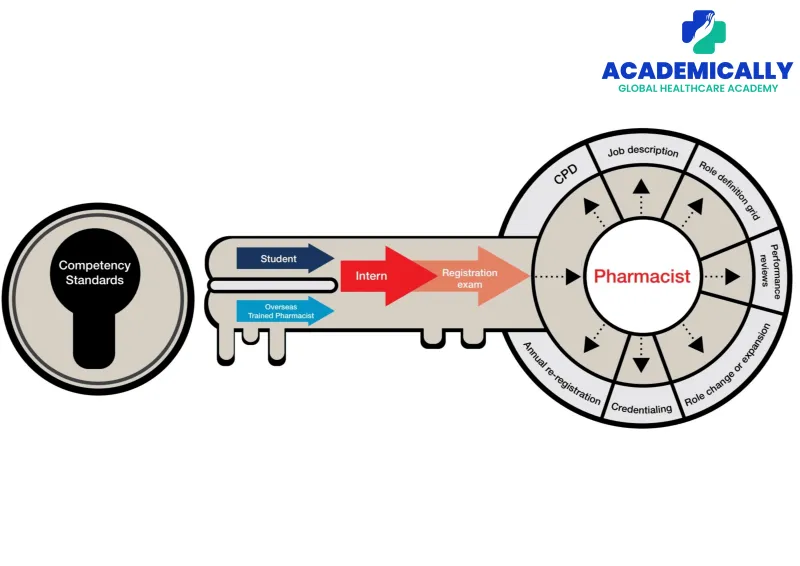
Pharmaceutical Society of Australia identifies uses including curriculum development, intern training, professional development, credentialing, advanced practice and employer performance processes.
| User | Use |
| Student | Connect academic learning with professional expectations |
| Intern | Identify development needs and workplace evidence |
| Registered pharmacist | Review competence and plan development |
| Advanced practitioner | Structure evidence of higher-level capability |
| Employer | Support job descriptions and performance discussions |
| Educator | Align learning activities with competency expectations |
Using the framework for CPD
Start with your scope of practice. Identify relevant standards, reflect on gaps, choose learning activities and record improvement using PSA’s CPD planning resources.
What counts as evidence?
Evidence should relate directly to the performance criterion. It can include workplace examples, reflection, feedback, assessments, audits, projects, learning records or service improvements. Evidence should relate to the current or planned role.
Why does this matter to overseas-trained pharmacists?
For overseas-trained pharmacists, competency standards sit within a larger pathway. APC explains that candidates may need assessment, examinations, supervised practice and registration steps. Visa matters are separate and handled by the Department of Home Affairs.
This means the framework can help you understand professional expectations, but it does not replace current pathway, registration or visa instructions.
Navigating the Australian Pharmacist exam, intern training, English requirements, and visa processes doesn't have to be overwhelming. Let Academically support your journey every step of the way.