A Medical Information role requires more than medical knowledge. Employers typically look for healthcare professionals capable of researching, analysing and communicating scientific evidence effectively, while balancing accuracy, compliance and appropriate patient safety.
As such, preparing for medical information interview questions requires a different approach compared to preparing for a general healthcare interview.
Interviewers can ask questions about your understanding of medical information, literature searching, evidence evaluation, scientific communication, adverse events, unsolicited medical queries, evidence evaluation and compliance. They may also present you with practical scenarios to determine how you would react if the available evidence is incomplete or if a question falls outside your expertise.
This guide covers the majority of medical information interview questions and answers, alongside top tips that can help freshers and healthcare professionals prepare for Medical Information Associate, Medical Information Specialist, Medical Information Writer and related roles.
What Does A Medical Information Professional Do?
Medical Information professionals provide accurate, balanced and evidence-based responses to scientific and medical questions from healthcare professionals, patients and other stakeholders.
This can include:
- Responding to unsolicited medical questions
- Searching scientific literature
- Reviewing clinical studies and publications
- Preparing standard response documents
- Developing scientific content
- Evaluating evidence
- Maintaining medical information databases
- Escalating adverse events and product complaints
- Supporting compliance and quality
- Communicating scientific information
This makes interview preparation even more important, as employers may test your scientific knowledge and functional understanding.
Expert Insights: What Makes Medical Information Different?
According to Dr. Akram Ahmad, one of the most distinctive aspects of a Medical Information role is the ability to communicate scientific knowledge without directly turning the conversation into a product promotion.
For example, when discussing a product such as Sensodyne, a Medical Information professional would not simply promote the toothpaste or list its benefits. Instead, the discussion could begin with the broader topic of oral health, dentinal hypersensitivity, relevant treatment approaches, and available scientific evidence. Research related to the product could then be presented in the context of that evidence, allowing healthcare professionals to understand the scientific basis behind its use.
Medical information closely intersects with other functions, including Medical Affairs, Pharmacovigilance, Regulatory Affairs and Medical Writing.
Top Medical Information Interview Questions And Answers
1. What Is Medical Information?
Sample answer:
“Medical Information is a function within the pharmaceutical and healthcare industry that provides accurate, balanced, evidence-based and non-promotional information in response to medical and scientific questions. Medical Information professionals research available evidence, evaluate its relevance and communicate the findings clearly to healthcare professionals, patients or other stakeholders while following applicable procedures and compliance requirements.”
Interview tip
Avoid mentioning Medical Information as simply “answering medical questions.” Mention evidence evaluation, scientific communication, accuracy, balance and compliance.
2. Why Do You Want To Work In Medical Information?
Sample answer:
“I am interested in Medical Information because it combines healthcare knowledge, scientific research and communication. I enjoy understanding scientific literature and converting complex medical information into clear, evidence-based responses. The role also allows me to contribute to informed healthcare decisions while working within a structured and quality-focused environment.”
Healthcare professionals transitioning from clinical practice can relate their existing knowledge to the role without implying that Medical Information is simply a non-clinical alternative.
3. What Is The Difference Between Medical Information And Medical Affairs?
Sample answer:
“Medical Information primarily focuses on responding to medical and scientific inquiries and ensuring that stakeholders receive accurate, balanced and evidence-based information. Medical Affairs is a broader strategic function that can include scientific engagement, evidence generation, medical strategy, publications, medical education, KOL engagement and field medical activities. Medical Information can therefore be considered an important component within the broader medical function.”
A strong candidate should highlight that the exact structure differs between organizations.
4. How Would You Handle An Unsolicited Medical Question?
One of the most important medical information interview questions.
Sample answer:
“I would first understand the exact question and clarify any ambiguity. I would then determine whether the query falls within the scope of Medical Information and identify the appropriate approved resources and scientific literature. I would critically evaluate the evidence, prepare a clear and balanced response, document the interaction according to company procedures and escalate the query if required.”
What is the interviewer testing?
They want to see if you understand that a Medical Information response should be:
Evidence-based , relevant to the question , balanced , scientifically accurate , appropriately documented , compliant with internal procedures
5. How Do You Search Scientific Literature?
Sample answer:
“I would begin by clearly defining the question and identifying key concepts and search terms. Depending on the requirement, I would use appropriate scientific databases such as PubMed and review relevant primary studies, systematic reviews, guidelines or other reliable sources. I would then assess the evidence for relevance, study design, population, limitations and applicability before using it in the response.”
Go one step further
Mention PICO where appropriate:
P – Population
I – Intervention
C – Comparison
O – Outcome
Using a structured approach demonstrates that you understand how to convert a broad medical question into an efficient literature search.
6. How Do You Evaluate The Quality Of A Scientific Study?
Sample answer:
“I would consider the study design, population, sample size, methodology, comparator, endpoints, statistical analysis, results and limitations. I would also consider whether the study directly answers the question being asked and whether the findings are applicable to the relevant population.”
A common mistake is to assume that a published paper automatically represents high-quality evidence.
Publication status alone does not eliminate the need for critical appraisal.
7. What Would You Do If There Is Insufficient Evidence To Answer A Medical Question?
Sample answer:
“I would not make assumptions or provide an unsupported conclusion. I would review available evidence from appropriate sources and clearly communicate the limitations of the available data. If necessary, I would escalate the question according to the organization's procedures or consult the appropriate subject matter expert.”
This answer demonstrates one of the most important qualities in Medical Information: knowing what you do not know.
8. How Would You Explain Complex Scientific Information To A Non-Medical Person?
Sample answer:
“I would first understand the person's level of knowledge and then explain the information using simple, precise language without changing the scientific meaning. I would avoid unnecessary technical terminology and use an appropriate example or analogy when useful. I would also make sure that important limitations and uncertainties are not lost during simplification.”
Medical Information professionals need both scientific accuracy and communication skills.
9. What Is The Difference Between Promotional And Non-Promotional Medical Communication?
Sample answer:
“Promotional communication is generally intended to influence the use or perception of a product, whereas Medical Information communication should provide objective, accurate and balanced scientific information in response to a legitimate medical question. Medical Information responses should not selectively present evidence to create a misleading impression.”
This is particularly important when discussing product-related queries.
10. What Would You Do If A Healthcare Professional Asks About An Off-Label Use?
Sample answer:
“I would follow the organization's established procedures for handling unsolicited off-label questions. I would ensure that any response is based on appropriate scientific evidence, remains balanced and does not become promotional. I would also document and escalate the interaction according to the applicable process.”
Avoid saying that you would immediately recommend whether the healthcare professional should use the product.
11. How Would You Handle An Adverse Event Mentioned During A Medical Information Call?
Sample answer:
“I would recognize that the conversation may contain information relevant to pharmacovigilance. I would follow the company's established adverse-event reporting procedure and ensure that the information is documented and escalated within the required process and timeline. I would not attempt to determine causality beyond my role independently.”
Why this question matters ?
Medical Information and Pharmacovigilance can interact closely. An interviewer wants to know whether you recognize when a query needs safety escalation.
12. What Is A Standard Response Document?
A Standard Response Document, or SRD, is a pre-developed resource used to provide consistent, scientifically appropriate responses to frequently received medical questions.
Sample answer:
“An SRD is a scientifically reviewed document designed to support consistent responses to recurring medical inquiries. It should contain accurate and balanced information, appropriate references and relevant disclaimers or approved language according to organizational procedures.”
13. How Would You Ensure Accuracy In A Medical Information Response?
Sample answer:
“I would verify the information against reliable and current scientific sources, ensure that references support the statements being made and check that the response directly addresses the question. I would also follow applicable review, approval and quality-control procedures before providing the final response.”
A good answer demonstrates that accuracy is a process rather than a final proofreading step.
14. How Do You Prioritize Multiple Medical Information Queries?
Sample answer:
“I would prioritise queries according to established organizational criteria, considering factors such as urgency, safety implications, regulatory requirements and agreed service timelines. I would maintain accurate documentation and communicate appropriately if a response requires additional time or expert input.”
Avoid saying that you would simply answer queries in the order that they arrive.
15. How Would You Handle A Question Outside Your Therapeutic-Area Knowledge?
Sample answer:
“I would acknowledge the limitation rather than guessing. I would identify appropriate internal resources or subject matter experts, conduct the necessary research and provide a response supported by reliable evidence and organizational procedures.”
That answer demonstrates professional judgment.
Scenario-Based Medical Information Interview Questions
Technical questions are only one part of the interview.Many employers use scenarios to understand how you think.
Scenario 1: A doctor asks for evidence supporting a product's superiority.
How would you respond?
Explain that you would first clarify the exact comparison and clinical outcome being requested. You would then identify appropriate comparative evidence and communicate the findings objectively, including relevant limitations.
Scenario 2: A patient asks whether they should change their medication.
A suitable response should recognize the boundary between providing medical information and making an individual treatment decision.
You could say:
“I would provide appropriate factual information within the scope of the role but would not make an individualised treatment recommendation. I would direct the patient to an appropriate healthcare professional for personal medical advice.”
Scenario 3: You discover that an existing response document contains outdated information.
You should explain that you would:
1. Verify the issue.
2. Notify the appropriate team.
3. Follow the document-review or correction process.
4. Assess whether previously provided responses require action.
5. Document the issue appropriately.
Medical Information Interview Questions For Freshers
Freshers may be asked questions such as:
- What is Medical Information?
- Why are you interested in Medical Information?
- What is evidence-based medicine?
- How do you search PubMed?
- What is a clinical trial?
- What is RCT?
- What is a systematic review?
- What is pharmacovigilance?
- What is an adverse event?
- What is an off-label use?
- How do you read a research paper?
- How would you summarise a scientific article?
- How do you ensure accuracy?
- How do you handle a question you cannot answer?
- Why should we hire you?
A useful strategy for freshers
Do not apologise for being a fresher.
Instead, connect your academic or clinical experience to transferable skills such as:
Medical knowledge → scientific understanding
Case presentations → scientific communication
Literature review → evidence evaluation
Patient communication → stakeholder communication
Clinical documentation → accurate documentation
Healthcare education → medical content development
This approach can make a fresher's background more relevant to the role.
Skills Interviewers Look For In Medical Information Candidates
Strong preparation should go beyond memorizing answers.
Employers may look for:
1. Scientific literacy
You should be comfortable reading clinical studies, abstracts, guidelines and scientific publications.
2. Literature-searching skills
Know how to formulate search strategies and identify credible sources.
3. Critical thinking
You should be able to distinguish study findings from unsupported conclusions.
4. Communication
Scientific accuracy has limited value if the information cannot be communicated clearly.
5. Attention to detail
A small error in medical information can have significant consequences.
6. Compliance awareness
Understand the importance of approved processes, documentation and appropriate escalation.
7. Therapeutic-area knowledge
Basic understanding of the relevant disease area can be highly valuable.
8. Time management
Medical Information teams may handle multiple queries with different priorities and deadlines.
Academically's Executive Programme in Medical Affairs includes a dedicated module on Medical Information & Scientific Communication, alongside modules covering Medical Affairs, therapeutic-area understanding, clinical trials, health technology assessment, KOL management, insights generation and scientific writing. The program also includes practical case studies and a capstone/internship component.
The course can therefore be useful to healthcare professionals who want structured exposure to Medical Affairs while strengthening skills relevant to Medical Information.
Career support is also integrated into the program, including CV and LinkedIn optimization, mock Medical Affairs interviews, soft-skills training and access to Jobslly.
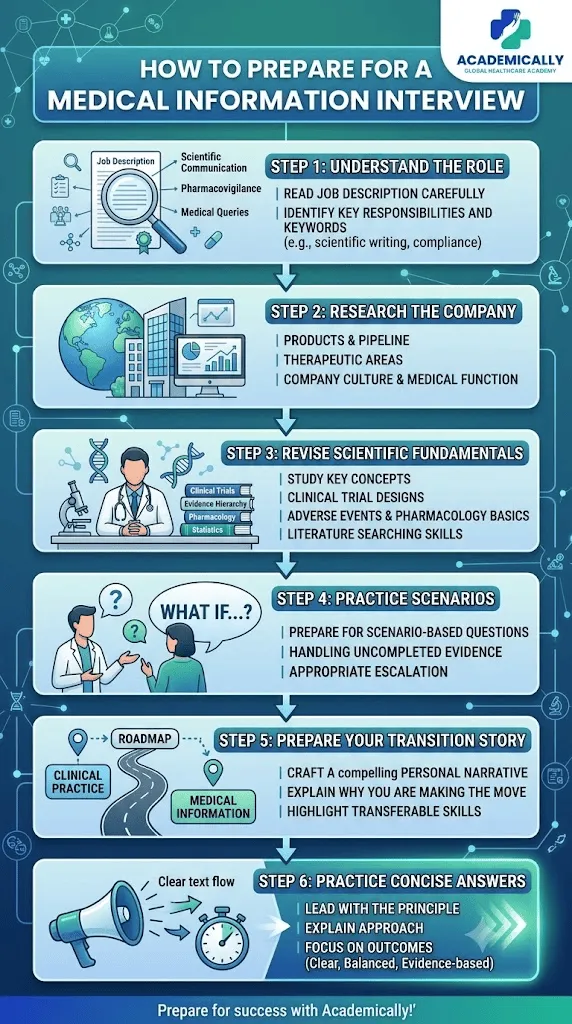
How To Prepare For A Medical Information Interview?
A practical preparation plan can look like this:
Where Can You Find Medical Information Jobs?
Knowing the right interview answers is only useful when you also know where to find relevant opportunities.
Jobslly focuses specifically on healthcare careers and currently includes categories such as Non-Clinical, Medical Affairs and Pharmacovigilance, alongside other healthcare roles.
Current listings demonstrate that Medical Information-related positions can appear under different titles. Examples include Medical Information Writer and Medical Affairs/Medical Information content-management roles, meaning candidates should search using multiple related keywords rather than relying only on the title "Medical Information Associate."
Useful search terms include:
- Medical Information Associate
- Medical Information Specialist
- Medical Information Writer
- Medical Information Executive
- Medical Information Scientist
- Medical Affairs Associate
- Medical Affairs/Medical Information
- Scientific Communications Associate
- Medical Communications Associate
Jobslly also provides healthcare-specific job matching, resume/profile support and career resources, which can be useful when transitioning into non-clinical healthcare roles.
Final Tips To Crack Medical Information Interviews
Preparing for medical information interview questions should go beyond memorizing textbook definitions.
Remember these five principles:
1. Be evidence-focused
Show that your answers are based on reliable scientific information.
2. Be balanced
Avoid presenting one study or outcome without discussing relevant limitations.
3. Know your boundaries
Medical Information is about providing appropriate scientific information, not replacing individualized clinical decision-making.
4. Demonstrate your process
Interviewers often want to understand how you would investigate a question, not simply whether you know the answer.
5. Connect your healthcare background to the role
Clinical, pharmacy, dentistry, nursing, life-science and research experience can provide valuable foundations for Medical Information careers when paired with strong scientific communication skills.
Ultimately, the strongest candidates demonstrate a combination of medical knowledge, evidence appraisal, scientific writing, communication, attention to detail and compliance awareness.
With structured preparation, practical scenario practice and a clear understanding of what Medical Information teams actually do, you can approach the interview with much more than memorized answers—you can demonstrate how you would think and work in the role.